PulseAugur / Brief
EN
LIVE 23:04:26

Brief

last 24h
[34/34] 221 sources

Multi-source AI news clustered, deduplicated, and scored 0–100 across authority, cluster strength, headline signal, and time decay.

  1. Qwen 3.6 benchmarks on 2x RTX PRO 6000

    A user on Reddit shared performance benchmarks for the Qwen 3.6 large language model, specifically testing the 27B and 35B parameter versions. The tests were conducted using a setup with two RTX PRO 6000 GPUs and the latest stable VLLM backend. Results indicate varying throughputs depending on concurrency levels and whether multi-turn prompting (MTP) was enabled, with the 35B model achieving up to 3500 tokens per second at 128 concurrency. AI

    IMPACT Provides performance data for Qwen 3.6, aiding developers in hardware selection and deployment for local LLM applications.

  2. FastKernels: Benchmarking GPU Kernel Generation in Production

    Researchers have introduced FastKernels, a new benchmark designed to better evaluate GPU kernel generation agents used in production LLM inference. Existing benchmarks are misaligned with real-world systems, leading agents to produce kernels that perform poorly outside of testing environments. FastKernels aims to bridge this gap by serving as a production-grade inference framework that mirrors real-world deployment needs and covers a vast majority of HuggingFace Transformers architectures. AI

    IMPACT Addresses a critical bottleneck in LLM inference by improving the alignment of GPU kernel generation benchmarks with production systems.

  3. Build real-time voice applications with Amazon SageMaker AI and vLLM

    Amazon SageMaker AI now supports bidirectional streaming, enabling real-time, two-way communication between clients and model containers. This feature, combined with vLLM's Realtime API, allows for continuous audio streaming and simultaneous transcription. The integration is demonstrated by deploying Mistral AI's Voxtral-Mini-4B-Realtime-2602 model for efficient speech-to-text applications. AI

    Build real-time voice applications with Amazon SageMaker AI and vLLM

    IMPACT Enhances real-time voice application development by reducing latency and simplifying infrastructure.

  4. Ray is Joining The PyTorch Foundation

    Anyscale announced that its open-source distributed computing framework, Ray, is joining the PyTorch Foundation, which is part of the Linux Foundation. Ray has experienced significant growth, with downloads increasing nearly tenfold in the past year and powering AI workloads for numerous companies including xAI, Netflix, and JPMorgan. This move aims to foster a stronger open-source community around Ray to meet the evolving demands of AI infrastructure. AI

    Ray is Joining The PyTorch Foundation

    IMPACT Accelerates the development of open-source AI infrastructure by consolidating community efforts under a major foundation.

  5. How to fix OOM crashes when running large open-source LLMs locally

    Running large open-source language models locally can lead to out-of-memory errors, even if the model's weights seem to fit within the available VRAM. This is primarily due to the significant memory required for the KV cache, which scales with context length, and intermediate activation memory during inference. Developers can address these issues by profiling memory usage with tools like PyTorch's memory snapshot, applying appropriate quantization techniques to model weights and the KV cache, and managing memory fragmentation. AI

    IMPACT Provides practical solutions for developers running large language models locally, addressing common memory issues.

  6. vLLM V0 to V1: Correctness Before Reinforcement Learning https:// huggingface.co/blog/ServiceNow -AI/correctness-before-corrections ※AI-generated auto-post (headline + link) # AI # GenerativeAI # LLM # AIGenerated

    A blog post details the transition of vLLM from version 0 to version 1, focusing on its accuracy before reinforcement learning corrections. The post highlights the model's performance and improvements in this area. AI

    vLLM V0 to V1: Correctness Before Reinforcement Learning https:// huggingface.co/blog/ServiceNow -AI/correctness-before-corrections ※AI-generated auto-post (headline + link) # AI # GenerativeAI # LLM # AIGenerated

    IMPACT Details advancements in vLLM's accuracy, potentially influencing the development and deployment of large language models.

  7. How to deploy Mistral 7B on a GPU server via vLLM If the budget and resources are limited, and you need to deploy a self-hosted LLM, consider this combination: Mistral-

    This article provides a guide on deploying the Mistral 7B language model on a GPU server using the vLLM framework. It is aimed at users with limited budgets and resources who need to set up a self-hosted LLM solution. The recommended setup involves Mistral-7B-Instruct-v0.3 and a virtual machine, detailing the inference process on cloud servers with NVIDIA RTX GPUs. AI

    How to deploy Mistral 7B on a GPU server via vLLM If the budget and resources are limited, and you need to deploy a self-hosted LLM, consider this combination: Mistral-

    IMPACT Provides a practical guide for efficiently deploying LLMs on limited hardware, potentially lowering the barrier for self-hosting.

  8. vLLM in Production: Ranked Configuration Decisions, Failure Modes, and the Architecture That Makes Them Work

    This article provides a guide for optimizing vLLM deployments, focusing on three critical configuration decisions that impact performance and cost. It details how static KV cache allocation can lead to GPU out-of-memory errors and emphasizes the importance of selecting the right serving framework, managing memory budgets for KV cache versus model weights, and configuring batching strategies like chunked prefill and prefix caching. The guide also outlines common failure modes and offers architectural insights for effective vLLM operation. AI

    vLLM in Production: Ranked Configuration Decisions, Failure Modes, and the Architecture That Makes Them Work

    IMPACT Provides crucial operational insights for efficiently deploying and managing large language models using vLLM.

  9. End-to-End Observability for vLLM and TGI: from DCGM to Tokens

    This article details how to achieve end-to-end observability for large language model inference servers like vLLM and TGI. It highlights that standard observability tools fall short due to unique LLM serving characteristics such as variable latency, dynamic batching, and the critical role of the KV cache. The author proposes a layered approach, correlating user-facing token rendering with underlying GPU silicon metrics, and provides specific signals to monitor at each layer, from business costs down to GPU hardware. AI

    IMPACT Provides engineers with a framework to monitor and optimize LLM inference performance, crucial for production deployments.

  10. I read the 33-comment Reddit fight about Google Spark vs OpenClaw and the real debate is way weirder

    A Reddit discussion reveals that the competition between Google Spark and OpenClaw is not about which AI model is smarter, but rather about control over user workflows. Google Spark leverages its ecosystem of cloud services like Gmail and Docs for convenience, while OpenClaw focuses on providing users with control through local model support, inspectable memory stored in Markdown files, and the ability to integrate with custom stacks. The debate highlights a fundamental trade-off for users: convenience versus control, and the associated costs of cloud subscriptions versus hardware investments for running AI agents. AI

    I read the 33-comment Reddit fight about Google Spark vs OpenClaw and the real debate is way weirder

    IMPACT Highlights the trade-offs between convenience and control in AI agent development, influencing user choices and infrastructure investments.

  11. Qwen3.7 Max vs Open-Weight LLMs: Practical Migration Notes

    The author discusses practical considerations for migrating inference workloads from closed LLM APIs to open-weight models, driven by cost, data sensitivity, and latency concerns. They highlight Qwen as a strong contender with a rapid release cycle, alongside other notable models like Llama, DeepSeek, and Mistral. The article provides code examples demonstrating how to adapt existing OpenAI SDK calls to interface with self-hosted models via compatible API endpoints, such as those offered by vLLM. AI

    IMPACT Provides practical guidance for developers and organizations considering the shift to self-hosted open-weight LLMs.

  12. DeepSeek V4 Complete Guide — 1.6T MoE with 1M Context at 73% Lower Cost

    DeepSeek V4, an open-weight model family, has been released with a 1.6-trillion-parameter Mixture-of-Experts architecture that activates only 49 billion parameters per token. This new model boasts a 1-million-token context window and significantly reduced inference costs, achieving up to 73% lower costs than its predecessor due to innovations like Hybrid Attention. The V4 family, available on Hugging Face, offers comparable quality to leading models like GPT-5.4 and Claude Opus 4.6 at a fraction of the price, with optimized hardware performance for NVIDIA Blackwell. AI

    DeepSeek V4 Complete Guide — 1.6T MoE with 1M Context at 73% Lower Cost

    IMPACT Sets a new standard for efficiency in large MoE models, making advanced AI capabilities more accessible and affordable for developers.

  13. Your LLM Server Is Wasting 80% of Its GPU Memory — Here’s How vLLM Fixes That

    Large language models (LLMs) face a significant bottleneck in serving efficiency due to the memory demands of KV cache, which stores intermediate attention calculations. This KV cache, essential for enabling faster responses and handling longer context windows, can consume up to 80% of GPU memory. Innovations like vLLM's PagedAttention, inspired by operating system memory management, are addressing this by optimizing KV cache storage and reducing memory fragmentation, leading to substantial improvements in inference throughput. AI

    Your LLM Server Is Wasting 80% of Its GPU Memory — Here’s How vLLM Fixes That

    IMPACT Optimizing KV cache and memory usage is crucial for reducing LLM serving costs and improving inference speed, enabling wider adoption of AI applications.

  14. openbmb/MiniCPM5-1B

    OpenBMB has released MiniCPM5-1B, a 1-billion parameter Transformer model designed for on-device and resource-constrained environments. This model claims state-of-the-art performance within its size class, particularly excelling in agentic tool use, code generation, and complex reasoning. The release includes resources for deployment and fine-tuning, as well as a "desktop pet" application powered by the model. AI

    IMPACT Enables advanced AI capabilities on resource-constrained devices, potentially broadening access to local LLM applications.
  15. Best coding model on RTX 3060

    A user on the r/LocalLLaMA subreddit is seeking recommendations for the best coding-focused large language model that can run on hardware with 12GB of VRAM, specifically an RTX 3060. The user is also inquiring about optimal setup configurations, such as using vLLM or Llama.cpp, and the best quantization methods for this setup. They are looking for practical advice on achieving useful results with these constraints. AI

  16. Cohere releases Command A+, an MoE multimodal AI built for agent tasks, a high-performance open-source model for enterprises that can be deployed in their own environments https://fed.brid.gy/r/https://gigazine.net/news/20260522-cohere-command-a-p

    Cohere has released Command A+, an open-source, multimodal AI model designed for enterprise use and agentic tasks. This new model integrates reasoning, vision, and multilingual capabilities, supporting 48 languages and offering significant improvements in speed and efficiency over previous versions. Command A+ is available on Hugging Face with various quantization options, including W4A4, which drastically reduces serving footprint with minimal performance loss, making it suitable for on-premises deployment. AI

    Cohere releases Command A+, an MoE multimodal AI built for agent tasks, a high-performance open-source model for enterprises that can be deployed in their own environments https://fed.brid.gy/r/https://gigazine.net/news/20260522-cohere-command-a-p

    IMPACT Accelerates enterprise adoption of advanced AI agents by providing a powerful, efficient, and customizable open-source model.

  17. Modal's Series C: Raising $355M at a $4.65B valuation

    Modal has secured $355 million in Series C funding, valuing the company at $4.65 billion post-money. The company has experienced significant growth, with annualized revenue surpassing $300 million and a fivefold increase in size since September. This funding will support Modal's mission to provide a cloud infrastructure specifically designed for AI workloads, offering elastic compute, safe isolation, and programmatic control for diverse applications. AI

    Modal's Series C: Raising $355M at a $4.65B valuation

    IMPACT Accelerates development of specialized cloud infrastructure for AI, potentially lowering costs and improving performance for AI workloads.

  18. Qwen3.6 MTP and API / Connections

    Unsloth has released version v0.1.405-beta, introducing significant performance enhancements and new features. The update includes up to 2x faster GGUF inference through MTP speculative decoding and adds API calling support for services like OpenAI and Anthropic, enabling features such as web search and code execution. Additionally, Unsloth now offers experimental MLX inference for Mac users and improved support for non-English languages, alongside various security and UI/UX improvements. AI

    Qwen3.6 MTP and API / Connections

    IMPACT Accelerates local LLM inference and integration capabilities for developers.

  19. Qwen3.6-27B: Flagship-Level Coding in a 27B Dense Model

    Qwen has released Qwen3.6-27B, a dense 27-billion-parameter multimodal model designed for advanced coding tasks. This model aims to provide flagship-level agentic coding performance, surpassing previous open-source models in this category. Various community members have already made different quantized versions of Qwen3.6-27B available on Hugging Face, facilitating its use across different platforms and libraries. AI

    Qwen3.6-27B: Flagship-Level Coding in a 27B Dense Model

    IMPACT Sets a new benchmark for dense coding models, potentially influencing future development in agentic AI and code generation.

  20. numind/NuExtract3

    Numind has released NuExtract3, a 4-billion parameter vision-language model designed for document understanding. This model excels at structured information extraction and converting images to Markdown, making it useful for OCR, RAG preprocessing, and handling various document types. NuExtract3 supports multimodal inputs, multilingual documents, and offers both reasoning and non-reasoning inference modes, with various quantization formats already available. AI

    IMPACT Enhances document processing capabilities for structured extraction and OCR tasks.

  21. DavidAU/Qwen3.6-27B-Heretic-Uncensored-FINETUNE-NEO-CODE-Di-IMatrix-MAX-GGUF

    Hugging Face hosts two fine-tuned versions of the Qwen 3.6 model, one with 40 billion parameters and another with 27 billion. These models, named 'DavidAU/Qwen3.6-40B-Claude-4.6-Opus-Deckard-Heretic-Uncensored-Thinking-NEO-CODE-Di-IMatrix-MAX-GGUF' and 'DavidAU/Qwen3.6-27B-Heretic-Uncensored-FINETUNE-NEO-CODE-Di-IMatrix-MAX-GGUF', are available in GGUF format. The listings provide detailed instructions for integrating these models with various libraries and applications, including Transformers, llama-cpp-python, and vLLM. AI

    IMPACT Provides access to specialized, fine-tuned open-source models for developers.

  22. DeepSeek V4 Pro: Validating Frontier Models for Production

    Fireworks AI has released DeepSeek V4 Pro, an open-source model notable for its advancements in long-context reasoning, agentic performance, and inference efficiency. The model features a mixture-of-experts architecture and a 1M-token context window, designed for cost-effective handling of extensive state and complex agentic workflows. Fireworks AI delayed the public release to address critical serving-path correctness issues that caused reasoning degradation and output corruption, ensuring production readiness before launch. AI

    DeepSeek V4 Pro: Validating Frontier Models for Production

    IMPACT Sets a new standard for open-source models in long-context reasoning and agentic tasks, potentially influencing future model development and deployment strategies.

  23. froggeric/Qwen-Fixed-Chat-Templates

    A Hugging Face model repository, froggeric/Qwen-Fixed-Chat-Templates, has been updated with significant improvements to its chat templates for Qwen 3.5 and 3.6 models. These updates address issues such as "empty think" poisoning, system prompt logic traps, and KV cache inconsistencies. The changes aim to enhance the model's ability to use tools, transition between thinking and conversational responses, and maintain a consistent memory during multi-step processes. AI

    IMPACT Fixes to chat templates improve Qwen model reliability and tool usage, potentially enhancing agentic capabilities.

  24. moonshotai/Kimi-K2.6

    Moonshot AI has released Kimi K2.6, an open-source multimodal model designed for advanced agentic tasks. This model demonstrates significant improvements in long-horizon coding across multiple languages and domains. Kimi K2.6 also excels at generating production-ready interfaces and full-stack workflows from prompts and visual inputs, with a focus on aesthetic precision. AI

    IMPACT Enhances agentic capabilities for complex coding and design tasks, potentially accelerating development workflows.

  25. Jiunsong/supergemma4-26b-uncensored-gguf-v2

    The Jiunsong/supergemma4-26b-uncensored-gguf-v2 model is now available for use with various popular AI libraries and applications. These include llama-cpp-python, llama.cpp, vLLM, Ollama, Unsloth Studio, and Pi. Detailed instructions and code snippets are provided for integrating the model into local applications and servers, enabling users to run inference directly or via OpenAI-compatible APIs. AI

    IMPACT Facilitates broader adoption and experimentation with the Jiunsong/supergemma4-26b-uncensored-gguf-v2 model across different platforms.

  26. How Notion cuts embedding costs by 80% and other stories on scaling AI with Ray from Salesforce, Uber, and more…

    Anyscale hosted Ray Day Seattle, showcasing how companies like Notion and Salesforce are using the Ray framework to scale AI workloads. Notion significantly reduced embedding costs by 80% and improved query latency by migrating their AI pipeline to Ray, consolidating multiple steps into a single engine. Salesforce leveraged Ray to build a distributed system for summarizing lengthy documents, achieving low latency with a 20B parameter model. Uber also presented improvements in GPU utilization and training time using Ray for their ML platform. AI

    How Notion cuts embedding costs by 80% and other stories on scaling AI with Ray from Salesforce, Uber, and more…

    IMPACT Demonstrates practical scaling solutions for AI workloads, reducing costs and improving performance for major tech companies.

  27. HauhauCS/Gemma-4-E4B-Uncensored-HauhauCS-Aggressive

    HauhauCS has released two new models, Qwen3.6-35B-A3B-Uncensored-HauhauCS-Aggressive and Gemma-4-E4B-Uncensored-HauhauCS-Aggressive, available on Hugging Face. These models are designed for users who want to run them locally or through various inference providers. The releases include detailed instructions for integration with popular tools like llama-cpp-python, llama.cpp, vLLM, Ollama, and Unsloth Studio, facilitating direct use and experimentation. AI

    IMPACT Provides new open-source models and integration guides for local AI development.

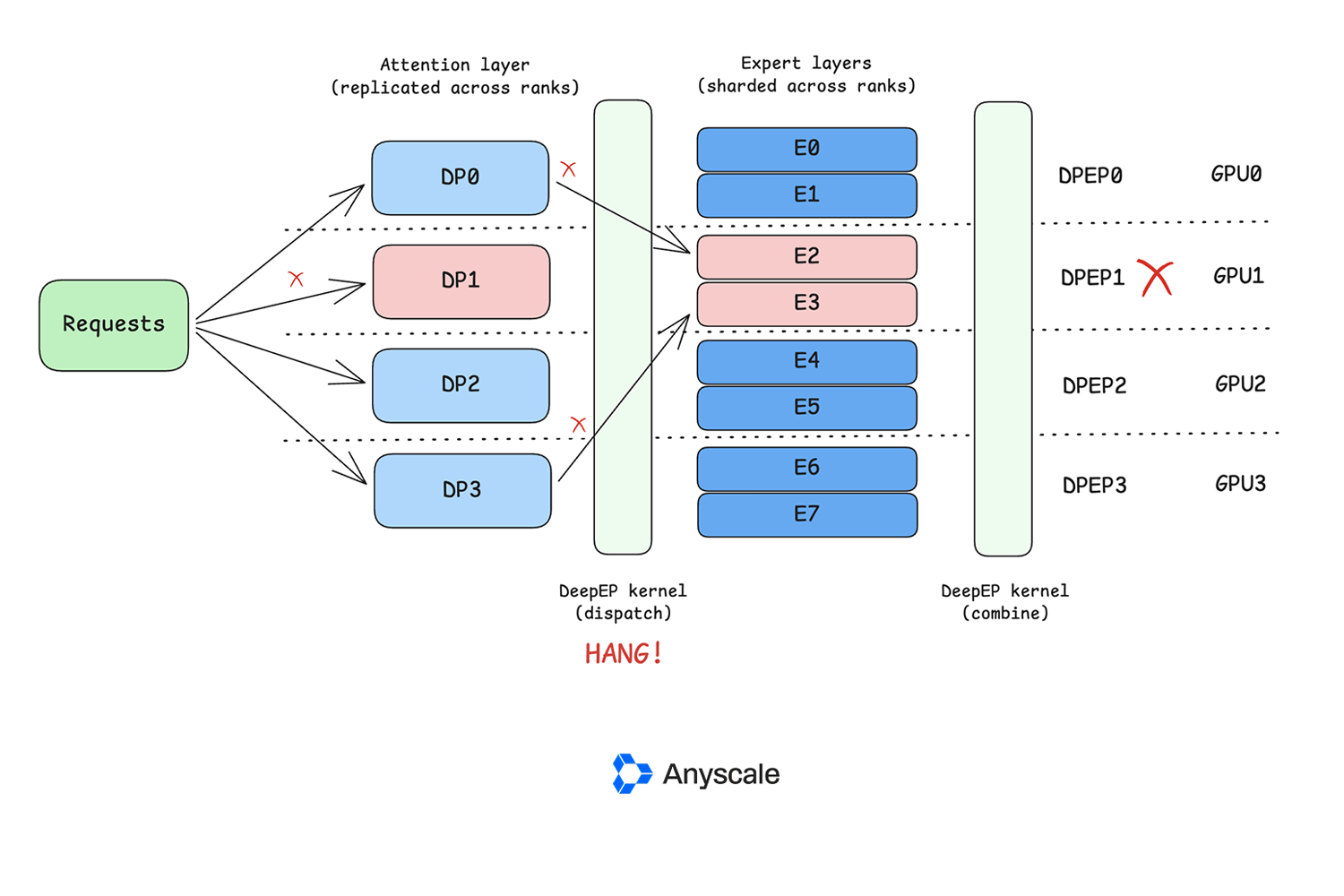
  28. Announcing DP Group Fault Tolerance for vLLM WideEP Deployments with Ray Serve LLM

    Anyscale has introduced a new fault tolerance feature for its vLLM serving engine, integrated with Ray Serve. This enhancement specifically addresses the challenges of deploying large Mixture-of-Experts (MoE) models, which are sharded across multiple GPUs. The new system can now identify and restart entire groups of GPUs that form a data-parallel (DP) group when a single GPU within that group fails, preventing the entire deployment from becoming unavailable. AI

    Announcing DP Group Fault Tolerance for vLLM WideEP Deployments with Ray Serve LLM

    IMPACT Enhances the reliability and operational efficiency of serving large, complex Mixture-of-Experts models, which are becoming increasingly common.

  29. nvidia/Nemotron-Labs-Diffusion-14B

    NVIDIA has released the Nemotron-Labs Diffusion family of language models, available in 3B, 8B, and 14B parameter sizes. These models uniquely support autoregressive (AR), diffusion, and self-speculation decoding modes within a single architecture, offering significant speed-ups. By generating tokens in parallel blocks rather than sequentially, Nemotron-Labs Diffusion achieves up to 6.4x higher throughput than traditional AR models, while maintaining or improving accuracy. This breakthrough addresses the memory-bandwidth bottleneck inherent in AR models, making them more efficient for production deployments and agentic systems. AI

    IMPACT Accelerates AI inference by breaking the sequential token generation bottleneck, enabling more efficient and cost-effective production deployments.

  30. Introducing AutoJudge: Streamlined inference acceleration via automated dataset curation

    Researchers at Together AI have developed AutoJudge, a novel method to accelerate large language model inference. This technique automates the curation of task-specific datasets, enabling lossy speculative decoding without manual annotation. AutoJudge identifies critical tokens that impact downstream quality, achieving up to a 2x speedup over standard speculative decoding with minimal accuracy loss. AI

    IMPACT Accelerates LLM inference by automating dataset curation for speculative decoding, potentially reducing operational costs.

  31. How to run TorchForge reinforcement learning pipelines in the Together AI Native Cloud

    Together AI is enhancing its cloud platform to support advanced reinforcement learning (RL) pipelines, integrating TorchForge and Monarch for distributed training. The platform now offers low-latency GPU communication and heterogeneous scheduling for mixed CPU/GPU workloads, crucial for complex RL tasks. New integrations with Together CodeSandbox and Code Interpreter allow RL agents to interact with tools and execute code, expanding their capabilities beyond traditional game-playing scenarios. AI

    How to run TorchForge reinforcement learning pipelines in the Together AI Native Cloud

    IMPACT Enhances infrastructure for complex AI training, enabling more sophisticated RL applications and tool integration.

  32. Show HN: AI-powered web service combining FastAPI, Pydantic-AI, and MCP servers

    A developer has created an open-source AI-powered web service that integrates FastAPI for APIs, Pydantic-AI for agent construction, and Model Context Protocol (MCP) servers for tools. The service allows users to query information from sources like Hacker News and web search, presenting ranked trend cards with summaries. It supports various local LLM configurations and is containerized with Docker for production deployment. AI

    Show HN: AI-powered web service combining FastAPI, Pydantic-AI, and MCP servers

    IMPACT Provides a template for building production-ready AI services with modular components and local LLM support.

  33. Rule2DRC: Benchmarking LLM Agents for DRC Script Synthesis with Execution-Guided Test Generation

    Researchers have developed several new tools and frameworks to improve the efficiency and accuracy of large language model (LLM) operations. Charon and Frontier are simulators designed to predict LLM training and inference performance with high accuracy, aiding in optimization efforts. FT-Dojo provides a benchmark environment for autonomous LLM fine-tuning, while rePIRL offers an inverse RL-inspired framework for learning process reward models. Additionally, PALS focuses on power-aware LLM serving for Mixture-of-Experts models, and LlamaWeb enables memory-efficient LLM inference in web browsers using WebGPU. AI

    IMPACT New simulators and frameworks promise more efficient, accurate, and power-aware LLM operations, potentially accelerating research and deployment.

  34. FlexDraft: Flexible Speculative Decoding via Attention Tuning and Bonus-Guided Calibration

    Two new research papers, Graft and FlexDraft, introduce advanced techniques for speculative decoding to accelerate large language model inference. Graft combines pruning and retrieval to fill gaps left by pruned branches, achieving significant speedups without training. FlexDraft employs attention tuning and bonus-guided calibration to adapt flexibly across different batch sizes, mitigating draft verification mismatches and improving throughput. These methods aim to overcome the latency-cost trap in LLM deployment by allowing high-quality responses at speeds closer to smaller models. AI

    FlexDraft: Flexible Speculative Decoding via Attention Tuning and Bonus-Guided Calibration

    IMPACT These advancements in speculative decoding could significantly reduce LLM inference latency and cost, enabling faster and more efficient deployment of AI applications.