LLM inference and reasoning techniques advance with new research and hardware
ByPulseAugur Editorial·[564 sources]·
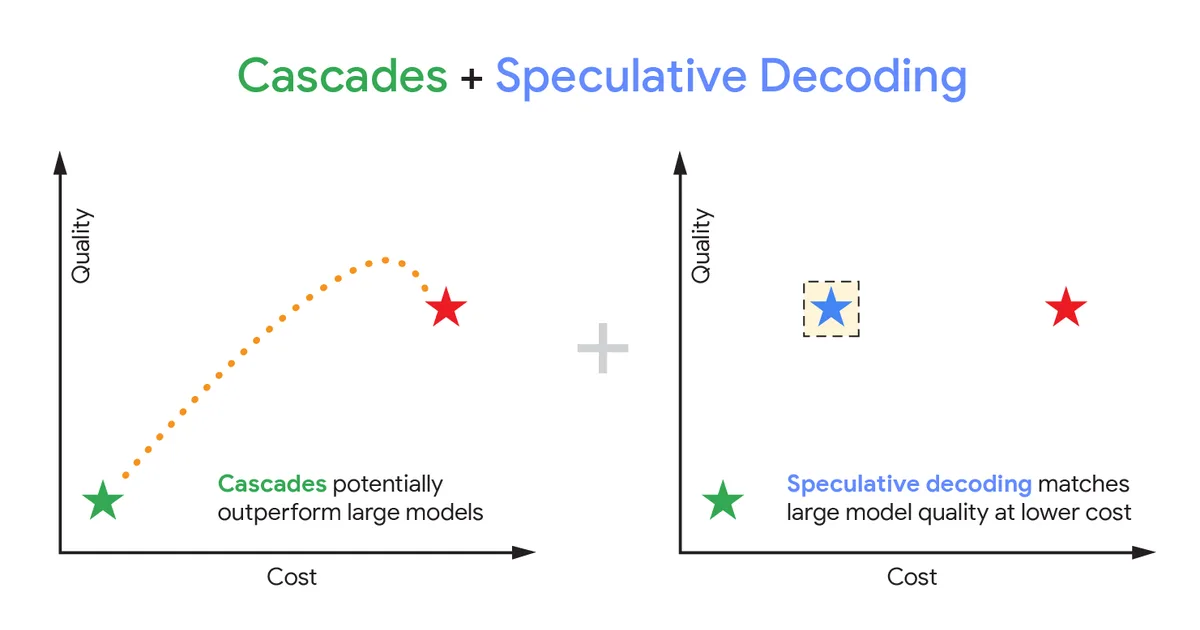
Researchers are exploring novel methods to enhance the efficiency and reasoning capabilities of large language models (LLMs). Google Research is developing techniques to train LLMs to reason in a Bayesian manner, improving their ability to update probabilistic estimates and generalize to new tasks. Concurrently, advancements in inference optimization include "speculative cascades" which combine smaller, faster models with larger ones, and "context recycling" to manage long conversational horizons. Additionally, methods like "Cascaded Multi-Granularity Pruning" and "SharQ" are being developed to compress LLMs for on-device inference, reducing latency and memory usage while maintaining accuracy. OpenAI and Broadcom have also collaborated on a custom AI chip, Jalapeño, designed to optimize LLM inference performance.
AI
IMPACT
Advances in LLM reasoning and inference efficiency could lead to more capable and cost-effective AI systems across various applications.
RANK_REASON
Multiple research papers detailing new methods for LLM reasoning and inference optimization, alongside a product announcement for a custom AI chip.
arXiv:2607.01293v1 Announce Type: new Abstract: We present RuleChef, a framework that uses large language models (LLMs) to generate executable rules for NLP tasks such as text classification, Named Entity Recognition (NER), or relation extraction. Rules are generated based on a t…
arXiv:2607.01585v1 Announce Type: cross Abstract: Predicate invention (PI), the creation of new predicates to extend the hypothesis space, remains a critical bottleneck in Inductive Logic Programming (ILP). Existing methods rely on domain expertise and produce semantically opaque…
arXiv cs.AI
TIER_1English(EN)·Samir Abdaljalil, Erchin Serpedin, Hasan Kurban·
arXiv:2607.01431v1 Announce Type: cross Abstract: We introduce ISOSCI, a benchmark of isomorphic cross-domain science problem pairs that separates reasoning ability from domain knowledge retrieval in LLM evaluation. Each pair shares identical logical structure but requires differ…
arXiv:2607.02509v1 Announce Type: new Abstract: Understanding and reasoning over long contexts has become a key requirement for deploying large language models (LLMs) in realistic applications. Although recent LLMs support increasingly long context windows, they often fail to use…
Understanding and reasoning over long contexts has become a key requirement for deploying large language models (LLMs) in realistic applications. Although recent LLMs support increasingly long context windows, they often fail to use relevant evidence that is already present in th…
Understanding and reasoning over long contexts has become a key requirement for deploying large language models (LLMs) in realistic applications. Although recent LLMs support increasingly long context windows, they often fail to use relevant evidence that is already present in th…
arXiv:2509.21013v4 Announce Type: replace-cross Abstract: Given the prohibitive cost of pre-training large language models, it is essential to leverage smaller proxy models to optimize datasets before scaling up. However, this approach becomes challenging for reasoning capabiliti…
arXiv cs.AI
TIER_1English(EN)·Fatima Jahara, Mark Dredze, Sharon Levy·
arXiv:2511.06160v2 Announce Type: replace Abstract: While recent safety guardrails effectively suppress overtly biased outputs, subtler forms of social bias emerge during complex logical reasoning tasks that evade current evaluation benchmarks. To fill this gap, we introduce a ne…
arXiv cs.CL
TIER_1English(EN)·Yao Dou, Benjamin Mamut, Wei Xu·
arXiv:2601.04424v2 Announce Type: replace Abstract: Large language models (LLMs) now support contexts of up to 1M tokens, but their strengths and weaknesses on complex long-context tasks remain unclear. To study this, we focus on multi-document legal case summarization, where a s…
arXiv cs.CL
TIER_1English(EN)·Yujia Hu, Tuan-Phong Nguyen, Shrestha Ghosh, Moritz M\"uller, Simon Razniewski·
arXiv:2507.05740v2 Announce Type: replace Abstract: Language models are powerful artifacts, yet their factual knowledge is still poorly understood, and inaccessible to ad-hoc browsing and scalable statistical analysis. This demonstration introduces GPTKB v1.5, a densely interlink…
Predicate invention (PI), the creation of new predicates to extend the hypothesis space, remains a critical bottleneck in Inductive Logic Programming (ILP). Existing methods rely on domain expertise and produce semantically opaque predicates, hindering adaptation to unfamiliar do…
We introduce ISOSCI, a benchmark of isomorphic cross-domain science problem pairs that separates reasoning ability from domain knowledge retrieval in LLM evaluation. Each pair shares identical logical structure but requires different domain-specific knowledge, enabling controlled…
arXiv cs.AI
TIER_1English(EN)·Zhaoyang Luo, Runmin Dong, Miao Yang, Fan Wei, Yushan Lai, Bin Luo, Haohuan Fu·
arXiv:2606.31903v1 Announce Type: cross Abstract: Multimodal large language models (MLLMs) increasingly process long visual-token sequences, increasing the overall inference computation. Existing acceleration methods usually remove visual tokens or skip visual-token updates in en…
arXiv:2605.11599v3 Announce Type: replace Abstract: Fixed reasoning benchmarks evaluate canonical prompts, but semantically valid changes in presentation can still change model behavior. Studies of prompt variation can reveal such failures, but without audit they can mix genuine …
arXiv cs.CL
TIER_1English(EN)·Xudong Shen, Li Yuan, Ye Chen, Xin Wu, Yi Cai, Zhiyong Wu·
arXiv:2606.31039v1 Announce Type: new Abstract: Large Language Models (LLMs) exhibit strong semantic capabilities, yet their resilience to manipulative linguistic patterns such as logical fallacies remains underexplored. Prior work has primarily examined whether LLMs can identify…
arXiv cs.AI
TIER_1English(EN)·Zijun Di, Bin Lu, Huquan Kang, Luoyi Fu, Jiaxin Ding, Xiaoying Gan, Lei Zhou, Xinbing Wang·
arXiv:2601.08187v3 Announce Type: replace Abstract: Large language models (LLMs) have demonstrated promising capabilities in Text-Attributed Graph (TAG) understanding. Recent studies typically focus on verbalizing the graph structures via handcrafted prompts, feeding the target n…
arXiv cs.AI
TIER_1English(EN)·Ankur Samanta, Akshayaa Magesh, Tal Lancewicki, Ayush Jain, Youliang Yu, Paul Sajda, Kaveh Hassani, Aditya Modi, Daniel R. Jiang, Yonathan Efroni·
arXiv:2606.30850v1 Announce Type: new Abstract: Large language models (LLMs) are typically deployed in multi-turn conversations, where each turn provides new evidence that should reduce epistemic uncertainty about their environment. Acting rationally then requires inferring the u…
arXiv:2606.29296v1 Announce Type: new Abstract: Group Relative Policy Optimization (GRPO) is a default recipe for process-supervised reinforcement learning of LLM reasoners, and dense process supervision -- via learned process reward models (PRMs) or on-policy-distillation KL sig…
arXiv cs.LG
TIER_1English(EN)·Pei-Chi Pan, Yingbin Liang, Sen Lin·
arXiv:2602.09305v2 Announce Type: replace Abstract: Large Language Models (LLMs) demonstrate transformative potential, yet their reasoning remains inconsistent and unreliable. Reinforcement learning (RL)-based fine-tuning is a key mechanism for improvement, but its effectiveness …
arXiv:2606.30420v1 Announce Type: new Abstract: Reinforcement Learning with Verifiable Rewards (RLVR) is a powerful paradigm for improving the reasoning capabilities of large language models (LLMs). However, existing RLVR methods typically rely on on-policy optimization from scra…
arXiv:2606.30247v1 Announce Type: new Abstract: Knowledge graphs can guide large language models (LLMs) reasoning, but the graph seen by a system is usually a retrieved, linked, temporally scoped, and incomplete evidence state rather than a complete account of truth. We develop a…
arXiv cs.AI
TIER_1English(EN)·Sirui Li, Shuhan Xiao, Mihir Joshi, Ahmed Metwally, Daniel McDuff, Wei Wang, Yuzhe Yang·
arXiv:2603.06638v3 Announce Type: replace-cross Abstract: The rise of large language models (LLMs) has shifted time series analysis from narrow analytics to general-purpose reasoning. Yet, existing benchmarks cover only a small set of health time series modalities and tasks, fail…
arXiv cs.AI
TIER_1English(EN)·Tiancheng Xing, Jerry Li, Yixuan Du, Xiyang Hu·
arXiv:2510.06732v2 Announce Type: replace-cross Abstract: Large language models (LLMs) are increasingly used as rerankers in information retrieval, yet their ranking behavior can be steered by small, natural-sounding prompts. To expose this vulnerability, we present Rank Anything…
arXiv:2601.01569v4 Announce Type: replace Abstract: LLM-based agents are increasingly capable of complex task execution, yet current agentic systems remain constrained by text-centric paradigms that struggle with long-horizon tasks due to fragile multi-turn dependencies and conte…
arXiv:2606.30441v1 Announce Type: cross Abstract: A rigorous formalization of system requirements is a fundamental prerequisite for the verification of Multi-Agent Systems (MAS). However, writing correct formal specifications is well known as an error-prone, time-consuming, and e…
arXiv cs.AI
TIER_1English(EN)·Xiteng Yao, Taeho Kim, Hengzhi Pei, Xinle Liu, Kyle Ulrich, Leonard Lausen, Ashish Khetan, Xiang Song, George Karypis, Martin Herbordt·
arXiv:2606.28565v1 Announce Type: cross Abstract: As large language models (LLMs) move into production serving, practitioners must rapidly evaluate inference performance across diverse hardware, models, and serving parameters to meet cost and latency targets. However, the end-to-…
arXiv:2606.29929v1 Announce Type: new Abstract: Distilling historical trajectories into reusable experience to enhance future problem-solving has become a focal point of recent LLM research. However, existing methods predominantly operate at the task level, leveraging general sum…
arXiv:2606.28589v1 Announce Type: new Abstract: Current approaches to enhance Large Language Model (LLM) reasoning, such as Chain-of-Thought and "Wait" prompts, primarily encourage models to think more, yet often fail to guide them toward Truth. While Representation Editing (RepE…
Large Language Models (LLMs) exhibit strong semantic capabilities, yet their resilience to manipulative linguistic patterns such as logical fallacies remains underexplored. Prior work has primarily examined whether LLMs can identify or classify fallacies, leaving their robustness…
A rigorous formalization of system requirements is a fundamental prerequisite for the verification of Multi-Agent Systems (MAS). However, writing correct formal specifications is well known as an error-prone, time-consuming, and expertise-intensive task. This difficulty is furthe…
A rigorous formalization of system requirements is a fundamental prerequisite for the verification of Multi-Agent Systems (MAS). However, writing correct formal specifications is well known as an error-prone, time-consuming, and expertise-intensive task. This difficulty is furthe…
Reinforcement Learning with Verifiable Rewards (RLVR) is a powerful paradigm for improving the reasoning capabilities of large language models (LLMs). However, existing RLVR methods typically rely on on-policy optimization from scratch, resulting in high sampling costs and ineffi…
Knowledge graphs can guide large language models (LLMs) reasoning, but the graph seen by a system is usually a retrieved, linked, temporally scoped, and incomplete evidence state rather than a complete account of truth. We develop a theoretical perspective on grounding observable…
Knowledge graphs can guide large language models (LLMs) reasoning, but the graph seen by a system is usually a retrieved, linked, temporally scoped, and incomplete evidence state rather than a complete account of truth. We develop a theoretical perspective on grounding observable…
arXiv:2602.20094v2 Announce Type: replace Abstract: As large language models (LLMs) witness increasing deployment in complex, high-stakes decision-making scenarios, it becomes imperative to ground their reasoning in causality rather than spurious correlations. However, strong per…
arXiv cs.AI
TIER_1English(EN)·Yuhang Chen, Jinhao Duan, Ruichen Zhang, Mingfu Liang, Xiaohan Wei, Yunchen Pu, Fei Tian, Chonglin Sun, Parish Aggarwal, Frank Shyu, Luke Simon, Sandeep Pandey, Tianlong Chen, Xi Liu·
arXiv:2606.27743v1 Announce Type: cross Abstract: Large Language Models (LLMs) inference is typically deployed under a static resource assumption, where models execute a fixed computational graph regardless of the runtime environment. However, real-world cloud infrastructure is i…
arXiv:2606.27550v1 Announce Type: new Abstract: Multi-token prediction has been shown to increase data density during training, improve downstream text-generation quality, and serves as the defacto approach for self-speculative decoding. Existing foundation and open source models…
arXiv cs.AI
TIER_1English(EN)·Yiheng Tao, Yihe Zhang, Matthew Dearing, Xin Wang, Yuping Fan, Michael E. Papka, Zhiling Lan·
arXiv:2510.03243v3 Announce Type: replace-cross Abstract: Efficient scheduling of large language model (LLM) inference tasks is critical for achieving low latency and high throughput, a challenge that is becoming increasingly acute with the rise of reasoning-capable LLMs whose ge…
Large Language Models (LLMs) inference is typically deployed under a static resource assumption, where models execute a fixed computational graph regardless of the runtime environment. However, real-world cloud infrastructure is inherently dynamic, characterized by fluctuating av…
arXiv:2606.26105v1 Announce Type: cross Abstract: Large language models (LLMs) exhibit strong capabilities in short-context reasoning but degrade in performance over long conversational horizons due to context window limitations and inefficient token usage. We introduce ContextFo…
arXiv:2606.26861v1 Announce Type: new Abstract: Deploying large language models (LLMs) on Industrial Internet of Things (IIoT) edge devices demands extreme compression, yet existing structured pruning methods collapse at high compression ratios due to one-shot importance estimati…
Multi-token prediction has been shown to increase data density during training, improve downstream text-generation quality, and serves as the defacto approach for self-speculative decoding. Existing foundation and open source models that use MTP heads commit to a static tree-base…
Deploying large language models (LLMs) on Industrial Internet of Things (IIoT) edge devices demands extreme compression, yet existing structured pruning methods collapse at high compression ratios due to one-shot importance estimation, and their cross-architecture behavior remain…
Deploying large language models (LLMs) on Industrial Internet of Things (IIoT) edge devices demands extreme compression, yet existing structured pruning methods collapse at high compression ratios due to one-shot importance estimation, and their cross-architecture behavior remain…
Low-bit floating-point formats and semi-structured sparsity are increasingly supported by modern accelerators, yet combining them for LLM activation compression remains challenging: activations contain input-dependent outliers that dominate block scales in FP4 quantization, and d…
arXiv cs.LG
TIER_1English(EN)·DatologyAI, :, Matthew L. Leavitt, Siddharth Joshi, Haoli Yin, Rishabh Adiga, Haakon Mongstad, Alvin Deng, David Schwab, Bogdan Gaza, Ari Morcos·
arXiv:2606.25432v1 Announce Type: new Abstract: Inference efficiency is typically pursued by shrinking the model: distillation, pruning, quantization, and sparse routing each lower per-token cost while treating token count as fixed. But output length has been inflating, and it is…
arXiv cs.LG
TIER_1English(EN)·Stefan Wahl, Raphaela Schenk, Ali Farnoud, Jakob H. Macke, Daniel Gedon·
arXiv:2602.18266v2 Announce Type: replace Abstract: Automated methods for discovering mechanistic simulator models from observational data offer a promising path toward accelerating scientific progress. Such methods often take the form of agentic-style iterative workflows that re…
arXiv:2606.25524v1 Announce Type: cross Abstract: Large language models (LLMs) reach high accuracy in mathematical reasoning, but individual traces on the same problem diverge; some arrive at the correct answer while others fail. Prior work analyzes failure at the step, chunk, or…
arXiv cs.LG
TIER_1English(EN)·Francisco Ferreira da Silva, Stefan Heimersheim·
arXiv:2606.24964v1 Announce Type: new Abstract: Understanding the features of large language models (LLMs) is a central goal of interpretability. LLMs are commonly assumed to use superposition to represent more features than they have dimensions. They may not only represent featu…
Large language models (LLMs) reach high accuracy in mathematical reasoning, but individual traces on the same problem diverge; some arrive at the correct answer while others fail. Prior work analyzes failure at the step, chunk, or sentence level, or at tokens where failure has al…
Inference efficiency is typically pursued by shrinking the model: distillation, pruning, quantization, and sparse routing each lower per-token cost while treating token count as fixed. But output length has been inflating, and it is precisely the component the standard toolkit le…
Inference efficiency is typically pursued by shrinking the model: distillation, pruning, quantization, and sparse routing each lower per-token cost while treating token count as fixed. But output length has been inflating, and it is precisely the component the standard toolkit le…
arXiv cs.AI
TIER_1English(EN)·Ismail Labiad, Mathurin Videau, Matthieu Kowalski, Marc Schoenauer, Alessandro Leite, Julia Kempe, Olivier Teytaud·
arXiv:2507.01752v4 Announce Type: replace-cross Abstract: Gradient-based optimization is the workhorse of deep learning, offering efficient and scalable training via backpropagation. However, exposing gradients during training can leak sensitive information about the underlying d…
arXiv:2606.23001v1 Announce Type: cross Abstract: On-device LLM inference is increasingly attractive for privacy-preserving, reliable, and cost-effective deployment, yet its energy and thermal costs remain a critical bottleneck. Existing systems primarily optimize for decoding sp…
arXiv:2511.21056v2 Announce Type: replace-cross Abstract: Supervised fine-tuning (SFT) datasets are critical to the downstream performance of large language models, yet they often contain low-quality or harmful question-response pairs. To improve SFT data quality, we develop a un…
arXiv:2501.11790v5 Announce Type: replace-cross Abstract: Recent studies have raised significant concerns regarding the reliability of current mathematics benchmarks, highlighting issues such as simplistic design and potential data contamination. Consequently, developing a reliab…
arXiv:2606.23238v2 Announce Type: replace Abstract: Logical reasoning is essential for reliable AI, yet existing benchmarks are largely first-order-logic-centric, focusing on object-level deduction over fixed predicates. This misses many realistic scenarios where models must reas…
arXiv:2606.24605v1 Announce Type: new Abstract: Accurate user modeling often depends on rich interaction histories, which are unavailable for billions of low-activity users. Large Language Models (LLMs) can infer latent user states from static profiles, but this reasoning becomes…
arXiv cs.AI
TIER_1English(EN)·Xiaolin Lin, Jingcun Wang, Olga Kondrateva, Yiyu Shi, Bing Li, Grace Li Zhang·
arXiv:2606.24467v1 Announce Type: new Abstract: Long-context large language model (LLM) inference is increasingly constrained by the memory footprint and decoding cost of key-value (KV) caches, limiting sustainable deployment on resource-constrained hardware. Existing KV cache ev…
Accurate user modeling often depends on rich interaction histories, which are unavailable for billions of low-activity users. Large Language Models (LLMs) can infer latent user states from static profiles, but this reasoning becomes unreliable when profiles are sparse, and applyi…
Long-context large language model (LLM) inference is increasingly constrained by the memory footprint and decoding cost of key-value (KV) caches, limiting sustainable deployment on resource-constrained hardware. Existing KV cache eviction methods typically apply heuristic token s…
Long-context large language model (LLM) inference is increasingly constrained by the memory footprint and decoding cost of key-value (KV) caches, limiting sustainable deployment on resource-constrained hardware. Existing KV cache eviction methods typically apply heuristic token s…
<p><span>We would often like to get a qualitative sense of a target model’s behaviors in important distributions (e.g. deployment, RL training, or evals). For example, we might want to </span><a href="https://alignment.anthropic.com/2026/petri-v2/"><span>discover novel behaviors<…
Long-running LLM agents keep valuable state resident on GPUs: KV caches, request schedulers, communication state, and sometimes online adapters. Losing this state after a GPU or communicator failure can discard minutes to hours of work, yet existing recovery mechanisms either res…
Long-running LLM agents keep valuable state resident on GPUs: KV caches, request schedulers, communication state, and sometimes online adapters. Losing this state after a GPU or communicator failure can discard minutes to hours of work, yet existing recovery mechanisms either res…
Pretrained text embeddings are increasingly used as representational maps, yet high category separability does not imply that their geometry recovers expert-defined structure. We study this problem in mental-health-related language, where symptom relations provide an external ref…
Memory systems are essential for personalized Large Language Models (LLMs). However, existing retrieval methods in these systems primarily rely on semantic similarity, potentially missing logically critical memories with limited semantic overlap. Current benchmarks remain inadequ…
Knowledge injection via synthetic data is crucial for enhancing Large Language Models (LLMs). However, current synthesis methods simply stop at preset token counts or fixed data ratios, lacking awareness of knowledge distribution. This results in some domains being sparse while o…
Logical reasoning is essential for reliable AI, yet existing benchmarks are largely first-order-logic-centric, focusing on object-level deduction over fixed predicates. This misses many realistic scenarios where models must reason over rules, predicates, functions, constraints, a…
Large language models (LLMs) are increasingly deployed in multilingual settings, yet the energy costs of serving these models across different languages remain poorly understood. We present a systematic study of inference energy consumption across languages with ML.Energy framewo…
Large language models produce fluent but often incorrect multi-step reasoning, and naive correction methods risk degrading already-correct answers. We introduce Denoising Iterative Self-Correction (DISC), a test-time procedure that treats verification question outputs as noisy me…
arXiv:2606.20295v1 Announce Type: cross Abstract: Large model inference optimization serves as a key foundation for supporting the scalable, low-cost, and highly stable operation of large model services. Centered on token-oriented inference optimization technology, this paper pro…
arXiv:2606.19946v1 Announce Type: new Abstract: Activation steering controls model behavior by modifying intermediate hidden states at inference time without retraining. Existing methods handle only single-direction injection; when multiple semantic directions are superposed with…
arXiv:2606.19353v1 Announce Type: new Abstract: In-Context Learning (ICL) allows LLMs to adapt to new tasks from a few demonstrations, but its reliability remains a concern: predictions are highly sensitive to both prompt design and the model's ability to understand the context, …
arXiv cs.LG
TIER_1English(EN)·Abhinit Sen, Ajeet Kumar, Manaranjan Pradhan·
arXiv:2606.19364v1 Announce Type: new Abstract: The prefill stage of Large Language Model (LLM) inference is a growing contributor to cloud-scale energy cost. Many consumer-support and conversational prompts contain social scaffolding: politeness markers, apologetic preamble, rep…
arXiv cs.AI
TIER_1English(EN)·Xuanzhi Feng, Zhengyang Li, Zeyu Liu, Haoxi Li, Yuming Jiang, Bing Guo, Jingcai Guo, Jie Zhang, Song Guo·
arXiv:2606.19771v1 Announce Type: new Abstract: Reinforcement Learning with Verifiable Rewards (RLVR) has significantly advanced Large Language Model (LLM) reasoning; however, it faces a fundamental optimization instability: uniform token updates precipitate entropy collapse, lea…
Large model inference optimization serves as a key foundation for supporting the scalable, low-cost, and highly stable operation of large model services. Centered on token-oriented inference optimization technology, this paper proposes for the first time a four-layer technical ar…
Activation steering controls model behavior by modifying intermediate hidden states at inference time without retraining. Existing methods handle only single-direction injection; when multiple semantic directions are superposed without constraints, the model collapses. We show th…
arXiv cs.LG
TIER_1English(EN)·Jiaxing Wang, Deping Xiang, Jin Xu, Zirui Liu, Zicheng Zhang, Guoqiang Gong, Jun Fang, Chao Liu, Pengzhang Liu, Tongxuan Liu, Ke Zhang, Qixia Jiang·
arXiv:2606.18650v1 Announce Type: new Abstract: As Large Language Model (LLM) datasets scale to trillions of tokens, data selection has emerged as a critical frontier to filter out uninformative noise and construct adaptive learning trajectories. Beyond static heuristic filtering…
arXiv:2606.18431v1 Announce Type: new Abstract: LLM serving exhibits extreme length variability, making size-based scheduling difficult in practice. Recent LLM schedulers approximate SJF/SRPT using predicted decode lengths or ranks and primarily report mean-centric metrics such a…
arXiv cs.AI
TIER_1English(EN)·Yan Scholten, Sophie Xhonneux, Leo Schwinn, Stephan G\"unnemann·
arXiv:2507.04219v5 Announce Type: replace-cross Abstract: Current unlearning methods for LLMs optimize on the private information they seek to remove by incorporating it into their fine-tuning data. We argue this not only risks reinforcing exposure to sensitive data, but also fun…
arXiv cs.AI
TIER_1English(EN)·Shabari S Nair, Krishanu Saini·
arXiv:2606.17059v1 Announce Type: cross Abstract: Prefix caching can reduce LLM inference latency by reusing KV caches across requests with shared prompts, but cluster-scale reuse is challenging because caches are partitioned across nodes. We propose a decentralized, prefix-cache…
arXiv cs.AI
TIER_1English(EN)·Shun Usami, Venkatram Vishwanath, E. Wes Bethel·
arXiv:2606.17104v1 Announce Type: cross Abstract: As large language models (LLMs) are increasingly deployed in latency- and cost-sensitive settings, inference efficiency has become a central systems challenge. While GPUs dominate current deployments, a growing number of AI accele…
arXiv cs.AI
TIER_1English(EN)·Jessica McFadyen, Ole Jorgensen, Harry Coppock, Kevin Wei, Cozmin Ududec·
arXiv:2606.17930v1 Announce Type: new Abstract: AI evaluations are shifting toward harder tasks that benefit from longer trajectories involving tool use and iterative problem solving. As a result, performance is increasingly sensitive to the amount and allocation of compute avail…
arXiv cs.LG
TIER_1English(EN)·Md Abdullah Al Mamun, Ngoc Phu Doan, Pedram Zaree, Ihsen Alouani, Nael Abu-Ghazaleh·
arXiv:2606.17110v1 Announce Type: cross Abstract: Large Language Models are increasingly trained on proprietary or sensitive data, from private healthcare and financial records to user conversations containing secrets. Ensuring the privacy of such data against extraction attacks …
arXiv:2606.17634v1 Announce Type: new Abstract: Evaluating large language models (LLMs) is important for understanding their capabilities, comparing competing systems, and supporting the deployment of reliable models in practice. For open-ended tasks, pairwise evaluation has beco…
arXiv cs.CL
TIER_1English(EN)·Filip Sondej, Yushi Yang, Adam Mahdi·
arXiv:2606.17168v1 Announce Type: new Abstract: Making large language models (LLMs) deeply forget specific knowledge and values without sacrificing general capabilities remains a central challenge in unlearning. However, current methods are easily reversed by fine-tuning or few-s…
AI evaluations are shifting toward harder tasks that benefit from longer trajectories involving tool use and iterative problem solving. As a result, performance is increasingly sensitive to the amount and allocation of compute available at test time ("inference compute"). Yet man…
Evaluating large language models (LLMs) is important for understanding their capabilities, comparing competing systems, and supporting the deployment of reliable models in practice. For open-ended tasks, pairwise evaluation has become a popular paradigm, in which two responses to…
arXiv cs.AI
TIER_1English(EN)·Ziqun Chen, Ming Wu, Michael Heinrich, Jason Zeng, Huiying Lan, Tianwei Zhang, Rui Tan·
arXiv:2606.16352v1 Announce Type: cross Abstract: Computation integrity of remote large language model (LLM) serving can be questionable. For conventional deep neural networks (DNNs), the existing TEE-shielded DNN partitioning (TSDP) approach uses Trusted Execution Environment (T…
arXiv cs.LG
TIER_1English(EN)·Lorenzo Sani, Alex Iacob, Zeyu Cao, Royson Lee, Bill Marino, Yan Gao, Dongqi Cai, Zexi Li, Wanru Zhao, Xinchi Qiu, Nicholas D. Lane·
arXiv:2411.02908v2 Announce Type: replace Abstract: Scaling large language models (LLMs) demands extensive data and computing resources, which are traditionally constrained to data centers by the high-bandwidth requirements of distributed training. Low-bandwidth methods like fede…
arXiv cs.LG
TIER_1English(EN)·Yingnan Zhao, Razvan Bunescu, Ahmed Louri, Avinash Karanth, Ke Wang·
arXiv:2606.15453v1 Announce Type: cross Abstract: Mixture-of-Experts (MoE) based large language models (LLMs), such as Qwen and DeepSeek, have recently emerged as an effective approach to improving model capacity without proportionally increasing computational cost. By replacing …
arXiv cs.LG
TIER_1English(EN)·Alexander Yukhimchuk, Andrey Shulga, Mladen Kolar, Martin Tak\'a\v{c}·
arXiv:2606.16461v1 Announce Type: new Abstract: Running large language models locally is often impractical, pushing inference on sensitive text to third-party providers. Split inference partially mitigates this by keeping tokens on the client and sending only hidden representatio…
arXiv:2603.26557v2 Announce Type: replace Abstract: Large Language Models (LLMs) deliver strong performance but incur high inference cost in real-world services, especially under workloads with repeated or near-duplicate queries across users and sessions. In this work, we propose…
arXiv:2506.11418v2 Announce Type: replace Abstract: Large language models (LLMs) with extended context windows have become increasingly prevalent for tackling complex tasks. However, the substantial Key-Value (KV) cache required for long-context LLMs poses significant deployment …
arXiv:2606.15652v1 Announce Type: cross Abstract: 4-bit quantization significantly reduces the memory footprint and accelerates the inference of large language models (LLMs). However, its limited bit-width representation struggles to faithfully capture both dense common values (\…
arXiv:2505.23878v2 Announce Type: replace-cross Abstract: Optimizing pretraining data composition is pivotal for LLM generalization. While dynamic mixing outperforms static strategies by capturing evolving training dynamics, current methods fail to reconcile computational efficie…
arXiv cs.AI
TIER_1English(EN)·Youngcheon You, Banseok Lee, Minseop Choi, Seonyoung Kim, Hyochan Chong, Changdong Kim, Youngmin Kim, Dongkyu Kim·
arXiv:2606.16847v1 Announce Type: cross Abstract: Diffusion Large Language Models (dLLMs) offer a promising avenue for parallel generation but face a trade-off between decoding speed and quality. While revocable decoding strategies attempt to mitigate errors by verifying and rema…
arXiv:2606.16332v1 Announce Type: cross Abstract: Modern CPUs increasingly integrate matrix extensions, such as Arm Scalable Matrix Extension (SME), that provide high-throughput matrix execution within the CPU. For LLM inference, however, these units are not a universal replaceme…
arXiv:2606.15841v1 Announce Type: new Abstract: Large language model (LLM) systems increasingly use uncertainty signals to allocate limited computation across verification, test-time scaling, tool execution, and other selective-compute decisions. Such policies rely on a \emph{glo…
Making large language models (LLMs) deeply forget specific knowledge and values without sacrificing general capabilities remains a central challenge in unlearning. However, current methods are easily reversed by fine-tuning or few-shot prompting, suggesting their forgetting is on…
Diffusion Large Language Models (dLLMs) offer a promising avenue for parallel generation but face a trade-off between decoding speed and quality. While revocable decoding strategies attempt to mitigate errors by verifying and remasking tokens, they typically operate within a mixe…
arXiv cs.AI
TIER_1English(EN)·Anas Nassar, Steve Mohr, Leonard Apanasevich, Himanshu Sharma·
arXiv:2606.13968v1 Announce Type: cross Abstract: Researchers and practitioners working with large language models face a fragmented landscape: local models are free and private but hardware limits the model size and context windows a researcher can use; institutional HPC centers…
arXiv cs.AI
TIER_1English(EN)·Hengjie Cao, Zhendong Huang, Mengyi Chen, Yifeng Yang, Fang Dong, Anrui Chen, Ruijun Huang, Xin Zhang, Mingzhi Dong, Yujiang Wang, Jinlong Hou, Qin Lv, Robert P. Dick, Yuan Cheng, Tun Lu, Fan Yang, Yixuan Chen, Li Shang·
arXiv:2603.10444v2 Announce Type: replace-cross Abstract: FP4 training promises substantial memory and compute savings for large language models, but remains fragile because blockwise quantization is dictated by extreme activation magnitudes, which inflate dynamic range and compr…
RepSelect isolates forget-set-specific representations in LLMs by collapsing top principal components of weight gradients, achieving deeper and more robust unlearning compared to existing methods.
arXiv:2606.13316v1 Announce Type: new Abstract: Reinforcement Learning with Verifiable Rewards (RLVR) is a central technique for improving long-horizon reasoning in Large Language Models (LLMs). However, existing RLVR methods often encourage unnecessarily long reasoning rollouts,…
arXiv:2606.12935v1 Announce Type: new Abstract: Parallel test-time scaling samples many reasoning traces and majority-votes their answers, improving LLM accuracy but requiring traces to run to completion, incurring substantial computational overhead. We observe that probing parti…
Reinforcement Learning with Verifiable Rewards (RLVR) is a central technique for improving long-horizon reasoning in Large Language Models (LLMs). However, existing RLVR methods often encourage unnecessarily long reasoning rollouts, which can degrade reasoning coherence and exhau…
Parallel test-time scaling samples many reasoning traces and majority-votes their answers, improving LLM accuracy but requiring traces to run to completion, incurring substantial computational overhead. We observe that probing partial traces at intermediate checkpoints can extrac…
arXiv:2606.11357v1 Announce Type: cross Abstract: With the growing demand for on-device LLM inference, edge SoCs increasingly integrate NPUs to improve performance and energy efficiency under tight power and thermal budgets. However, practical LLM deployment on current client NPU…
arXiv cs.AI
TIER_1English(EN)·Ruxue Shi, Yili Wang, Mengnan Du, Hangting Ye, Yi Chang, Xin Wang·
arXiv:2606.11640v1 Announce Type: cross Abstract: Few-shot tabular learning provides a cost-effective approach for real-world applications where annotation is costly and collecting sufficient samples for new tasks is difficult. Existing Traditional and LLM-based methods have demo…
arXiv cs.AI
TIER_1English(EN)·Arther Tian, Alex Ding, Frank Chen, Simon Wu, Aaron Chan·
arXiv:2606.11196v1 Announce Type: cross Abstract: Decentralized LLM inference networks need lightweight, reference-free quality evaluation for Proof of Quality (PoQ). We present PoQ-Judge, a framework that trains dedicated judge models to score query-output pairs without ground-t…
arXiv:2601.04710v2 Announce Type: replace Abstract: Fine-tuning large language models (LLMs) achieves strong performance but is often limited by the memory overhead of backpropagation. Zeroth-order (ZO) optimization avoids this overhead by estimating gradients through forward pas…
arXiv:2606.11562v1 Announce Type: cross Abstract: Graph analysis underlies many applications whose answers cannot be looked up in a single record or retrieved along a path: laundering rings, drug repurposing, user preference, and scientific theme are all inferred from a node toge…
arXiv:2606.12160v1 Announce Type: new Abstract: In this work, we introduce CHAIR (Classifier of Hallucination As ImproveR), a supervised framework for detecting hallucinations by analyzing internal logits from each layer of every token. Our method extracts a compact set of featur…
arXiv cs.AI
TIER_1English(EN)·Mingyi Luo, Ruichen Zhang, Xiangwang Hou, Jun Du, Chunxiao Jiang, Yong Ren, Shiwen Mao·
arXiv:2509.23248v3 Announce Type: replace Abstract: The rapid advancement of large language models (LLMs) has enabled an emergence of agentic artificial intelligence (AI) with powerful reasoning and autonomous decision-making capabilities. This integration with edge computing has…
arXiv:2606.12117v1 Announce Type: cross Abstract: Benchmark scores often misrepresent a large language model's (LLM's) knowledge, because they rely, e.g., on the model's ability to follow specific formatting requirements. This especially penalizes base models that may know the co…
In this work, we introduce CHAIR (Classifier of Hallucination As ImproveR), a supervised framework for detecting hallucinations by analyzing internal logits from each layer of every token. Our method extracts a compact set of features such as maximum, minimum, mean, standard devi…
Benchmark scores often misrepresent a large language model's (LLM's) knowledge, because they rely, e.g., on the model's ability to follow specific formatting requirements. This especially penalizes base models that may know the correct answers but lack the ability -- typically in…
arXiv:2606.10852v1 Announce Type: cross Abstract: LLM deception is often evaluated through direct markers such as fabricated claims, explicit lies, or strategic concealment. However, many real-world misleading communications do not depend on false statements, rather, they arise f…
arXiv:2606.09865v1 Announce Type: new Abstract: Privacy and data sharing are often in tension. Many organizations use synthetic data to reduce privacy risk and still share useful data. For tabular data, auditing privacy remains hard. In many cases, even humans cannot easily tell …
arXiv cs.CL
TIER_1English(EN)·Lena S. Bolliger, Lena A. J\"ager·
arXiv:2606.10860v1 Announce Type: cross Abstract: Production LLMs receive instructions from sources with very different levels of trust, yet attend to every token with uniform architectural privilege. This is the structural vulnerability that enables malicious prompt injections a…
arXiv:2606.10445v1 Announce Type: cross Abstract: Semi-structured 2:4 sparsity is widely supported by modern accelerators, providing up to a 2x theoretical speedup. However, its strict 50% sparsity constraint often causes non-negligible accuracy degradation under post-training pr…
arXiv:2606.10722v1 Announce Type: new Abstract: We study dense-to-sparse continual training as a way to construct channel-sparse large language models from dense checkpoints. Starting from a Qwen2.5-8B dense backbone, we continue training at 32K context and introduce a predictor-…
arXiv:2606.10694v1 Announce Type: new Abstract: Large Language Models (LLMs) are increasingly expected to interact with users over long time horizons. However, due to their finite context window, LLMs cannot retain all past interactions, making long-term memory management essenti…
arXiv cs.CL
TIER_1English(EN)·Pratibha Revankar, Kargi Chauhan, Jihye Kim, Sadiba Nusrat Nur, Vincent Siu, Chenguang Wang·
arXiv:2606.10304v1 Announce Type: new Abstract: When LLM agents are coerced into covertly encoding sensitive data (Base64, ROT13, acrostic, synonym chains, and beyond), the resulting outputs evade output-side detection but the underlying computation does not. Across nine encoding…
arXiv:2606.11081v1 Announce Type: cross Abstract: Communication-efficient pre-training of LLMs is increasingly important as training draws on compute distributed across clusters, data centers, and lower-bandwidth links. Many practical methods reduce communication frequency but st…
arXiv:2606.10706v1 Announce Type: cross Abstract: Resource constraints increasingly determine what can be trained, fine-tuned, and deployed in large language models (LLMs), yet efficiency is often studied through isolated techniques rather than as an interacting system of limits.…
arXiv:2606.10487v1 Announce Type: cross Abstract: Deploying large language models in user-facing systems requires efficient output safety filtering. Existing approaches typically rely on a separate moderation model applied after generation, which doubles inference cost and only d…
arXiv cs.AI
TIER_1English(EN)·Hainiu Xu, Italo Luis da Silva, Jiangnan Ye, Yuhao Wang, Wei Liu, Linyi Yang, Jonathan Richard Schwarz, Nicola Paoletti, Yulan He, Hanqi Yan·
arXiv:2606.09890v1 Announce Type: cross Abstract: Large language models (LLMs) are increasingly deployed as autonomous agents capable of executing multi-step action trajectories toward a given objective. While existing safety research has focused on detecting unethical behavior f…
arXiv cs.AI
TIER_1English(EN)·Xinrui Chen, Jianhao Zhang, Ou Wu, Di Gao·
arXiv:2606.09866v1 Announce Type: cross Abstract: Fine-tuning safety aligned large language models (LLMs) on downstream data improves adaptation but may erode learned safety behavior. Existing methods use fixed safety examples, global constraints, or one-sided task filtering. Our…
arXiv:2606.10532v1 Announce Type: new Abstract: Memory is essential for enabling large language model (LLM) agents to handle long-horizon reasoning tasks. Existing memory mechanisms are largely centralized, typically organizing retrieved information and interaction history within…
arXiv:2502.11034v3 Announce Type: replace Abstract: Loss spikes remain a persistent obstacle in large-scale language model pretraining. While previous research has attempted to identify the root cause of loss spikes by investigating individual factors, we observe that, in practic…
arXiv cs.LG
TIER_1English(EN)·Qingbo Wu, Ke Li, Wenzhu Wang, Jie Yu, Ruian Zhang, Lili Liu·
arXiv:2606.09879v1 Announce Type: new Abstract: This study addresses on-device inference bottlenecks of Transformer models on Tenstorrent's Tensix architecture and proposes an operator fusion strategy that enhances data locality. RMSNorm is fused with matrix multiplication in sel…
Graph analysis underlies many applications whose answers cannot be looked up in a single record or retrieved along a path: laundering rings, drug repurposing, user preference, and scientific theme are all inferred from a node together with its neighbourhood. We introduce GraphInf…
Communication-efficient pre-training of LLMs is increasingly important as training draws on compute distributed across clusters, data centers, and lower-bandwidth links. Many practical methods reduce communication frequency but still rely on synchronous All-Reduce operations that…
Communication-efficient pre-training of LLMs is increasingly important as training draws on compute distributed across clusters, data centers, and lower-bandwidth links. Many practical methods reduce communication frequency but still rely on synchronous All-Reduce operations that…
Production LLMs receive instructions from sources with very different levels of trust, yet attend to every token with uniform architectural privilege. This is the structural vulnerability that enables malicious prompt injections and, more broadly, leaves models without a principl…
LLM deception is often evaluated through direct markers such as fabricated claims, explicit lies, or strategic concealment. However, many real-world misleading communications do not depend on false statements, rather, they arise from selective treatment of true material facts: om…
We study dense-to-sparse continual training as a way to construct channel-sparse large language models from dense checkpoints. Starting from a Qwen2.5-8B dense backbone, we continue training at 32K context and introduce a predictor-gated sparse SwiGLU FFN in the 32K stage. For ea…
We study dense-to-sparse continual training as a way to construct channel-sparse large language models from dense checkpoints. Starting from a Qwen2.5-8B dense backbone, we continue training at 32K context and introduce a predictor-gated sparse SwiGLU FFN in the 32K stage. For ea…
Resource constraints increasingly determine what can be trained, fine-tuned, and deployed in large language models (LLMs), yet efficiency is often studied through isolated techniques rather than as an interacting system of limits. This survey adopts a constraint-centric perspecti…
Large Language Models (LLMs) are increasingly expected to interact with users over long time horizons. However, due to their finite context window, LLMs cannot retain all past interactions, making long-term memory management essential for storing, updating, and retrieving histori…
Memory is essential for enabling large language model (LLM) agents to handle long-horizon reasoning tasks. Existing memory mechanisms are largely centralized, typically organizing retrieved information and interaction history within a single model context. This design imposes a f…
Semi-structured 2:4 sparsity is widely supported by modern accelerators, providing up to a 2x theoretical speedup. However, its strict 50% sparsity constraint often causes non-negligible accuracy degradation under post-training pruning. Meanwhile, existing relaxed sparsity format…
Semi-structured 2:4 sparsity is widely supported by modern accelerators, providing up to a 2x theoretical speedup. However, its strict 50% sparsity constraint often causes non-negligible accuracy degradation under post-training pruning. Meanwhile, existing relaxed sparsity format…
arXiv:2606.07524v1 Announce Type: cross Abstract: The explosive growth of large language models (LLMs) has created a heterogeneous and poorly documented ecosystem, making systematic model comparison increasingly important for provenance auditing, security analysis, and model sele…
arXiv:2602.21788v2 Announce Type: replace-cross Abstract: Scaling long-context capabilities is crucial for Large Language Models (LLMs). However, real-world data contain a large number of sequences with heterogeneous lengths. Existing training libraries for LLMs rely on static pa…
arXiv:2601.03093v2 Announce Type: replace Abstract: Recent work on activation and latent steering has demonstrated that modifying internal representations can effectively guide large language models (LLMs) toward improved reasoning and efficiency without updating model parameters…
arXiv:2606.09821v1 Announce Type: new Abstract: Reinforcement learning (RL) has become a key component of post-training large language models (LLMs). In practice, LLM RL is often off-policy because of training-inference mismatch and policy staleness, making trust-region control e…
arXiv:2606.09080v1 Announce Type: new Abstract: Pruning has emerged as a dominant paradigm for accelerating large language model (LLM) inference, spanning a broad spectrum of methods that remove computation across tokens, layers, heads, dimensions, and attention patterns. Despite…
arXiv:2606.08454v1 Announce Type: new Abstract: Activation steering provides a lightweight inference-time mechanism for controlling large language models (LLMs) by modifying their internal activation vectors toward desired behaviors. Most existing methods compute a fixed steering…
arXiv:2606.07726v1 Announce Type: new Abstract: Large Language Models are typically benchmarked by evaluating every model on every test query. For practitioners seeking the best model to deploy, this is often wasteful: if a model clearly performs worse than others, there is no ne…
arXiv cs.AI
TIER_1English(EN)·Vincent-Daniel Yun, Junhyuk Jo, Sai Praneeth Karimireddy, Sunwoo Lee·
arXiv:2605.15491v2 Announce Type: replace-cross Abstract: Layer pruning removes entire Transformer decoder blocks from large language models, but introduces a mismatch between the hidden state received by the next surviving layer and the distribution it was trained to process, le…
arXiv cs.AI
TIER_1English(EN)·Zeju Qiu, Lixin Liu, Adrian Weller, Han Shi, Weiyang Liu·
arXiv:2603.05500v2 Announce Type: replace-cross Abstract: Efficient and stable training of large language models (LLMs) remains a core challenge in modern machine learning systems. To address this challenge, Reparameterized Orthogonal Equivalence Training (POET), a spectrum-prese…
arXiv cs.AI
TIER_1English(EN)·Minwei Kong, Ao Qu, Xiaotong Guo, Wenbin Ouyang, Chonghe Jiang, Han Zheng, Yining Ma, Dingyi Zhuang, Yuhan Tang, Junyi Li, Shenhao Wang, Haris Koutsopoulos, Hai Wang, Cathy Wu, Jinhua Zhao·
arXiv:2510.18428v4 Announce Type: replace Abstract: Optimization modeling underlies critical decision-making across industries, yet remains difficult to automate: natural-language problem descriptions must be translated into precise mathematical formulations and executable solver…
arXiv:2509.25004v2 Announce Type: replace Abstract: Online reinforcement learning with verifiable rewards (RLVR) has become an effective paradigm for improving the reasoning abilities of large language models, but most methods still optimize reasoning trajectories over the static…
arXiv cs.AI
TIER_1English(EN)·Yuhan Ma, Yong Li, Stefan Schmid·
arXiv:2606.09551v1 Announce Type: cross Abstract: Two-server secure inference allows a client to query a hosted large language model (LLM) without revealing prompts or embeddings. Recent GPU systems based on function secret sharing (FSS) make linear layers efficient, but fixed-po…
arXiv cs.AI
TIER_1English(EN)·Hong Guo, Nianhui Guo, Weixing Wang, Jona Otholt, Christoph Meinel, Haojin Yang·
arXiv:2606.08761v1 Announce Type: cross Abstract: W4A4 quantization promises full utilization of INT4 Tensor Cores, yet group dequantization overhead on CUDA Cores has driven existing systems to mixed-precision fallbacks. We present the first systematic study of how intra-SM comp…
arXiv:2606.08476v1 Announce Type: cross Abstract: Context parallelism (CP) is essential for training large-scale, long-context language models, as it partitions sequences to reduce memory overhead. However, existing CP methods suffer from workload imbalance, inefficient kernels, …
arXiv:2606.07943v1 Announce Type: cross Abstract: Agent skills provide a lightweight mechanism for extending general-purpose agents, but their open format exposes them to skill-poisoning attacks. A practically dangerous injection must stay invisible: if executing the payload dera…
arXiv cs.AI
TIER_1English(EN)·Zhanchao Xu, Haoyang Li, Qingfa Xiao, Fei Teng, Chen Jason Zhang, Lei Chen, Qing Li·
arXiv:2606.09508v1 Announce Type: new Abstract: Existing sparse attention and KV cache compression methods for long-context LLM inference typically apply fixed sparsity patterns or uniform budgets across all attention heads, overlooking the substantial variation in attention beha…
arXiv:2606.08904v1 Announce Type: new Abstract: Macro placement is a fundamental step in modern chip physical design, playing a crucial role in determining the solution quality of high-dimensional combinatorial optimization problems. Despite recent advancements in machine learnin…
arXiv:2606.08543v1 Announce Type: new Abstract: Reinforcement learning with verifiable rewards (RLVR) improves large language model reasoning but often suffers from rapid policy-entropy collapse, where the policy prematurely concentrates on narrow high-probability reasoning paths…
arXiv cs.AI
TIER_1English(EN)·Siyu Lou, Yao Yan, Yuntian Chen, Quanshi Zhang·
arXiv:2606.08129v1 Announce Type: new Abstract: Large language models (LLMs) differ in architecture, training data, and optimization procedures, yet they may still develop similar internal inference patterns. In this paper, we examine this hypothesis using interaction-based expla…
When LLM agents are coerced into covertly encoding sensitive data (Base64, ROT13, acrostic, synonym chains, and beyond), the resulting outputs evade output-side detection but the underlying computation does not. Across nine encoding families and eight models from five architectur…
Reinforcement learning (RL) has become a key component of post-training large language models (LLMs). In practice, LLM RL is often off-policy because of training-inference mismatch and policy staleness, making trust-region control essential for stable optimization. Mainstream met…
Two-server secure inference allows a client to query a hosted large language model (LLM) without revealing prompts or embeddings. Recent GPU systems based on function secret sharing (FSS) make linear layers efficient, but fixed-point nonlinearities and helper operations remain a …
Existing sparse attention and KV cache compression methods for long-context LLM inference typically apply fixed sparsity patterns or uniform budgets across all attention heads, overlooking the substantial variation in attention behavior among heads and contexts. We observe two di…
Pruning has emerged as a dominant paradigm for accelerating large language model (LLM) inference, spanning a broad spectrum of methods that remove computation across tokens, layers, heads, dimensions, and attention patterns. Despite sharing the same objective, these pruning appro…
arXiv cs.LG
TIER_1English(EN)·Ziyue Li, Yang Li, Tianyi Zhou·
arXiv:2606.06574v1 Announce Type: new Abstract: Large language models (LLMs) perform inference by following a fixed depth and order, non-recurrent execution of all layers. We reveal the wide existence of training-free, flexible, dynamic program-of-layers (PoLar), where pretrained…
arXiv:2601.12359v1 Announce Type: cross Abstract: Prompt injection attacks have become an increasing vulnerability for LLM applications, where adversarial prompts exploit indirect input channels such as emails or user-generated content to circumvent alignment safeguards and induc…
arXiv:2606.07190v1 Announce Type: new Abstract: Reasoning prefixes shape the future trajectory of LLM problem solving, yet existing process reward models usually evaluate them through local step correctness. We argue that correctness is a useful but indirect proxy for the effect …
Macro placement is a fundamental step in modern chip physical design, playing a crucial role in determining the solution quality of high-dimensional combinatorial optimization problems. Despite recent advancements in machine learning for spatial coordinate determination, the temp…
Reinforcement learning with verifiable rewards (RLVR) improves large language model reasoning but often suffers from rapid policy-entropy collapse, where the policy prematurely concentrates on narrow high-probability reasoning paths. While global entropy regularization can encour…
Context parallelism (CP) is essential for training large-scale, long-context language models, as it partitions sequences to reduce memory overhead. However, existing CP methods suffer from workload imbalance, inefficient kernels, and redundant communication due to static sequence…
Activation steering provides a lightweight inference-time mechanism for controlling large language models (LLMs) by modifying their internal activation vectors toward desired behaviors. Most existing methods compute a fixed steering direction in the original activation space, typ…
arXiv cs.AI
TIER_1English(EN)·Thibaud Ardoin, Jonas Sch\"afer, Gerhard Wunder·
arXiv:2606.06315v1 Announce Type: new Abstract: Recent advances in interpretability suggest that large language models (LLMs) implicitly encode signals in their generated text that enable self-recognition of their outputs. We demonstrate that this capability is reliable, even in …
arXiv cs.AI
TIER_1English(EN)·Giuseppe Canonaco, Alberto Pozanco, Daniel Borrajo·
arXiv:2602.22067v2 Announce Type: replace Abstract: Grounding is a critical step in classical planning, yet it often becomes a computational bottleneck due to the exponential growth in grounded actions and atoms as task size increases. Recent advances in partial grounding have ad…
arXiv:2606.06284v1 Announce Type: new Abstract: Large language model agents increasingly rely on external tools, but larger tool menus can reduce reliability and efficiency by increasing wrong-tool calls, premature actions, and token cost. Existing tool-selection methods often op…
arXiv cs.AI
TIER_1English(EN)·Nicol\'as Astorga, Nabeel Seedat, Mihaela van der Schaar·
arXiv:2606.05464v1 Announce Type: new Abstract: Verifiable reward training has improved mathematical and coding reasoning, but these domains capture only part of step-by-step decision making. Many real-world tasks require finding a high-value feasible plan among many valid altern…
arXiv:2606.05332v1 Announce Type: new Abstract: Patch-based Time Series Foundation Models (TSFMs) suffer from context poisoning: structurally anomalous patches capture disproportionate attention and silently degrade zero-shot forecast quality. We propose improving TSFM accuracy a…
Agent skills provide a lightweight mechanism for extending general-purpose agents, but their open format exposes them to skill-poisoning attacks. A practically dangerous injection must stay invisible: if executing the payload derails the user's legitimate task, the resulting fail…
POISE is a stealthy skill-poisoning attack that embeds malicious triggers within benign-looking instructions, achieving high attack success rates while avoiding detection by LLM scanners that are overly sensitive to privileged tool operations.
Reasoning prefixes shape the future trajectory of LLM problem solving, yet existing process reward models usually evaluate them through local step correctness. We argue that correctness is a useful but indirect proxy for the effect we ultimately care about: whether a prefix incre…
arXiv:2606.05610v1 Announce Type: new Abstract: The efficacy of continued pre-training for Large Language Models (LLMs) hinges upon hyperparameter configurations, such as learning rate and batch size. However, current practices often rely on heuristics or grid searches, leading t…
arXiv:2606.05843v1 Announce Type: new Abstract: While Multimodal Large Language Models (MLLMs) demonstrate remarkable proficiency on complex vision-language tasks, the mechanisms by which they extract query-relevant visual features from complex, noisy contexts remain opaque. In t…
arXiv cs.LG
TIER_1English(EN)·Jingyao Wu, Ashley Wang, Keane Ong, Paul Pu Liang, Rosalind Picard·
arXiv:2606.05376v1 Announce Type: new Abstract: Many human-centered tasks, including natural language inference (NLI) and emotion recognition (ER), have multiple plausible interpretations, leading to label ambiguity and challenging disagreements across human annotators. As LLMs a…
arXiv cs.CL
TIER_1English(EN)·Mary Llewellyn, Isobel Thornton, James Bishop, Annie Gray·
arXiv:2510.05709v2 Announce Type: replace-cross Abstract: LLM benchmarking metrics often misstate performance and uncertainty as they rely on two assumptions that frequently do not hold in practice: (i) a sufficient number of evaluations are available for classical inference, and…
arXiv cs.CL
TIER_1English(EN)·Jiahao Zeng, Ming Tang, Ningning Ding·
arXiv:2606.06178v1 Announce Type: cross Abstract: Large language models (LLMs) present a trade-off between performance and cost, where more powerful models incur greater expense. LLM routing aims to mitigate expenses while maintaining performance by sending queries to the most su…
arXiv:2606.06470v1 Announce Type: new Abstract: We propose a preconditioning (PC) layer, a weight parameterization via polynomial preconditioner that ensures stable weight conditioning throughout LLM training. The PC module reshapes the singular-value spectrum of weight matrices …
We propose a preconditioning (PC) layer, a weight parameterization via polynomial preconditioner that ensures stable weight conditioning throughout LLM training. The PC module reshapes the singular-value spectrum of weight matrices via low-degree polynomial preconditioning. After…
Recent advances in interpretability suggest that large language models (LLMs) implicitly encode signals in their generated text that enable self-recognition of their outputs. We demonstrate that this capability is reliable, even in low-entropy scenarios, and that it can be amplif…
Large language model agents increasingly rely on external tools, but larger tool menus can reduce reliability and efficiency by increasing wrong-tool calls, premature actions, and token cost. Existing tool-selection methods often optimize semantic relevance, exposing tools whose …
Large language models (LLMs) present a trade-off between performance and cost, where more powerful models incur greater expense. LLM routing aims to mitigate expenses while maintaining performance by sending queries to the most suitable model. However, existing methods cannot per…
While Multimodal Large Language Models (MLLMs) demonstrate remarkable proficiency on complex vision-language tasks, the mechanisms by which they extract query-relevant visual features from complex, noisy contexts remain opaque. In this paper, we present an in-depth interpretabili…
arXiv cs.CL
TIER_1English(EN)·Siheng Xiong, Oguzhan Gungordu, James C. Kerce, Faramarz Fekri·
arXiv:2606.04594v1 Announce Type: cross Abstract: LLM serving frameworks are quickly evolving with a complex software stack and a vast number of optimizations. The rapid development process can introduce silent errors where output quality silently degrades without any explicit er…
arXiv cs.CL
TIER_1English(EN)·Xin Zhang, Yang Cao, Baoxing Wu, Kai Song, Siying Li·
arXiv:2606.04454v1 Announce Type: new Abstract: Large language models have shown strong performance in natural language generation and downstream reasoning tasks, but they still struggle with logical consistency, factual grounding, and interpretability in complex multi-step reaso…
arXiv:2606.04050v1 Announce Type: cross Abstract: Existing quantization methods are fundamentally limited by rigid, integer-based bit-widths (e.g., 2, 3-bit), resulting in a ``deployment gap" where Large Language Models cannot be optimally fitted to specific memory budgets. To br…
arXiv:2603.05881v2 Announce Type: replace Abstract: Reliable deployment of large language models (LLMs) requires accurate uncertainty estimation. Existing methods are predominantly answer-first, producing confidence only after generating an answer, which measure the correctness o…
arXiv:2605.19852v2 Announce Type: replace Abstract: Tool-augmented reasoning has emerged as a promising direction for enhancing the reasoning capabilities of multimodal large language models (MLLMs). However, existing studies mainly focus on enabling models to perform tool invoca…
arXiv:2606.04929v1 Announce Type: new Abstract: LLM post-training proceeds through multiple stages, e.g., supervised fine-tuning (SFT) followed by reinforcement learning from human feedback (RLHF) or direct preference optimization (DPO), where each stage draws data from different…
Pretrained language models can execute layers dynamically through flexible program-of-layers strategies that improve accuracy while reducing computational overhead compared to standard fixed-depth inference.
LLM post-training proceeds through multiple stages, e.g., supervised fine-tuning (SFT) followed by reinforcement learning from human feedback (RLHF) or direct preference optimization (DPO), where each stage draws data from different, potentially untrusted sources. Existing litera…
LLM serving frameworks are quickly evolving with a complex software stack and a vast number of optimizations. The rapid development process can introduce silent errors where output quality silently degrades without any explicit error signals. Diagnosing silent errors is notorious…
arXiv cs.AI
TIER_1English(EN)·Patrick Emami, Nan Qiang, Peter Graf·
arXiv:2606.03685v1 Announce Type: cross Abstract: Supervised fine-tuning (SFT) improves end-to-end classical planning in large language models (LLMs), but do these models also learn to represent and reason about the planning problems they are solving? Due to the relative complexi…
arXiv:2606.03910v1 Announce Type: cross Abstract: Disaggregated LLM inference forces the KV cache to traverse the datacenter network before decoding begins, so transfer time enters directly into the Time to First Token (TTFT) budget. Current schedulers route on compute load and p…
arXiv cs.AI
TIER_1English(EN)·Qiao Xiao, Alan Ansell, Boqian Wu, Lu Yin, Mykola Pechenizkiy, Shiwei Liu, Decebal Constantin Mocanu·
arXiv:2505.24037v3 Announce Type: replace Abstract: Sparse large language models (LLMs) offer an attractive direction toward efficient deployment, but adapting them to downstream tasks remains challenging. The central difficulty is to enable effective task adaptation without sacr…
arXiv cs.AI
TIER_1English(EN)·Shani Goren, Ido Galil, Ran El-Yaniv·
arXiv:2602.11908v3 Announce Type: replace Abstract: LLMs are widely used, yet they remain prone to factual errors that erode user trust and limit adoption in high-risk settings. One approach to mitigate this risk is to equip models with uncertainty estimation mechanisms that abst…
arXiv cs.AI
TIER_1English(EN)·Tianxi Gao, Yufan Cai, Yusi Yuan, Jin Song Dong·
arXiv:2512.03019v2 Announce Type: replace-cross Abstract: Thinking Large Language Models (LLMs) used as judges for pairwise preferences remain noisy at the single-sample level, and common aggregation rules (majority vote, soft self-consistency, or instruction-based self-aggregati…
arXiv cs.AI
TIER_1English(EN)·Mehmet Hamza Erol, Xiangpeng Hao, Federico Bianchi, Ciro Greco, Jacopo Tagliabue, James Zou·
arXiv:2602.10387v2 Announce Type: replace-cross Abstract: Traditional query optimization relies on cost-based optimizers that estimate execution cost (e.g., runtime, memory, and I/O) using predefined heuristics and statistical models. Improving these requires substantial engineer…
arXiv cs.LG
TIER_1English(EN)·Yunsheng Yuan, Shaowei Li, Kai Wang, Zhongyuan Sun, Zheng Zhang, Kai Han, Jun Luo, Feng Li·
arXiv:2606.03209v1 Announce Type: new Abstract: Fine-tuning large language models (LLMs) in privacy-sensitive and resource-constrained environments remains challenging. Since training data are often distributed across multiple clients, decentralized fine-tuning offers a natural p…
SparDA is a decoupled sparse attention architecture that improves long-context LLM inference by reducing KV cache bottlenecks and attention complexity through aForecast projection for lookahead selection.
Disaggregated LLM inference forces the KV cache to traverse the datacenter network before decoding begins, so transfer time enters directly into the Time to First Token (TTFT) budget. Current schedulers route on compute load and prefix-cache locality alone, ignoring the topologic…
Supervised fine-tuning (SFT) improves end-to-end classical planning in large language models (LLMs), but do these models also learn to represent and reason about the planning problems they are solving? Due to the relative complexity of classical planning problems and the challeng…
arXiv:2606.00516v1 Announce Type: new Abstract: Mixed batching (MB)--interleaving prefill and decode in a single batch--has become the standard scheduling strategy for large language model (LLM) inference due to its efficiency in maximizing compute and memory utilization. However…
arXiv:2606.01730v1 Announce Type: new Abstract: Large language models (LLMs) are increasingly used as heuristic advisors for black-box optimization, yet their suggestions and self-reported confidence are not necessarily calibrated to downstream objective values. This issue become…
arXiv:2606.01755v1 Announce Type: new Abstract: Personalized large language models adapt responses to users' preferences and social attributes, but can introduce substantial universal truth inconsistencies across social groups, where some groups systematically receive less accura…
arXiv cs.AI
TIER_1English(EN)·Mingyi Wang, Zhuoer Shen, Yuheng Bu, Shaofeng Zou·
arXiv:2606.00392v1 Announce Type: cross Abstract: AI-text detectors are vulnerable to paraphrasing and detector-guided paraphrasing attacks, but existing detector-evasion methods often lack precise control over semantic preservation. In particular, optimizing directly for detecto…
arXiv cs.AI
TIER_1English(EN)·Qiao Xiao, Boqian Wu, Patrik Okanovic, Tomasz Sternal, Maurice van Keulen, Elena Mocanu, Mykola Pechenizkiy, Decebal Constantin Mocanu, Torsten Hoefler·
arXiv:2606.00888v1 Announce Type: cross Abstract: Dynamic Sparse Training (DST) offers a promising paradigm for improving the training and inference efficiency of deep neural networks; however, we find that in large language model training, DST can suffer from optimization instab…
arXiv:2606.00946v1 Announce Type: cross Abstract: Efficiently serving large language model (LLM) inference tasks is crucial both for user-perceived latency such as time-to-first-token (TTFT) and for GPU utilization. However, LLM request routing, that is, assigning each inference …
arXiv cs.AI
TIER_1English(EN)·Wentao Mo, Yang Liu·
arXiv:2606.01215v1 Announce Type: cross Abstract: Current 3D spatial reasoning methods face a fundamental trade-off: neuro-symbolic 3D (NS3D) concept learners achieve interpretable reasoning through compositional programs but are constrained to closed-set concept vocabularies and…
arXiv:2606.01281v1 Announce Type: cross Abstract: Reinforcement learning with verifiable rewards (RLVR) has emerged as a powerful paradigm for enhancing the reasoning capabilities of large language models (LLMs). However, its effectiveness is substantially hindered by the prevale…
arXiv cs.AI
TIER_1English(EN)·Denica Kjorvezir, Marko Djukanovi\'c, Ana Gjorgjevikj, Gjorgjina Cenikj, Tome Eftimov·
arXiv:2606.01400v1 Announce Type: cross Abstract: Evaluating large language models (LLMs) across comprehensive benchmarks is expensive and time-consuming. We propose a graph-based prompt selection framework that models each benchmark as a similarity graph -- nodes are prompts con…
arXiv cs.AI
TIER_1English(EN)·Liu Qing, Ou Wu, Yi Du·
arXiv:2606.01635v1 Announce Type: cross Abstract: Token selection is pivotal for effective LLM post-training. However, existing methods mostly rely on local heuristics and rarely formulate token selection as a principled valuation of individual response tokens. We introduce $\tex…
arXiv:2602.16902v4 Announce Type: replace Abstract: We introduce LLM-Wikirace, a benchmark for evaluating planning, reasoning, and world knowledge in large language models (LLMs). In LLM-Wikirace, models must efficiently navigate Wikipedia hyperlinks step by step to reach a targe…
arXiv:2502.16174v4 Announce Type: replace-cross Abstract: Although modern LLMs are aligned with human values during post-training, robust moderation remains essential to prevent harmful outputs at deployment time. Existing approaches suffer from performance-efficiency trade-offs …
arXiv cs.LG
TIER_1English(EN)·Andrei Panferov, Erik Schultheis, Soroush Tabesh, Dan Alistarh·
arXiv:2601.22813v2 Announce Type: replace Abstract: The NVFP4 lower-precision format, supported in hardware by NVIDIA Blackwell GPUs, promises to allow, for the first time, end-to-end fully-quantized pre-training of massive models such as LLMs. Yet, existing quantized training me…
arXiv cs.LG
TIER_1English(EN)·Tuan Nguyen, Long Tran-Thanh·
arXiv:2510.09330v3 Announce Type: replace Abstract: Ensuring that large language models (LLMs) comply with safety requirements is a central challenge in AI deployment. Existing alignment approaches primarily operate during training, such as through fine-tuning or reinforcement le…
arXiv:2606.00382v1 Announce Type: new Abstract: Sequential fine-tuning of large language models forces a choice: let the shared substrate keep learning and accept catastrophic forgetting, or freeze it after task one and foreclose cross-task refinement. Per-task adapter methods (L…
arXiv cs.CL
TIER_1English(EN)·Junjie Chen, Yuxi Dong, Haitao Li, Weihang Su, Yujia Zhou, Min Zhang, Yiqun Liu, Qinyao Ai·
arXiv:2606.01629v1 Announce Type: new Abstract: As large language models (LLMs) are increasingly used for long-form generation, reliably evaluating long-form outputs has become a critical challenge. LLM-as-a-judge offers a scalable alternative to human evaluation, yet its reliabi…
arXiv cs.CL
TIER_1English(EN)·Hanno Hiss, Jasper Dekoninck, Martin Vechev·
arXiv:2606.01436v1 Announce Type: new Abstract: The growing capabilities of large language models (LLMs) have led to the saturation of many benchmarks and training datasets used to improve them. Motivated by this, we investigate whether questions solved with perfect empirical acc…
arXiv:2606.01338v1 Announce Type: new Abstract: Biopharmaceutical manufacturing organizations operate under regulatory frameworks such as FDA guidance, EU Good Manufacturing Practice (GMP), and the EU AI Act, which can restrict the use of cloud-based artificial intelligence syste…
arXiv:2602.18008v2 Announce Type: replace-cross Abstract: Large language models (LLMs) have shown promise in constructing mechanistic models from data. However, existing evaluations largely focus on simplified settings and fail to capture the complexity of real-world scientific m…
arXiv:2602.14134v2 Announce Type: replace-cross Abstract: Multimodal Large Language Models (MLLMs) have demonstrated exceptional capabilities in high-level visual understanding. However, extending these models to fine-grained dense prediction tasks, such as semantic segmentation …
arXiv cs.AI
TIER_1English(EN)·Bogdan Zagribelnyy, Ivan Ilin, Maksim Kuznetsov, Nikita Bondarev, Mathieu Reymond, Roman Schutski, Thomas MacDougall, Rim Shayakhmetov, Zulfat Miftakhutdinov, Mikolaj Mizera, Vladimir Aladinskiy, Alex Aliper, Alex Zhavoronkov·
arXiv:2602.03554v2 Announce Type: replace-cross Abstract: Recent progress has expanded the use of large language models (LLMs) in drug discovery, including synthesis planning. However, objective evaluation of retrosynthesis performance remains limited. Existing benchmarks and met…
arXiv cs.AI
TIER_1English(EN)·Yu He, Yingxi Li, Colin White, Ellen Vitercik·
arXiv:2505.24069v4 Announce Type: replace-cross Abstract: Large language models (LLMs) are deployed on increasingly complex tasks that require multi-step decision-making. Understanding their algorithmic reasoning abilities is therefore crucial. However, we lack a diagnostic bench…
Large language models (LLMs) are increasingly used as heuristic advisors for black-box optimization, yet their suggestions and self-reported confidence are not necessarily calibrated to downstream objective values. This issue becomes more pronounced in multi-objective Bayesian op…
arXiv:2510.00419v2 Announce Type: replace Abstract: Zeroth-order optimizers have recently emerged as an attractive approach for fine-tuning large language models (LLMs), as they avoid backpropagation and can substantially reduce memory overhead relative to standard first-order tr…
arXiv:2605.31164v1 Announce Type: cross Abstract: Training data plays a central role in large language models (LLMs) optimization, motivating extensive research on data scheduling strategies. Most existing approaches concentrate on adjusting the overall data distribution but negl…
arXiv cs.AI
TIER_1English(EN)·Mikkel Godsk J{\o}rgensen, Lars Kai Hansen·
arXiv:2605.31183v1 Announce Type: cross Abstract: Sparse Autoencoders (SAEs) have been seen as a promising avenue for exploring the internals of Large Language Models (LLMs) and for steering model output generation. When AxBench - a model steering benchmark - was introduced in Wu…
arXiv:2511.18760v2 Announce Type: replace Abstract: Informal mathematics has been central to modern large language model (LLM) reasoning, offering flexibility and efficient construction of arguments. However, purely informal reasoning is prone to logical gaps and subtle errors th…
arXiv:2510.07651v2 Announce Type: replace-cross Abstract: Large language models (LLMs) with extended context windows enable powerful applications but impose significant memory overhead, as caching all key-value (KV) states scales linearly with sequence length and batch size. Exis…
arXiv cs.AI
TIER_1English(EN)·Saeed Mohammadzadeh, Erfan Hamdi, Joel Shor, Emma Lejeune·
arXiv:2512.20732v2 Announce Type: replace-cross Abstract: As LLMs advance their reasoning capabilities about the physical world, the absence of rigorous benchmarks for evaluating their ability to generate scientifically valid physical models has become a critical gap. Computation…
arXiv cs.AI
TIER_1English(EN)·Sher Badshah, Ali Emami, Hassan Sajjad·
arXiv:2602.13110v3 Announce Type: replace-cross Abstract: Large language models (LLMs) are increasingly used as scalable judges in pairwise evaluation, but they remain prone to miscalibration and biases. We propose SCOPE (Selective Conformal Optimized Pairwise Evaluation), a fram…
arXiv cs.CL
TIER_1English(EN)·Sander Land, Daniel M. Bikel·
arXiv:2605.30504v1 Announce Type: new Abstract: LLM benchmark labels are frozen at release and silently propagated into downstream benchmarks, errors and all. We introduce an Item Response Theory-based indicator that surfaces likely mislabels at 95% precision in the top 200 examp…
arXiv:2605.30876v1 Announce Type: new Abstract: Diffusion Large Language Models (dLLMs) have recently emerged as a promising alternative to autoregressive models, offering competitive performance while naturally supporting parallel decoding. However, as dLLMs are increasingly int…
arXiv:2605.31175v1 Announce Type: new Abstract: The annealing phase is a pivotal convergence stage in LLM pre-training that ultimately determines final model quality. However, effectively selecting training data during this phase remains a key challenge. Current strategies rely o…
arXiv:2605.31494v1 Announce Type: new Abstract: Post-training of language models is commonly framed as a sample-score-update loop implemented by gradient descent. A recent line of work, exemplified by RandOpt, relocates this loop to weight space, sampling Gaussian perturbations a…
arXiv:2605.30526v1 Announce Type: cross Abstract: Aligned language models often exhibit a recognizable AI-like style, yet its connection to post-training and internal representations remains poorly understood. In this work, we study whether post-training introduces or amplifies A…
arXiv cs.CL
TIER_1English(EN)·Quentin Lemesle, L\'eane Jourdan, Daisy Munson, Pierre Alain, Jonathan Chevelu, Arnaud Delhay, Damien Lolive·
arXiv:2602.15778v2 Announce Type: replace Abstract: Evaluating the quality of automatically generated text often relies on LLM-as-a-judge (LLM-judge) methods. While effective, these approaches are computationally expensive and require post-processing. To address these limitations…
arXiv cs.CL
TIER_1English(EN)·Juneyoung Park, Yuri Hong, Seongwan Kim, Jaeho Lee·
arXiv:2602.13069v2 Announce Type: replace-cross Abstract: On-device fine-tuning enables privacy-preserving personalization of large language models, but mobile devices impose severe memory constraints, typically 6--12GB shared across all workloads. Existing approaches force a tra…
arXiv:2605.30537v1 Announce Type: new Abstract: Data selection is increasingly used to reduce the cost of large language model (LLM) fine-tuning, with recent methods prioritizing samples by current utility, diversity, quality, or influence. This paper studies a different question…
arXiv cs.AI
TIER_1English(EN)·Stephane Hatgis-Kessell, Emma Brunskill·
arXiv:2605.30719v1 Announce Type: cross Abstract: We study when large language models (LLMs) can serve as effective black-box policy optimizers for reinforcement learning (RL) tasks, i.e., when can we replace classical RL algorithms with an LLM? We explore this question by introd…
arXiv:2603.09221v2 Announce Type: replace Abstract: Associative memory has long underpinned the design of sequential models. Beyond recall, humans reason by projecting future states and selecting goal-directed actions, a capability that modern language models increasingly require…
arXiv cs.AI
TIER_1English(EN)·Liwei Kang, Yee Whye Teh, Wee Sun Lee·
arXiv:2605.31492v1 Announce Type: new Abstract: Large language models (LLMs) often solve reasoning problems by generating intermediate traces that explore and revise partial solutions. From a search perspective, these traces can be viewed as linearized search trees, where the mod…
arXiv:2605.30385v1 Announce Type: cross Abstract: The purpose of this article is to provide validation to my deep neural network alternative in the context of LLMs. Very recently, there has been a significant interest by Chinese researchers in a model called RBF network, as a sub…
Large language models exhibit limited ability to correct zero-shot errors through prompting, with model performance more strongly linked to definition-specific familiarity than text-level memorization metrics.
Post-training of language models is commonly framed as a sample-score-update loop implemented by gradient descent. A recent line of work, exemplified by RandOpt, relocates this loop to weight space, sampling Gaussian perturbations around a pretrained model and ensembling the top-…
Large language models (LLMs) often solve reasoning problems by generating intermediate traces that explore and revise partial solutions. From a search perspective, these traces can be viewed as linearized search trees, where the model extends a partial solution, abandons it when …
Sparse Autoencoders (SAEs) have been seen as a promising avenue for exploring the internals of Large Language Models (LLMs) and for steering model output generation. When AxBench - a model steering benchmark - was introduced in Wu et al. (2025), SAEs did not seem to live up to th…
The annealing phase is a pivotal convergence stage in LLM pre-training that ultimately determines final model quality. However, effectively selecting training data during this phase remains a key challenge. Current strategies rely on empirical heuristics, such as domain filtering…
Training data plays a central role in large language models (LLMs) optimization, motivating extensive research on data scheduling strategies. Most existing approaches concentrate on adjusting the overall data distribution but neglect the underlying interactions between samples du…
arXiv:2605.28918v1 Announce Type: new Abstract: For sparse, structured reinforcement-learning tasks with semantic reward-function interfaces, LLM-generated reward shaping is better framed as debugging than one-shot generation. We study PPO-trained agents using MiniGrid as core ev…
arXiv cs.LG
TIER_1English(EN)·Karim Galliamov, Rochelle Choenni, Ivan Titov·
arXiv:2605.29075v1 Announce Type: new Abstract: LLMs encode both general capabilities and domain-specific knowledge in a single set of parameters. We ask whether this capacity can be reorganized: keeping broadly useful computation in a shared backbone, while moving specialized kn…
arXiv cs.LG
TIER_1English(EN)·Kexin Chu, Yang Zhou, Wei Zhang·
arXiv:2605.30218v1 Announce Type: new Abstract: Temperature-zero BF16 LLM inference is often treated as reproducible, yet the same request can emit different tokens when decoded alone or inside a larger batch. Existing fixes use batch-invariant operators or LLM-42's per-token ver…
arXiv cs.AI
TIER_1English(EN)·Haoyang Liu, Jie Wang, Boxuan Niu, Xiongwei Han, Yian Xu, Mingxuan Ye, Zijie Geng, Fangzhou Zhu, Tao Zhong, Mingxuan Yuan, Jianye Hao·
arXiv:2605.29556v1 Announce Type: new Abstract: Building mathematical optimization models is critical in operations research (OR), while it requires substantial human expertise. Recent advancements have utilized large language models (LLMs) to automate this modeling process. Howe…
arXiv cs.AI
TIER_1English(EN)·Yundong Kim, Heyoung Yang·
arXiv:2605.29656v1 Announce Type: new Abstract: Evaluating open-ended outputs from large language models (LLMs) remains challenging due to the absence of ground truth. Existing metrics rely on final-answer accuracy or surface-level statistics, leaving the reasoning process itself…
arXiv cs.AI
TIER_1English(EN)·Tong Ye, Hang Yu, Tengfei Ma, Xuhong Zhang, Jianguo Li, Peng Di, Peiyu Liu, Jianwei Yin, Wenhai Wang·
arXiv:2605.30039v1 Announce Type: new Abstract: Large Language Models have demonstrated remarkable progress in general-purpose capabilities and can achieve strong performance in specific domains through fine-tuning on domain-specific data. However, acquiring high-quality data for…
arXiv:2605.30150v1 Announce Type: new Abstract: LLMs are increasingly used to generate candidate-idea pools for creative tasks where broad exploration is valuable. Parallel inference can be attractive in this setting when it broadens the pool while retaining quality and cost effi…
arXiv:2605.30334v1 Announce Type: new Abstract: Large Language Models (LLMs) have revolutionized various fields, yet their training efficiency is heavily reliant on effective data curation. While data selection has been widely studied, the strategic data organization for enhanced…
arXiv cs.AI
TIER_1English(EN)·Boqi Chen, Jos\'e Antonio Hern\'andez L\'opez, Aren A. Babikian·
arXiv:2605.30054v1 Announce Type: cross Abstract: Large language models (LLMs) are increasingly used to generate software artifacts across many software engineering (SE) tasks, yet ensuring the semantic validity of these artifacts remains a fundamental challenge. Existing constra…
arXiv cs.AI
TIER_1English(EN)·Kajetan Schweighofer, Conor F. Hayes, Roberto Dailey, Risto Miikkulainen, Xin Qiu·
arXiv:2605.30148v1 Announce Type: cross Abstract: Evolution Strategies (ES) has recently emerged as a competitive alternative to reinforcement learning (RL) for large language model (LLM) fine-tuning, offering advantages through simplicity, scalability, and inference-only trainin…
arXiv:2605.30260v1 Announce Type: cross Abstract: Large Language Models (LLMs) must continuously learn and update knowledge to remain effective in dynamic real-world environments. While Low-Rank Adaptation (LoRA) is widely used for such memory updates, existing studies mainly rel…
arXiv:2602.10388v3 Announce Type: replace-cross Abstract: The diversity of post-training data is critical for effective downstream performance in large language models (LLMs). Many existing approaches to constructing post-training data quantify diversity using text-based metrics …
arXiv:2605.30021v1 Announce Type: new Abstract: Many open-ended instructions have multiple valid answers that users can benefit from seeing, but post-training often narrows an LLM's output space toward a small set of canonical responses. We introduce REDIPO, an offline DPO data-c…
arXiv:2605.30104v1 Announce Type: new Abstract: Widely used language-model benchmarks are increasingly saturated, with frontier systems often receiving near-tied scores that standard metrics cannot resolve. Rather than constructing harder alternatives, we ask whether existing tas…
arXiv:2605.30245v1 Announce Type: new Abstract: Current plan-based reasoning methods improve large language models (LLMs) by inserting a planning stage before execution, giving rise to the question $\rightarrow$ plan $\rightarrow$ cot paradigm. While effective, a closer examinati…
arXiv cs.CL
TIER_1English(EN)·Haoxiang Jiang, Zihan Dong, Tianci Liu, Wanying Wang, Ran Xu, Tony Yu, Linjun Zhang, Haoyu Wang·
arXiv:2605.30315v1 Announce Type: new Abstract: Across two public LLM leaderboards, many displayed pairwise rankings do not meet a conventional paired-test resolution target under the actual paired evaluation design: 11 of 40 Open LLM Leaderboard v1 pairwise comparisons and 4 of …
arXiv cs.AI
TIER_1English(EN)·Daniel Lee, Owen Queen, James Zou·
arXiv:2605.29192v1 Announce Type: new Abstract: Chain-of-thought traces from large reasoning models can span tens of thousands of tokens, yet we lack a vocabulary for describing their internal structure. Previous methods developed to analyze chain-of-thought traces are either too…
arXiv:2605.29396v1 Announce Type: new Abstract: Safety alignment for large language models (LLMs) aims to reduce harmful or unsafe behavior while preserving general utility. However, recent findings reveal that alignment effects can be fragile: lightweight post-alignment manipula…
arXiv:2605.30337v1 Announce Type: new Abstract: Test-time finetuning (TTFT) is a rapidly evolving paradigm that adapts a language model to each prompt by retrieving related sequences, updating the model on them, and then evaluating the prompt. However, TTFT is only practical if i…
arXiv cs.LG
TIER_1English(EN)·Xiaowen Jiang, Andrei Semenov, Sebastian U. Stich·
arXiv:2603.14315v2 Announce Type: replace Abstract: While spectral-based optimizers like Muon operate directly on the spectrum of updates, standard adaptive methods such as AdamW do not account for the spectral structure of weights and gradients, leaving them vulnerable to two em…
Diffusion large language models combined with mixture-of-experts architectures face a mismatch between block parallel decoding and token-level expert selection, which dMoE addresses by aggregating token-level distributions into block-level routing to reduce activated experts and …
DOMINO enables domain-specific data synthesis through an inductive approach that learns domain representations from reference examples, improving code benchmark performance without requiring explicit domain descriptions.
Test-time finetuning (TTFT) is a rapidly evolving paradigm that adapts a language model to each prompt by retrieving related sequences, updating the model on them, and then evaluating the prompt. However, TTFT is only practical if it is fast: selection and finetuning both happen …
Large Language Models (LLMs) have revolutionized various fields, yet their training efficiency is heavily reliant on effective data curation. While data selection has been widely studied, the strategic data organization for enhanced training remains an underexplored area, particu…
Across two public LLM leaderboards, many displayed pairwise rankings do not meet a conventional paired-test resolution target under the actual paired evaluation design: 11 of 40 Open LLM Leaderboard v1 pairwise comparisons and 4 of 9 MMLU-Pro top-10 adjacent-rank pairs are unreso…
Large Language Models (LLMs) must continuously learn and update knowledge to remain effective in dynamic real-world environments. While Low-Rank Adaptation (LoRA) is widely used for such memory updates, existing studies mainly rely on qualitative downstream evaluations, leaving t…
Current plan-based reasoning methods improve large language models (LLMs) by inserting a planning stage before execution, giving rise to the question $\rightarrow$ plan $\rightarrow$ cot paradigm. While effective, a closer examination reveals an inherent paradigm-level gap: both …
Temperature-zero BF16 LLM inference is often treated as reproducible, yet the same request can emit different tokens when decoded alone or inside a larger batch. Existing fixes use batch-invariant operators or LLM-42's per-token verification, incurring cost even when most steps a…
LLMs are increasingly used to generate candidate-idea pools for creative tasks where broad exploration is valuable. Parallel inference can be attractive in this setting when it broadens the pool while retaining quality and cost efficiency. We study inference-time controls for can…
Evolution Strategies (ES) has recently emerged as a competitive alternative to reinforcement learning (RL) for large language model (LLM) fine-tuning, offering advantages through simplicity, scalability, and inference-only training. However, recent work suggests that ES fine-tuni…
Widely used language-model benchmarks are increasingly saturated, with frontier systems often receiving near-tied scores that standard metrics cannot resolve. Rather than constructing harder alternatives, we ask whether existing tasks can be made informative again through improve…
Large language models (LLMs) are increasingly used to generate software artifacts across many software engineering (SE) tasks, yet ensuring the semantic validity of these artifacts remains a fundamental challenge. Existing constrained decoding techniques can enforce syntactic cor…
Large Language Models have demonstrated remarkable progress in general-purpose capabilities and can achieve strong performance in specific domains through fine-tuning on domain-specific data. However, acquiring high-quality data for target domains remains a significant challenge.…
Many open-ended instructions have multiple valid answers that users can benefit from seeing, but post-training often narrows an LLM's output space toward a small set of canonical responses. We introduce REDIPO, an offline DPO data-construction pipeline for recovering distinct val…
arXiv cs.AI
TIER_1English(EN)·Yuming (Rapheal), Huang, Yao Liu, Lei Wang, Junchen Wan·
arXiv:2605.27914v1 Announce Type: cross Abstract: Subjective evaluation of LLM behavior -- empathy, restraint, calibrated emotional tone -- is hard. Human inter-rater agreement on such qualities saturates near rho ~ 0.45, and an LLM-as-judge proxy alone risks circularity: a judge…
arXiv:2605.27712v1 Announce Type: new Abstract: Long reasoning traces need reliability estimates before final answers are known. We study prefix-conditioned eventual-success estimation, $P(y=1 \mid o_{1:t})$, using prefix-safe observations. Sequential Bayesian Belief Tracking (SB…
arXiv cs.AI
TIER_1English(EN)·Hankyeol Kim, Pilsung Kang·
arXiv:2605.27752v1 Announce Type: new Abstract: LLM confidence calibration is often evaluated by comparing two signals: token-probability scores and verbalized confidence. These signals are sometimes treated as direct readouts of model uncertainty, but their comparison depends on…
arXiv:2605.28010v1 Announce Type: new Abstract: Self-evolving large language models (LLMs) learn by generating their own training tasks and solutions, reducing reliance on human-curated supervision. However, in many reasoning domains, the model must also validate generated tasks …
arXiv:2605.27435v1 Announce Type: cross Abstract: Deploying large language models (LLMs) on mobile devices increasingly relies on heterogeneous execution, yet no prior study has systematically characterized NPU effectiveness at the operator and pipeline level. We present the firs…
arXiv:2605.27472v1 Announce Type: cross Abstract: Assertion-based verification (ABV) is a cornerstone of modern hardware design, yet manually translating design intent into formal SystemVerilog Assertions (SVAs) remains labor-intensive and error-prone. While Large Language Models…
arXiv:2605.27765v1 Announce Type: cross Abstract: Self-Distillation Policy Optimization (SDPO) provides dense token-level credit assignment for reinforcement learning with large language models by leveraging the model's own feedback-conditioned predictions as a self-teacher. Unli…
arXiv cs.AI
TIER_1English(EN)·Hui Yang, Daiwei He, Kevin Jiang, Taejin Park, Kungang Li, Jiajun Luo, Yuying Chen, Xinyi Zhang, Sihan Wang, Haoyu He, Yu Liu, Lakshmi Manoharan, David Xue, Shubham Barhate, Runze Su, Duna Zhan, Ling Leng, Siping Ji, Jinfeng Zhuang, Alice Wu, Leo Lu, Han…·
arXiv:2605.27856v1 Announce Type: cross Abstract: Recommendation systems power engagement and monetization across feeds, ads, and short-video platforms, but translating the latest advances in Large Language Models into Recommendation Systems (RecSys) gains remains rare, particula…
arXiv:2605.28760v1 Announce Type: new Abstract: Zeroth-order (ZO) fine-tuning is attractive for large language models because it replaces backpropagation with forward objective evaluations. Existing implementations nevertheless execute ZO algorithms inside conventional training l…
arXiv:2605.27971v1 Announce Type: cross Abstract: When large language models are fine-tuned to generate persona- or tone-conditioned responses, their output diversity is severely limited--a failure we term Cross-Style Collapse. We trace this collapse to the cross-entropy objectiv…
arXiv cs.AI
TIER_1English(EN)·Leonardo Matthew Yauw, Wei-Bin Kou, Yujiu Yang·
arXiv:2605.28006v1 Announce Type: cross Abstract: Understanding how LLMs reason is hindered by a practical asymmetry: while their generated outputs are observable, the underlying reasoning patterns remain opaque. Relying on single probes, such as Mutual Information Peak (MIP) or …
arXiv:2605.28791v1 Announce Type: cross Abstract: On-policy self-distillation (SD) improves LLM reasoning by using teacher-side privileged information (PI) to turn sparse verifier outcomes into dense token-level supervision. Existing methods usually assume trusted PI, such as ref…
arXiv cs.AI
TIER_1English(EN)·Yutong Wang, Pengliang Ji, Chaoqun Yang, Kaixin Li, Ming Hu, Jiaoyang Li, Guillaume Sartoretti·
arXiv:2502.12468v2 Announce Type: replace-cross Abstract: The LLM-as-a-Judge paradigm shows promise for evaluating generative content but lacks reliability in reasoning-intensive scenarios, such as programming. Inspired by recent advances in reasoning models and shifts in scaling…
arXiv:2510.15859v4 Announce Type: replace-cross Abstract: Reinforcement learning (RL) has driven recent breakthroughs in large language models (LLMs), especially for tasks where rewards can be computed automatically, such as code generation. However, it is less effective in open-…
arXiv cs.CL
TIER_1English(EN)·Jiayong Wan, Jiawei Chen, Zhaoxia Yin, Liu Shuyuan, Hang Su·
arXiv:2605.27375v1 Announce Type: new Abstract: Large Language Models (LLMs) are increasingly acting as autonomous agents, but their continuous interaction with the environment can lead to in-context reward hacking (ICRH), a phenomenon where LLMs iteratively optimize their behavi…
arXiv cs.CL
TIER_1English(EN)·Pitipat Kongsomjit, Suryansh Goyal, Jacob Whitehill·
arXiv:2605.27642v1 Announce Type: new Abstract: Soft prompt tuning is a parameter-efficient method for adapting LLMs to specific tasks, but suffers from a lack of interpretability. Building on recent work on interpreting soft prompts (Ramati et al., 2024), we explore how training…
arXiv cs.CL
TIER_1English(EN)·Haihui Pan, Junwei Bao, Hongfei Jiang, Yang Song·
arXiv:2605.28389v1 Announce Type: new Abstract: While large language models have made significant progress in mathematical reasoning, they remain unreliable at judging the correctness of their own solutions. Existing approaches that equip models with self-verification typically t…
arXiv cs.LG
TIER_1English(EN)·Binh-Nguyen Nguyen, Khang Tran, NhatHai Phan, Issa Khalil·
arXiv:2605.27591v1 Announce Type: new Abstract: Many organizations lack computational resources to fine-tune large language models (LLMs) on private (unshareable) data for better utility, while fine-tuning tiny language models (TinyLMs) alone performs poorly. To address this bott…
Evolutionary model merging provides a powerful framework for the automated, training-free composition of LLMs through parameter-space search. However, existing methods predominantly rely on stochastic, hand-crafted operators that overlook the underlying performance landscape of t…
Research investigates the quantitative limits of parametric memory in large language models using LoRA as a probe, establishing a power law relationship and developing a threshold-guided optimization method for improved memory performance.
For sparse, structured reinforcement-learning tasks with semantic reward-function interfaces, LLM-generated reward shaping is better framed as debugging than one-shot generation. We study PPO-trained agents using MiniGrid as core evaluation and MuJoCo as boundary stress test. Our…
On-policy self-distillation (SD) improves LLM reasoning by using teacher-side privileged information (PI) to turn sparse verifier outcomes into dense token-level supervision. Existing methods usually assume trusted PI, such as reference answers or successful traces. We ask whethe…
On-policy self-distillation (SD) improves LLM reasoning by using teacher-side privileged information (PI) to turn sparse verifier outcomes into dense token-level supervision. Existing methods usually assume trusted PI, such as reference answers or successful traces. We ask whethe…
Zeroth-order (ZO) fine-tuning is attractive for large language models because it replaces backpropagation with forward objective evaluations. Existing implementations nevertheless execute ZO algorithms inside conventional training loops, even though their dominant work is repeate…
Zeroth-order (ZO) fine-tuning is attractive for large language models because it replaces backpropagation with forward objective evaluations. Existing implementations nevertheless execute ZO algorithms inside conventional training loops, even though their dominant work is repeate…
While large language models have made significant progress in mathematical reasoning, they remain unreliable at judging the correctness of their own solutions. Existing approaches that equip models with self-verification typically treat solution generation and verification as two…
arXiv cs.AI
TIER_1English(EN)·Paul Sigloch, Christoph Benzm\"uller·
arXiv:2605.26942v1 Announce Type: new Abstract: LLMs deployed in high-stakes domains face fundamental reliability challenges: hallucinations, inconsistencies, and privacy vulnerabilities introduce unacceptable risks where errors carry legal, financial, or safety consequences. Thi…
arXiv cs.AI
TIER_1English(EN)·Allen Nie, Xavier Daull, Zhiyi Kuang, Abhinav Akkiraju, Anish Chaudhuri, Max Piasevoli, Ryan Rong, YuCheng Yuan, Prerit Choudhary, Shannon Xiao, Rasool Fakoor, Adith Swaminathan, Ching-An Cheng·
arXiv:2603.23994v2 Announce Type: replace-cross Abstract: Generative optimization uses large language models (LLMs) to iteratively improve artifacts (such as code, workflows or prompts) using execution feedback. It is a promising approach to building self-improving agents, yet in…
arXiv cs.AI
TIER_1English(EN)·Mind Lab, :, Song Cao, Vic Cao, Andrew Chen, Kaijie Chen, Cleon Cheng, Steven Chiang, Kaixuan Fan, Hera Feng, Huan Feng, Arthur Fu, Jun Gao, Hongquan Gu, Aaron Guan, Nolan Ho, Mutian Hong, Hailee Hou, Peixuan Hua, Charles Huang, Miles Jiang, Nora Jiang,…·
arXiv:2605.13779v2 Announce Type: replace-cross Abstract: We present MindLab Toolkit (MinT), a managed infrastructure system for Low-Rank Adaptation (LoRA) post-training and online serving. MinT targets a setting where many trained policies are produced over a small number of exp…
arXiv cs.CL
TIER_1English(EN)·Faeze Ghorbanpour, Alexander Fraser·
arXiv:2510.05864v2 Announce Type: replace Abstract: Large language models (LLMs) increasingly operate on long inputs, yet their behavior when harmful sentences are sparsely embedded within such inputs remains poorly understood. We present a sensitivity analysis that probes how LL…
arXiv:2605.27033v1 Announce Type: cross Abstract: Transformer-based large language models (LLMs) are comprised of billions of parameters arranged in deep and wide computational graphs, but it is not clear that they exploit their full capacity for all inputs. We introduce the s-Tr…
arXiv cs.AI
TIER_1English(EN)·Xin Huang, Antoni B. Chan·
arXiv:2601.03089v2 Announce Type: replace-cross Abstract: Large Language Models (LLMs) are increasingly evaluated with input attribution methods, yet comparing such explanations remains challenging. Existing soft-perturbation faithfulness metrics, such as Soft-NC and Soft-NS, can…
arXiv:2507.16679v3 Announce Type: replace-cross Abstract: In-Context Learning has shown great potential for aligning Large Language Models (LLMs) with human values, helping reduce harmful outputs and accommodate diverse preferences without costly post-training, known as In-Contex…
arXiv cs.AI
TIER_1English(EN)·Yi Jing, Zao Dai, Jinwu Hu, Zijun Yao, Lei Hou, Juanzi Li, Xiaozhi Wang·
arXiv:2605.27354v1 Announce Type: cross Abstract: Model internals encode rich information about how a large language model (LLM) processes its training data; however, post-training data engineering largely relies on external signals and ignores rich intrinsic signals lying in mod…
arXiv:2605.27255v1 Announce Type: cross Abstract: Long chain-of-thought reasoning has made autoregressive decoding the dominant inference cost of modern large language models. Existing methods target either the input side (latent compression) or the output side (speculative decod…
arXiv:2605.27081v1 Announce Type: cross Abstract: Fine-grained Mixture-of-Experts (MoE) models sparsely activate only a subset of experts per token, reducing activated computation while maintaining high model capacity. However, in memory-constrained inference scenarios, only a sm…
arXiv cs.CL
TIER_1English(EN)·Ishir Garg, Neel Kolhe, Xuandong Zhao, Dawn Song·
arXiv:2601.00575v2 Announce Type: replace Abstract: Large language models (LLMs) have demonstrated significant advancements in reasoning and code generation, but efficiently creating new benchmarks to evaluate these capabilities remains a challenge. Traditional benchmark creation…
arXiv:2605.27014v1 Announce Type: cross Abstract: Large Language Models (LLMs) have transformed artificial intelligence from primarily generative systems into increasingly capable reasoning agents. Recent advances in theorem proving, autoformalization, symbolic reasoning, and too…
Recommendation systems power engagement and monetization across feeds, ads, and short-video platforms, but translating the latest advances in Large Language Models into Recommendation Systems (RecSys) gains remains rare, particularly in advertising and production-scale real-world…
Large language models (LLMs) have recently shown strong potential for ranking by capturing semantic relevance and adapting across diverse domains, yet existing methods remain constrained by limited context length and high computational costs, restricting their applicability to re…
RUBRIC-ARROW presents an alternating framework for reward modeling that improves upon rubric-based methods by reducing ties and leveraging pairwise preference data for training.
Model internals encode rich information about how a large language model (LLM) processes its training data; however, post-training data engineering largely relies on external signals and ignores rich intrinsic signals lying in model internals. We propose SAERL, a data engineering…
Long chain-of-thought reasoning has made autoregressive decoding the dominant inference cost of modern large language models. Existing methods target either the input side (latent compression) or the output side (speculative decoding and multi-token prediction, MTP), but the two …
Fine-grained Mixture-of-Experts (MoE) models sparsely activate only a subset of experts per token, reducing activated computation while maintaining high model capacity. However, in memory-constrained inference scenarios, only a small set of experts can be cached. Experts not in t…
Transformer-based large language models (LLMs) are comprised of billions of parameters arranged in deep and wide computational graphs, but it is not clear that they exploit their full capacity for all inputs. We introduce the s-Trace method to efficiently estimate the subgraph of…
Large Language Models (LLMs) have transformed artificial intelligence from primarily generative systems into increasingly capable reasoning agents. Recent advances in theorem proving, autoformalization, symbolic reasoning, and tool-augmented language models demonstrate substantia…
LLMs deployed in high-stakes domains face fundamental reliability challenges: hallucinations, inconsistencies, and privacy vulnerabilities introduce unacceptable risks where errors carry legal, financial, or safety consequences. This paper presents a hybrid verification architect…
arXiv cs.AI
TIER_1English(EN)·Minwei Kong, Chonghe Jiang, Ao Qu, Wenbin Ouyang, Zhaoming Zeng, Xiaotong Guo, Zhekai Li, Junyi Li, Yi Fan, Xinshou Zheng, Xi Jing, Yikai Zhang, Zhiwei Liang, Seonghoo Kim, Runqing Yang, Zijian Zhou, Sirui Li, Han Zheng, Wangyang Ying, Ou Zheng, Chonghua…·
arXiv:2605.25246v1 Announce Type: new Abstract: Large language models (LLMs) are increasingly used for optimization modeling and solver-code generation, yet practical operations research and optimization problems often require a harder capability: designing scalable algorithms th…
arXiv:2604.00499v2 Announce Type: replace Abstract: To schedule LLM inference, the \textit{shortest job first} (SJF) principle is favorable by prioritizing requests with short output lengths to avoid head-of-line (HOL) blocking. Existing methods usually predict a single output le…
arXiv cs.LG
TIER_1English(EN)·Daniel Barley, Jonathan Leis, Benjamin Klenk, Holger Fr\"oning·
arXiv:2605.24006v1 Announce Type: cross Abstract: Pipeline parallelism is a key technique for distributed training of large language models because it reduces per-device parameter and activation memory. However, comparing pipeline schedules is difficult: analytical models expose …
arXiv:2605.25451v1 Announce Type: new Abstract: Training multimodal large language models (MLLMs) is challenged by both model and data heterogeneity. Existing systems redesign the training pipeline to address these challenges, but remain bound by a Pareto frontier between compute…
arXiv:2605.24879v1 Announce Type: new Abstract: Large language models (LLMs) are trained on vast datasets that may contain sensitive information. Differential privacy (DP), the de facto standard for formal privacy guarantees, provides a principled framework for training LLMs with…
arXiv:2605.24331v1 Announce Type: new Abstract: Context or prompt-level reweighting has emerged as a central algorithmic lever in Reinforcement Learning with Verified Rewards (RLVR) for improving the reasoning capability of large language models, yet the principle determining wha…
arXiv:2605.25704v1 Announce Type: new Abstract: In contemporary large language models (LLMs), the swish-gated linear unit (SwiGLU) activation function is widely adopted to regulate the information flow and introduce non-linearity. For large positive inputs, SwiGLU approximates th…
arXiv:2605.24956v1 Announce Type: new Abstract: Standard next-token prediction (NTP) supervises language models solely through discrete labels in the output logit space. We argue that this sparse one-hot supervision leaves the latent representation space under-constrained, allowi…
arXiv:2605.12906v2 Announce Type: replace-cross Abstract: Data selection during supervised fine-tuning (SFT) can critically change the behavior of large language models (LLMs). Although existing work has studied the effect of selecting data based on heuristics such as perplexity,…
arXiv:2603.18363v2 Announce Type: replace-cross Abstract: Unsupervised Reinforcement Learning from Internal Feedback (RLIF) has emerged as a promising paradigm for eliciting the latent capabilities of Large Language Models (LLMs) without external supervision. However, current met…
arXiv:2510.02361v2 Announce Type: replace-cross Abstract: Transformer-based large models excel in natural language processing and computer vision, but face severe computational inefficiencies due to the self-attention's quadratic complexity with input tokens. Recently, researcher…
arXiv cs.AI
TIER_1English(EN)·Zhuchen Cao, Sven Apel, Adish Singla, Vera Demberg·
arXiv:2502.15835v5 Announce Type: replace-cross Abstract: Pragmatic reasoning helps interlocutors infer intended meaning from ambiguous or underspecified messages by considering shared context and counterfactual alternatives. Similar challenges arise in natural language-to-code g…
arXiv:2510.14925v4 Announce Type: replace Abstract: High-confidence errors in large language models are often treated as fragile failures. We study an alternative: some errors may be false fixed points, locally stable, internally coherent, and confidently wrong. This separates ro…
arXiv:2605.26046v1 Announce Type: cross Abstract: Customizing an LLM judge to a specific task or domain often involves optimizing its prompt across multiple evaluation criteria simultaneously. Textual gradient methods automate this for a single judge criterion, however they produ…
arXiv cs.AI
TIER_1English(EN)·Muyu Pan, Shu Zhao, Nan Zhang, Philip Shin, Varun Parekh, Vijaykrishnan Narayanan, Rui Zhang·
arXiv:2605.25850v1 Announce Type: cross Abstract: This paper investigates large language model (LLM) abstention learning, specifically using ternary reward, which incentivize truthfulness in large language models. This paper extends that idea by moving from a ternary reward to a …
arXiv cs.AI
TIER_1English(EN)·Haoran Gu, Handing Wang, Yi Mei, Mengjie Zhang·
arXiv:2605.25658v1 Announce Type: cross Abstract: Expensive optimization tasks are ubiquitous in real-world applications, demanding highly specialized solvers. While LLM-driven automated solver generation shows promise, current paradigms face three critical issues when tackling e…
arXiv cs.AI
TIER_1English(EN)·Xiangtian Ji, Yuxin Chen, Zhengzhou Cai, Xiang Wang, An Zhang, Tat-Seng Chua·
arXiv:2605.24846v1 Announce Type: cross Abstract: Large language models (LLMs) display strong comprehensive abilities, yet the internal mechanisms that support these behaviors remain insufficiently understood. In this work, we show that across a wide range of open-weight Transfor…
arXiv cs.AI
TIER_1English(EN)·Jaeung Lee, Dohyun Kim, Jaemin Jo·
arXiv:2605.24614v1 Announce Type: cross Abstract: Large language model (LLM) unlearning has emerged as a crucial post-hoc mechanism for privacy protection and AI safety, yet auditing whether target knowledge is truly erased remains challenging. Existing output-level metrics fail …
arXiv:2605.24613v1 Announce Type: cross Abstract: Post-hoc repair of LLM mathematical reasoning introduces an asymmetric risk: fixing an incorrect reasoning trace is useful, but replacing a trace that was already correct can be harmful. We study this problem under a selective rep…
arXiv cs.AI
TIER_1English(EN)·Jo\~ao Sedoc, Baotong Zhang, Dean Foster·
arXiv:2605.25133v1 Announce Type: new Abstract: Reliably knowing when a language model is correct is almost as important as being correct. We introduce prover-verifier deliberation (PVD), an inference-time protocol grounded in interactive proof theory, as a mechanism for selectiv…
arXiv cs.AI
TIER_1English(EN)·Jingchu Gai, Guanning Zeng, Christina Baek, Chen Wu, J. Zico Kolter, Andrej Risteski, Aditi Raghunathan·
arXiv:2605.24396v1 Announce Type: new Abstract: Long chains of thought (CoT) from current language models frequently contain logical gaps and unjustified leaps, limiting the gains from additional test-time compute. Improving reasoning quality directly would require process reward…
arXiv cs.AI
TIER_1English(EN)·Ashok Chandrasekar, Jason Kramberger·
arXiv:2605.24217v1 Announce Type: new Abstract: As Large Language Models (LLMs) transition from research environments to production deployments, evaluating their performance against strict Service Level Objectives (SLOs) has become critical. However, current evaluation methodolog…
SAERL uses Sparse Autoencoder-derived signals from model internals to enhance LLM reinforcement learning through diversity control, difficulty-aware curriculum learning, and quality-based data filtering.
Customizing an LLM judge to a specific task or domain often involves optimizing its prompt across multiple evaluation criteria simultaneously. Textual gradient methods automate this for a single judge criterion, however they produce natural-language critiques, not numerical vecto…
This paper investigates large language model (LLM) abstention learning, specifically using ternary reward, which incentivize truthfulness in large language models. This paper extends that idea by moving from a ternary reward to a Trajectory-Informed advantage reweighting, dynamic…
This paper investigates large language model (LLM) abstention learning, specifically using ternary reward, which incentivize truthfulness in large language models. This paper extends that idea by moving from a ternary reward to a Trajectory-Informed advantage reweighting, dynamic…
In contemporary large language models (LLMs), the swish-gated linear unit (SwiGLU) activation function is widely adopted to regulate the information flow and introduce non-linearity. For large positive inputs, SwiGLU approximates the quadratic function $x^2$, providing strong non…
Expensive optimization tasks are ubiquitous in real-world applications, demanding highly specialized solvers. While LLM-driven automated solver generation shows promise, current paradigms face three critical issues when tackling expensive optimization: factual hallucinations due …
Expensive optimization tasks are ubiquitous in real-world applications, demanding highly specialized solvers. While LLM-driven automated solver generation shows promise, current paradigms face three critical issues when tackling expensive optimization: factual hallucinations due …
Post-training via Supervised Fine-Tuning (SFT) and Reinforcement Learning (RL) is crucial for enhancing reasoning in Multimodal Large Language Models (MLLMs), yet existing paradigms often reach a performance bottleneck due to the limitations of static data. While current methods …
arXiv cs.AI
TIER_1English(EN)·Zihao Jing, Qiuhao Zeng, Ruiyi Fang, Yan Yi Li, Yan Sun, Boyu Wang, Pingzhao Hu·
arXiv:2602.02780v3 Announce Type: replace Abstract: Large language models (LLMs) are enabling reasoning over 2D and 3D structures, yet existing methods remain modality-specific and typically compress structural inputs through sequence-based tokenization or fixed-length query conn…
arXiv:2602.20102v2 Announce Type: replace-cross Abstract: Despite the strong performance of large language models (LLMs) across diverse tasks, their susceptibility to adversarial attacks and unsafe content generation remains a significant obstacle to deployment, particularly in h…
arXiv:2605.23168v1 Announce Type: cross Abstract: When practitioners fine-tune LLMs on unvetted datasets, an adversary can exploit the data supply chain through task-level poisoning: inserting a small number of crafted instruction-response pairs that cause the model to embed atta…
arXiv:2605.23170v1 Announce Type: cross Abstract: Position-controlled evaluation is standard for retrieval tasks such as Needle-in-a-Haystack and RULER, but mainstream reasoning benchmarks do not control positional placement of target tasks in long contexts. We audit 11 long-cont…
arXiv:2605.11215v2 Announce Type: replace-cross Abstract: Pre-training large language models on massive GPU clusters has made hardware faults routine rather than rare, driving the need for resilient training systems. Yet existing frameworks either focus on specific parallelism sc…
arXiv:2601.17261v4 Announce Type: replace Abstract: Zeroth-Order (ZO) optimization has emerged as a promising solution for fine-tuning LLMs under strict memory constraints, as it avoids the prohibitive memory cost of storing activations for backpropagation. However, existing ZO m…
arXiv cs.LG
TIER_1English(EN)·Mohammad R. Rezaei, Rahul G. Krishnan·
arXiv:2605.22897v1 Announce Type: new Abstract: A persistent challenge in machine learning for scientific applications is jointly achieving prediction and understanding. Statistical models excel on structured data but operate as black boxes, while existing interpretability method…
arXiv cs.AI
TIER_1English(EN)·Sixing Chen, Ji-An Li, Saner Cakir, Sinan Akcali, Kayla Lee, Marcelo G. Mattar·
arXiv:2605.06840v5 Announce Type: replace Abstract: Large language models (LLMs), especially reasoning models, generate extended chain-of-thought (CoT) reasoning that often contains explicit deliberation over future outcomes. Yet whether this deliberation constitutes genuine plan…
arXiv cs.AI
TIER_1English(EN)·Yiwen Duan, Jing Ye, Xinpei Zhao·
arXiv:2602.05472v2 Announce Type: replace Abstract: The quest for expert-level reasoning in Large Language Models (LLMs) has been hampered by a persistent \textit{reward bottleneck}: traditional reinforcement learning (RL) relies on scalar rewards that are \textbf{costly} to scal…
Multi-objective LLM judge customization using textual gradients faces challenges from gradient dilution and instruction interference that limit optimization effectiveness.
Next Implicit Token Prediction enhances language model training by adding dense continuous supervision in representation space, improving generalization and performance across model sizes with minimal computational overhead.
A new metric called Unlearning Depth Score (UDS) is introduced to evaluate how thoroughly knowledge has been removed from large language models, addressing limitations of previous methods that could not detect hidden knowledge in internal representations.
arXiv:2605.21975v1 Announce Type: new Abstract: Financial markets are characterized by extreme non-stationarity, low signal-to-noise ratios, and strong dependence on external information such as news, company fundamentals, and macroeconomic signals. Yet, existing approaches eithe…
arXiv:2605.22156v1 Announce Type: new Abstract: Reinforcement Learning with Verifiable Rewards (RLVR) has become a promising paradigm for scaling reasoning capabilities of Large Language Models (LLMs). However, the sparsity of binary verifier rewards often leads to low efficiency…
arXiv cs.LG
TIER_1English(EN)·Manuel Noah Riesen, Peter Alfred von Niederh\"ausern·
arXiv:2605.22195v1 Announce Type: new Abstract: Graph of Thoughts (GoT), a generalized form of recent prompting paradigms for large language models (LLMs), has been shown to be useful for elaborate problem solving. By executing a graph of operations, thoughts of the LLM are struc…
arXiv:2605.22297v1 Announce Type: new Abstract: Learning rate configuration is a fundamental aspect of modern deep learning. The prevailing practice of applying a uniform learning rate across all layers overlooks the structural heterogeneity of Transformers, potentially limiting …
arXiv:2506.16659v3 Announce Type: replace Abstract: Training large language models (LLMs) relies on adaptive optimizers such as Adam, which introduce extra operations and require significantly more memory to maintain first- and second-order moments than SGD. While recent works su…
arXiv:2602.00688v2 Announce Type: replace Abstract: Fine-tuning large language models (LLMs) on sensitive datasets raises privacy concerns, as training data extraction (TDE) attacks can expose highly confidential information. Existing defenses against such attacks either lack for…
arXiv:2602.12506v3 Announce Type: replace Abstract: Reinforcement learning (RL) finetuning has become a key technique for enhancing large language models (LLMs) on reasoning-intensive tasks, motivating its extension to vision-language models (VLMs). While RL-tuned VLMs improve on…
arXiv:2605.10067v3 Announce Type: replace Abstract: Red teaming is critical for uncovering vulnerabilities in Large Language Models (LLMs). While automated methods have improved scalability, existing approaches often rely on static heuristics or stochastic search, rendering them …
arXiv cs.LG
TIER_1English(EN)·Hongbin Zhang, Chaozheng Wang, Kehai Chen, Youcheng Pan, Yang Xiang, Jinpeng Wang, Min Zhang·
arXiv:2605.22263v1 Announce Type: new Abstract: On-policy self-distillation (OPSD) is an emerging LLM post-training paradigm in which the model serves as its own teacher: conditioned on privileged information such as a reference trace or hint, the same policy provides dense token…
arXiv cs.AI
TIER_1English(EN)·Akshay Manglik (Emily), Apaar Shanker (Emily), Kaustubh Deshpande (Emily), Jason Qin (Emily), Yash Maurya (Emily), Veronica Chatrath (Emily), Vijay S. Kalmath (Emily), Levi Lentz (Emily), Yuan (Emily), Xue·
arXiv:2605.21347v2 Announce Type: new Abstract: Diagnosing failures in LLM agents remains largely manual. Practitioners inspect a small subset of execution traces, form ad-hoc hypotheses, and iterate. This process misses patterns that only emerge across trace populations and does…
arXiv:2605.21427v1 Announce Type: new Abstract: Large language model (LLM) inference has become a dominant workload in modern data centers, driving significant GPU utilization and energy consumption. While prior systems optimize throughput and latency by batching, scheduling, and…
arXiv:2605.20194v1 Announce Type: cross Abstract: Large language models (LLMs) have been increasingly used to analyze text. However, they are often plagued with contextual reasoning limitations when analyzing long documents. When long documents are processed sequentially, early o…
arXiv:2605.20706v1 Announce Type: cross Abstract: Running language models in the browser presents a unique opportunity to build efficient, private, and portable AI applications, but requires contending with constrained memory availability and heterogeneous hardware targets. To re…
arXiv:2605.21312v1 Announce Type: cross Abstract: Modern LLM serving is no longer homogeneous or monolithic. Production systems now combine disaggregated execution, complex parallelism, runtime optimizations, and stateful workloads such as reasoning, agents, and RL rollouts. Simu…
arXiv cs.AI
TIER_1English(EN)·Jaemin Kim, Hangeol Chang, Hyunmin Hwang, Choonghan Kim, Jong Chul Ye·
arXiv:2505.19075v3 Announce Type: replace Abstract: Large Language Models (LLMs) have demonstrated remarkable general capabilities, but enhancing skills such as reasoning often demands substantial computational resources and may compromise generalization. While Parameter-Efficien…
arXiv:2603.01712v2 Announce Type: replace Abstract: Fine-tuning large language models for vertical domains remains labor-intensive, requiring practitioners to curate data, configure training, and iteratively diagnose model behavior. Despite growing interest in autonomous machine …
arXiv:2602.07832v2 Announce Type: replace-cross Abstract: Process rewards have been widely used in deep reinforcement learning to improve training efficiency, reduce variance, and prevent reward hacking. In LLM reasoning, existing works also explore various solutions for learning…
arXiv:2605.17164v2 Announce Type: replace-cross Abstract: Deploying large-scale LLM training and inference with optimal performance is exceptionally challenging due to a complex design space of parallelism strategies, system optimizations, and hardware configurations. Accurate an…
arXiv:2605.19362v2 Announce Type: replace-cross Abstract: Users often interpret and select agent skills through their SKILL markdown specifications. To protect users, existing audits mainly focus on malicious or unsafe skills. We study the complementary question of whether specif…
arXiv cs.CL
TIER_1English(EN)·Zhenwei Tang, Zhaoyan Liu, Rasa Hosseinzadeh, Tongzi Wu, Keyvan Golestan, Jesse C. Cresswell·
arXiv:2605.21748v1 Announce Type: new Abstract: As interactive LLM-based applications are created and refined, model developers need to evaluate the quality of generated text along many possible axes. For simpler systems, human evaluation may be practical, but in complicated syst…
arXiv:2605.22389v1 Announce Type: new Abstract: Effectively training Large Language Models (LLMs) for complex, long-CoT reasoning is often bottlenecked by the need for massive high-quality reasoning data. Existing methods are either computationally expensive or fail to reliably d…
arXiv cs.CL
TIER_1English(EN)·Arip Asadulaev, Daniil Ognev, Karim Salta, Martin Takac·
arXiv:2605.21654v1 Announce Type: cross Abstract: Reinforcement learning substantially improves pretrained language models, but it remains understudied why critic-free methods such as PPO and GRPO work as well as they do, and when they should provide the largest gains. We develop…
arXiv:2605.15588v2 Announce Type: replace Abstract: As large language models (LLMs) are deployed in consequential settings such as medical question answering and legal reasoning, the ability to estimate when their outputs are likely to be correct is essential for safe and reliabl…
arXiv:2603.27355v2 Announce Type: replace-cross Abstract: We present a readiness harness for LLM and RAG applications that turns evaluation into a deployment decision workflow. The system combines automated benchmarks, OpenTelemetry observability, and CI quality gates under a min…
arXiv cs.LG
TIER_1English(EN)·Andy Han, Kristina Fujimoto, Avidan Shah, Kiet Nguyen, Kai Xu, Chen Yueh-Han, Ilia Sucholutsky, Rico Angell·
arXiv:2605.21834v1 Announce Type: new Abstract: Aligned models can misbehave in several ways: they are often sycophantic, fall victim to jailbreaks, or fail to include appropriate safety warnings. Consistency training is a promising new alignment paradigm to mitigate such failure…
arXiv:2605.21851v1 Announce Type: new Abstract: Reinforcement learning with verifiable rewards has become the standard recipe for improving LLM reasoning, but the dominant algorithm GRPO assigns a single trajectory-level advantage to every token, diluting the signal at pivotal re…
arXiv:2605.21856v1 Announce Type: new Abstract: Large language models (LLMs) have demonstrated impressive reasoning abilities across a wide range of tasks, but data contamination undermines the objective evaluation of these capabilities. This problem is further exacerbated by mal…
Position-controlled evaluation is standard for retrieval tasks such as Needle-in-a-Haystack and RULER, but mainstream reasoning benchmarks do not control positional placement of target tasks in long contexts. We audit 11 long-context benchmarks and find none jointly controls task…
Effectively training Large Language Models (LLMs) for complex, long-CoT reasoning is often bottlenecked by the need for massive high-quality reasoning data. Existing methods are either computationally expensive or fail to reliably distinguish high- from low-quality reasoning samp…
Self-evolving skill libraries, pioneered by Voyager, let frozen LLM agents accumulate reusable knowledge without weight updates, yet recent evaluation shows that LLM-authored skills deliver $+0.0$pp over no-skill baselines while human-curated ones deliver $+16.2$pp: the bottlenec…
Self-evolving skill libraries, pioneered by Voyager, let frozen LLM agents accumulate reusable knowledge without weight updates, yet recent evaluation shows that LLM-authored skills deliver $+0.0$pp over no-skill baselines while human-curated ones deliver $+16.2$pp: the bottlenec…
A black-box detection method called Zero-CoT Probe is introduced to identify data contamination in large language models by truncating reasoning processes and comparing performance on original and perturbed datasets.
Reinforcement learning with verifiable rewards (RLVR) has become a dominant paradigm for improving reasoning in large language models (LLMs), yet the underlying geometry of the resulting parameter trajectories remains underexplored. In this work, we demonstrate that RLVR weight t…
Large language model (LLM) inference has become a dominant workload in modern data centers, driving significant GPU utilization and energy consumption. While prior systems optimize throughput and latency by batching, scheduling, and parallelism, they largely treat GPU power as a …
Large language model (LLM) inference has become a dominant workload in modern data centers, driving significant GPU utilization and energy consumption. While prior systems optimize throughput and latency by batching, scheduling, and parallelism, they largely treat GPU power as a …
Diagnosing failures in LLM agents remains largely manual. Practitioners inspect a small subset of execution traces, form ad-hoc hypotheses, and iterate. This process misses patterns that only emerge across trace populations and does not scale to production corpora where individua…
Diagnosing failures in LLM agents remains largely manual. Practitioners inspect a small subset of execution traces, form ad-hoc hypotheses, and iterate. This process misses patterns that only emerge across trace populations and does not scale to production corpora where individua…
Modern LLM serving is no longer homogeneous or monolithic. Production systems now combine disaggregated execution, complex parallelism, runtime optimizations, and stateful workloads such as reasoning, agents, and RL rollouts. Simulation is attractive for exploring this growing de…
Running language models in the browser presents a unique opportunity to build efficient, private, and portable AI applications, but requires contending with constrained memory availability and heterogeneous hardware targets. To realize this opportunity, we present Llamas on the W…
A benchmark generator called RankJudge evaluates large language model judges on multi-turn conversations by creating flawed conversation pairs and using statistical models for ranking and difficulty assessment.
Diffusion Large Language Models (dLLMs) have emerged as a competitive alternative to autoregressive (AR) models, offering better hardware utilization and bidirectional context through parallel block-level decoding. However, as dLLMs continue to scale up with mixture-of-experts (M…
Tool-augmented reasoning has emerged as a promising direction for enhancing the reasoning capabilities of multimodal large language models (MLLMs). However, existing studies mainly focus on enabling models to perform tool invocation, while neglecting the necessity of invoking too…
LLM discovery and optimization systems are increasingly applied across domains, implementing a common propose-evaluate-revise loop. Such optimization or discovery progresses via context conditioning on received feedback from an environment. However, as modern LLM agents are incre…
LLM discovery and optimization systems are increasingly applied across domains, implementing a common propose-evaluate-revise loop. Such optimization or discovery progresses via context conditioning on received feedback from an environment. However, as modern LLM agents are incre…
Evaluating large language models (LLMs) on natural-language logical reasoning is essential because rule-governed tasks require conclusions to follow strictly from stated premises. Many existing logical-reasoning benchmarks are generated by templating natural-language items from s…
Large language models (LLMs) have achieved remarkable success in complex reasoning tasks via long chain-of-thought (CoT), yet their immense computational overhead hinders real-world deployment. LLM reasoning distillation addresses this by transferring reasoning capabilities from …
Entropy-based deep reasoning has emerged as a promising direction for improving the reasoning capabilities of Large Language Models (LLMs), but existing methods often either increase response length indiscriminately or shorten responses at the cost of accuracy. To better balance …
Large Language Models have achieved strong performance on reasoning tasks with objective answers by generating step-by-step solutions, but diagnosing where a multi-step reasoning trace might fail remains difficult. Confidence estimation offers a diagnostic signal, yet existing me…
arXiv cs.AI
TIER_1English(EN)·Pascal Van Hentenryck·
Optimization models developed by operations research (OR) experts are often deployed as decision-support systems in industrial settings. However, real-world environments are dynamic, with evolving business rules, previously overlooked constraints, and unforeseen perturbations. In…
Large Language Models (LLMs) are increasingly deployed as scientific AI as- sistants, and a growing body of benchmarks evaluates their capabilities across knowledge retrieval, reasoning, code generation, and tool use. These evaluations, however, typically assume the scientific pr…
Supporting long-context LLMs is challenging due to the substantial memory demands of the key-value (KV) cache. Existing offloading systems store the full cache in host memory and selectively fetch critical entries during decoding, but this strategy quickly hits a ceiling: sparsit…
Vectorization via Single Instruction, Multiple Data (SIMD) architectures is a cornerstone of high-performance computing. To fully exploit hardware potential, developers often resort to explicit vectorization using intrinsics, as compiler-based auto-vectorization frequently yields…
Whether machines can originate novel content has been debated for nearly two centuries, from Lovelace's assertion that no engine can "originate anything" to Turing's question of whether a machine can amplify ideas brought in from outside. Multi-large language model (LLM) systems,…
Second-order methods offer an attractive path toward more sample-efficient LLM training, but their practical use is often blocked by the systems cost of maintaining and updating large matrix-based optimizer states. We introduce \textbf{Asteria}, a runtime system designed to remov…
Rule2DRC introduces a large-scale benchmark for DRC script synthesis with 1,000 rule-to-script tasks and 13,921 evaluation layouts, along with SplitTester which improves program selection through execution-based feedback.
Multimodal large language models (MLLMs) increasingly process long visual-token sequences, increasing the overall inference computation. Existing acceleration methods usually remove visual tokens or skip visual-token updates in entire layers, but these coarse strategies may disca…
arXiv stat.ML
TIER_1English(EN)·Johannes Zenn, Jonas Geiping·
arXiv:2606.27359v1 Announce Type: new Abstract: Many decoding methods for large language models can be understood as shifting probability mass toward outputs that are more likely under the model, either locally at the token level or globally at the sequence level. Therefore, thei…
Many decoding methods for large language models can be understood as shifting probability mass toward outputs that are more likely under the model, either locally at the token level or globally at the sequence level. Therefore, their success depends on a fundamental question: whe…
<p><span>We would often like to get a qualitative sense of a target model’s behaviors in important distributions (e.g. deployment, RL training, or evals). For example, we might want to </span><a href="https://alignment.anthropic.com/2026/petri-v2/"><span>discover novel behaviors<…
arXiv stat.ML
TIER_1English(EN)·Etienne Casanova, Rafal Kocielnik, R. Michael Alvarez·
arXiv:2606.00467v1 Announce Type: cross Abstract: Large Language Models (LLMs) are increasingly used for zero-shot annotation and LLM-as-a-judge tasks, yet their reliability hinges on how model-internalized priors interact with user-provided instructions. We investigate three dim…
arXiv stat.ML
TIER_1English(EN)·Jingkai Huang, Will Ma, Zhengyuan Zhou·
arXiv:2602.05395v2 Announce Type: replace Abstract: A simple strategy for improving LLM accuracy, especially in math and reasoning problems, is to sample multiple responses and submit the answer most consistently reached. In this paper we leverage Bayesian prior information to sa…
arXiv cs.CV
TIER_1English(EN)·Hyeonwoo Cho, DongHyeon Baek, Yewon Kim, Bumsub Ham·
arXiv:2606.01711v1 Announce Type: new Abstract: Recent advancements in Multimodal Large Language Models (MLLMs) have achieved remarkable success in vision-language tasks, yet the quadratic computational complexity arising from the vast number of visual tokens incurs significant m…
arXiv stat.ML
TIER_1English(EN)·R. Michael Alvarez·
Large Language Models (LLMs) are increasingly used for zero-shot annotation and LLM-as-a-judge tasks, yet their reliability hinges on how model-internalized priors interact with user-provided instructions. We investigate three dimensions of this interaction: (1) how an LLM's fami…
arXiv stat.ML
TIER_1English(EN)·Jiachun Li, David Simchi-Levi, Will Wei Sun·
arXiv:2605.29395v1 Announce Type: cross Abstract: Pairwise human-preference platforms such as Chatbot Arena have become central to large language model (LLM) evaluation, yet reliable task-specific ranking remains challenging. Global leaderboards mask task heterogeneity, while ran…
Pairwise human-preference platforms such as Chatbot Arena have become central to large language model (LLM) evaluation, yet reliable task-specific ranking remains challenging. Global leaderboards mask task heterogeneity, while ranking each fine-grained task independently is unsta…
arXiv stat.ML
TIER_1English(EN)·Paula Cordero-Encinar, Georgy Tyukin, Andrew B. Duncan·
arXiv:2605.27747v1 Announce Type: new Abstract: Existing training approaches for large language models learn a single set of parameters, based on large volumes of data, which is typically heterogeneous, conflicting and often outright contradictory. As a result, the model is force…
arXiv stat.ML
TIER_1English(EN)·Shijin Gong, Erhan Xu, Kai Ye, Francesco Quinzan, Giulia Livieri, Chengchun Shi·
arXiv:2605.27293v1 Announce Type: cross Abstract: Reinforcement learning with verifiable rewards has become a standard recipe for improving the reasoning abilities of large language models. Existing algorithms face a tradeoff between computational efficiency and sample efficiency…
Existing training approaches for large language models learn a single set of parameters, based on large volumes of data, which is typically heterogeneous, conflicting and often outright contradictory. As a result, the model is forced to compress conflicting goals, and inherent un…
Reinforcement learning with verifiable rewards has become a standard recipe for improving the reasoning abilities of large language models. Existing algorithms face a tradeoff between computational efficiency and sample efficiency in value estimation and policy learning. We intro…
arXiv:2605.25571v1 Announce Type: new Abstract: Post-training via Supervised Fine-Tuning (SFT) and Reinforcement Learning (RL) is crucial for enhancing reasoning in Multimodal Large Language Models (MLLMs), yet existing paradigms often reach a performance bottleneck due to the li…
arXiv:2605.23362v1 Announce Type: cross Abstract: Evaluating large language models increasingly relies on LLM-as-a-judge protocols, but such evaluations remain costly: different judges have different prices and reliabilities, and the difficulty of each prompt-response pair can va…
Context or prompt-level reweighting has emerged as a central algorithmic lever in Reinforcement Learning with Verified Rewards (RLVR) for improving the reasoning capability of large language models, yet the principle determining what constitutes an optimal weighting remains poorl…
Evaluating large language models increasingly relies on LLM-as-a-judge protocols, but such evaluations remain costly: different judges have different prices and reliabilities, and the difficulty of each prompt-response pair can vary substantially. This raises a basic allocation q…
arXiv:2605.20270v1 Announce Type: cross Abstract: A local specialist LLM, fine-tuned with reinforcement learning from verifiable rewards (RLVR) on operator-local data, is installed in a regulated organization with per-deployment error budget $\alpha$. The operator needs a safety …
arXiv:2504.07347v3 Announce Type: replace Abstract: As demand for Large Language Models (LLMs) and AI agents grows rapidly, optimizing systems for efficient LLM inference becomes critical. While significant efforts have targeted system-level engineering, little has been explored …
A local specialist LLM, fine-tuned with reinforcement learning from verifiable rewards (RLVR) on operator-local data, is installed in a regulated organization with per-deployment error budget $α$. The operator needs a safety certificate for this deployment's stream at every round…
arXiv stat.ML
TIER_1English(EN)·Ruicheng Ao, Gan Luo, David Simchi-Levi, Xinshang Wang·
arXiv:2504.11320v3 Announce Type: replace-cross Abstract: Large language models now serve millions of users daily, with providers incurring costs exceeding $700,000 per day. Each request requires token-by-token inference, making GPU scheduling central to latency, capacity, and co…
This post demonstrates a comprehensive observability solution using Amazon Managed Grafana dashboards that provides a holistic view of both quality and quantity for LLMs served on Amazon SageMaker AI endpoints with inference components.
New research shows LLMs can optimize database query execution plans—achieving up to 4.78x speedups by correcting the cardinality estimation errors that statistical heuristics miss.
Learn how Ray Serve LLM + vLLM stack achieves up to 24x higher throughput with direct streaming, HAProxy integration, and a new vLLM Ray executor backend.
Hacker News — AI stories ≥50 points
TIER_1English(EN)·AMavorParker·
<h4><em>A systems-level mental model of quantization, built from the asymmetry that explains every method in the field</em></h4><figure><img alt="" src="https://cdn-images-1.medium.com/max/1024/1*kywVQlvTSCtdxy9PH3N6RQ.jpeg" /></figure><p>Quantizing the weights of a large languag…
<h4>Imagine checking your enterprise cloud billing dashboard on a Monday morning and seeing a sudden, violent $45,000 spike.</h4><figure><img alt="" src="https://cdn-images-1.medium.com/max/1024/1*XkxO-XoTC2kSonJPHveTrA.png" /><figcaption>Source from Author</figcaption></figure><…
Medium — MLOps tag
TIER_1English(EN)·The_Turingetic_Guy·
<p>Hi there. I’m Gurutva Murdia, the developer behind Duplex. Today I’m excited to share the story, architecture, and technical deep dives of a project that’s been consuming my focus for months: a fully decentralised , browser-native wrapper that lets you run multiple Large Langu…
<h4>An engineering deep dive into KV cache quantization, asymmetric thread tuning, and PCIe bottlenecks</h4><h3><strong>Introduction</strong></h3><p>New frontier models launch weekly, and for most developers, the testing phase abruptly ends when the API bill arrives or the rate l…
<p>LLM inference optimization can be understood along three major axes: <strong>memory optimization, compute optimization, and decoding algorithms</strong>. Compared to memory and compute optimizations, decoding algorithms are often discussed less, even though they are becoming i…
Medium — MLOps tag
TIER_1English(EN)·The_Turingetic_Guy·
<p>You can cut your LLM API spend by 50 to 90% without switching models or degrading output quality. The techniques exist, the docs are public, and most teams are not using them. Here is what actually moves the needle.</p> <h2> Where your LLM bill actually comes from </h2> <p>Eve…
<p>Artificial Intelligence is nothing new. It has been around since the early days of computing and has slowly evolved over time. But today, where we stand with Generative AI, or GenAI, it has become one of the most popular and widely adopted categories of advanced AI.<br /> At t…
dev.to — LLM tag
TIER_1English(EN)·Vladyslav Donchenko·
<p>Training gets the headlines. Inference gets the bill. If you run LLMs in production, inference is almost certainly your biggest AI line item — a meter running 24/7 on every request. The gap between naive and optimized serving is routinely <strong>5-10x in cost and 3-5x in late…
<h1> LLM Function Calling: The Complete Guide for Building AI Tools </h1> <p>Function calling (tool use) is the technology that turned LLMs from chatbots into agents. Here's the complete guide.</p> <h2> What Is Function Calling? </h2> <p>Function calling lets an LLM <strong>decid…
<p>Running your own LLMs on Kubernetes isn't just a cost play — it's about latency, data sovereignty, and fine-tuning control. But GPU scheduling at scale is a different beast entirely.</p> <p>Here's what a production K8s LLM inference stack looks like in 2026: vLLM or TGI for th…
<p> </p> <p><strong>What:</strong> The <strong>OpenAI and Broadcom Jalapeño announcement</strong> (June 24, 2026) is OpenAI's <strong>first custom LLM-inference ASIC</strong> — a reticle-sized compute chiplet paired with HBM, built to <strong>run</strong> models rather than train…
dev.to — LLM tag
TIER_1English(EN)·Lycore Development·
<p>Every team we talk to has a version of the same story. They built an LLM integration that works well in testing. Then, three weeks into production, something comes back slightly different — the model wraps the JSON in a code block, or uses <code>"status": "Completed"</code> in…
<p>the insight that started this project hit me while i was finishing a bytecode-compiled language i'd written in C</p> <p>i'd spent months building a hand-written lexer, a single-pass Pratt compiler, a stack VM with 35 opcodes, and a mark-and-sweep garbage collector. and right n…
<p><a class="article-body-image-wrapper" href="https://media2.dev.to/dynamic/image/width=800%2Cheight=%2Cfit=scale-down%2Cgravity=auto%2Cformat=auto/https%3A%2F%2Fdev-to-uploads.s3.us-east-2.amazonaws.com%2Fuploads%2Farticles%2Foxxdppg4ygvpqbzrm0i4.png"><img alt="A Guide to the B…
<p>Most AI systems today are cloud‑based. You send a prompt to an API, and a model somewhere else generates a response. You don't control the model. You don't control the data. You don't control the infrastructure.</p> <p>IONA AI is the opposite.</p> <p>It runs inside the kernel …
<p>LLMs generate text one token at a time.</p> <p>That sounds simple.</p> <p>But without KV Cache, every new token would repeat a lot of old work.</p> <p>That is why inference optimization starts with keys and values.</p> <h2> Core Idea </h2> <p>KV Cache stores previously compute…
dev.to — LLM tag
TIER_1English(EN)·globose technology solutions·
<p>Artificial intelligence has transformed the way businesses communicate, automate processes, and provide personalized customer experiences. As businesses grow to global markets, AI systems need to understand and produce content in many languages while maintaining cultural and r…
<h2> TL;DR </h2> <ul> <li>Real-time LLM inference on standard GPUs can reach 3k tokens/s per request</li> <li>Optimizing the whole software stack with architecture/engine/kernel co-design is crucial for fast inference</li> <li>Standard datacenter GPU hardware has a higher decodin…
<!-- SC_OFF --><div class="md"><p><a href="https://openai.com/index/openai-broadcom-jalapeno-inference-chip/">https://openai.com/index/openai-broadcom-jalapeno-inference-chip/</a></p> <p>Quoted from the start of the blog post:</p> <ul> <li>Early testing shows that the first-gener…
dev.to — LLM tag
TIER_1English(EN)·Ashwin Giridharan·
<p>Production vLLM is 100,000+ lines of C++, CUDA, and Python. It powers most of the industry's LLM serving — but reading it cold is brutal.</p> <p>So I built a study series around <strong>nano-vLLM</strong>, an open-source reimplementation of vLLM's core ideas in ~1,200 lines of…
dev.to — LLM tag
TIER_1English(EN)·Manoj Krishna Mohan·
<p>Frontier LLM inference is expensive. I wanted to see how far a 4B local model could go before needing a cloud call — and when the cloud call actually adds value.</p> <p>The result is Buddy System: a tiered inference architecture where a Rust entropy monitor watches per-token u…
<p><a href="https://github.com/zhongkaifu/TensorSharp" rel="noopener noreferrer">TensorSharp</a><br /> I would like to share my latest open source .net native local LLM inference engine and applications. It supports many models, like Gemma4, DiffusionGemma, Qwen3.6 with multi-mod…
<!-- SC_OFF --><div class="md"><p>I've been working through the internals of LLM inference and writing up what I learn as an open, in-progress handbook.</p> <p>Just wrapped another chapter on GPU execution and memory internals: why a GPU sits mostly idle during inference, how the…
dev.to — LLM tag
TIER_1English(EN)·globose technology solutions·
<p>Artificial intelligence is changing the way businesses operate, innovate, and engage customers. From intelligent virtual assistants to content generation tools, predictive analytics, and enterprise automation, AI has become a catalyst for digital transformation. These developm…
<p>When we shipped the first version of AI-generated replies for <a href="https://helperx.app" rel="noopener noreferrer">HelperX</a>, each reply cost us about $0.011 in API spend. That sounds tiny until you multiply by 30 replies per slot per day times 200 active slots: roughly $…
<p>There is a version of token cost optimization that I do not recommend: cutting token counts by reducing the quality of your system prompt, your retrieved context, or your response formatting. This approach reduces cost and reduces quality in equal measure. You have not optimiz…
dev.to — LLM tag
TIER_1English(EN)·globose technology solutions·
<p>Large Language Models (LLMs) have revolutionized artificial intelligence by enabling machines to seamlessly generate text, answer complex queries, and translate languages; however, the true catalyst behind these capabilities is high-fidelity training data. As organizations rap…
<p>I was jolted awake at 2 a.m. by a PagerDuty alert — users were complaining that the AI “called me Mr. Wang yesterday, but today it doesn’t recognise me at all.” Groggily I pulled up the monitoring dashboards and saw that the vector database’s retrieval latency had spiked, and …
dev.to — LLM tag
TIER_1English(EN)·globose technology solutions·
<p>Generative AI has revolutionized industries by allowing machines to generate human-like text, images, audio, and code. Any successful Large Language Model (LLM) relies on high-quality data as its bedrock. As organizations accelerate their AI initiatives, effective dataset cura…
dev.to — LLM tag
TIER_1English(EN)·Manoranjan Rajguru·
<blockquote> <p><strong>Meta Description:</strong> Xiaomi's MiMo-V2.5-Pro-UltraSpeed just shattered the 1,000 tokens/second barrier on a 1T-parameter model using commodity GPUs. This deep dive unpacks the FP4 quantization, DFlash speculative decoding, and TileRT persistent engine…
dev.to — LLM tag
TIER_1English(EN)·Kotcherla Murali Krishna·
<p>A deep dive into memory fragmentation, paged memory management, and why PagedAttention can deliver up to 24× higher throughput than conventional KV cache implementations.</p> <p>Every token you generate during LLM inference silently eats GPU memory. With traditional KV caching…
<p>Today I'm sharing a new utility, the Fast LLM Token Counter. This tool is built to provide quick token count estimations for any given text input.</p> <p>It uses OpenAI's <code>tiktoken</code> library, which is the same method OpenAI uses. This allows for accurate predictions …
dev.to — LLM tag
TIER_1English(EN)·Abhinav Tripathi·
<p>About 1 year ago, AMD released their <a href="https://www.amd.com/en/products/processors/laptop/ryzen/ai-300-series/amd-ryzen-ai-max-plus-395.html" rel="noopener noreferrer">AI Max+ series CPUs</a> (aka <code>Strix Halo</code>). It seemed that all of my youtube feed was filled…
dev.to — LLM tag
TIER_1English(EN)·globose technology solutions·
<p>Generative AI has transformed the way we create content, automate workflows, and interact with technology. From writing articles and generating code to creating realistic images and answering complex questions, Large Language Models (LLMs) are powering a new era of artificial …
<h2> New <code>llama.cpp</code> Updates, AI Agents for Any LLM, and Quantized Vector Index for Local Inference </h2> <h3> Today's Highlights </h3> <p>Today's top stories highlight advancements in efficient local AI, starting with core <code>llama.cpp</code> updates for faster LLM…
<!-- SC_OFF --><div class="md"><p>​</p> <p>i felt like zero order optimization in pytotch was needlessly slow and tough. i am working on zero order optimization so i built this. mostly vibe coded but design choises were mine and yes i read every single line of code before …
<blockquote> <p>"이번 캠페인 카피 30개만 더 뽑아주세요" — 마케터의 단골 주문이었던 이 한 줄이, GPT/Claude 등장 이후 의미가 달라졌어요. 이제 100개도 5분이면 나옵니다. 그런데 정작 광고 매니저에 100개를 다 태우면 학습 분산이 깨지고, 비슷한 카피끼리 서로 잠식해서 결과가 망가져요. 이 글은 LLM으로 양산한 카피를 <strong>중복 제거 → 사전 스코어링 → A/B 후보 선별</strong>까지 가는 운영자용 4단계 파이프라인입니다.</p> </blockqu…
<!-- SC_OFF --><div class="md"><h1>written 20%-ish by me and 80% by Claude code</h1> <p>Spent basically a whole day getting my box to run Qwen3.6-27B as one OpenAI-compatible endpoint that hot-swaps between four quant/backend combos (llama.cpp Q6_K and Q8_0, vLLM INT4 and INT8). …
<h2> Local LLM Advances: Holo3.1 Agents, Headroom Token Compression & Open-LLM-VTuber for Local Inference </h2> <h3> Today's Highlights </h3> <p>This week's top stories highlight practical tools and techniques for enhancing local LLM performance and deployment, from efficient…
<p>By 2026, the default assumption for LLM inference pricing is still token-based billing. You count input tokens, output tokens, and occasionally tokens spilled across tool calls or retrieval context. For short prompts this feels manageable, but as context windows stretch into t…
<p>Если в 2024 году рынок LLM-API ещё можно было назвать «дуополией OpenAI + Anthropic с догоняющим Google», то к маю 2026 ландшафт расщепился на четыре чёткие лиги: премиум-reasoning (Claude Opus 4.7, GPT-5.5), value-tier с длинным контекстом (Claude Sonnet 4.6, Gemini 3 Pro), a…
<h2> The 🤗 Emoji Cost Me $47 in API Calls </h2> <p>I ran a batch job that sent 10,000 user-generated messages to GPT-4. The average message was about 200 characters. I budgeted for ~50 tokens per message based on the "~4 characters per token" rule everyone quotes.</p> <p>Actual c…
<p>If you've built an AI chatbot or agent, you've hit the same problem: the LLM forgets everything between sessions. The standard solution is to stuff your conversation history into a vector store and retrieve relevant chunks before each call. It works — but it has a hidden cost.…
<p><em>Originally posted at <a href="https://samiryuja.dev/blog/futbol-report-multi-model-eval" rel="noopener noreferrer">samiryuja.dev</a>.</em></p> <p>A few months ago I set up a soccer-digest bot that sends me a Telegram message every few days with fixtures, results, transfer …
dev.to — LLM tag
TIER_1English(EN)·globose technology solutions·
<p><strong>Introduction</strong><br /> Artificial Intelligence (AI) is rapidly transforming industries by enabling machines to understand, process, and generate human-like language. At the heart of this transformation are Large Language Models (LLMs), which power applications suc…
<p>Getting structured data out of a language model reliably is harder than it looks. The model might return JSON that's almost valid, skip required fields, or wrap the object in a markdown block. Three Python libraries try to solve this differently: <strong>instructor</strong>, <…
<p>Les LLMs sont excellents pour générer du texte. Ils sont mauvais pour générer des données structurées de manière fiable. Si vous avez déjà essayé de faire produire à un agent un objet JSON avec un schéma précis, vous connaissez le douloureux résultat : champs manquants, clés h…
<!-- SC_OFF --><div class="md"><p>We built a monokernel that runs the full decode sequence as one GPU-resident program on AMD MI300X, with some neat optimizations. The die topology is central to the result, we map memory access patterns to the physical layout, compute units group…
<p>If you ship a chatbot, a RAG app, or an AI agent against a large language model, prompt caching is the single optimization that gives you back <strong>50–90% of input cost and 3–10× of time-to-first-token</strong> at no quality cost. It isn't a bolt-on trick — it falls directl…
[Перевод] Масштабирование LLM: от одного чипа до ЦОДа. Глава 3. Траснформеры Это продолжение цикла статей о масштабировании тренировки и инференса LLM. Предыдущая статья А теперь перейдем к чему-то более практическому, а именно к тому, сколько нужно FLOPs и байт для работы трансф…
<p>A single prompt often yields inconsistent, unvalidated AI output. To fix this, I built <strong>Compyl</strong> a multi-stage LLM compiler that inputs english words converting them into directly usable JSON blueprint. </p> <p>Compyl converts plain English into a complete, valid…
<p><em>A daily deep dive into llm topics, coding problems, and platform features from <a href="https://pixelbank.dev" rel="noopener noreferrer">PixelBank</a>.</em></p> <h2> Topic Deep Dive: Applications of LLMs </h2> <p><em>From the Introduction to LLMs chapter</em></p> <h2> Intr…
<blockquote> <p>Cross-posted from <a href="https://carrick.tools/blog/benchmarking-llm-structured-outputs/" rel="noopener noreferrer">carrick.tools</a>.</p> </blockquote> <p>When you read the API documentation for OpenAI, Anthropic, or Google Gemini, the feature called "structure…
<h2> Introduction to LLM Inference Caching: Why It Matters? </h2> <p>When working with Large Language Models (LLMs), especially as you start using them in production environments, one of the first major challenges you'll face is the delicate balance between cost and latency. LLMs…
dev.to — LLM tag
TIER_1English(EN)·Nishkarsh Sahu·
<p>Recently I’ve been experimenting with integrating local AI runtimes into Rails applications using tools like Ollama and LM Studio.</p> <p>At first, the integration looked straightforward:<br /> make an HTTP request, stream the response, and return the generated text.</p> <p>Bu…
dev.to — LLM tag
TIER_1English(EN)·Kotcherla Murali Krishna·
<p>Why vLLM, TensorRT-LLM, and llama.cpp each solve only part of the problem — and how I built inferx to fill the gap. Runs on any laptop, no GPU needed.</p> <p>I spent the last few months building inferx — an open-source LLM inference optimization library that runs on any machin…
LLM-Inferenz, Quantisierung und lokale KI: Wo Qualität wirklich verloren geht Quantisierung wirkt oft harmlos, doch Flips zeigen: Gleiche Accuracy kann anderes Verhalten verdecken. Für lokale KI zählt Drift mehr als Benchmarks. https:// aisyndicate.ch/llm-inferenz-qu antisierung-…
[Перевод] Масштабирование LLM: от одного чипа до ЦОДа. Глава 2. Шардинг Это продолжение цикла статей о масштабировании тренировки и инференса LLM. Предыдущая глава находится по этой ссылке . Итак, с основами разобрались, давайте теперь разбираться с тем, как распихать матрицы по …
<!-- SC_OFF --><div class="md"><p>“We optimized the architecture around the kernels, memory movement, networking, and serving patterns that matter most for frontier AI models. Based on early testing, Jalapeño will efficiently execute our most important workloads close to the hard…