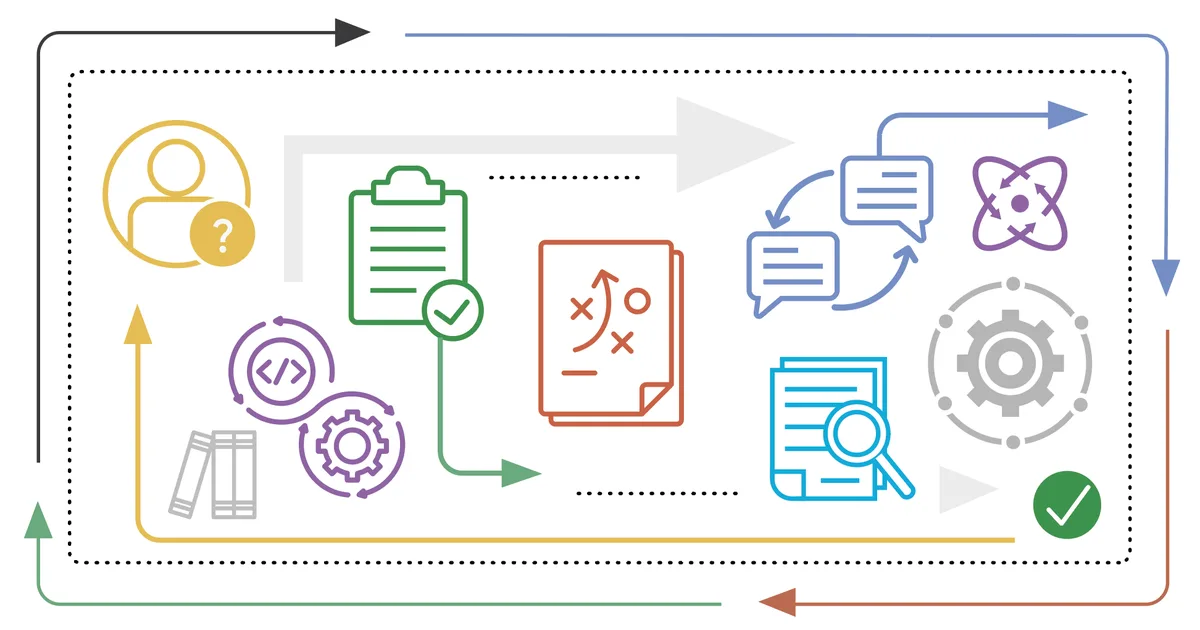
English(EN)Unlocking dependable responses with Gemini Enterprise Agent Platform’s Agentic RAG
AI 代理通过新的 RAG、模拟和合规性工具取得进展
作者PulseAugur 编辑部·[970 个来源]·
研究人员正在开发先进的代理框架,以提高各种领域的 AI 可靠性和效率。Google 推出了 agentic RAG 系统,通过迭代搜索完整上下文来增强企业查询处理能力,准确率最高可提高 34%。Hugging Face 使用一个小型 3B 模型演示了多代理经济模拟,突显了模型大小与实时性能之间的权衡。其他研究探索了可靠的工具使用方法、通过代理间协议实现的监管合规性、代理行为的动态基准测试以及 AI 代理的稳健自我演化机制。
AI
/ Page-level: make tables full-width up to 1100px and centered / table { width: 85% !important; max-width: 1100px; margin: 0 auto; } Today we introduce Qwen3.7-Plus — a multimodal agent model that unifies vision and language into a single, versatile agent foundation. Building on …
arXiv:2606.18537v1 Announce Type: new Abstract: Humans often acquire new skills by observing others, since observed behaviors implicitly reveal how to act in an environment. However, observations drawn from a heterogeneous population introduce conflicting behavioral signals, maki…
arXiv cs.CL
TIER_1English(EN)·Shuang Xie, Yunan Lu, Han Li, Lingyun Wang·
arXiv:2606.18668v1 Announce Type: cross Abstract: In large-scale enterprise settings, centralized multi-agent systems (MAS) are increasingly adopted, in which a coordinator delegates user requests to lightweight, domain-specialized sub-agents. While this architecture improves mod…
arXiv cs.CL
TIER_1English(EN)·Leyang Shen, Yang Zhang, Xiaoyan Zhao, Chun Kai Ling, Tat-Seng Chua·
arXiv:2606.19308v1 Announce Type: new Abstract: Large language model (LLM)-based multi-agent systems (MAS) have demonstrated great potential in solving tasks with execution complexity, by distributing subtasks across cooperative agents. However, this divide-and-conquer paradigm f…
arXiv:2606.18502v1 Announce Type: new Abstract: Large language model (LLM)-based multi-agent systems demonstrate strong performance on complex reasoning and task execution, enabling broad enterprise applications. However, production deployment remains challenging due to domain-sp…
arXiv cs.CL
TIER_1(CA)·Ziyan Jiang, Li An, Yujian Liu, Jiabao Ji, Qiucheng Wu, Jacob Andreas, Yang Zhang, Shiyu Chang·
arXiv:2606.18448v1 Announce Type: new Abstract: Computer-use agents (CUAs) approach human-level performance on standardised benchmarks but still struggle on long-horizon tasks and unseen software. Existing skill libraries address this with reusable skills, but represent the skill…
arXiv:2506.09046v3 Announce Type: replace-cross Abstract: Leveraging multiple Large Language Models (LLMs) has proven effective for addressing complex, high-dimensional tasks, but current approaches often rely on static, manually engineered multi-agent configurations. To overcome…
arXiv:2603.00656v2 Announce Type: replace Abstract: Real-world user requests to LLM agents are often underspecified. Agents must interact to acquire missing information and make correct downstream decisions. However, current multi-turn GRPO-based methods often rely on trajectory-…
arXiv:2510.05107v5 Announce Type: replace Abstract: The central challenge for AI agents is not only performance but accountability. Agents that act through opaque prompt sequences may produce correct outputs, but they provide little basis for verifying why an action was permitted…
arXiv:2606.19135v1 Announce Type: cross Abstract: As large language models (LLMs) advance and multi-agent systems aim to overcome the limits of standalone agents, robust communication protocols are becoming essential infrastructure for distributed agent networks. Nonetheless, the…
arXiv:2606.18976v1 Announce Type: cross Abstract: Automated assessment in software engineering education has advanced significantly for code grading and essay scoring. However, reviewing software architecture deliverables, which requires analyzing structural completeness and requ…
arXiv:2606.18837v1 Announce Type: cross Abstract: Large Language Model (LLM)-based automatic Multi-Agent Systems (MAS) generation has become a crucial frontier for tackling complex tasks. However, existing methods face a dilemma between model capability and experience retention. …
arXiv cs.AI
TIER_1English(EN)·Haoyang Fang, Wei Zhu, Boran Han, Alex Zhang, Zhenyu Pan, Shuo Yang, Shuai Zhang, Jiading Gai, Peng Tang, Cuixiong Hu, Xuan Zhu, Huzefa Rangwala, George Karypis, Bernie Wang·
arXiv:2606.18388v1 Announce Type: cross Abstract: RL post-training strategies are dataset-dependent and reveal a recurring empirical pattern: capacity parameters accumulate monotonically across stages, while regularization parameters predominantly oscillate in response to shiftin…
arXiv cs.AI
TIER_1English(EN)·Eranga Bandara, Ross Gore, Ravi Mukkamala, Asanga Gunaratna, Safdar H. Bouk, Xueping Liang, Peter Foytik, Abdul Rahman, Sachini Rajapakse, Isurunima Kularathna, Pramoda Karunarathna, Chalani Rajapakse, Ng Wee Keong, Kasun De Zoysa, Tharaka Hewa, Amin Has…·
arXiv:2606.19116v1 Announce Type: new Abstract: The World Wide Web was built on an assumption held for three decades: the primary consumer of web content is a human being. This permeates every layer; its access model presumes human visitors, its economics rest on human attention,…
arXiv:2606.19047v1 Announce Type: new Abstract: Multi-turn tool-use RL is bottlenecked by the rapid depletion of informative samples in static datasets. We observe that the gradient signal in GRPO concentrates on tasks with the highest rollout reward variance, a consequence of th…
arXiv:2606.18847v1 Announce Type: new Abstract: To assist humans over extended periods in real homes, embodied agents must remember user routines, world states, and past interactions. Existing long-term memory benchmarks mainly evaluate language-centric retrieval and question ans…
arXiv:2606.18890v1 Announce Type: new Abstract: Improving GUI agents typically relies on behavior cloning on expert trajectories. However, as the current policy deviates from the expert policy, it inevitably encounters policy-induced off-trajectory states during closed-loop execu…
Large language model (LLM)-based multi-agent systems (MAS) have demonstrated great potential in solving tasks with execution complexity, by distributing subtasks across cooperative agents. However, this divide-and-conquer paradigm falls short on decision-making tasks that are als…
Large language model (LLM)-based multi-agent systems (MAS) have demonstrated great potential in solving tasks with execution complexity, by distributing subtasks across cooperative agents. However, this divide-and-conquer paradigm falls short on decision-making tasks that are als…
As large language models (LLMs) advance and multi-agent systems aim to overcome the limits of standalone agents, robust communication protocols are becoming essential infrastructure for distributed agent networks. Nonetheless, the fragmented protocol landscape presents a signific…
The World Wide Web was built on an assumption held for three decades: the primary consumer of web content is a human being. This permeates every layer; its access model presumes human visitors, its economics rest on human attention, and its content targets human perception. The r…
The World Wide Web was built on an assumption held for three decades: the primary consumer of web content is a human being. This permeates every layer; its access model presumes human visitors, its economics rest on human attention, and its content targets human perception. The r…
Multi-turn tool-use RL is bottlenecked by the rapid depletion of informative samples in static datasets. We observe that the gradient signal in GRPO concentrates on tasks with the highest rollout reward variance, a consequence of the Popoviciu upper bound. Consequently, samples n…
Automated assessment in software engineering education has advanced significantly for code grading and essay scoring. However, reviewing software architecture deliverables, which requires analyzing structural completeness and requirements traceability, has not yet been fully auto…
Production LLM agents increasingly depend on real-time search, yet native search grounding bundles retrieval policy, provider choice, evidence injection, cost, latency, and generation behavior behind a single model-provider boundary. This coupling makes grounding hard to inspect,…
Improving GUI agents typically relies on behavior cloning on expert trajectories. However, as the current policy deviates from the expert policy, it inevitably encounters policy-induced off-trajectory states during closed-loop execution, i.e., states that fall outside the expert …
To assist humans over extended periods in real homes, embodied agents must remember user routines, world states, and past interactions. Existing long-term memory benchmarks mainly evaluate language-centric retrieval and question answering, while embodied benchmarks often focus on…
Large Language Model (LLM)-based automatic Multi-Agent Systems (MAS) generation has become a crucial frontier for tackling complex tasks. However, existing methods face a dilemma between model capability and experience retention. Inference-time MAS leverages frozen frontier LLMs …
In large-scale enterprise settings, centralized multi-agent systems (MAS) are increasingly adopted, in which a coordinator delegates user requests to lightweight, domain-specialized sub-agents. While this architecture improves modularity, scalability, and cost efficiency, its rel…
In large-scale enterprise settings, centralized multi-agent systems (MAS) are increasingly adopted, in which a coordinator delegates user requests to lightweight, domain-specialized sub-agents. While this architecture improves modularity, scalability, and cost efficiency, its rel…
arXiv:2606.18051v1 Announce Type: new Abstract: LLM agents increasingly rely on external skills -- reusable tool specifications -- but real-world tasks often require composing multiple skills, not just selecting one. We formalize this as the Compositional Skill Routing problem: g…
arXiv cs.CL
TIER_1English(EN)·Tongxu Luo, Rongsheng Wang, Jiaxi Bi, Chenming Xu, Zhengyang Tang, Jianlong Chen, Juhao Liang, Ke Ji, Shuqi Guo, Yuhao Du, Fan Bu, Wenyu Du, Xiaotong Zhang, Kyle Li, Shaobo Wang, Linfeng Zhang, Yuxuan Liu, Xin Lai, Chenxin Li, Yiduo Guo, Zhexin Zhang, Xi…·
arXiv:2606.17861v1 Announce Type: new Abstract: Game generation is an emerging application of coding agents, requiring models to transform natural-language specifications into playable interactive systems. Unlike traditional coding tasks, game generation takes place within a game…
arXiv:2606.17838v1 Announce Type: new Abstract: LLM agents in interactive environments are highly sensitive to their prompts, yet prompt engineering remains a manual, task-specific process. We introduce an automated prompt optimization framework for LLM agents that decomposes the…
arXiv:2606.17682v1 Announce Type: new Abstract: Reinforcement learning pipelines for Large Language Model (LLM) training often rely on manually redesigned environments between stages, requiring practitioners to heuristically infer which configuration will best improve the current…
arXiv:2606.17628v1 Announce Type: new Abstract: Memory has become a standard substrate for self-evolving agents, yet retaining experience is not the same as learning how to evolve through it. Existing memory agents can store trajectories, retrieve reflections, or accumulate skill…
arXiv:2605.12729v2 Announce Type: replace-cross Abstract: Large language models are increasingly being used to support network operations (NetOps) and artificial intelligence for IT operations (AIOps), including incident investigation, root-cause analysis, configuration synthesis…
arXiv cs.AI
TIER_1English(EN)·Xiaojun Jia, Jie Liao, Simeng Qin, Jindong Gu, Wenqi Ren, Xiaochun Cao, Yang Liu, Philip Torr·
arXiv:2602.14211v3 Announce Type: replace-cross Abstract: Agent skills extend LLM agents with task-specific instructions, executable scripts, and auxiliary resources, improving reusability but creating a new supply-chain attack surface. A malicious or compromised skill can be rep…
arXiv cs.AI
TIER_1English(EN)·Ankita Samaddar, Sandeep Neema, Daniel Balasubramanian, Xenofon Koutsoukos·
arXiv:2606.17819v1 Announce Type: cross Abstract: Agent skills -- structured, reusable knowledge artifacts that augment LLM agent capabilities -- have been rapidly adopted in industry, yet their cross-domain impact and use across commercial and open-source models remain under-stu…
arXiv cs.AI
TIER_1English(EN)·Ander Alvarez, Santhiya Rajan, Samuel Mugel, Rom\'an Or\'us·
arXiv:2606.18037v1 Announce Type: new Abstract: Tool-using LLM agents increasingly use the Model Context Protocol (MCP) to answer from heterogeneous evidence sources, including search, APIs, databases, clinical records, and formulary tools. Standard factuality metrics usually tes…
arXiv:2606.17929v1 Announce Type: new Abstract: Computer-using agents drive real software through the screen -- clicking and typing -- but they solve every task from scratch: asked to repeat a task, an agent re-reads the screen, re-reasons every tap, and pays the full cost again.…
arXiv cs.AI
TIER_1English(EN)·Congjie Zheng, Chuanyi Xue, Bin Liang, Jun Yang, Changshui Zhang·
arXiv:2606.17546v1 Announce Type: new Abstract: Self-evolving LLM-based agents improve mainly by changing their agent harness: the structured execution layer around a base model, including prompts, memory, tools, middleware, runtime state, and the model-tool interaction loop. Exi…
arXiv cs.AI
TIER_1English(EN)·Gaurav Gupta, Vatshank Chaturvedi, Jun Huan, Anoop Deoras·
arXiv:2606.17454v1 Announce Type: new Abstract: AI agent performance is not just a modeling problem, it is fundamentally a systems problem. The advanced capabilities of models are realized through agent harnesses. Therefore, a gap between model assumptions and harness behavior ca…
arXiv cs.AI
TIER_1English(EN)·Shengli Zhang, Deen Ma, Zibin Lin, Taotao Wang·
arXiv:2606.17368v1 Announce Type: new Abstract: Large language models have accelerated the transition from passive conversational assistants to autonomous agents that can understand goals, plan actions, invoke tools, and execute multi-step tasks. Yet the capability of a single ag…
arXiv:2606.17209v1 Announce Type: new Abstract: Test-time scaling for agentic search typically increases depth (i.e., more turns and tokens per trajectory) or breadth (i.e., more parallel rollouts). Here we focus on breadth scaling, showing that standard parallel sampling yields …
Effective programming education requires personalized instruction adapted to diverse learner backgrounds. However, while LLM-based multi-agent systems (MAS) excel at complex planning, existing planners often lack profile-grounding and pedagogical scaffolding, thereby undermining …
RODS addresses sample depletion in multi-turn tool-use reinforcement learning by dynamically synthesizing new data based on reward variance to maintain informative training samples.
Large language model (LLM)-based multi-agent systems demonstrate strong performance on complex reasoning and task execution, enabling broad enterprise applications. However, production deployment remains challenging due to domain-specific customization requirements and high laten…
Computer-use agents (CUAs) approach human-level performance on standardised benchmarks but still struggle on long-horizon tasks and unseen software. Existing skill libraries address this with reusable skills, but represent the skill artifact as text only, despite the visual natur…
RL post-training strategies are dataset-dependent and reveal a recurring empirical pattern: capacity parameters accumulate monotonically across stages, while regularization parameters predominantly oscillate in response to shifting training dynamics. This distinction matters beca…
With sophisticated cyber-attacks becoming increasingly prevalent, modern networks require intelligent autonomous cyber-defense agents trained via Reinforcement Learning (RL). These agents employ neurosymbolic approaches such as behavior trees with learning-enabled components (LEC…
LLM agents increasingly rely on external skills -- reusable tool specifications -- but real-world tasks often require composing multiple skills, not just selecting one. We formalize this as the Compositional Skill Routing problem: given a complex user query and a large skill libr…
Tool-using LLM agents increasingly use the Model Context Protocol (MCP) to answer from heterogeneous evidence sources, including search, APIs, databases, clinical records, and formulary tools. Standard factuality metrics usually test whether an answer is supported by pooled evide…
Computer-using agents drive real software through the screen -- clicking and typing -- but they solve every task from scratch: asked to repeat a task, an agent re-reads the screen, re-reasons every tap, and pays the full cost again. We present PreAct, which lets such an agent get…
Game generation is an emerging application of coding agents, requiring models to transform natural-language specifications into playable interactive systems. Unlike traditional coding tasks, game generation takes place within a game engine, where scripts, scenes, assets, renderin…
LLM agents in interactive environments are highly sensitive to their prompts, yet prompt engineering remains a manual, task-specific process. We introduce an automated prompt optimization framework for LLM agents that decomposes the observation-to-action pipeline into a goal-cond…
Agent skills -- structured, reusable knowledge artifacts that augment LLM agent capabilities -- have been rapidly adopted in industry, yet their cross-domain impact and use across commercial and open-source models remain under-studied, and no reusable methodology exists for evalu…
Reinforcement learning pipelines for Large Language Model (LLM) training often rely on manually redesigned environments between stages, requiring practitioners to heuristically infer which configuration will best improve the current policy. To automate this process, we propose th…
Memory has become a standard substrate for self-evolving agents, yet retaining experience is not the same as learning how to evolve through it. Existing memory agents can store trajectories, retrieve reflections, or accumulate skills, but often lack the holistic competence to sel…
arXiv cs.AI
TIER_1English(EN)·Wasi Uddin Ahmad, Nikolai Ludwig, Somshubra Majumdar, Boris Ginsburg·
arXiv:2606.16038v1 Announce Type: cross Abstract: The path toward autonomous software engineering is currently bottlenecked by a severe deficit of diverse, large-scale trajectory data. We address this by introducing \ourdataset, an expansive dataset of 207,489 agentic trajectorie…
arXiv:2606.14945v1 Announce Type: new Abstract: The autoresearch pattern enables autonomous experimentation by having a large language model (LLM) iteratively modify code to optimize a target metric. Its stateless design, however, reconstructs experimental context from scratch at…
arXiv cs.CL
TIER_1English(EN)·Lawrence Keunho Jang, Andrew Keunwoo Jang, Jing Yu Koh, Ruslan Salakhutdinov·
arXiv:2606.16748v1 Announce Type: cross Abstract: Current benchmarks for computer-use agents evaluate models in impersonal environments. This leaves a gap between evaluation and deployment where personal assistants are expected to work across a user's whole digital life, includin…
arXiv:2606.16295v1 Announce Type: cross Abstract: Vision language models are serving as general-purpose interfaces for complex multimodal tasks. However, deployment still faces three gaps: VLMs typically incur high latency and cost when processing dense video frames and long prom…
arXiv:2606.17053v1 Announce Type: new Abstract: Large language models (LLMs) often fail when answering requires identifying a small but decisive piece of evidence within a long or complex context, such as a single line in a tool trace or a subtle detail in an image. We propose Co…
arXiv:2606.16591v1 Announce Type: new Abstract: Large language model (LLM) agents increasingly rely on agent harnesses that manage context, tools, and multi-turn execution, making tools a central interface for acting in realistic digital environments. As harness-connected tool ec…
arXiv:2606.16576v1 Announce Type: new Abstract: We propose agentic automata learning to evaluate the extent to which tool-calling LLM agents can uncover hidden environments through interaction. In our setup, an agent should uncover a hidden deterministic finite automaton (DFA) by…
arXiv:2606.16523v1 Announce Type: new Abstract: While knowledge is managed through Wikipedia and software through GitHub, agent skills still lack an infrastructure for large-scale production, governance, and evolution. SkillWiki is a living knowledge infrastructure that supports …
arXiv:2606.16111v1 Announce Type: new Abstract: Recent advances in tool-integrated language agents have significantly improved their ability to solve complex reasoning tasks. However, existing alignment methods predominantly focus on maximizing task accuracy, while overlooking au…
arXiv:2606.16000v1 Announce Type: new Abstract: We introduce GRACE-DS, a Guarded Reward-guided Agent Correction Environment in Data Science for pre-deployment evaluation of LLM-powered AutoML agents. GRACE-DS is a set of evaluation metrics in an isolated environment that can be a…
arXiv cs.CL
TIER_1English(EN)·Sina Hajimiri, Masih Aminbeidokhti, Jose Dolz, Ismail Ben Ayed, Issam H. Laradji, Spandana Gella, Nicolas Gontier·
arXiv:2606.15017v1 Announce Type: new Abstract: Online web agents often augment a base actor with memory, workflow, or skill modules. These modules can improve performance, but they also consume test-time tokens, a cost rarely reported alongside the actor's inference cost. We stu…
arXiv cs.AI
TIER_1English(EN)·Hongyi Liu, Haoyan Yang, Tao Jiang, Bo Tang, Feiyu Xiong, Yuyu Luo, Zhiyu Li·
arXiv:2605.18401v2 Announce Type: replace-cross Abstract: Long-horizon LLM agents generate traces that could become reusable experience, but raw trajectories are noisy, local, and hard to govern. Agent Skills offer a structured artifact for combining procedural guidance, executab…
arXiv:2605.11047v2 Announce Type: replace-cross Abstract: Agentic language-model systems increasingly rely on mutable execution contexts, including files, memory, tools, skills, and auxiliary artifacts, creating security risks beyond explicit user prompts. This paper presents Dee…
arXiv cs.AI
TIER_1English(EN)·Yifan Sui, Han Zhao, Rui Ma, Zhiyuan He, Hao Wang, Jianxun Li, Kaiqiang Xu, Kai Chen, Yuqing Yang·
arXiv:2603.18897v2 Announce Type: replace-cross Abstract: LLM-powered agents execute tasks through a sequential loop of model generation and tool execution. Today's serving systems serialize this loop, leaving tool latency exposed on the task critical path. This paper presents PA…
arXiv cs.AI
TIER_1English(EN)·Wei Gao, Yuheng Zhao, Tianyuan Wu, Shaopan Xiong, Weixun Wang, Dakai An, Lunxi Cao, Dilxat Muhtar, Zichen Liu, Haizhou Zhao, Ju Huang, Siran Yang, Yongbin Li, Wenbo Su, Jiamang Wang, Lin Qu, Bo Zheng, Wei Wang·
arXiv:2510.06445v3 Announce Type: replace-cross Abstract: LLM-based agents are now used throughout cybersecurity. While these agents facilitate powerful and autonomous security applications, their autonomy opens up new attack surfaces, and the security community is actively build…
arXiv cs.AI
TIER_1Deutsch(DE)·Shawn Li, Chenxiao Yu, Han Wang, Wei Yang, Ryan Rossi, Franck Dernoncourt, Xiyang Hu, Philip Yu, Chaowei Xiao, Huan Zhang, Yue Zhao·
arXiv:2605.09163v3 Announce Type: replace Abstract: Large language model agents increasingly operate through an intermediate skill layer that mediates between user intent and concrete task execution. This layer is widely treated as an organizational abstraction, but we argue it i…
arXiv:2602.12670v4 Announce Type: replace Abstract: Agent Skills are structured packages of procedural knowledge that augment large language model (LLM) agents at inference time. Despite rapid adoption, there is no standard way to measure whether they actually help. We present Sk…
arXiv:2509.21862v3 Announce Type: replace Abstract: How collective behaviors emerge from the interactions of individual LLM-driven agents is a central question in artificial life, yet controlled study of these emergent dynamics has been hindered by the lack of a principled simula…
arXiv:2606.17016v1 Announce Type: cross Abstract: As LLM agents are deployed in long-horizon sessions, context accumulation drives up inference costs. Existing approaches utilize text pruning or dynamic memory eviction to minimize token footprints; however, their unconstrained se…
arXiv:2606.16603v1 Announce Type: cross Abstract: LLM-based agents have demonstrated strong capabilities in data-intensive analytical tasks, yet their outputs are rarely verifiable: a reliance on linear text trajectories makes their reasoning difficult to audit. In particular, de…
arXiv:2606.16215v1 Announce Type: cross Abstract: Multi-turn tool-use agents must reason, call tools, and adapt to observations across several interaction turns. Post-training such agents is challenging, as reinforcement learning often suffers from sparse rewards and weak credit …
arXiv:2606.15390v1 Announce Type: cross Abstract: LLM agents can improve without weight updates by accumulating natural-language skills from experience, but current systems entrust every decision about which skills to keep and how to apply them to LLM judgment alone. We argue tha…
arXiv:2606.15376v1 Announce Type: cross Abstract: Multi-agent LLM systems -- coding agents, devops agents, document agents -- now routinely run several agents in parallel against the same git tree, Kubernetes cluster, or document. As soon as two of them mutate shared state, they …
arXiv:2606.15057v1 Announce Type: cross Abstract: Indirect prompt injection (IPI) is a major security threat to LLM-powered agents. Thus, a growing body of work have proposed a variety of defensive approaches against IPI. These can be grouped into three broad categories: 1) promp…
arXiv cs.AI
TIER_1English(EN)·Kirill Vasilevski (Justina), Ximing Dong (Justina), Benjamin Rombaut (Justina), Ruochen Deng (Justina), Jiahuei Lin (Justina), Arthur Leung, Dayi Lin, Boyuan Chen, Shaowei Wang, Ahmed E. Hassan·
arXiv:2606.14948v1 Announce Type: cross Abstract: LLMs have substantially improved software engineering yet real-world development requires architectural understanding. Such understanding is prohibitively expensive to label manually and impossible to verify through tests alone. W…
arXiv cs.AI
TIER_1English(EN)·Andoni Rodr\'iguez, Alberto Pozanco, Daniel Borrajo·
arXiv:2606.14831v1 Announce Type: cross Abstract: This paper presents and characterizes a spectrum of previously unreported behaviours we term Constraint-Evasive Fabrication (CEF): when an LLM agent operates under irreconcilable constraints (where no response can simultaneously s…
arXiv cs.AI
TIER_1English(EN)·Dong Ho Kang, Hyeonjeong Cha, Daein Weon·
arXiv:2606.14805v1 Announce Type: cross Abstract: Reliable operation of multi-agent large language model (LLM) systems depends on debugging long execution traces, where the few causally decisive events are buried in unstructured logs of messages, routes, memory writes, and tool c…
arXiv cs.AI
TIER_1English(EN)·Hanqi Li, Jing Peng, Zijian Wang, Lu Chen, Kai Yu·
arXiv:2606.14790v1 Announce Type: cross Abstract: LLM-based multi-agent systems increasingly coordinate planning, reasoning, tool use, and human interaction, yet their reliability remains limited. A central source of this limitation is the underspecified prompt--harness boundary.…
arXiv:2606.14778v1 Announce Type: cross Abstract: Long-term action anticipation (LTA) aims to predict an ordered sequence of future verb-noun actions from a partially observed video. While this task serves as the foundation for embodied intelligence, anticipating physically feasi…
arXiv:2606.16813v1 Announce Type: new Abstract: Tool-augmented LLM agents rely on runtime filtering to decide which tools should be visible at each step. Causal Minimal Tool Filtering (CMTF) reduces tool-choice confusion by exposing only the next causally necessary tool frontier,…
arXiv:2606.16769v1 Announce Type: new Abstract: Agent skills are commonly distributed as SKILL.md files: human-readable procedural documents that describe workflows, tools, resources, and domain conventions. While convenient for inspection and reuse, this design requires the same…
arXiv:2606.16613v1 Announce Type: new Abstract: As LLM agents become capable of increasingly long-horizon tasks, evaluating their performance in economic systems is becoming increasingly important. Unlike existing benchmarks that primarily evaluate a single agent interacting with…
arXiv:2606.16364v1 Announce Type: new Abstract: LLM agents mis-call tools, and the natural guess is that the model failed to see the right tool in a crowded harness. We show the opposite through a lens concurrent work sets aside -- the model's attention to labeled tool-definition…
arXiv:2606.16328v1 Announce Type: new Abstract: Large Language Models (LLMs) demonstrate remarkable potential in dynamic graph reasoning, but suffer from a scaling bottleneck: current models can only handle graphs with tens of nodes, constrained by exponential reasoning overhead …
arXiv:2606.16307v1 Announce Type: new Abstract: Training tool-augmented LLM agents requires large corpora of multi-turn, tool-grounded conversational data that is expensive to annotate, privacy-constrained in production settings, and largely absent from public datasets. We presen…
arXiv:2606.15874v1 Announce Type: new Abstract: Every major LLM agent framework gives the LLM the role of orchestrator; the model decides what to do next, when to call tools, and when to stop. We argue that token explosion, control-flow hallucination, and unreliable completion ar…
arXiv:2606.15797v1 Announce Type: new Abstract: Compilation-based techniques represent an important stream of solvers for multi-agent path finding (MAPF) due to their modularity and adaptability for non-standard variants of the problem. While in the standard MAPF the task is to n…
arXiv cs.AI
TIER_1English(EN)·Juheon Yi, Jinglu Wang, Xiaoyi Zhang, Yan Lu·
arXiv:2606.15684v1 Announce Type: new Abstract: We present TickingCollabBench, a Minecraft-based multi-agent benchmark for a novel class of time-sensitive complementary collaboration tasks. Our benchmark reflects four core characteristics of real-world collaboration: agent hetero…
arXiv:2606.15673v1 Announce Type: new Abstract: Web agents act through long interaction sequences, yet existing benchmarks evaluate only terminal success, discarding all process information and offering little guidance on improvement. In this work, we conduct a process-level anal…
arXiv:2606.15579v1 Announce Type: new Abstract: We propose Base Sequence Analysis, a framework that encodes the runtime behavior of LLM-powered autonomous agents into compact symbolic sequences using a four-letter alphabet: X (Explore), E (Execute), P (Plan), and V (Verify). Draw…
arXiv:2606.15508v1 Announce Type: new Abstract: Tool-augmented large language model agents increasingly operate over large tool libraries, but existing evaluations often focus on whether a model can call a tool correctly rather than how the visible tool menu shapes reliability, e…
arXiv cs.AI
TIER_1English(EN)·Sanhorn Chen, Xiaoyang Chen, Boyu Liu, Roy Zhao·
arXiv:2606.15107v1 Announce Type: new Abstract: Time series data in real-world deployments is overwhelmingly irregular. Observations are asynchronous, missing values are informative rather than random, and sampling frequencies vary across sensors and operational windows. However,…
arXiv:2606.14935v1 Announce Type: new Abstract: Frontier reasoning-tuned language models still fail on deductive tasks at depth, and the cost of improved performance through extended internal reasoning scales poorly. Symbolic delegation offers a complementary route: a language mo…
A framework automates environment redesign in reinforcement learning for large language models by having the policy analyze failures and suggest configuration changes, achieving superior performance over larger proprietary models and fixed-environment baselines.
End-to-end game generation presents significant challenges for coding agents, requiring them to create complete playable games from natural language descriptions while meeting specific evaluation criteria for engine grounding, artifact completeness, and interactive verification.
OPD-Evolver is a self-evolving agent framework that combines slow-fast co-evolution with on-policy self-distillation to enhance memory management and policy learning across multiple domains.
Test-time scaling for agentic search typically increases depth (i.e., more turns and tokens per trajectory) or breadth (i.e., more parallel rollouts). Here we focus on breadth scaling, showing that standard parallel sampling yields diminishing returns, tracing this to query redun…
As LLM agents are deployed in long-horizon sessions, context accumulation drives up inference costs. Existing approaches utilize text pruning or dynamic memory eviction to minimize token footprints; however, their unconstrained sequence mutations alter layouts, introducing prefix…
Tool-augmented LLM agents rely on runtime filtering to decide which tools should be visible at each step. Causal Minimal Tool Filtering (CMTF) reduces tool-choice confusion by exposing only the next causally necessary tool frontier, but it assumes that the user request has alread…
Agent skills are commonly distributed as SKILL.md files: human-readable procedural documents that describe workflows, tools, resources, and domain conventions. While convenient for inspection and reuse, this design requires the same reusable procedure to be repeatedly injected in…
Current benchmarks for computer-use agents evaluate models in impersonal environments. This leaves a gap between evaluation and deployment where personal assistants are expected to work across a user's whole digital life, including their context, historical data, and logged-in ac…
As LLM agents become capable of increasingly long-horizon tasks, evaluating their performance in economic systems is becoming increasingly important. Unlike existing benchmarks that primarily evaluate a single agent interacting with a passive environment, economic systems are inh…
LLM-based agents have demonstrated strong capabilities in data-intensive analytical tasks, yet their outputs are rarely verifiable: a reliance on linear text trajectories makes their reasoning difficult to audit. In particular, deterministic computations over raw data and semanti…
Large language model (LLM) agents increasingly rely on agent harnesses that manage context, tools, and multi-turn execution, making tools a central interface for acting in realistic digital environments. As harness-connected tool ecosystems expand to hundreds or thousands of APIs…
We propose agentic automata learning to evaluate the extent to which tool-calling LLM agents can uncover hidden environments through interaction. In our setup, an agent should uncover a hidden deterministic finite automaton (DFA) by interacting with an oracle through (1) membersh…
While knowledge is managed through Wikipedia and software through GitHub, agent skills still lack an infrastructure for large-scale production, governance, and evolution. SkillWiki is a living knowledge infrastructure that supports the organization, grounding, and continuous evol…
Training tool-augmented LLM agents requires large corpora of multi-turn, tool-grounded conversational data that is expensive to annotate, privacy-constrained in production settings, and largely absent from public datasets. We present StateGen, a synthetic data generation platform…
Multi-turn tool-use agents must reason, call tools, and adapt to observations across several interaction turns. Post-training such agents is challenging, as reinforcement learning often suffers from sparse rewards and weak credit assignment despite matching the prompt-only infere…
arXiv:2606.13715v1 Announce Type: new Abstract: The best agent on WorkBench in March 2024, GPT-4, completed 43% of tasks and took an unintended harmful action, such as emailing the wrong person, on 26% of them. We re-visit the benchmark in June 2026 and find that the best agent t…
arXiv cs.CL
TIER_1English(EN)·Kang Zhou, Sangmin Woo, Haibo Ding, Kiran Ramnath, Subramanian Chidambaram, Aosong Feng, Vinayak Arannil, Muhyun Kim, Ishan Singh, Darren Wang, Zhichao Xu, Megha Gandhi, Nirmal Prabhu, Soumya Smruti Mishra, Vivek Singh, Gouri Pandeshwar, Lin Lee Cheong·
arXiv:2605.11378v2 Announce Type: replace Abstract: Agent evaluation requires assessing complex multi-step behaviors involving tool use and intermediate reasoning, making it costly and expertise-intensive. A natural question arises: can frontier coding assistants reliably automat…
arXiv:2606.14155v1 Announce Type: cross Abstract: Context adaptation automates prompt engineering in LLM-based systems by iteratively revising tunable prompts from task feedback, without modifying model weights. Extending this paradigm to multi-LLM agentic systems is crucial: exi…
arXiv cs.CL
TIER_1English(EN)·Jixuan Chen, Jianzhi Shen, Haoqiang Kang, Zhi Hong, Qingyi Jiang, Soham Bose, Yiming Zhang, Leon Leng, Amit Vyas, Lingjun Mao, Siru Ouyang, Kun Zhou, Lianhui Qin·
arXiv:2606.14674v1 Announce Type: new Abstract: LLM agents are increasingly built not as single model calls, but as scaffolded systems that combine reasoning, memory, reflection, action execution, and learning. While such scaffolds often improve performance, they are often embedd…
arXiv cs.CL
TIER_1English(EN)·Xinbei Ma, Congmin Zheng, Jiyang Qiu, Jiale Hong, Yao Yao, Xiangmou Qu, Jiaxin Yin, Xingyu Lou, Jun Wang, Weiwen Liu, Weinan Zhang, Zhuosheng Zhang, Hai Zhao·
arXiv:2606.14302v1 Announce Type: new Abstract: LLM-based agents trained with reinforcement learning optimize step-wise action prediction but lack metacognitive awareness of task progress, inducing a gap that hinders long-horizon scaling. A pilot study reveals that online progres…
arXiv cs.CL
TIER_1English(EN)·Md Amirul Islam, Sumiran Thakur, Huancheng Chen, Su Min Park, Jiayun Wang, Gyuhak Kim·
arXiv:2606.14179v1 Announce Type: new Abstract: We present CacheRL, a system for training small agent foundation models that achieves 92 percent process accuracy on multi-step tool-calling tasks, approaching GPT-5's 94 percent while requiring 100 times less compute. Our approach …
arXiv cs.AI
TIER_1English(EN)·Rui Ye, Keduan Huang, Qimin Wu, Yuzhu Cai, Tian Jin, Xianghe Pang, Xiangrui Liu, Jiaqi Su, Chen Qian, Bohan Tang, Kaiqu Liang, Jiaao Chen, Yue Hu, Zhenfei Yin, Rongye Shi, Bo An, Yang Gao, Wenjun Wu, Lei Bai, Siheng Chen·
arXiv:2505.16988v2 Announce Type: replace-cross Abstract: LLM-based multi-agent systems (MAS) have demonstrated significant potential in enhancing single LLMs to address complex and diverse tasks in practical applications. Despite considerable advancements, the field lacks a unif…
arXiv:2606.14445v1 Announce Type: cross Abstract: Existing multi-agent software development systems have proposed many forms of agent collaboration, including role-based collaboration and automated code review. However, many systems assume a common runtime, a central conversation…
arXiv cs.AI
TIER_1English(EN)·Rui Melo, Riccardo Fogliato, Sean Zhou, Pratiksha Thaker, Zhiwei Steven Wu·
arXiv:2606.13757v1 Announce Type: cross Abstract: Large language model (LLM) reviewers are increasingly used in pull-request (PR) workflows, where their approvals help decide which code is merged into a repository. This raises a question that benchmarks for static vulnerability d…
arXiv cs.AI
TIER_1English(EN)·Shikun Liu, Mufei Li, Dongqi Fu, Haoyu Wang, Yinglong Xia, Hong Li, Hong Yan, Pan Li·
arXiv:2606.14672v1 Announce Type: new Abstract: Large language models increasingly serve as execution engines for agentic systems, yet they still consume context through a sequential text interface. This creates a mismatch with modern structured agent workflows, in which independ…
arXiv:2606.14476v1 Announce Type: new Abstract: A growing line of work equips large language model (LLM) agents with graph neural networks (GNNs) as callable tools, assuming the agent exercises judgment over when and how much to rely on such a tool. We test this directly. We expo…
arXiv cs.AI
TIER_1English(EN)·Xinbei Ma, Jiyang Qiu, Yao Yao, Zheng Wu, Yijie Lu, Xiangmou Qu, Jiaxin Yin, Xingyu Lou, Jun Wang, Weiwen Liu, Weinan Zhang, Zhuosheng Zhang, Hai Zhao·
arXiv:2606.14314v1 Announce Type: new Abstract: LLM agents have rapidly evolved into autonomous systems, yet a persistent information gap remains between users and agents: communication is costly, while users' identical preferences further limit information exchange. To investiga…
arXiv:2606.14249v1 Announce Type: new Abstract: AI agent performance depends critically on the runtime harness, comprising the prompts, tools, memory, and control flow that mediate how a model observes, reasons, and acts. Yet today's harnesses remain largely hand-crafted and stat…
arXiv:2606.14211v1 Announce Type: new Abstract: LLMs are increasingly deployed as agents that interact with external environments and observe feedback such as execution results, error messages, and tool outputs. A well-functioning agent should be able to leverage this feedback to…
arXiv:2606.14200v1 Announce Type: new Abstract: Open platforms increasingly route tasks among heterogeneous LLM agents--differing in base model, scaffold, and tool stack--whose competence varies sharply by skill: an agent excellent at one skill may be useless at another. The stan…
arXiv cs.AI
TIER_1English(EN)·Theodore Meek, Siyuan Ge, Di Qiu Xiang, Simon Chess, Vasily Ilin·
arXiv:2606.14000v1 Announce Type: new Abstract: Recent work has demonstrated that coding agents can formalize entire advanced mathematics textbooks in Lean 4, yet existing efforts concentrate on branches of mathematics already well-represented in mathlib and measure success solel…
arXiv:2606.13884v1 Announce Type: new Abstract: Modern decision systems increasingly rely on learned components whose outputs may be confident yet wrong, exposing downstream actions to costly errors. We introduce Risk-Aware Causal Gating (RACG), a framework that decides whether t…
arXiv:2606.13707v1 Announce Type: new Abstract: The recent success of agent swarms has shifted the paradigm of large language model (LLM)-based agents from single-agent workflows to multi-agent systems, highlighting the importance of agent orchestration for task decomposition and…
arXiv:2606.13733v1 Announce Type: cross Abstract: Multi-agent systems (MAS) were expected to overcome the limitation of single-agent systems (SAS) through collaboration. However, under typicality conditions on the task's constraint graph and bounded inter-agent communication, we …
arXiv cs.LG
TIER_1English(EN)·Mykola Vysotskyi, Runqi Lin, Grzegorz Biziel, Michal Zakrzewski, Sebastian Montagna, Damian Rynczak, Shreyansh Padarha, Kumail Alhamoud, Zihao Fu, William Lugoloobi, Kai Rawal, Hanna Yershova, Xander Davies, Taras Rumezhak, Guohao Li, Fazl Barez, Baoyuan…·
arXiv:2606.14397v1 Announce Type: new Abstract: As agentic systems continue to evolve and are widely deployed in real-world scenarios, there is a growing demand to faithfully evaluate their capabilities. However, current benchmarks are typically built on popular applications with…
TokenPilot is a dual-granularity context management framework that reduces inference costs in long-horizon LLM sessions by stabilizing prompt prefixes and conservatively managing context segments.
MyPCBench evaluates computer-use agents as personal assistants in a simulated Linux desktop environment with real-world web applications, revealing that Claude Opus 4.6 achieves the highest task completion rate of 55.4% while struggles with multi-application tasks and long trajec…
VisualClaw is a self-evolving multimodal agent that reduces deployment costs through hybrid encoding and skill evolution while improving video-QA accuracy across multiple benchmarks.
Multi-agent LLM systems -- coding agents, devops agents, document agents -- now routinely run several agents in parallel against the same git tree, Kubernetes cluster, or document. As soon as two of them mutate shared state, they enter the regime classical concurrency control has…
LLM agents are increasingly built not as single model calls, but as scaffolded systems that combine reasoning, memory, reflection, action execution, and learning. While such scaffolds often improve performance, they are often embedded in tightly coupled pipelines, making it diffi…
Large language models increasingly serve as execution engines for agentic systems, yet they still consume context through a sequential text interface. This creates a mismatch with modern structured agent workflows, in which independent branches explore subtasks, retrieve evidence…
<p><i><span>This is the second in a series of research updates from the Google DeepMind Language Model Interpretability team, in interpretability and adjacent areas. The first post can be found </span></i><a href="https://www.lesswrong.com/posts/aTcsN5ZZDnMFJvRiG/models-may-behav…
A growing line of work equips large language model (LLM) agents with graph neural networks (GNNs) as callable tools, assuming the agent exercises judgment over when and how much to rely on such a tool. We test this directly. We expose a frozen GNN to a ReAct-style LLM agent as an…
Existing multi-agent software development systems have proposed many forms of agent collaboration, including role-based collaboration and automated code review. However, many systems assume a common runtime, a central conversation server, or the same API family. Under these assum…
As agentic systems continue to evolve and are widely deployed in real-world scenarios, there is a growing demand to faithfully evaluate their capabilities. However, current benchmarks are typically built on popular applications with relatively simple tasks and focus on a narrow s…
LLM agents have rapidly evolved into autonomous systems, yet a persistent information gap remains between users and agents: communication is costly, while users' identical preferences further limit information exchange. To investigate how agents should communicate across modaliti…
LLM-based agents trained with reinforcement learning optimize step-wise action prediction but lack metacognitive awareness of task progress, inducing a gap that hinders long-horizon scaling. A pilot study reveals that online progress prompting hurts performance while retrospectiv…
AI agent performance depends critically on the runtime harness, comprising the prompts, tools, memory, and control flow that mediate how a model observes, reasons, and acts. Yet today's harnesses remain largely hand-crafted and static: each new model or task still demands bespoke…
LLMs are increasingly deployed as agents that interact with external environments and observe feedback such as execution results, error messages, and tool outputs. A well-functioning agent should be able to leverage this feedback to accurately assess its own performance. Yet we f…
Open platforms increasingly route tasks among heterogeneous LLM agents--differing in base model, scaffold, and tool stack--whose competence varies sharply by skill: an agent excellent at one skill may be useless at another. The standard reputation approach summarizes each agent b…
We present CacheRL, a system for training small agent foundation models that achieves 92 percent process accuracy on multi-step tool-calling tasks, approaching GPT-5's 94 percent while requiring 100 times less compute. Our approach addresses three challenges in practical agent tr…
Context adaptation automates prompt engineering in LLM-based systems by iteratively revising tunable prompts from task feedback, without modifying model weights. Extending this paradigm to multi-LLM agentic systems is crucial: existing methods suffer from inaccurate credit assign…
arXiv cs.AI
TIER_1English(EN)·Longkun Hao, Hongyu Lin, Hao Li, Zhichao Yang, Haojie Hao, Dongshuo Huang, Haitao Yang, Hongyu Ge, Ming jie Xie, Yanjun Wu, Zi Hao Yin, Yan Bai, Yihang Lou·
arXiv:2606.12485v1 Announce Type: cross Abstract: Training interactive web agents through imitation learning from expert trajectories has emerged as a highly effective approach. However, determining the optimal timing for expert intervention presents a critical challenge in this …
arXiv:2606.12780v1 Announce Type: cross Abstract: Self-evolving agents are expected to improve through interaction without external supervision, but this remains difficult in partially observable environments where agents must explore actively, learn from limited feedback, and de…
arXiv:2606.13663v1 Announce Type: new Abstract: Tool-augmented LLM agents commonly rely on step-wise atomic tool calls, where each invocation, observation, and value transfer is exposed in the main reasoning trace. This creates an \emph{execution-granularity mismatch}: locally de…
arXiv cs.CL
TIER_1English(EN)·Elias Lumer, Sahil Sen, Kevin Paul, Vamse Kumar Subbiah·
arXiv:2606.13643v1 Announce Type: new Abstract: Recursive language models (RLMs) showed that recursion over model calls is an effective strategy for long-context reasoning, and production coding agents have begun to write code that spawns subagents at scale, most recently in Anth…
arXiv cs.CL
TIER_1English(EN)·Kunfeng Chen, Qihuang Zhong, Juhua Liu, Bo Du·
arXiv:2606.13317v1 Announce Type: new Abstract: Skill self-evolution methods for LLM agents aim to turn execution trajectories into reusable skill documents, but current pipelines typically learn from one trajectory per task, merge candidate skill patches before checking them, an…
arXiv cs.AI
TIER_1English(EN)·Xu Li, Simon Yu, Minzhou Pan, Yiyou Sun, Bo Li, Dawn Song, Xue Lin, Weiyan Shi·
arXiv:2602.13379v2 Announce Type: replace-cross Abstract: LLM-based agents are becoming increasingly capable, yet their safety lags behind. This creates a gap between what agents can do and should do. This gap widens as agents engage in multi-turn interactions and employ diverse …
arXiv cs.AI
TIER_1English(EN)·Zihao Wang, Yiming Li, Yutong Wu, Zheyu Liu, Kangjie Chen, Fok Kar Wai, Pin-Yu Chen, Vrizlynn L. L. Thing, Bo Li, Dacheng Tao, Tianwei Zhang·
arXiv:2606.13385v1 Announce Type: cross Abstract: Web agents driven by large language models (LLMs) are increasingly deployed in real-world environments, where they operate over untrusted web content and execute actions with direct consequences. This makes them vulnerable to prom…
arXiv:2606.13097v1 Announce Type: cross Abstract: Code-writing large language models (CodeLLMs) generate executable code policies for embodied agents by translating natural language goals and environmental constraints into structured control programs. However, policy generation i…
arXiv cs.AI
TIER_1English(EN)·Chejian Xu, Zhaorun Chen, Jingyang Zhang, Freddy Lecue, Avni Kothari, Sarah Tan, Wenbo Guo, Bo Li·
arXiv:2606.12918v1 Announce Type: cross Abstract: Hierarchical multi-agent systems (MAS) are rapidly being deployed in high-stakes workflows across domains such as finance and software engineering. In these systems, safety and security are inherently distributed across role-speci…
arXiv:2606.12703v1 Announce Type: cross Abstract: Retrieval-augmented generation (RAG) agents increasingly run with persistent memory that accumulates across user sessions. This creates a new attack surface: an adversary interacting only through normal channels can inject crafted…
arXiv cs.AI
TIER_1English(EN)·Tianyu Ding, Jianhong Xin, Juan Pablo De la Cruz Weinstein·
arXiv:2606.12634v1 Announce Type: cross Abstract: Long-horizon tool-use reinforcement learning can learn from outcome verification, but its trajectory-level advantage is broadcast across many reasoning, API, and answer tokens. Self-distillation promises a denser signal by reusing…
arXiv cs.AI
TIER_1English(EN)·Ruxue Shi, Yili Wang, Mengnan Du, Qinggang Zhang, Rui Miao, Yixin Liu, Xin Wang·
arXiv:2606.12474v1 Announce Type: cross Abstract: LLM-based multi-agent systems (MAS) solve complex tasks through inter-agent collaboration, but their communication-driven nature also allows security risks to spread across agents and trigger system-wide failures. Existing MAS def…
arXiv:2606.13669v1 Announce Type: new Abstract: Current LLM-based research agents have advanced through agent orchestration, yet largely overlook scientific knowledge orchestration. Existing works often reduce papers to abstracts, surface mentions, and flat \texttt{cites} edges, …
arXiv:2606.13662v1 Announce Type: new Abstract: LLM-based agents have shown increasing potential in automating scientific discovery. Given an optimizable metric and an execution environment, they can propose, validate, and iterate scientific solutions, and have produced results t…
arXiv cs.AI
TIER_1English(EN)·Xiaoyuan Liu, Jianhong Tu, Yuqi Chen, Siyuan Xie, Sihan Ren, Tianneng Shi, Gal Gantar, Evan Sandoval, Donghyun Lee, Daniel Miao, Peter J. Gilbert, Nick Hynes, Mauro Staver, Warren He, David Marn, Andrew Low, Xi Zhang, Elron Bandel, Michal Shmueli-Scheuer…·
arXiv:2606.13608v1 Announce Type: new Abstract: Agent systems are advancing quickly across domains, but their evaluation remains fragmented. Most benchmarks rely on fixed, LLM-centric harnesses that require heavy integration, create test-production mismatch, and limit fair compar…
arXiv:2606.13598v1 Announce Type: new Abstract: Multi-Agent Systems (MAS) built on Large Language Models (LLMs) require effective orchestration to coordinate specialized agents, yet training such orchestrators is hindered by limited supervision and high computational cost. We pro…
arXiv cs.AI
TIER_1English(EN)·Ali Elahi, Barbara Di Eugenio·
arXiv:2606.13591v1 Announce Type: new Abstract: Confidence is used for reliability, oversight, and a range of downstream decision tasks in Natural Language Processing (NLP), yet no existing method produces or evaluates a confidence for the output of a multiagent system. Prior wor…
arXiv:2606.13003v1 Announce Type: new Abstract: Prevailing wisdom posits that Multi-Agent Systems (MAS) are superior to Single-Agent Systems (SAS), citing advantages like context protection, parallel processing and distributed decision-making. However, empirical support for this …
arXiv:2606.12924v1 Announce Type: new Abstract: We present a modular two-agent simulation framework for evaluating conversational shopping assistant architectures. An independent buyer agent, configured with personas, missions, and patience levels, is paired with an interchangeab…
arXiv cs.AI
TIER_1English(EN)·Xiaoxuan Wang, Haixin Wang, Alexander Taylor, Jason Cong, Yizhou Sun, Wei Wang·
arXiv:2606.12882v1 Announce Type: new Abstract: Large language models are increasingly deployed as agents for long-horizon tasks, yet their performance is shaped not only by model capability and environment design, but also by the harness that mediates agent--environment interact…
arXiv cs.AI
TIER_1English(EN)·Renmin Cheng (The Hong Kong University of Science,Technology), Changhao Chen (The Hong Kong University of Science,Technology)·
arXiv:2606.12852v1 Announce Type: new Abstract: Rapid advances have been made in developing general-purpose embodied agent in environments like Minecraft through the adoption of LLM-augmented hierarchical approaches. Despite their promise, low-level controllers often become perfo…
arXiv cs.AI
TIER_1English(EN)·Woong Shin, Craig A. Bridges, Marshall T. McDonnell, Rafael Ferreira da Silva·
arXiv:2606.12834v1 Announce Type: new Abstract: As scientific workflows shift from deterministic executables to LLM-based agents, the development practices on offer, such as fine-tuning, reinforcement learning, and prompt-and-go, bury the scientist's judgment. We propose treating…
arXiv:2606.12674v1 Announce Type: new Abstract: Compact language models (LMs) reduce cost, latency, and deployment risk for tool agents. Yet MCP-style tool use requires more than isolated function calling: an agent must discover tools from live catalogs, satisfy schemas, preserve…
Recent work has demonstrated that coding agents can formalize entire advanced mathematics textbooks in Lean 4, yet existing efforts concentrate on branches of mathematics already well-represented in mathlib and measure success solely through kernel acceptance. We address both lim…
HarnessX enables adaptive and evolvable AI agent runtime interfaces through compositional primitives, trace-driven evolution, and feedback loops that improve both harness design and model training.
Recent image generators have demonstrated impressive photorealism and instruction-following capabilities in single-image generation and editing. However, constrained by their architectures, they cannot achieve interleaved generation (text-image sequence), which has crucial applic…
Current LLM-based research agents have advanced through agent orchestration, yet largely overlook scientific knowledge orchestration. Existing works often reduce papers to abstracts, surface mentions, and flat \texttt{cites} edges, omitting key entities, claims, evidence, mechani…
Tool-augmented LLM agents commonly rely on step-wise atomic tool calls, where each invocation, observation, and value transfer is exposed in the main reasoning trace. This creates an \emph{execution-granularity mismatch}: locally deterministic tool workflows are unfolded into rep…
LLM-based agents have shown increasing potential in automating scientific discovery. Given an optimizable metric and an execution environment, they can propose, validate, and iterate scientific solutions, and have produced results that outperform human-designed approaches. As mod…
LLM-based agents have shown increasing potential in automating scientific discovery. Given an optimizable metric and an execution environment, they can propose, validate, and iterate scientific solutions, and have produced results that outperform human-designed approaches. As mod…
Recursive language models (RLMs) showed that recursion over model calls is an effective strategy for long-context reasoning, and production coding agents have begun to write code that spawns subagents at scale, most recently in Anthropic's dynamic workflows. We name and study the…
Agent systems are advancing quickly across domains, but their evaluation remains fragmented. Most benchmarks rely on fixed, LLM-centric harnesses that require heavy integration, create test-production mismatch, and limit fair comparison across diverse agent designs. The root prob…
Multi-Agent Systems (MAS) built on Large Language Models (LLMs) require effective orchestration to coordinate specialized agents, yet training such orchestrators is hindered by limited supervision and high computational cost. We propose Orchestration Reward Modeling (OrchRM), a s…
Multi-agent systems communicate mostly through text, paying a lossy and expensive decode and re-encode cost. KV-cache communication is a promising alternative, yet most prior work is homogeneous, using duplicate copies of the same model, and avoids the central challenge of cross-…
arXiv cs.MA (Multiagent)
TIER_1English(EN)·Barbara Di Eugenio·
Confidence is used for reliability, oversight, and a range of downstream decision tasks in Natural Language Processing (NLP), yet no existing method produces or evaluates a confidence for the output of a multiagent system. Prior work uses confidence within multiagent debate (MAD)…
Web agents driven by large language models (LLMs) are increasingly deployed in real-world environments, where they operate over untrusted web content and execute actions with direct consequences. This makes them vulnerable to prompt-injection attacks, in which seemingly benign co…
Skill self-evolution methods for LLM agents aim to turn execution trajectories into reusable skill documents, but current pipelines typically learn from one trajectory per task, merge candidate skill patches before checking them, and load the full skill corpus before inference. W…
Prevailing wisdom posits that Multi-Agent Systems (MAS) are superior to Single-Agent Systems (SAS), citing advantages like context protection, parallel processing and distributed decision-making. However, empirical support for this claim relies primarily on comparisons with SAS b…
arXiv cs.CL
TIER_1English(EN)·Kexin Ding, Yang Zhou, Can Jin, Feng Tong, Mu Zhou, Dimitris N. Metaxas·
arXiv:2606.11435v1 Announce Type: new Abstract: The growth of agent skills has transformed how agentic systems are built, evaluated, and deployed. As skill libraries continue to scale, rigorous evaluation becomes critical to ensuring their utility, quality, and safety in real-wor…
arXiv:2606.11897v1 Announce Type: new Abstract: Scientific discovery workflows usually contain and rely heavily on lab notes, where researchers record observations, interpret uncertain results, and plan follow-up experiments. Such informative lab notes preserve evolving scientifi…
arXiv:2606.11213v1 Announce Type: new Abstract: We present Context Window Lifecycle (CWL), a context-management scheme that gives long-horizon LLM agents an effectively unbounded working horizon. As a session accumulates history, CWL keeps the context within budget through gradua…
arXiv cs.AI
TIER_1English(EN)·Issa Hanou, Eric Kemmeren, Devin Wild Thomas, Mathijs de Weerdt·
arXiv:2601.04884v3 Announce Type: replace Abstract: Executing a multi-agent plan can be challenging when an agent is delayed, because this typically creates conflicts with other agents. So, we need to quickly find a new safe plan. Replanning only the delayed agent often does not …
arXiv:2307.01472v2 Announce Type: replace Abstract: We present a novel Diffusion Offline Multi-agent Model (DOM2) for offline Multi-Agent Reinforcement Learning (MARL). Different from existing algorithms that rely mainly on conservatism in policy design, DOM2 enhances policy expr…
arXiv:2606.12191v1 Announce Type: cross Abstract: Environments serve as interactive systems for large language model (LLM) based agents across diverse scenarios and play a crucial role in driving the continual evolution of model capabilities. Despite this importance, existing wor…
arXiv cs.AI
TIER_1English(EN)·Sawyer Zhang, Alexander Wang, Sophie Lei·
arXiv:2606.11686v1 Announce Type: cross Abstract: End-to-end task-success is the dominant way to evaluate LLM agents, but one aggregate number tells you that an agent regressed, not where. We present layer-isolated evaluation: a deployed ordering agent is decomposed into a fixed …
arXiv:2606.11671v1 Announce Type: cross Abstract: Agent skills let LLM agents reuse instructions, resources, tools, and workflows, but they also create a new place for malicious behavior to hide. A skill may look benign in its documentation or code while becoming harmful only whe…
arXiv:2606.11520v1 Announce Type: cross Abstract: Training capable OS agents requires data that simultaneously captures structured user intents, multi-turn task delegation, and grounded tool execution--properties absent from existing datasets. We propose ISE (Intent -> Simulate -…
arXiv:2606.11290v1 Announce Type: cross Abstract: Large Language Model (LLM)-based multi-agent systems are increasingly powerful, but current agentic workflow optimization paradigms make an unsatisfying trade-off. Task-level methods spend substantial offline compute yet deploy on…
arXiv:2606.11543v1 Announce Type: new Abstract: Agent Skills augment large language model (LLM) agents with procedural knowledge at inference time, but current benchmarks rarely distinguish what a Skill says from how it is organized. We study this distinction through Progressive …
arXiv:2606.11522v1 Announce Type: new Abstract: Autoresearch agents now propose, evaluate, and select scientific candidates against a metric, and that metric is usually an aggregate reduced over a heterogeneous space of regions, slices, or cohorts. We show that when scientific va…
arXiv:2606.11440v1 Announce Type: new Abstract: Existing multi-agent LLM orchestration methods, ranging from brute-force ensembles to learned routers, select models and topologies based on task and model features. However, these methods do not consider the runtime state of the se…
Heterogeneous multi-agent systems can effectively transfer knowledge through aligned KV-cache communication, achieving better performance than text-based methods with reduced computational costs.
Learnable harness controller called HarnessBridge is introduced to parameterize agent-environment interfaces through bidirectional projections, achieving performance comparable to specialized harnesses with reduced computational overhead.
Environment engineering enhances autonomous scientific discovery by designing structured agent environments that optimize behaviors like exploration and collaboration while mitigating issues such as reward hacking and human oversight friction, as demonstrated by the EurekAgent sy…
InterleaveThinker enables interleaved generation capabilities for image generators through a multi-agent pipeline with planner and critic agents, achieving performance comparable to state-of-the-art models while enhancing reasoning benchmarks.
As LLM-based multi-agent systems (MAS) are deployed in the wild, the resilience of their collaboration structures against adversarial compromise becomes a critical safety concern. Attackers may leverage prompt-injection or jailbreaking to sabotage individual agents within MAS wor…
The best agent on WorkBench in March 2024, GPT-4, completed 43% of tasks and took an unintended harmful action, such as emailing the wrong person, on 26% of them. We re-visit the benchmark in June 2026 and find that the best agent to date, Claude Opus 4.8, completes 89% and takes…
Agentic Reinforcement Learning method that improves multi-turn tool-use capabilities by refining branching decisions and credit assignment through fine-grained decision points and procedure-level advantage scaling.
Environments serve as interactive systems for large language model (LLM) based agents across diverse scenarios and play a crucial role in driving the continual evolution of model capabilities. Despite this importance, existing work lacks a systematic categorization and deep analy…
Scientific discovery workflows usually contain and rely heavily on lab notes, where researchers record observations, interpret uncertain results, and plan follow-up experiments. Such informative lab notes preserve evolving scientific reasoning and author uncertainty, rather than …
Scientific discovery workflows usually contain and rely heavily on lab notes, where researchers record observations, interpret uncertain results, and plan follow-up experiments. Such informative lab notes preserve evolving scientific reasoning and author uncertainty, rather than …
End-to-end task-success is the dominant way to evaluate LLM agents, but one aggregate number tells you that an agent regressed, not where. We present layer-isolated evaluation: a deployed ordering agent is decomposed into a fixed taxonomy of layers (ontology, intent, routing, dec…
End-to-end task-success is the dominant way to evaluate LLM agents, but one aggregate number tells you that an agent regressed, not where. We present layer-isolated evaluation: a deployed ordering agent is decomposed into a fixed taxonomy of layers (ontology, intent, routing, dec…
LLM-based multi-agent systems (MAS) solve complex tasks through inter-agent collaboration, but their communication-driven nature also allows security risks to spread across agents and trigger system-wide failures. Existing MAS defenses mainly follow a reactive paradigm after exec…
arXiv cs.CL
TIER_1English(EN)·Yunan Lu, Ryan Shea, Yusen Zhang, Zhou Yu·
arXiv:2606.11079v1 Announce Type: new Abstract: Evaluation remains a critical bottleneck for interactive agent development. Existing evaluation methods often rely on static benchmarks, which fail to capture the dynamic, multi-step nature of agentic behavior and struggle to expose…
arXiv:2606.10423v1 Announce Type: new Abstract: Autonomous web navigation remains challenging for LLM agents, and the strongest generalist systems rely on proprietary reasoning models whose inference cost is prohibitive for the repetitive tasks where such agents would be most use…
arXiv cs.AI
TIER_1English(EN)·Youjin Wang, Run Zhou, Yingjie Ma, Rong Fu, Jiani Liang, Shuaishuai Cao, Min Huang, Tao Fang, Liangming Pan·
arXiv:2602.04935v3 Announce Type: replace-cross Abstract: Adapting LLM agents to domain-specific tool calling remains notably brittle under evolving interfaces. Prompt and schema engineering is easy to deploy but often fragile under distribution shift and strict parsers, while co…
arXiv cs.AI
TIER_1English(EN)·Samuel Holt, Max Ruiz Luyten, Thomas Pouplin, Mihaela van der Schaar·
arXiv:2506.09171v2 Announce Type: replace-cross Abstract: Large Language Models (LLMs) are increasingly capable, but LLM agents still struggle to plan effectively in interactive, partially observable, long-horizon environments when search is unguided or recent history is insuffic…
arXiv:2407.20242v5 Announce Type: replace-cross Abstract: Embodied AI represents systems where AI is integrated into physical entities. Large Language Model (LLM), which exhibits powerful language understanding abilities, has been extensively employed in embodied AI by facilitati…
arXiv cs.AI
TIER_1English(EN)·Valerie Chen, Rohit Malhotra, Xingyao Wang, Juan Michelini, Xuhui Zhou, Aditya Bharat Soni, Hoang H. Tran, Calvin Smith, Ameet Talwalkar, Graham Neubig·
arXiv:2510.09801v3 Announce Type: replace Abstract: While benchmarks measure the accuracy of LLM-powered agents, they mostly assume full automation, failing to represent the collaborative nature of real-world use cases. In this paper, we make two major steps towards the rigorous …
arXiv:2606.11070v1 Announce Type: cross Abstract: Recent advances in reasoning and tool-calling capabilities of large language models (LLMs) have enabled increasingly capable agentic systems. However, existing benchmarks remain limited in task complexity, realism, and domain dive…
arXiv:2606.10662v1 Announce Type: cross Abstract: Multi-agent systems (MAS) can scale large language model reasoning at test time by decomposing complex problems into parallel subtasks. However, most existing MAS rely on centralized orchestration, where a main agent assigns work,…
arXiv:2606.10749v1 Announce Type: cross Abstract: Large language model (LLM) agents are rapidly moving from conversational interfaces to software components that plan, invoke tools, maintain memory, and act on external environments. This transition changes the nature of security …
arXiv cs.AI
TIER_1English(EN)·Sirui Liang, Bohan Yu, Peiyu Wang, Shiguang Guo, Wenxing Hu, Pengfei Cao, Jian Zhao, Cao Liu, Ke Zeng, Xunliang Cai, Kang Liu·
arXiv:2606.10394v1 Announce Type: new Abstract: Large language models are increasingly used to power personal agents for everyday applications, but evaluating these agents remains a challenge. Existing benchmarks still rely on sandboxed artifacts, static task design, and coarse s…
arXiv:2606.10209v1 Announce Type: new Abstract: Large language models deployed as autonomous agents for enterprise workflows face a key challenge: verbose tool responses from enterprise systems can cause context overflow, stale-state errors, and high inference cost. We study this…
arXiv:2606.10457v1 Announce Type: new Abstract: Decision rules that enterprise experts apply tacitly -- in auditing, compliance, and contract review -- can be systematically recovered and improved through iterative error analysis. We present \textbf{Trace2Policy}, whose core mech…
arXiv cs.AI
TIER_1English(EN)·Filippo Tonini, Federico Torrielli, Anton Danholt Lautrup, Peter Schneider-Kamp, Mustafa Mert \c{C}elikok, Lukas Galke Poech·
arXiv:2606.10747v1 Announce Type: new Abstract: As AI systems built from multiple language-model agents become more common, they are increasingly used to make decisions together: discussing, negotiating, and acting on shared tasks. While individual agents may appear well-aligned …
arXiv:2606.10752v1 Announce Type: new Abstract: Numerical solvers for partial differential equations (PDEs) are core computational tools in science and engineering. Building reliable PDE solvers requires not only executable code, but a numerical solver strategy, a set of decision…
arXiv:2606.10917v1 Announce Type: new Abstract: Although Large Language Model (LLM) agents have demonstrated strong performance on complex tasks, their learning is often limited by inefficient interaction feedback and static training environments, which hinder broader generalizat…
arXiv cs.AI
TIER_1English(EN)·Andrew Bo Liu, Samira Nedungadi, Bryce Cai, Alex Kleinman, Harmon Bhasin, Seth Donoughe·
arXiv:2606.11150v1 Announce Type: new Abstract: Large language models (LLMs) are rapidly acquiring capabilities relevant to biological research, from literature synthesis to interpretation of experimental data. Increasingly, LLM agents can also perform in silico biology tasks tha…
arXiv:2606.09833v1 Announce Type: cross Abstract: AI agents are reshaping the workspace, leading to drastic change of how humans work. Despite the considerable potential of human-agent collaboration both in preserving human agency and generating economic value, this paradigm rema…
arXiv cs.AI
TIER_1English(EN)·Sawyer Zhang, Alexander Wang, Sophie Lei·
arXiv:2606.10315v1 Announce Type: cross Abstract: LLM-as-judge is the default instrument for evaluating conversational agents, yet its reliability is almost always reported as agreement with human ratings, not recall of real defects. We study a deployed multi-turn food-and-bevera…
arXiv:2606.10525v1 Announce Type: cross Abstract: Indirect prompt injection poses a critical threat to LLM agents that interact with untrusted external data, yet automated attack methods--proven effective for jailbreaking--remain underexplored in realistic agentic settings. We pr…
arXiv:2606.09863v1 Announce Type: new Abstract: LLM agents can fail silently by asserting task completion when the environment state shows otherwise. We study this failure mode, false success, across two agent benchmarks: 9,876 tau2-bench trajectories from 8 model families and 1,…
arXiv cs.CL
TIER_1English(EN)·Shuwen Xu (May), Zhitao He (May), Yi R. (May), Fung·
Agent Skills augment large language model (LLM) agents with procedural knowledge at inference time, but current benchmarks rarely distinguish what a Skill says from how it is organized. We study this distinction through Progressive Disclosure, where a concise root file points age…
An omnimodal agent orchestration framework is presented that enables efficient collaboration across multiple modalities through unified task decomposition and specialized sub-agent execution, achieving superior performance on complex multimodal benchmarks.
Evoflux enables compact language models to execute tool workflows more reliably by using evolutionary search to repair failed plans during inference, significantly improving execution feasibility compared to traditional fine-tuning methods.
Large language model agents require specialized environments for training and evaluation, which can be categorized by their engineering lifecycle stages and evolved through various paradigms including neural and symbolic approaches.
Users rely on execution traces to observe agent behavior, diagnose failures, and ensure accountability. These traces contain rich procedural detail, including tool invocations, intermediate decisions, and error-recovery logic. Yet this detail can expose private procedural skills,…
Training capable OS agents requires data that simultaneously captures structured user intents, multi-turn task delegation, and grounded tool execution--properties absent from existing datasets. We propose ISE (Intent -> Simulate -> Execute), a three-stage synthesis paradigm that …
Large language models (LLMs) are rapidly acquiring capabilities relevant to biological research, from literature synthesis to interpretation of experimental data. Increasingly, LLM agents can also perform in silico biology tasks that previously required experienced human biologis…
Evaluation remains a critical bottleneck for interactive agent development. Existing evaluation methods often rely on static benchmarks, which fail to capture the dynamic, multi-step nature of agentic behavior and struggle to expose meaningful failure modes. While user-simulation…
Recent advances in reasoning and tool-calling capabilities of large language models (LLMs) have enabled increasingly capable agentic systems. However, existing benchmarks remain limited in task complexity, realism, and domain diversity, and often fail to capture interactions that…
Although Large Language Model (LLM) agents have demonstrated strong performance on complex tasks, their learning is often limited by inefficient interaction feedback and static training environments, which hinder broader generalization. To address these limitations, this paper in…
Role-Agent framework enables LLM agents to function as both agent and environment through bootstrapped co-evolution, improving performance via environment-aware reasoning and targeted practice.
Users rely on execution traces to observe agent behavior, diagnose failures, and ensure accountability. These traces contain rich procedural detail, including tool invocations, intermediate decisions, and error-recovery logic. Yet this detail can expose private procedural skills,…
Numerical solvers for partial differential equations (PDEs) are core computational tools in science and engineering. Building reliable PDE solvers requires not only executable code, but a numerical solver strategy, a set of decisions about discretization, stabilization, solver co…
Large language model (LLM) agents are rapidly moving from conversational interfaces to software components that plan, invoke tools, maintain memory, and act on external environments. This transition changes the nature of security risk. In agentic settings, failures are no longer …
As AI systems built from multiple language-model agents become more common, they are increasingly used to make decisions together: discussing, negotiating, and acting on shared tasks. While individual agents may appear well-aligned when tested on their own, problems can arise fro…
Multi-agent systems (MAS) can scale large language model reasoning at test time by decomposing complex problems into parallel subtasks. However, most existing MAS rely on centralized orchestration, where a main agent assigns work, collects outputs, and merges results. As the numb…
Skill documents, structured natural-language instructions that guide Large Language Model (LLM) agents, are critical to modern agent frameworks, yet LLMs struggle to write skills that actually work. On SkillsBench, human-authored skills improve pass rates by 16.2 percentage point…
Skill documents, structured natural-language instructions that guide Large Language Model (LLM) agents, are critical to modern agent frameworks, yet LLMs struggle to write skills that actually work. On SkillsBench, human-authored skills improve pass rates by 16.2 percentage point…
Indirect prompt injection poses a critical threat to LLM agents that interact with untrusted external data, yet automated attack methods--proven effective for jailbreaking--remain underexplored in realistic agentic settings. We present a comprehensive empirical evaluation of auto…
Autonomous web navigation remains challenging for LLM agents, and the strongest generalist systems rely on proprietary reasoning models whose inference cost is prohibitive for the repetitive tasks where such agents would be most useful. We argue this gap stems not from insufficie…
Large language models are increasingly used to power personal agents for everyday applications, but evaluating these agents remains a challenge. Existing benchmarks still rely on sandboxed artifacts, static task design, and coarse scoring, which hinder scalability and limit progr…
arXiv:2606.08081v1 Announce Type: cross Abstract: Repeated reference games test whether interlocutors replace their initially long descriptions with shorter, partner-specific conventions grounded in shared interaction history. Prior work shows that multimodal LLMs fail to become …
arXiv:2606.08323v1 Announce Type: cross Abstract: Multi-agent large language model (LLM) systems are rapidly emerging, yet transparency, a cornerstone of responsible AI, remains under-defined in these distributed architectures, which have complexities of inter-agent coordination …
arXiv cs.AI
TIER_1English(EN)·Deepak Akkil, Ravi Kokku, Karthik Vikram, Tamer Abuelsaad, Aditya Vempaty, Satya Nitta·
arXiv:2606.08367v1 Announce Type: cross Abstract: Most evaluations of LLM agents look like exams: a discrete task, a clean environment, a score in minutes or hours. We argue that this approach is mismatched with the deployment conditions of autonomous systems, where the relevant …
arXiv cs.AI
TIER_1English(EN)·Zhengyi Zhuo, Yan Liu·
arXiv:2606.08500v1 Announce Type: cross Abstract: Software engineering agents (SWE agents) increasingly work through tool-mediated trajectories in real repositories, yet their behavior remains difficult to characterize in concrete, observable terms. These trajectories record tool…
arXiv cs.AI
TIER_1English(EN)·Yuhan Ma, Stefan Schmid·
arXiv:2606.09549v1 Announce Type: cross Abstract: Tool-using large language model (LLM) agents face two distinct security failures: unauthorized external actions and exposure of sensitive plaintext inside the runtime before any final output check can intervene. Existing defenses …
arXiv cs.AI
TIER_1English(EN)·Rakibul Hasan Rajib, Mengxin Zheng, Qian Lou·
arXiv:2606.09613v1 Announce Type: cross Abstract: Multi-turn LLM agents interleave model calls with external tool invocations, shifting serving from stateless request processing to stateful program execution. Serving these workloads requires scheduling, KV-cache management, and r…
arXiv:2606.09826v1 Announce Type: cross Abstract: Vision-language model (VLM) agents are increasingly deployed in interactive game environments. Yet game benchmarks for VLM agents typically report a single first-attempt score per (agent, game) pair, focus on single-agent Solo pla…
arXiv:2404.02039v5 Announce Type: replace Abstract: Game environments provide rich, controllable settings that stimulate many aspects of real-world complexity. As such, game agents offer a valuable testbed for exploring capabilities relevant to Artificial General Intelligence. Re…
arXiv cs.AI
TIER_1English(EN)·Trung-Kiet Huynh, Dao-Sy Duy-Minh, Thanh-Bang Cao, Phong-Hao Le, Hong-Dan Nguyen, Phu-Quy Nguyen-Lam, Minh-Luan Nguyen-Vo, Hong-Phat Pham, Phu-Hoa Pham, Thien-Kim Than, Chi-Nguyen Tran, Huy Tran, Gia-Thoai Tran-Le, Alessio Buscemi, Le Hong Trang, The Anh…·
arXiv:2601.19082v2 Announce Type: replace Abstract: Large language models (LLMs) are increasingly deployed as autonomous agents that negotiate, coordinate, and act on behalf of users. Whether they cooperate in such settings is no longer just an academic question, but a central is…
arXiv cs.LG
TIER_1English(EN)·Nivya Talokar, Ayush K Tarun, Murari Mandal, Maksym Andriushchenko, Antoine Bosselut·
arXiv:2602.16346v4 Announce Type: replace-cross Abstract: LLM-based agents execute real-world workflows via tools and memory. These affordances enable ill-intended adversaries to also use these agents to carry out complex misuse scenarios. Existing agent misuse benchmarks largely…
arXiv:2606.07845v1 Announce Type: cross Abstract: We measure how well current large language models coordinate as multiple agents sharing a common resource, using the dining philosophers problem as a clean test bed. Across 630 episodes spanning seven models and three philosopher …
arXiv:2606.08671v1 Announce Type: new Abstract: Agent skills extend language-model agents with task-specific procedures, scripts, and references, but the tasks and environments they target continually change. Existing methods improve skills in bounded runs and retain only the fin…
arXiv cs.LG
TIER_1English(EN)·Yi Xie, Zhanke Zhou, Chentao Cao, Bo Liu, Bo Han·
arXiv:2606.08068v1 Announce Type: new Abstract: Multi-agent large language model (LLM) systems often fail to reliably outperform a single strong model equipped with best-of-N sampling. We argue that a core source of this instability is ill-posed equilibrium selection: current sys…
arXiv cs.AI
TIER_1English(EN)·Safayat Bin Hakim, Keyan Guo, Wenkai Tan, Alvaro Velasquez, Shouhuai Xu, Houbing Herbert Song·
arXiv:2605.16309v2 Announce Type: replace Abstract: LLM-based agents can recover from individual execution errors, yet they repeatedly fail on the same fault when the underlying process knowledge--operator schemas, preconditions, and constraints--remains unrepaired. Existing self…
arXiv:2604.17406v3 Announce Type: replace Abstract: The convergence of large language models and agents is catalyzing a new era of scientific discovery: Agentic Science. While the scientific method is inherently iterative, existing agent frameworks are predominantly static, narro…
arXiv:2606.07805v1 Announce Type: new Abstract: The rapid evolution of Large Language Models (LLMs) from passive assistants to autonomous, execution-capable agents has introduced critical operational risks. Most current evaluation frameworks neglect procedural compliance, leading…
arXiv cs.AI
TIER_1English(EN)·Akshay J. Dave, David Grabaskas, Joseph A. Renevitz, Richard B. Vilim·
arXiv:2606.07866v1 Announce Type: new Abstract: Regulatory review of advanced nuclear reactor designs routinely spans more than three years and consumes hundreds of millions of dollars in combined regulator and applicant labor. We present the Regulatory Context Protocol (RCP), an…
arXiv:2606.07904v1 Announce Type: new Abstract: Tool-augmented large language model agents increasingly rely on external APIs, but standard tool schemas describe how to call a tool, not when the tool is causally appropriate or what task state it produces. Causal tool filtering ad…
arXiv cs.AI
TIER_1English(EN)·Amine El Hattami, Nicolas Chapados, Christopher Pal·
arXiv:2606.08049v1 Announce Type: new Abstract: AI agents increasingly turn past experience into reusable artifacts such as code, workflows, and procedural memories. Reuse can improve efficiency, but it also creates a lifecycle reliability problem: artifacts that succeed once may…
arXiv:2606.08106v1 Announce Type: new Abstract: Self-evolving agents improve by repeatedly proposing changes to their own prompts, skills, or workflows and keeping those that score higher on a small held-out set. Almost all effort has gone into the proposer that generates candida…
arXiv cs.AI
TIER_1English(EN)·Hyogon Ryu, Jeonghwan Kim, Yewon Lim, Chaeun Lee, Jeongwook Kim, Donghoon Ham·
arXiv:2606.08200v1 Announce Type: new Abstract: Evaluating LLM-powered interactive social agents is challenging because socially relevant behaviors depend not only on isolated outputs, but also on prior interactions, social roles, and downstream actions. Existing methods typicall…
arXiv:2606.08285v1 Announce Type: new Abstract: Large language models (LLMs) and agentic systems are increasingly proposed for financial trading, yet their reported performance remains difficult to compare because studies vary in data provenance, temporal split discipline, execut…
arXiv cs.AI
TIER_1English(EN)·Kale-ab Abebe Tessera, Andras Szecsenyi, Cameron Barker, Alexander Rutherford, Davide Paglieri, Aidan Scannell, Henry Gouk, Elliot J. Crowley, Tim Rockt\"aschel, Amos Storkey·
arXiv:2606.08340v1 Announce Type: new Abstract: As language models are increasingly deployed as autonomous agents, they must coordinate with others over long horizons in open-ended interactive tasks. Yet existing evaluations rarely test these demands together, instead emphasising…
arXiv:2606.08531v1 Announce Type: new Abstract: Large language models (LLMs) are increasingly evolving from simple text-based interaction systems into LLM agents that can maintain memory, use tools, access external environments, and execute tasks. As their capabilities and autono…
arXiv:2606.08552v1 Announce Type: new Abstract: I discuss some quantitative representations of Promise Theory for processes involving autonomous agents. Agent models are common in software systems, machine learning, and biology, for example, but may also apply to physics and othe…
arXiv cs.AI
TIER_1English(EN)·Adrian de Valois-Franklin, Alex Bogdan·
arXiv:2606.08790v1 Announce Type: new Abstract: Autonomous agents negotiate, purchase, deploy code, and move funds, but no neutral mechanism determines whether they met their delegated obligation, who is responsible when they did not, or which settlement action follows. This is t…
arXiv:2606.09039v1 Announce Type: new Abstract: This study proposes the Behavioral Protocol Framework (BPF), an entropy-controlled pluralistic alignment framework designed to address two critical challenges in autonomous agent economies: the hivemind effect arising from excessive…
arXiv cs.AI
TIER_1English(EN)·Xiaofeng Lin, Yingxu Wang, Tung Sum Thomas Kwok, Daniel Guo, Sahil Arun Nale, Charles Fleming, Guang Cheng·
arXiv:2606.09071v1 Announce Type: new Abstract: Large language model (LLM) agents now solve complex tasks through long plan-and-execution traces, yet the ability to locate errors in a completed traces still lags far behind, especially in the \emph{silent failure} regime. Existing…
arXiv cs.AI
TIER_1English(EN)·Qianjun Pan, Yutao Yang, Junsong Li, Jie Zhou, Kai Chen, Xin Li, Qin Chen, Liang He·
arXiv:2606.09316v1 Announce Type: new Abstract: Retrieval-augmented generation (RAG) enables agents to access external knowledge at inference time, but it primarily retrieves fragmented declarative evidence, leaving agents to repeatedly infer task procedures from passages, manual…
arXiv:2606.09426v1 Announce Type: new Abstract: Computer-use agents (CUAs) increasingly operate in runtimes that combine visual desktop control, command-line execution, code editing, browsers, and external tools. Existing benchmarks, however, often evaluate these interfaces as se…
arXiv:2606.09447v1 Announce Type: new Abstract: We present AliyunConsoleAgent, a web agent framework for automated documentation verification in real-world cloud consoles. Major cloud platforms encompass hundreds of products with rapid feature iteration, causing console UIs to fr…
arXiv cs.AI
TIER_1English(EN)·Pu Ning, Quan Chen, Kun Tao, Xinyu Tang, Tianshu Wang, Qianggang Cao, Xinyu Kong, Zujie Wen, Zhiqiang Zhang, Jun Zhou·
arXiv:2606.09730v1 Announce Type: new Abstract: Large language models are increasingly expected to handle complex, long-horizon real-world tasks whose context demands can grow without bound, yet model context windows remain inherently finite. Recent work explores a paradigm where…
arXiv cs.AI
TIER_1English(EN)·Arsalan Shahid, Gordon Suttie, Philip Black·
arXiv:2606.09751v1 Announce Type: new Abstract: Foundation models are moving from response generation into operational roles. They plan across steps, call tools, request human input, coordinate with other agents, and increasingly carry responsibility for work that affects custome…
arXiv:2606.09774v1 Announce Type: new Abstract: Advanced scientific simulators expose specialized input languages that turn simulation goals into executable configurations, but learning them can cost domain scientists hours to days. We study simulator setup as a problem of agent-…
arXiv cs.AI
TIER_1English(EN)·Jiajie Li, Erwei Wang, Zhiru Zhang, Samuel Bayliss·
arXiv:2606.07586v1 Announce Type: cross Abstract: Spatial neural processing units (NPUs) provide an energy-efficient platform for edge LLM inference, but efficiently deploying an LLM end-to-end on such hardware remains labor-intensive. Although AI coding agents have begun to lowe…
arXiv cs.AI
TIER_1English(EN)·Bowen Ren, Heyan Huang, Yinghao Li, Yang Gao·
arXiv:2606.07603v1 Announce Type: cross Abstract: Large language models (LLMs) exhibit strong reasoning capabilities, yet most LLM-based agents are statically deployed and unable to improve through task interactions. Existing experience-driven methods often rely on memory or heur…
arXiv:2603.16020v2 Announce Type: replace Abstract: Adaptive agents operating under uncertainty must do more than optimize task outputs: they must maintain a workable internal state under noise, perturbation, and changing conditions. This paper introduces IRAM-Omega-Q, a computat…
arXiv cs.AI
TIER_1English(EN)·Rishi Desai, Jesse Hu, Joan Cabezas, Neel Harsola, Pratyush Shukla, Roey Ben Chaim, Adnan El Assadi, Omkaar Mukund Kamath, Fenil Faldu, Prannay Hebbar, Jiankai Sun, Yiyuan Li, Pramod Srinivasan, Ishan Gupta, Christopher Settles, Daniel Wang, Derek Chen, …·
arXiv:2606.07682v1 Announce Type: cross Abstract: AI agents are increasingly expected to complete long-horizon workflows that require sustained progress over hours, millions of tokens, and complex environments. Yet current agent benchmarks largely evaluate short-form tasks, such …
arXiv:2606.07846v1 Announce Type: cross Abstract: LLM-agent workflows chain model calls and tool invocations, and spend most of their wall-clock time waiting on upstream operations before downstream ones can start. Speculative execution can reclaim that idle time by launching a d…
arXiv:2606.08275v1 Announce Type: cross Abstract: When an LLM agent fails -- issues a refund it should not have, calls the wrong tool, leaks data -- existing tooling answers what happened (observability) or whether it passed (evaluation), but not which step caused the failure. Th…
Large Language Models (LLMs) in multi-turn interactions maintain evolving context rather than generating isolated responses, making them vulnerable to prompt-injection and context-poisoning attacks in which locally plausible adversarial fragments gradually distort reasoning traje…
LLM-as-judge is the default instrument for evaluating conversational agents, yet its reliability is almost always reported as agreement with human ratings, not recall of real defects. We study a deployed multi-turn food-and-beverage ordering agent and measure how many genuine qua…
Decentralized Language Models (DeLM) framework enables scalable large language model reasoning through parallel agents that asynchronously coordinate via a shared verified context, improving performance and efficiency over centralized approaches.
A multi-agent system monitoring framework identifies misaligned behavior through real-time inspection with resource constraints, demonstrating effective detection of misalignment types under various conditions.
WebChallenger presents a web agent framework that improves autonomous navigation through structured page representation and cognitive-inspired mechanisms, achieving high performance with open-weight models.
Vision-language model (VLM) agents are increasingly deployed in interactive game environments. Yet game benchmarks for VLM agents typically report a single first-attempt score per (agent, game) pair, focus on single-agent Solo play, and lack unified protocols for evaluating heter…
Advanced scientific simulators expose specialized input languages that turn simulation goals into executable configurations, but learning them can cost domain scientists hours to days. We study simulator setup as a problem of agent-tool interface grounding: what minimal simulator…
Foundation models are moving from response generation into operational roles. They plan across steps, call tools, request human input, coordinate with other agents, and increasingly carry responsibility for work that affects customers, claims, code, contracts, and clinical decisi…
Large language models are increasingly expected to handle complex, long-horizon real-world tasks whose context demands can grow without bound, yet model context windows remain inherently finite. Recent work explores a paradigm where a main agent decomposes tasks and dispatches su…
Multi-turn LLM agents interleave model calls with external tool invocations, shifting serving from stateless request processing to stateful program execution. Serving these workloads requires scheduling, KV-cache management, and routing policies that use program-level context, in…
Multi-turn LLM agents interleave model calls with external tool invocations, shifting serving from stateless request processing to stateful program execution. Serving these workloads requires scheduling, KV-cache management, and routing policies that use program-level context, in…
Tool-using large language model (LLM) agents face two distinct security failures: unauthorized external actions and exposure of sensitive plaintext inside the runtime before any final output check can intervene. Existing defenses usually protect one boundary, either the planner/r…
We present AliyunConsoleAgent, a web agent framework for automated documentation verification in real-world cloud consoles. Major cloud platforms encompass hundreds of products with rapid feature iteration, causing console UIs to frequently diverge from their corresponding docume…
Computer-use agents (CUAs) increasingly operate in runtimes that combine visual desktop control, command-line execution, code editing, browsers, and external tools. Existing benchmarks, however, often evaluate these interfaces as separable capabilities, leaving long-horizon cross…
Large language model (LLM)-based agents are increasingly used in interactive textual environments, from web navigation and code editing to tool use and long-horizon dialogue. Yet many remain largely reactive, mapping observations to actions without an explicit model of how these …
arXiv:2606.07513v1 Announce Type: new Abstract: Humans learn from social life. Simulating this process with LLM-powered agents represents a promising research direction, raising a natural question: whether LLMs can learn from such simulated social experience to better understand …
arXiv cs.CL
TIER_1English(EN)·Shubham Gaur, Ian Lane·
arXiv:2606.06708v1 Announce Type: new Abstract: Web agents operating over long horizons ingest raw DOM and accessibility trees -- routinely tens of thousands of tokens -- at every action step, causing progressive context degradation that erodes reasoning well before tasks complet…
arXiv:2604.04226v2 Announce Type: replace-cross Abstract: The Agentic Web is emerging as a paradigm in which autonomous software agents interact with online resources and with each other to accomplish user goals. However, the capacity of Agentic Web is still limited by insufficie…
arXiv cs.AI
TIER_1English(EN)·Karolina Korgul, Yushi Yang, Arkadiusz Drohomirecki, Piotr B{\l}aszczyk, Will Howard, Lukas Aichberger, Chris Russell, Philip H. S. Torr, Adam Mahdi, Adel Bibi·
arXiv:2512.23128v2 Announce Type: replace-cross Abstract: Web-based agents powered by large language models are increasingly used for tasks such as email management or professional networking. Their reliance on dynamic web content, however, makes them vulnerable to prompt injecti…
arXiv cs.AI
TIER_1English(EN)·Chuan Xiao, Zhengbo Jiao, Shaobo Wang, Wei Wang, Bing Zhao, Hu Wei, Linfeng Zhang, Lin Qu·
arXiv:2606.07412v1 Announce Type: cross Abstract: LLM-driven software engineering agents have become a central testbed for real-world language-model capability, yet their training remains limited by the availability of high-quality SWE tasks. Existing synthetic data methods typic…
arXiv cs.AI
TIER_1English(EN)·Haoran Xu, Lei Zhang, Iadh Ounis, Xianbin Wang·
arXiv:2606.07316v1 Announce Type: cross Abstract: Byzantine collaboration among large-language-model agents requires a finality-control primitive: given delivered stochastic, structured natural-language proposals, the protocol must decide whether the round supports a commit, what…
arXiv:2606.06545v1 Announce Type: cross Abstract: Enterprise agent systems increasingly need to connect large language models to private tools, internal knowledge, and Model Context Protocol (MCP) interfaces. In this setting, raw task capability is insufficient: organizations als…
arXiv:2602.04234v6 Announce Type: cross Abstract: Multi-agent systems (MAS) have emerged as a prominent paradigm for leveraging large language models (LLMs) to tackle complex tasks. However, the mechanisms governing the effectiveness of MAS built upon publicly available LLMs, spe…
arXiv:2606.07299v1 Announce Type: new Abstract: Deep Research (DR) has emerged as a new agentic paradigm to tackle complex, open-ended research tasks, demanding systems that can iteratively frame problems, acquire evidence, verify sources, and synthesize long-form reports. In pra…
arXiv:2606.07017v1 Announce Type: new Abstract: Foundation model agents are increasingly deployed for real-world decision-making, but suffer from the sim-to-real gap. While robotics and classical control have mature frameworks to address this gap, the foundation model community i…
arXiv:2606.06976v1 Announce Type: new Abstract: Large language model (LLM)-based agents often make suboptimal tool-use decisions, including unsupported tool invocation and hallucinated direct responses, which may accumulate errors throughout multi-step interactions. Existing appr…
arXiv cs.AI
TIER_1English(EN)·Zhiling Yan, Dingjie Song, Hanrong Zhang, Wei Liang, Yuxuan Zhang, Yutong Dai, Lifang He, Philip S. Yu, Ran Xu, Xiang Li, Lichao Sun·
arXiv:2606.06741v1 Announce Type: new Abstract: Self-evolving agents requires adaptation after deployment, but existing approaches assume a usable learning loop, such as curated skills, successful trajectories, or verifier signals. Real open-world deployments may provide none of …
arXiv:2606.06523v1 Announce Type: new Abstract: Equipping Large Language Models (LLMs) to execute reliable multi-step workflows has become a central challenge in artificial intelligence. Despite recent advances in LLMs' agentic capabilities, most agent systems still lack formal m…
arXiv:2511.02748v2 Announce Type: replace-cross Abstract: We argue that sixth-generation (6G) intelligence is not fluent token prediction but the capacity to imagine and choose -- to simulate future scenarios, weigh trade-offs, and act with calibrated uncertainty. We reframe open…
arXiv:2606.07367v1 Announce Type: new Abstract: Large Language Models (LLMs) have recently emerged as powerful controllers for interactive agents in complex environments, yet training them to perform reliable long-horizon decision making remains a fundamental challenge. A key dif…
arXiv:2512.13278v2 Announce Type: replace Abstract: Agentic reinforcement learning has advanced large language models (LLMs) to reason through long chain-of-thought trajectories while interleaving external tool use. Existing approaches assume a fixed inventory of tools, which lim…
arXiv:2606.06960v1 Announce Type: new Abstract: Experience-based self-evolution is crucial for LLM agents, but existing benchmarks often assume explicit goals, stable task patterns, and clear feedback. We study a more challenging setting: low-repetition tasks with implicit reward…
Text world models serve as transition models for LLM-based agents in interactive environments, enabling planning and efficient learning by predicting environmental changes from textual states and actions.
OmniGameArena presents a unified benchmark for evaluating vision-language model agents in diverse game settings with a reflection-based improvement protocol that tracks performance evolution and skill generalization.
A large language model trained on synthesized delegation intelligence achieves superior performance on long-horizon research tasks through task decomposition and subagent coordination.
WeaveBench presents a comprehensive benchmark for evaluating computer-use agents across multiple interfaces, revealing significant challenges in long-horizon task orchestration and highlighting the limitations of traditional performance assessment methods.
Real-world LLM applications are moving beyond single-agent workflows toward orchestrated multi-agent systems, yet current models still struggle to determine what each sub-agent needs to know. To measure this, we introduce PerspectiveGap, a benchmark for evaluating LLMs' ability t…
Autonomous agents negotiate, purchase, deploy code, and move funds, but no neutral mechanism determines whether they met their delegated obligation, who is responsible when they did not, or which settlement action follows. This is the agentic clearing problem. Tool protocols (MCP…
I discuss some quantitative representations of Promise Theory for processes involving autonomous agents. Agent models are common in software systems, machine learning, and biology, for example, but may also apply to physics and other forms of engineering. I describe how Bayesian …
Large language models (LLMs) are increasingly evolving from simple text-based interaction systems into LLM agents that can maintain memory, use tools, access external environments, and execute tasks. As their capabilities and autonomy expand, the safety risks they face also becom…
Software engineering agents (SWE agents) increasingly work through tool-mediated trajectories in real repositories, yet their behavior remains difficult to characterize in concrete, observable terms. These trajectories record tool use, intermediate reasoning, evidence selection, …
Most evaluations of LLM agents look like exams: a discrete task, a clean environment, a score in minutes or hours. We argue that this approach is mismatched with the deployment conditions of autonomous systems, where the relevant timescale can be weeks to months, and where the dy…
LLM agents increasingly rely on external inference conditions: prompts, tools, memory, SOPs, skills, and harness feedback. These assets can improve task execution without changing model weights, but they are often revised by heuristic reflection or by reusing observed successes a…
As language models are increasingly deployed as autonomous agents, they must coordinate with others over long horizons in open-ended interactive tasks. Yet existing evaluations rarely test these demands together, instead emphasising single-agent tasks, short interactions, or high…
Multi-agent large language model (LLM) systems are rapidly emerging, yet transparency, a cornerstone of responsible AI, remains under-defined in these distributed architectures, which have complexities of inter-agent coordination and orchestration. In this paper, we present one o…
Large language models (LLMs) and agentic systems are increasingly proposed for financial trading, yet their reported performance remains difficult to compare because studies vary in data provenance, temporal split discipline, execution timing, turnover treatment, and transaction-…
When an LLM agent fails -- issues a refund it should not have, calls the wrong tool, leaks data -- existing tooling answers what happened (observability) or whether it passed (evaluation), but not which step caused the failure. The obvious heuristics are wrong: the step that exec…
Evaluating LLM-powered interactive social agents is challenging because socially relevant behaviors depend not only on isolated outputs, but also on prior interactions, social roles, and downstream actions. Existing methods typically allow a target agent to act freely in an envir…
Large Language Model (LLM) agent systems suffer from failures that occur without external triggers -- no injection, no adversarial input, no resource exhaustion. These silent failures -- unexpected deviations from intended behavior under normal conditions -- are routinely misattr…
Self-evolving agents improve by repeatedly proposing changes to their own prompts, skills, or workflows and keeping those that score higher on a small held-out set. Almost all effort has gone into the proposer that generates candidates; we argue the weak point is the acceptor, th…
Repeated reference games test whether interlocutors replace their initially long descriptions with shorter, partner-specific conventions grounded in shared interaction history. Prior work shows that multimodal LLMs fail to become more efficient across rounds, although they align …
AI agents increasingly turn past experience into reusable artifacts such as code, workflows, and procedural memories. Reuse can improve efficiency, but it also creates a lifecycle reliability problem: artifacts that succeed once may fail under environment drift, underspecified ta…
arXiv:2602.13255v2 Announce Type: replace Abstract: We present DPBench, a benchmark for evaluating coordination in multi-agent systems built from large language models. Existing benchmarks measure task-level success under a fixed protocol; the structural conditions under which co…
arXiv:2606.05304v1 Announce Type: new Abstract: Multi-agent systems (MAS) built on large language models are typically organized around roles, pipelines, and turn schedules, while the content that agents pass to one another is often left as unconstrained natural language. However…
arXiv:2606.05670v1 Announce Type: new Abstract: Does adding more agents help an LLM workflow once compared systems share the same benchmark loader, tool access, answer contract, usage accounting, and trajectory logging? We introduce BenchAgent, an evaluation framework that places…
arXiv cs.AI
TIER_1English(EN)·Chengqi Dong, Chuhuai Yue, Hang He, yandong liu, Fenghe Tang, S Kevin Zhou, Xiaohan Wang, Jiajun Chai, Guojun Yin·
arXiv:2606.05784v1 Announce Type: new Abstract: We identify and formally characterize credit misassignment as a systematic failure mode of GRPO in tool-augmented multimodal search agents: its uniform broadcast of trajectory-level advantages to all tokens causes valuable tool-use …
arXiv:2606.05806v1 Announce Type: new Abstract: Existing benchmarks evaluate Tool-Integrated Reasoning (TIR) in LLMs on idealized ''happy paths'', largely overlooking real-world tool failures. We introduce ToolMaze, a benchmark for dynamic path discovery and error recovery in TIR…
arXiv:2606.06114v1 Announce Type: new Abstract: Self-evolving agents improve through continual self-play and self-generated learning signals, but autonomous evolution can also cause capability degradation and safety drift. Although human feedback has proven effective for static a…
arXiv:2606.06223v1 Announce Type: new Abstract: Language-model agents act through repeated cycles of observation, reasoning, and action selection, making safety monitoring depend on both internal model state and environment context. We study reward-hacking monitors in ReAct-style…
arXiv cs.AI
TIER_1English(EN)·Yasmine Omri, Ziyu Gan, Zachary Broveak, Robin Geens, Zexue He, Alex Pentland, Marian Verhelst, Tsachy Weissman, Thierry Tambe·
arXiv:2606.06448v1 Announce Type: new Abstract: LLM agents are increasingly deployed on long-horizon tasks requiring sustained reasoning over extended interaction histories. Realizing this at scale requires agents to persistently store, retrieve, and update their own memory acros…
arXiv:2606.05167v1 Announce Type: cross Abstract: Realism is a central yet seemingly under-theorized concept in Agent-Based Modelling. This paper presents a Systematic Literature Review, aiming to identify how realism is currently operationalized and demonstrated. The results sho…
arXiv:2606.05391v1 Announce Type: cross Abstract: Autonomous software agents hold promise to increase developer productivity but make mistakes and exhibit novel failure modes, making human oversight central to successful human-agent collaboration. Existing research on agent overs…
arXiv:2606.05548v1 Announce Type: cross Abstract: The rapid proliferation of Agent Development Kits (ADKs), SDK-level frameworks for building LLM-powered autonomous agents, has outpaced any empirical understanding of how framework choice affects agent performance. We propose \tex…
arXiv:2512.05013v2 Announce Type: replace Abstract: Generative models augmented with external tools and update mechanisms (or \textit{agents}) have demonstrated capabilities beyond intelligent prompting of base models. As agent use proliferates, dynamic multi-agent systems have n…
Bayesian-Agent presents a framework that treats reusable skills and SOPs as hypotheses for model success, using Bayesian inference to guide agent behavior and improve task performance through posterior-guided harness optimization.
arXiv cs.MA (Multiagent)
TIER_1English(EN)·Richard B. Vilim·
Regulatory review of advanced nuclear reactor designs routinely spans more than three years and consumes hundreds of millions of dollars in combined regulator and applicant labor. We present the Regulatory Context Protocol (RCP), an Agent-to-Agent communication standard that repl…
LLM-agent workflows chain model calls and tool invocations, and spend most of their wall-clock time waiting on upstream operations before downstream ones can start. Speculative execution can reclaim that idle time by launching a downstream operation with a predicted upstream inpu…
We measure how well current large language models coordinate as multiple agents sharing a common resource, using the dining philosophers problem as a clean test bed. Across 630 episodes spanning seven models and three philosopher counts, four frontier closed-source systems reach …
Researchers have shown that neural similarity among humans predicts social closeness and cooperative success, whereas innovation often emerges from interactions among dissimilar individuals. We investigate whether these principles extend to artificial intelligence by examining in…
The rapid evolution of Large Language Models (LLMs) from passive assistants to autonomous, execution-capable agents has introduced critical operational risks. Most current evaluation frameworks neglect procedural compliance, leading to ''Machiavellian'' behaviors where agents str…
Humans learn from social life. Simulating this process with LLM-powered agents represents a promising research direction, raising a natural question: whether LLMs can learn from such simulated social experience to better understand and replicate human behavior. However, prior age…
LLM-driven software engineering agents have become a central testbed for real-world language-model capability, yet their training remains limited by the availability of high-quality SWE tasks. Existing synthetic data methods typically create tasks through fixed mutation or bug-in…
Large Language Models (LLMs) have recently emerged as powerful controllers for interactive agents in complex environments, yet training them to perform reliable long-horizon decision making remains a fundamental challenge. A key difficulty lies in credit assignment: agents often …
Byzantine collaboration among large-language-model agents requires a finality-control primitive: given delivered stochastic, structured natural-language proposals, the protocol must decide whether the round supports a commit, what kind of commit, or a typed safe abort. Naive aggr…
Deep Research (DR) has emerged as a new agentic paradigm to tackle complex, open-ended research tasks, demanding systems that can iteratively frame problems, acquire evidence, verify sources, and synthesize long-form reports. In practice, however, current DR systems are constrain…
Foundation model agents are increasingly deployed for real-world decision-making, but suffer from the sim-to-real gap. While robotics and classical control have mature frameworks to address this gap, the foundation model community is treating agent robustness as an entirely novel…
Large language model (LLM)-based agents often make suboptimal tool-use decisions, including unsupported tool invocation and hallucinated direct responses, which may accumulate errors throughout multi-step interactions. Existing approaches mainly improve these behaviors through in…
Experience-based self-evolution is crucial for LLM agents, but existing benchmarks often assume explicit goals, stable task patterns, and clear feedback. We study a more challenging setting: low-repetition tasks with implicit rewards, where past experience is difficult to reuse a…
arXiv:2606.05558v1 Announce Type: new Abstract: Evaluating large language model (LLM) agents in multi-turn interactive environments is expensive and risky, as it requires online environment interaction. We propose ADWM (Autoregressive Diffusion World Model), an evaluation framewo…
arXiv:2606.05557v1 Announce Type: new Abstract: A situated query like "where is Lin Wei?" often encodes more than its literal content: the user may also want to know whether Lin Wei is free, in a good mood, or worth interrupting now. Standard tool-use agents answer the literal qu…
arXiv:2603.02376v2 Announce Type: replace-cross Abstract: Computation and communication in distributed LLM training and inference are traditionally optimized in isolation; expert-crafted systems such as DeepEP, FLUX, and TokenWeave show the potential of co-design but require deep…
arXiv cs.LG
TIER_1English(EN)·Muhammad Talha Sharif, Abdul Rehman·
arXiv:2606.05704v1 Announce Type: cross Abstract: Recent Large Language Models (LLMs) have shown impressive reasoning abilities; but they are still susceptible to hallucinations, intermediate reasoning mistakes, and unreliable reasoning results in complex mathematical reasoning p…
arXiv cs.LG
TIER_1English(EN)·Oleeviya Babu Poikarayil, C\'edric Schockaert, Abdulrahman Nahhas, Christian Daase, Mursal Dawodi, Jawid Ahmad Baktash·
arXiv:2606.05860v1 Announce Type: new Abstract: Designing neural architectures for time-series forecasting and anomaly detection remains a resource-intensive task that often requires substantial domain expertise. Traditional Automated Machine Learning (AutoML) systems typically r…
arXiv:2606.05711v1 Announce Type: new Abstract: Multi-agent systems built on large language models (LLMs) have become a prevailing paradigm for tackling complex reasoning, planning, and tool-use tasks. The dominant communication protocol in such systems is natural language: agent…
arXiv cs.CL
TIER_1English(EN)·Shaoyang Xu, Jingshen Zhang, Long P. Hoang, Jinyuan Li, Wenxuan Zhang·
arXiv:2606.05985v1 Announce Type: new Abstract: Multicultural multi-agent systems are increasingly deployed in globally diverse settings, where different agents are grounded in different cultural backgrounds. Existing cultural evaluation focuses on value alignment: how closely a …
arXiv:2606.06399v1 Announce Type: new Abstract: Multi-agent systems (MAS) built on large language models have shown growing promise, with their effectiveness resting on agents' ability to coordinate through text-based channels much as human teams do. Yet recent study suggests tha…
arXiv:2606.05597v1 Announce Type: new Abstract: Training vision-language web agents with multi-step RL is compute-intensive, with two dominant forms of inefficiency: idle GPUs in synchronous RL, and trajectories that use more steps and tokens than necessary. We present AsyncWebRL…
Retrieval for search agents is still inherited from non-agentic information retrieval: a retriever ranks the corpus and the agent reads a small set of returned documents. Recent direct corpus interaction (DCI) work shows that agents can instead interact with the raw corpus throug…
A multi-agent framework for deep research tasks that addresses planning, evidence acquisition, and report synthesis through decoupled components and dynamic optimization mechanisms.
RISE framework constructs bounded interaction spaces for agentic search by combining BM25 retrieval with preprocessed document indexing to enable efficient corpus exploration while maintaining high accuracy at scale.
Self-evolving agents requires adaptation after deployment, but existing approaches assume a usable learning loop, such as curated skills, successful trajectories, or verifier signals. Real open-world deployments may provide none of these, offering only a task prompt. In this work…
Web agents operating over long horizons ingest raw DOM and accessibility trees -- routinely tens of thousands of tokens -- at every action step, causing progressive context degradation that erodes reasoning well before tasks complete. We argue that this coupling of observation fr…
LLM agents are increasingly deployed on long-horizon tasks requiring sustained reasoning over extended interaction histories. Realizing this at scale requires agents to persistently store, retrieve, and update their own memory across sessions. A rich ecosystem of agent memory sys…
Multi-agent systems (MAS) built on large language models have shown growing promise, with their effectiveness resting on agents' ability to coordinate through text-based channels much as human teams do. Yet recent study suggests that MAS often falter not because agents lack indiv…
Language-model agents act through repeated cycles of observation, reasoning, and action selection, making safety monitoring depend on both internal model state and environment context. We study reward-hacking monitors in ReAct-style agents acting in Gameable ALFWorld and WebShop.…
Language-model agents act through repeated cycles of observation, reasoning, and action selection, making safety monitoring depend on both internal model state and environment context. We study reward-hacking monitors in ReAct-style agents acting in Gameable ALFWorld and WebShop.…
Self-evolving agents improve through continual self-play and self-generated learning signals, but autonomous evolution can also cause capability degradation and safety drift. Although human feedback has proven effective for static and post-trained agents, its role in self-evolvin…
Multicultural multi-agent systems are increasingly deployed in globally diverse settings, where different agents are grounded in different cultural backgrounds. Existing cultural evaluation focuses on value alignment: how closely a single agent matches a target culture. Yet align…
Retrospective Harness Optimization (RHO) is a self-supervised method that improves AI agent performance by optimizing agent harness using only past trajectories through diverse task selection, parallel re-solving, and self-validation techniques.
Recent Large Language Models (LLMs) have shown impressive reasoning abilities; but they are still susceptible to hallucinations, intermediate reasoning mistakes, and unreliable reasoning results in complex mathematical reasoning problems. In this study, we introduce a critic-base…
arXiv cs.AI
TIER_1English(EN)·Pietro Lugato, Luca Lavezzo, Jason Mohoney, Hasan Ozturk, Muhammad Hassan Ahmed, Juan Pablo Salas, Viphava Ohm, Krittin Phornsiricharoenphant, Gabriele Benelli, Mariarosaria D'Alfonso, Manasvita Joshi, Warren Nam, Aron Soha, Samantha Sunnarborg, Austin S…·
arXiv:2606.04755v1 Announce Type: cross Abstract: We present Archi, an open-source, end-to-end framework for scientific collaborations that combines the systematic ingestion and organization of heterogeneous data sources with the deployment of configurable, private, and extensibl…
arXiv:2606.04455v1 Announce Type: new Abstract: Current AI benchmarks evaluate agents on task execution within human-designed workflows. These evaluations fundamentally fail to measure a critical next-level capability: whether models can autonomously develop agent systems. We int…
arXiv:2606.04627v1 Announce Type: new Abstract: Mobile agents are increasingly expected to operate everyday applications from screenshots and language goals, where reliable control requires reasoning over screen affordances, multi-step navigation, and future state changes. Howeve…
arXiv cs.AI
TIER_1English(EN)·Zachary Blumenfeld, Jim Webber·
arXiv:2606.04781v1 Announce Type: new Abstract: Agent Skills today consist largely of free-form prose requiring the agent to read, interpret, and re-derive how to act in every session. This imposes two compounding costs: reduced reliability on implementation-heavy tasks, and diff…
arXiv cs.AI
TIER_1English(EN)·Samuel H. Christie V, Amit K. Chopra, Munindar P. Singh·
arXiv:2606.05043v1 Announce Type: new Abstract: The last few years have witnessed major advances in the modeling and implementation of multiagent systems based on declarative interaction protocols. Our contribution, Strabo, establishes the relevance of these advances to ongoing i…
arXiv:2606.04104v1 Announce Type: cross Abstract: Agent systems execute through runtimes with very different control points: local coding tools, framework SDKs, managed agent platforms, API gateways, and observer-only integrations. A high-risk action such as publishing data exter…
arXiv:2606.05158v1 Announce Type: cross Abstract: Multi-agent reasoning systems adopt a "generate-then-transfer" paradigm that forces end-to-end latency to scale linearly with pipeline depth. We introduce StreamMA, a multi-agent reasoning system that streams each reasoning step t…
arXiv cs.AI
TIER_1English(EN)·Pavan C Shekar, Aswanth Krishnan·
arXiv:2510.15416v2 Announce Type: replace Abstract: We investigate a framework in which LoRA adapters are treated as callable tools that a base language model can dynamically select and invoke. We hypothesize that, when adapters are trained to provide strong domain-specific gains…
arXiv cs.AI
TIER_1English(EN)·Jinbo Liu, Defu Cao, Yifei Wei, Tianyao Su, Yuan Liang, Yushun Dong, Yan Liu, Yue Zhao, Xiyang Hu·
arXiv:2512.04668v4 Announce Type: replace-cross Abstract: Graph topology is a fundamental determinant of memory leakage in multi-agent LLM systems, yet its effects remain poorly quantified. We introduce MAMA (Multi-Agent Memory Attack), a controlled evaluation framework for compa…
arXiv cs.AI
TIER_1English(EN)·Hojjat Navidan, Mohammad Cheraghinia, Jaron Fontaine, Mohamed Seif, Eli De Poorter, H. Vincent Poor, Ingrid Moerman, Adnan Shahid·
arXiv:2602.14117v2 Announce Type: replace-cross Abstract: Open Radio Access Networks (O-RAN) promise flexible 6G network access through disaggregated, software-driven components and open interfaces, but this programmability also increases operational complexity. Multiple control …
arXiv cs.CL
TIER_1English(EN)·Xinyu Pang, Zhanke Zhou, Xuan Li, Fangrui Lv, Shanshan Wei, Sen Cui, Bo Han, Changshui Zhang·
arXiv:2606.04360v1 Announce Type: new Abstract: Symbolic regression (SR) discovers compact mathematical expressions from data, yet recent LLM-based evolutionary methods remain sample-inefficient because they rely mainly on scalar feedback such as MSE. We identify a core limitatio…
arXiv:2606.04660v1 Announce Type: new Abstract: Lifelong digital companions must integrate cross-session cues, continually update their understanding of users, and adapt to shifting privacy boundaries. Existing evaluations fail to capture this, testing memory recall and short-ter…
arXiv cs.CL
TIER_1English(EN)·Haoyu Sun, Wenxuan Wang, Mingyang Song, Jujie He, Weinan Zhang, Yang Liu, Yang Yang, Yu Cheng·
arXiv:2606.04874v1 Announce Type: new Abstract: Planning is central to LLM agents: before acting, an agent must decompose goals, select tools, reason over constraints, and decide when a task is infeasible. Yet existing agent evaluations often report only end-to-end success, makin…
arXiv cs.CL
TIER_1English(EN)·Aliakbar Mehdizadeh, Martin Hilbert·
arXiv:2606.04197v1 Announce Type: cross Abstract: How much should an LLM agent remember, and how should multi-agent systems be connected when trying to reach consensus? We show these two design choices interact in a way that flips the sign of memory's effect on coordination. Acro…
AURA enhances query answering by incorporating an intent inference step that estimates implicit needs and optimizes tool usage through gap scoring, achieving better implicit-need coverage and reduced probe consumption compared to standard approaches.
ToolMaze benchmark reveals that real-world tool failures significantly degrade TIR performance, with implicit semantic failures causing the most severe drops and dynamic replanning emerging as a key bottleneck.
OpenSkill enables self-evolving agents to develop skills and verification signals from scratch using open-world resources without target-task supervision, achieving high automated performance across benchmarks.
AsyncWebRL improves vision-language web agent training through asynchronous reinforcement learning and trajectory normalization modifications, achieving faster throughput and better performance on challenging tasks.
arXiv cs.MA (Multiagent)
TIER_1English(EN)·Amit K. Chopra·
An interaction protocol formalizes how the agents in a multiagent system interact, which facilitates implementing agents. Existing approaches yield agent implementations specific to the selected protocols. How can we engineer intelligent agents that can enact protocols but are pr…
Multi-agent reasoning systems adopt a "generate-then-transfer" paradigm that forces end-to-end latency to scale linearly with pipeline depth. We introduce StreamMA, a multi-agent reasoning system that streams each reasoning step to downstream agents as soon as it is generated, pi…
The last few years have witnessed major advances in the modeling and implementation of multiagent systems based on declarative interaction protocols. Our contribution, Strabo, establishes the relevance of these advances to ongoing industry efforts in Agentic AI. Specifically, we …
Multi-agent AI orchestration systems increasingly rely on persistent memory to maintain context across sessions, agents, and tasks. When one agent must inject knowledge into another agent's memory -- a common requirement in hierarchical team architectures -- the delivery mechanis…
Multi-agent AI orchestration systems increasingly rely on persistent memory to maintain context across sessions, agents, and tasks. When one agent must inject knowledge into another agent's memory -- a common requirement in hierarchical team architectures -- the delivery mechanis…
Planning is central to LLM agents: before acting, an agent must decompose goals, select tools, reason over constraints, and decide when a task is infeasible. Yet existing agent evaluations often report only end-to-end success, making it difficult to determine whether failures ste…
Agent Skills today consist largely of free-form prose requiring the agent to read, interpret, and re-derive how to act in every session. This imposes two compounding costs: reduced reliability on implementation-heavy tasks, and difficulty in skill creation and improvement, since …
Agent Skills today consist largely of free-form prose requiring the agent to read, interpret, and re-derive how to act in every session. This imposes two compounding costs: reduced reliability on implementation-heavy tasks, and difficulty in skill creation and improvement, since …
We present Archi, an open-source, end-to-end framework for scientific collaborations that combines the systematic ingestion and organization of heterogeneous data sources with the deployment of configurable, private, and extensible agents that retrieve and reason over them. An in…
We present Archi, an open-source, end-to-end framework for scientific collaborations that combines the systematic ingestion and organization of heterogeneous data sources with the deployment of configurable, private, and extensible agents that retrieve and reason over them. An in…
Lifelong digital companions must integrate cross-session cues, continually update their understanding of users, and adapt to shifting privacy boundaries. Existing evaluations fail to capture this, testing memory recall and short-term empathy in isolation. To bridge this gap, we i…
Mobile agents are increasingly expected to operate everyday applications from screenshots and language goals, where reliable control requires reasoning over screen affordances, multi-step navigation, and future state changes. However, many agents externalize this computation as l…
arXiv:2606.03895v1 Announce Type: cross Abstract: Large language model (LLM) agents are evolving from request-response assistants into long-running software actors: they maintain state across model calls, fork subtasks, wait for external events, request human authority, generate …
arXiv:2606.03005v1 Announce Type: cross Abstract: Despite rapid progress, multimodal large language models (MLLMs) still fail on tasks that humans solve effortlessly, such as navigating a grid maze from a screenshot or selecting the correct puzzle piece. Rather than retraining th…
arXiv:2606.02908v1 Announce Type: cross Abstract: Multi-turn user-facing agents must infer user intent from incomplete requests, collect missing information through dialogue and tools, and execute valid actions. A training trajectory records this process as an interleaved sequenc…
arXiv cs.AI
TIER_1English(EN)·Zhenting Qi, Huangyuan Su, Ao Qu, Chenyu Wang, Yu Yao, Han Zheng, Kushal Chattopadhyay, Guowei Xu, Zihan Wang, Weirui Ye, Vijay Janapa Reddi, Ju Li, Paul Pu Liang, Himabindu Lakkaraju, Sham Kakade, Yilun Du·
arXiv:2606.02859v1 Announce Type: cross Abstract: How can a population of agents self-orchestrate and self-adapt into stronger collective intelligence without centralized control? Inspired by Friedrich Hayek's economic theory of decentralized coordination in markets, we study thi…
arXiv:2606.03755v1 Announce Type: new Abstract: Autonomous science is moving from demonstration to infrastructure. Large language model agents now plan experiments, and self-driving laboratories execute them. Yet every such system rebuilds the link between the reasoning agent and…
arXiv:2606.03557v1 Announce Type: new Abstract: As generative AI capabilities expand, AI-driven virtual worlds face a growing architectural challenge. Users interact through in-world interfaces in multimodal ways, yet their requests demand fundamentally different AI backend model…
arXiv:2606.03544v1 Announce Type: new Abstract: Self-improving language agents are typically evaluated in isolation: an agent attempts a task, receives feedback, and iteratively refines its own behavior. Yet agents increasingly operate alongside peers whose strategies and outcome…
arXiv:2606.03467v1 Announce Type: new Abstract: LLM-based multi-agent systems exhibit remarkable collaborative capabilities in complex multi-step tasks. However, these systems are highly sensitive to single-step execution errors that can propagate through agent interactions and l…
arXiv cs.AI
TIER_1English(EN)·Po-Nien Kung, Linfeng Song, Dawsen Hwang, Jinsung Yoon, Chun-Liang Li, Simone Severini, Mirek Ol\v{s}\'ak, Edward Lockhart, Quoc V Le, Burak Gokturk, Thang Luong, Tomas Pfister, Nanyun Peng·
arXiv:2606.03303v1 Announce Type: new Abstract: Large Language Models (LLMs) exhibit strong informal mathematical reasoning but struggle to generate mechanically verifiable proofs in formal languages like Lean. We present LEAP, an agentic framework that enables general-purpose fo…
arXiv:2606.03135v1 Announce Type: new Abstract: Large Language Model (LLM) agents often operate under underspecified user instructions, where latent uncertainty over user intent leads to erroneous tool actions. To address this challenge, we propose a goal-oriented clarification f…
arXiv:2606.02965v1 Announce Type: new Abstract: Benchmarks for autonomous agents measure whether agents complete tasks, yet this framing is systematically blind to whether an agent should have proceeded at all. Agents trained under human-feedback objectives develop a structural t…
arXiv:2606.02866v1 Announce Type: new Abstract: When does multi-agent debate help data cleaning, and when does it hurt? Across three benchmarks, four model families, and over 6,000 task-condition pairs, we find debate's effect reverses sign: it degrades generation across all four…
arXiv:2601.08173v2 Announce Type: replace Abstract: The rapid evolution of Multi-modal Large Language Models (MLLMs) has advanced workflow automation; however, existing research mainly targets performance upper bounds in static environments, overlooking robustness for stochastic …
arXiv:2604.17708v2 Announce Type: replace Abstract: Automating operations research (OR) with large language models (LLMs) remains limited by hand-crafted reasoning--execution workflows. Complex OR tasks require adaptive coordination among problem interpretation, mathematical form…
arXiv cs.AI
TIER_1English(EN)·Yuxiang Wei, Zhiqing Sun, Emily McMilin, Jonas Gehring, David Zhang, Gabriel Synnaeve, Daniel Fried, Lingming Zhang, Sida Wang·
arXiv:2512.18552v3 Announce Type: replace-cross Abstract: While current software agents powered by large language models (LLMs) and agentic reinforcement learning (RL) can boost programmer productivity, their training data (e.g., GitHub issues and pull requests) and environments …
arXiv:2606.03239v1 Announce Type: new Abstract: LLM-based search agents are trained predominantly with outcome-only reward, leaving the search process itself unsupervised. This signal degenerates on outcome-homogeneous groups where all sampled trajectories share the same correctn…
arXiv:2606.03889v1 Announce Type: new Abstract: Agent benchmarks should reflect what users actually ask deployed agents to do, yet existing benchmarks often miss key realism properties of real developer-agent sessions. We introduce RealClawBench, a live benchmark framework built …
arXiv:2606.03980v1 Announce Type: cross Abstract: Reward models (RMs) provide critical feedback signals for LLM post-training, notably in reinforced fine-tuning (RFT) and reinforcement learning (RL) pipelines. However, current reward evaluation relies on heterogeneous criteria su…
arXiv:2606.03014v1 Announce Type: new Abstract: Mixture-of-Agents (MoA) systems improve reasoning accuracy by routing each query to multiple expert LLMs and aggregating their outputs. Efficiently executing this workload on limited GPU resources has bottlenecks. Skill-based routin…
arXiv cs.LG
TIER_1English(EN)·Sangeun Park, Minhae Kwon·
arXiv:2606.03698v1 Announce Type: new Abstract: A central goal of large language model (LLM) research is to build agentic systems that can plan, act, and adapt through sustained interaction with dynamic environments. While recent LLM-based agents exhibit impressive contextual rea…
arXiv cs.AI
TIER_1English(EN)·Dongwon Jung, Peng Shi, Muhao Chen, Yi Zhang·
arXiv:2512.11213v2 Announce Type: replace Abstract: Scaling test-time computation has been shown to significantly improve large language model (LLM) performance without additional training. However, extending these techniques to multi-agent systems remains challenging: existing a…
LLM-based agents are increasingly deployed in workflows where generated outputs may directly trigger state-changing actions. This creates an execution-boundary problem: proposed actions must be governed before they are executed. We study this problem through economically conseque…
Multi-agent systems using large language models suffer from inefficient token consumption in agent-to-agent communication, which PACT addresses by structuring messages as compact action-state records that improve performance-cost trade-offs across different system architectures.
StreamMA enables efficient multi-agent reasoning by streaming intermediate results and leveraging reliable early steps to improve both latency and effectiveness across various reasoning tasks.
The Meta-Agent Challenge evaluates AI models' ability to autonomously develop agent systems through iterative programming within constrained environments, revealing significant gaps in current models' self-improvement capabilities.
How much should an LLM agent remember, and how should multi-agent systems be connected when trying to reach consensus? We show these two design choices interact in a way that flips the sign of memory's effect on coordination. Across 432 simulation runs of a networked Naming Game …
Reward models (RMs) provide critical feedback signals for LLM post-training, notably in reinforced fine-tuning (RFT) and reinforcement learning (RL) pipelines. However, current reward evaluation relies on heterogeneous criteria such as rule-based verifiers, ground-truth reference…
Reward models (RMs) provide critical feedback signals for LLM post-training, notably in reinforced fine-tuning (RFT) and reinforcement learning (RL) pipelines. However, current reward evaluation relies on heterogeneous criteria such as rule-based verifiers, ground-truth reference…
Large language model (LLM) agents are evolving from request-response assistants into long-running software actors: they maintain state across model calls, fork subtasks, wait for external events, request human authority, generate tools, and perform side effects that must be resum…
Large language model (LLM) agents are evolving from request-response assistants into long-running software actors: they maintain state across model calls, fork subtasks, wait for external events, request human authority, generate tools, and perform side effects that must be resum…
Agent benchmarks should reflect what users actually ask deployed agents to do, yet existing benchmarks often miss key realism properties of real developer-agent sessions. We introduce RealClawBench, a live benchmark framework built from real OpenClaw sessions to capture the distr…
Autonomous science is moving from demonstration to infrastructure. Large language model agents now plan experiments, and self-driving laboratories execute them. Yet every such system rebuilds the link between the reasoning agent and the physical instrument from scratch, against f…
A central goal of large language model (LLM) research is to build agentic systems that can plan, act, and adapt through sustained interaction with dynamic environments. While recent LLM-based agents exhibit impressive contextual reasoning, their long-horizon decision-making remai…
LLM agents complete complex tasks by composing multiple skills, and skill retrieval is a front-end stage for agents. Skill retrieval differs fundamentally from traditional document retrieval at the supervision level: top-K joint correctness depends not only on the semantic releva…
Self-improving language agents are typically evaluated in isolation: an agent attempts a task, receives feedback, and iteratively refines its own behavior. Yet agents increasingly operate alongside peers whose strategies and outcomes are publicly visible. This raises an under-stu…
Vulnerability disclosure volumes now far exceed organizational assessment capacity, yet three adjacent research communities (proof-of-concept generation, vulnerability prioritization, and detection rule engineering) operate largely in isolation. Existing automated exploit generat…
LLM-based search agents are trained predominantly with outcome-only reward, leaving the search process itself unsupervised. This signal degenerates on outcome-homogeneous groups where all sampled trajectories share the same correctness, yielding zero within-group advantage and no…
arXiv:2606.01365v1 Announce Type: new Abstract: Tool-using multi-agent large language model (LLM) systems spend computation through model tokens, tool calls, retries, and code execution before producing an answer. When a run fails, final-answer evaluation reveals the endpoint but…
arXiv:2606.01385v1 Announce Type: cross Abstract: Software architecture design is a critical yet inherently complex and knowledge-intensive phase that requires balancing competing quality attributes and adapting to evolving requirements. Traditionally, this process has been time-…
arXiv:2606.01508v1 Announce Type: cross Abstract: Traditional operating systems were designed around deterministic programs, explicit control flow, and human initiated workflows. Their core abstractions processes, threads, system calls, files, and permissions assume bounded behav…
arXiv:2606.01770v1 Announce Type: cross Abstract: Auto-harness systems such as A-Evolve, GEPA, and Meta-Harness improve LLM agents by optimizing prompts, skills, tools, memories, and supporting infrastructure from execution feedback, but they are typically evaluated on fixed offl…
arXiv:2606.01152v1 Announce Type: cross Abstract: The work of a professional software engineer has begun to consist, increasingly, of directing agents rather than writing code, and the empirical evidence for the shift is now several years deep. Anthropic's Economic Index puts aut…
arXiv cs.AI
TIER_1English(EN)·Hiskias Dingeto, Will Leeney·
arXiv:2606.02240v1 Announce Type: cross Abstract: Indirect prompt injection in tool-use agents is a concrete production threat: LLM agents read from integrations (third-party services such as Gmail, Salesforce, or Jira accessed through tool calls) whose response content the user …
arXiv:2606.00804v1 Announce Type: cross Abstract: Enterprise multi-agent systems increasingly expose multiple coordination patterns, but deployments often lack evidence for when to use consensus, debate, synthesis, or a simpler single-agent workflow. This paper evaluates whether …
arXiv:2606.00655v1 Announce Type: cross Abstract: The burgeoning field of LLM-based Multi-Agent Systems (MAS) promises to tackle complex tasks through collaborative intelligence, yet fundamental questions regarding their scaling behavior and intrinsic collective dynamics remain u…
arXiv:2606.00448v1 Announce Type: cross Abstract: LLM agents increasingly rely on community-contributed skills that expand an agent's operational capability set. We study a core safety problem in agentic AI systems: whether individually safe skills can compose into unsafe install…
arXiv cs.AI
TIER_1English(EN)·Maria Katarine Santana Barbosa, Kelvin L. Dias·
arXiv:2606.00417v1 Announce Type: cross Abstract: To meet the stringent requirements of emerging applications and the increasingly complex network management and operation, the Next Generation Mobile Networks (NextG), or 6G, will adopt an AI-native architecture on the Core Networ…
arXiv:2606.02494v1 Announce Type: cross Abstract: Agentic systems entering production typically operate as partially integrated assemblies where structural defects, not task-level errors, dominate the failure landscape. At this maturity level, task-level error detection may be in…
arXiv:2606.00408v1 Announce Type: cross Abstract: Long-horizon search agents accumulate large amounts of retrieved content across many tool calls, making context-budget efficiency increasingly important. A minimal intervention is to mask stale observations from the context as the…
arXiv:2606.00308v1 Announce Type: cross Abstract: Large-language-model code generation has shifted from single-shot prompting to multi-agent orchestrations - analyst, coder, tester, and debugger pipelines - and is evaluated almost exclusively on functional correctness. Whether th…
arXiv cs.AI
TIER_1English(EN)·Aditya Kumar, Zhihan Lei, Jerry Yan, Joshua W. Momo, Lauhitya Reddy, Rafael Enrique Cabrera Jimenez, Cassandra A. Cohen, Arthur Kajiyama, William W. Cohen·
arXiv:2606.00189v1 Announce Type: cross Abstract: Automated design and optimization of agentic LLM-based systems leads to sophisticated systems that substantially improve result quality over off-the-shelf agentic patterns. However, studies of fielded agentic systems show that pro…
arXiv cs.AI
TIER_1English(EN)·Tong Liu, Cheng Qian, Matej Cief, Yuan He, Daniele Dan, Nikolaos Aletras, Gabriella Kazai·
arXiv:2606.00135v1 Announce Type: cross Abstract: Tool-calling is a central component of modern large language model (LLM) agents, equipping them with skills beyond their parametric knowledge. This paper studies tool-calling along two complementary axes: effectiveness, i.e., how …
arXiv:2606.00660v1 Announce Type: new Abstract: Agentic search requires language model agents to explore many sources and answer complex information-seeking questions. Scaling test-time compute is a promising way to improve these agents, but current approaches can fail, because c…
arXiv:2606.00820v1 Announce Type: new Abstract: Multi-agent debate (MAD) is a promising strategy for improving LLM reasoning, but when agents converge on a shared answer, it is unclear whether that convergence reflects genuine deliberation or social compliance. We show that the c…
arXiv:2606.01779v1 Announce Type: new Abstract: LLM agents are increasingly expected to operate across heterogeneous task regimes that require distinct execution paradigms. This challenges fixed agent systems and motivates system-level meta-adaptation beyond isolated component up…
arXiv cs.CL
TIER_1English(EN)·Danqing Wang, Akshay Sivaraman, Lei Li·
arXiv:2606.01815v1 Announce Type: new Abstract: Evaluating LLM agents in realistic service scenarios requires complex task dependencies, imperfect user behavior, and an evaluation that accommodates multiple valid solutions. We introduce CRAB-Bench (Constraint-based Realistic Agen…
arXiv:2602.03318v3 Announce Type: replace Abstract: Operations Research (OR) relies on expert-driven modeling-a slow and fragile process ill-suited to novel scenarios. While large language models (LLMs) can automatically translate natural language into optimization models, existi…
arXiv cs.CL
TIER_1Română(RO)·Jing Yu Koh, Ruslan Salakhutdinov, Daniel Fried·
arXiv:2606.01533v1 Announce Type: cross Abstract: Computer use agents (CUAs) today are primarily deployed as single serial agents. This setup is suboptimal for complex long-horizon tasks that benefit from task decomposition, parallel execution, and consistent re-planning based on…
arXiv:2512.12634v4 Announce Type: replace Abstract: Mobile GUI Agents, AI agents capable of interacting with mobile applications on behalf of users, have the potential to transform human computer interaction. However, current evaluation practices for GUI agents face two fundament…
arXiv:2606.02304v1 Announce Type: new Abstract: LLM-based agents can solve multi-step interactive tasks by combining reasoning with environment feedback, yet each episode starts from the same fixed context and any useful strategy discovered along the way is lost once the task end…
arXiv:2606.02001v1 Announce Type: new Abstract: General agentic intelligence hinges on the ability to interact with diverse real-world tools to complete complex tasks, a capability fundamentally tied to the quality of interaction data. To bypass the prohibitive costs of human ann…
arXiv cs.AI
TIER_1English(EN)·Yifan Bao, Xinyu Xi, Xinyu Liu, Wen Ge, Lei Jiang, Kevin Zhang, Raad Khraishi, Yihao Ang, Anthony K. H. Tung, Lukasz Szpruch, Hao Ni·
arXiv:2606.00708v1 Announce Type: new Abstract: Automated data science is a structured model-selection problem. A solution must choose data transformations, feature representations, architecture, training procedure, evaluation protocol, and refinement strategy for a task. AutoML …
arXiv:2606.00765v1 Announce Type: new Abstract: LLM-based agents increasingly solve complex tasks through long trajectories involving reasoning steps, tool calls, and inter-agent communication. However, when these agents fail, it is often unclear which agent caused the failure an…
arXiv cs.AI
TIER_1English(EN)·Jonah Leshin, Manish Shah, Ian Timmis·
arXiv:2606.02536v1 Announce Type: new Abstract: Text files such as skill files, memory files, and behavioral configuration files play a central role in defining how modern agents act. Through edits by humans or the agents themselves, these files may evolve over time, directly ste…
arXiv cs.AI
TIER_1English(EN)·Leheng Chen, Zihao Liu, Wanyi He, Bin Dong·
arXiv:2606.02484v1 Announce Type: new Abstract: Recent advances in large language models and agentic AI systems have enabled significant progress in mathematical discovery, from solving competition problems to tackling research-level conjectures. However, open problems in computa…
arXiv:2606.02470v1 Announce Type: new Abstract: The Model Context Protocol (MCP) has emerged as a transformative standard for connecting large language models (LLMs) with external data sources and tools, and has been rapidly adopted across personal applications and development pl…
arXiv:2606.02372v1 Announce Type: new Abstract: Equipping language agents with world models enables them to anticipate environment dynamics and evaluate candidate actions before execution. However, existing textual world models are typically fixed after training, preventing them …
arXiv:2606.02359v1 Announce Type: new Abstract: Despite the remarkable progress of Large Language Model (LLM) based Multi-Agent Systems, most research focuses on optimizing coordination topology while largely underexploring the equally critical problem: how to transmit and optimi…
arXiv cs.AI
TIER_1English(EN)·I\~naki Dellibarda Varela, R. Sendra-Arranz, Pablo Romero-Sorozabal, J. M. Valverde-Garc\'ia, Annemarie F. Laudanski, \'Alvaro Guti\'errez, Eduardo Rocon, Manuel Cebrian·
arXiv:2606.02282v1 Announce Type: new Abstract: Orchestrating Large Language Models into Multi-Agent Systems (LLM-MAS) has unlocked remarkable reasoning capabilities, yet emergent failures and hallucinations that resist characterisation block their deployment in safety-critical d…
arXiv cs.AI
TIER_1English(EN)·Lichao Wang, Zhaoxing Ren, Tianzhuo Yang, Jiaming Ji, Chi Harold Liu, Yaodong Yang, Juntao Dai·
arXiv:2606.01991v1 Announce Type: new Abstract: As Large Language Model (LLM) agents increasingly leverage the Model Context Protocol (MCP) to operate in complex environments, the expansion of their action spaces offers agents unsafe capabilities and underscores the risk of power…
arXiv cs.AI
TIER_1English(EN)·Kuan Li, Shuo Zhang, Huacan Wang, Fangzhou Yu, Zecheng Sheng, Yi Gu, Weipeng Ming, Lei Xue, Chen Liu, Sen Hu, Ronghao Chen, Siyue Lin, Yuqing Hou, Xiaofeng Mou, Yi Xu·
arXiv:2606.01912v1 Announce Type: new Abstract: Smart homes are evolving toward complex state-dependent living environments, requiring Large Language Models (LLMs) to reason over user intent, preferences, and multi-device interactions. However, existing smart-home benchmarks ofte…
arXiv:2606.01830v1 Announce Type: new Abstract: Recent LLM search agents use reinforcement learning with verifiable rewards (RLVR) to learn search-augmented reasoning from outcome rewards. On hard problems, these agents rarely sample end-to-end successful rollouts, leaving outcom…
arXiv cs.AI
TIER_1English(EN)·Donghwan Kim, Prakhar Singh, Younghoon Min, Jongryool Kim, Jongse Park, Kiwan Maeng·
arXiv:2606.01725v1 Announce Type: new Abstract: Agentic AI completes tasks through iterative planning, tool use, and reasoning based on observed outcomes. Despite its popularity, its system-level behavior remains poorly understood, particularly for complex datasets and agent arch…
arXiv:2606.01185v1 Announce Type: new Abstract: Coding agents are becoming users of data infrastructure, but their success depends not only on model quality: it also depends on the skills and environment files that teach agents how to use a system. We study how to optimize these …
arXiv:2606.01199v1 Announce Type: new Abstract: Large language agents are increasingly used for social simulation, yet it remains unclear whether they can sustain coherent behavior in structured organizations, where goals must propagate through hierarchy, tasks depend on prior ex…
arXiv:2606.01314v1 Announce Type: new Abstract: Recent self-evolving agents have shown that skills can be discovered, refined, and accumulated through execution. However, existing skill-evolution frameworks typically assume a fixed tool layer and evaluate each skill independently…
arXiv:2606.01351v1 Announce Type: new Abstract: The transition from single-turn models to Multi-Agent Systems (MAS) promises enhanced problem-solving capabilities, yet the centralized orchestration topology remains a critical point of fragility. To analyze this, we propose a Mean…
arXiv:2602.16953v3 Announce Type: replace Abstract: Execution-aware LLM agents offer a promising paradigm for learning from tool feedback, but such feedback can be expensive and slow to obtain, making online reinforcement learning (RL) less practical in certain scenarios. High-co…
arXiv:2603.14465v2 Announce Type: replace Abstract: While Large Language Models (LLMs) have evolved into tool-using agents, they remain brittle in long-horizon interactions. Unlike mathematical reasoning where errors are often rectifiable via backtracking, tool-use failures frequ…
arXiv:2606.01552v1 Announce Type: new Abstract: Role-playing agents(RPAs) are widely used to steer large language models(LLMs) toward role-consistent behavior, yet existing benchmarks mainly evaluate surface-level fidelity and offer limited insight into decision making under role…
arXiv:2606.01416v1 Announce Type: new Abstract: Tool-augmented large language model (LLM) agents rely on orchestration layers that coordinate planning, retrieval, tool invocation, validation, memory, and recovery. In these systems, failures arise not only from model errors, but a…
arXiv cs.AI
TIER_1English(EN)·Wenchang Duan, Zhenguo Gao, Jinguo Xian, Yi Shi·
arXiv:2604.10169v2 Announce Type: replace Abstract: Trajectory prediction is a key component of autonomous driving systems because future motions directly affect collision checking, behavior planning, and control. The task remains challenging under dense interactions, heterogeneo…
arXiv cs.AI
TIER_1English(EN)·Jiaru Zou, Ruizhong Qiu, Gaotang Li, Xiyuan Yang, Katherine Tieu, Pan Lu, Ke Shen, Hanghang Tong, Yejin Choi, Jingrui He, James Zou, Mengdi Wang, Ling Yang·
arXiv:2511.20639v3 Announce Type: replace-cross Abstract: Multi-agent systems (MAS) extend large language models (LLMs) from independent single-model reasoning to coordinative system-level intelligence. While existing LLM agents depend on text-based mediation for reasoning and co…
arXiv:2512.16310v3 Announce Type: replace-cross Abstract: LLM-based agents increasingly use multiple external tools to complete complex tasks. We study Tools Orchestration Privacy Risk (TOP-R): an agent may combine individually non-sensitive tool returns and disclose an unintende…
arXiv cs.AI
TIER_1English(EN)·Xiaochen Zhu, Caiqi Zhang, Yizhou Chi, Tom Stafford, Nigel Collier, Andreas Vlachos·
arXiv:2601.19921v2 Announce Type: replace-cross Abstract: Multi-agent debate (MAD) is widely used to improve large language model (LLM) performance through test-time scaling, yet recent work shows that vanilla MAD often underperforms simple majority vote despite higher computatio…
arXiv:2602.14849v2 Announce Type: replace-cross Abstract: LLM agents execute multi-step workflows that mutate external state through tools. Common orchestrators treat tool return as the settlement trigger, so faults, speculation, and concurrent agents can leave partial effects, l…
arXiv cs.AI
TIER_1English(EN)·Simon Storf, Rich Barton-Cooper, James Peters-Gill, Marius Hobbhahn·
arXiv:2603.00829v2 Announce Type: replace-cross Abstract: Safe deployment of Large Language Model (LLM) agents in autonomous settings requires reliable oversight mechanisms. A central challenge is detecting scheming, where agents covertly pursue misaligned goals. One approach to …
Multi-agent AI systems show promise for automating software engineering tasks, yet existing approaches suffer from coordination overhead, quality control gaps, and limited human oversight. We introduce SPOQ (Specialist Orchestrated Queuing), a methodology combining three innovati…
Large language models can be equipped with formal verification frameworks using dependent-type languages to improve multi-step workflow reliability and performance.
Agent libOS provides a runtime substrate for long-running LLM agents with process-like execution, tool management, and security boundaries implemented through explicit capabilities and runtime primitives.
Skill-RM presents a unified reward modeling framework that treats reward computation as a structured agentic task, enabling dynamic evidence aggregation and consistent evaluation across diverse applications.
When does multi-agent debate help data cleaning, and when does it hurt? Across three benchmarks, four model families, and over 6,000 task-condition pairs, we find debate's effect reverses sign: it degrades generation across all four models (-1.6 to -15.5pp) through critique-induc…
How can a population of agents self-orchestrate and self-adapt into stronger collective intelligence without centralized control? Inspired by Friedrich Hayek's economic theory of decentralized coordination in markets, we study this question through an agent economy in which agent…
Text files such as skill files, memory files, and behavioral configuration files play a central role in defining how modern agents act. Through edits by humans or the agents themselves, these files may evolve over time, directly steering the agent's behavior in future interaction…
Text files such as skill files, memory files, and behavioral configuration files play a central role in defining how modern agents act. Through edits by humans or the agents themselves, these files may evolve over time, directly steering the agent's behavior in future interaction…
Agentic systems entering production typically operate as partially integrated assemblies where structural defects, not task-level errors, dominate the failure landscape. At this maturity level, task-level error detection may be infeasible: structural failure modes mask the signal…
Agentic systems entering production typically operate as partially integrated assemblies where structural defects, not task-level errors, dominate the failure landscape. At this maturity level, task-level error detection may be infeasible: structural failure modes mask the signal…
Recent advances in large language models and agentic AI systems have enabled significant progress in mathematical discovery, from solving competition problems to tackling research-level conjectures. However, open problems in computational mathematics have received comparatively l…
The Model Context Protocol (MCP) has emerged as a transformative standard for connecting large language models (LLMs) with external data sources and tools, and has been rapidly adopted across personal applications and development platforms. However, existing benchmarks predominan…
Equipping language agents with world models enables them to anticipate environment dynamics and evaluate candidate actions before execution. However, existing textual world models are typically fixed after training, preventing them from adapting to the on-policy state-action dist…
Despite the remarkable progress of Large Language Model (LLM) based Multi-Agent Systems, most research focuses on optimizing coordination topology while largely underexploring the equally critical problem: how to transmit and optimize messages among agents effectively? Current co…
LLM-based agents can solve multi-step interactive tasks by combining reasoning with environment feedback, yet each episode starts from the same fixed context and any useful strategy discovered along the way is lost once the task ends. Existing approaches either limit learning to …
Orchestrating Large Language Models into Multi-Agent Systems (LLM-MAS) has unlocked remarkable reasoning capabilities, yet emergent failures and hallucinations that resist characterisation block their deployment in safety-critical domains -- a gap made legally untenable by emergi…
Indirect prompt injection in tool-use agents is a concrete production threat: LLM agents read from integrations (third-party services such as Gmail, Salesforce, or Jira accessed through tool calls) whose response content the user neither writes nor controls. Existing benchmarks u…
General agentic intelligence hinges on the ability to interact with diverse real-world tools to complete complex tasks, a capability fundamentally tied to the quality of interaction data. To bypass the prohibitive costs of human annotation, prevailing paradigms depend entirely on…
As Large Language Model (LLM) agents increasingly leverage the Model Context Protocol (MCP) to operate in complex environments, the expansion of their action spaces offers agents unsafe capabilities and underscores the risk of power-seeking. While broad action space and greater e…
LLM agents face challenges in heterogeneous task regimes requiring distinct execution paradigms, prompting the need for system-level meta-adaptation that goes beyond component updates.
Adaptive Auto-Harness framework addresses dynamic task streams by decomposing performance gaps into evolution and adaptation losses, utilizing a stateful multi-agent evolver and harness tree with solve-time routing for sustained performance improvement.
arXiv:2605.30434v1 Announce Type: cross Abstract: Real-world data analysis is inherently iterative, yet existing benchmarks mostly evaluate isolated or short interactive tasks, leaving agents' ability to track evolving analytical context over long horizons untested. We introduce …
arXiv:2605.30621v1 Announce Type: new Abstract: LLM agents are increasingly deployed as systems built around editable external harnesses, including prompts, skills, memories and tools, that shape task execution without changing model parameters. Harness self-evolution adapts such…
arXiv:2605.17373v2 Announce Type: replace-cross Abstract: AI research agents accelerate ML research by automating hypothesis generation, experimentation, and empirical refinement. Existing agent strategies range from greedy hill-climbing to tree search and evolutionary optimizati…
arXiv cs.AI
TIER_1English(EN)·Hao Xiang Li, Michael Amir, Amanda Prorok·
arXiv:2511.03100v2 Announce Type: replace-cross Abstract: The agent-environment co-design paradigm jointly optimises agent policies and environment configurations in search of improved system performance. With application domains ranging from warehouse logistics to windfarm manag…
arXiv cs.AI
TIER_1English(EN)·Xiaolin Zhou, Jinbo Liu, Li Li, Ryan A. Rossi, Xiyang Hu·
arXiv:2605.11946v2 Announce Type: replace Abstract: Large Language Model agents are increasingly augmented with agent skills. Current evaluation methods for skills remain limited. Most deployed benchmarks report only pass rate before and after a skill is attached, treating the sk…
arXiv:2603.22744v2 Announce Type: replace Abstract: Large language models excel on objectively verifiable tasks such as math and programming, where evaluation reduces to unit tests or a single correct answer. In contrast, real-world enterprise work is often subjective and context…
arXiv cs.AI
TIER_1English(EN)·Srivatsa Kundurthy, Clara Na, Colton Moraine, Anoushka Mohta, Case Winter, George Fang, John Ling, Emma Strubell, Zach Kirshner·
arXiv:2605.30907v1 Announce Type: cross Abstract: We present BlueFin, a benchmark that tasks large language model (LLM) agents with synthesis, manipulation, and comprehension tasks over spreadsheet workbooks in the professional finance domain. Though estimates of the global popul…
arXiv cs.AI
TIER_1English(EN)·Omkar Ghugarkar, Vishvesh Bhat, Muhammad Ahmed Mohsin, Asad Aali·
arXiv:2605.30738v1 Announce Type: new Abstract: Generalization across agentic tool-calling environments remains a central challenge for reliable agentic reasoning systems. Although large language models achieve strong results on individual benchmarks, their ability to compose rea…
arXiv cs.AI
TIER_1English(EN)·Junjie Nian, Kang Chen, Ge Zhang, Yixin Cao, Yugang Jiang·
arXiv:2605.31308v1 Announce Type: new Abstract: Agent benchmarks increasingly record rich interaction trajectories, yet evaluation often reduces each rollout to a pass rate or reward score. We introduce TraceGraph, a graph-based framework that turns released multi-model agent tra…
arXiv:2605.31354v1 Announce Type: new Abstract: Modular visual reasoning systems increasingly rely on shared working memory for multi-step collaboration, yet the failure dynamics of intermediate state evolution in low-capacity regimes remain underexplored. We study failure modes …
arXiv:2605.30407v1 Announce Type: cross Abstract: Large Language Models (LLMs) have demonstrated strong performance on general tasks, while often struggling to adapt to specialized domains without high-quality domain-specific data. Existing LLM-based data curation methods primari…
arXiv cs.AI
TIER_1English(EN)·George Fatouros, Georgios Makridis, George Kousiouris, John Soldatos, Dimosthenis Kyriazis·
arXiv:2605.30862v1 Announce Type: cross Abstract: Text2SQL agents powered by LLMs translate natural language intent into SQL by exploring the data system through tool calls before formulating the query. However, to ensure secure and scoped access, data systems construct environme…
arXiv:2605.31005v1 Announce Type: new Abstract: We present a differentiable optimization framework for multi-agent coordination. An input is decomposed into overlapping local views, each processed by an agent that solves a convex subproblem parameterized by a neural encoder. Agen…
arXiv:2605.30931v1 Announce Type: new Abstract: Multimodal large language models (MLLMs) have shown strong capabilities in perception, reasoning, and action generation. However, their ability to sustain exploration in dynamic open worlds remains unclear. Existing embodied and gam…
As the reasoning capabilities of Large Language Models (LLMs) continue to advance, LLM-based agent systems offer advantages in flexibility and interpretability over traditional systems, garnering increasing attention. However, despite the widespread research interest and industri…
Computer use agents (CUAs) today are primarily deployed as single serial agents. This setup is suboptimal for complex long-horizon tasks that benefit from task decomposition, parallel execution, and consistent re-planning based on new information. In this paper, we argue that we …
Traditional operating systems were designed around deterministic programs, explicit control flow, and human initiated workflows. Their core abstractions processes, threads, system calls, files, and permissions assume bounded behavior and predictable interaction patterns. Agentic …
MCP-Persona benchmark evaluates agent performance on personalized tools interacting with individual accounts and local databases, revealing significant challenges in current SOTA agents.
Multi-agent computer use systems outperform single-agent approaches on complex tasks by enabling parallel execution and dynamic task decomposition through directed acyclic graphs.
Decentralized agent economies with auction-based competition and wealth accumulation enable emergent collective intelligence without central coordination, outperforming monolithic approaches in complex reasoning and optimization tasks.
We present a controlled experiment evaluating 12 multi-agent LLM collaboration topologies for software architecture design. Using a $2\times2\times2$ factorial design (Authority $\times$ Roles $\times$ Dynamics), we conducted 520 experimental runs across 8 design tasks of varying…
Inference-time multi-agent LLM scaling lacks a shared unit: counting nominal agents conflates cost with independent evidence. We derive a two-parameter scaling law $R(N) = N_\text{eff}/N = 1/(1+c(N-1)N^{-β})$ where the regime exponent $β$ classifies any configuration into one of …
Enterprise multi-agent systems increasingly expose multiple coordination patterns, but deployments often lack evidence for when to use consensus, debate, synthesis, or a simpler single-agent workflow. This paper evaluates whether coordination strategy should be selected dynamical…
Enterprise multi-agent systems increasingly expose multiple coordination patterns, but deployments often lack evidence for when to use consensus, debate, synthesis, or a simpler single-agent workflow. This paper evaluates whether coordination strategy should be selected dynamical…
The burgeoning field of LLM-based Multi-Agent Systems (MAS) promises to tackle complex tasks through collaborative intelligence, yet fundamental questions regarding their scaling behavior and intrinsic collective dynamics remain underexplored. This paper systematically investigat…
FineVerify is a self-verification framework for agentic search that improves accuracy through decomposed sub-question checking and trajectory selection.
Long-horizon search agents accumulate large amounts of retrieved content across many tool calls, making context-budget efficiency increasingly important. A minimal intervention is to mask stale observations from the context as the trajectory progresses, but it remains unclear whe…
Modular visual reasoning systems increasingly rely on shared working memory for multi-step collaboration, yet the failure dynamics of intermediate state evolution in low-capacity regimes remain underexplored. We study failure modes of collaborative reasoning with weak learners (4…
Agent benchmarks increasingly record rich interaction trajectories, yet evaluation often reduces each rollout to a pass rate or reward score. We introduce TraceGraph, a graph-based framework that turns released multi-model agent trajectories into shared decision landscapes. For e…
arXiv:2605.12925v2 Announce Type: replace-cross Abstract: Here is the updated abstract: Evaluation of software engineering (SWE) agents is dominated by a binary signal: whether the final patch passes the tests. This outcome-only view treats a principled solution and a chaotic tri…
arXiv cs.CL
TIER_1English(EN)·Shuyu Zhang, Yaqi Shi, Lu Wang·
arXiv:2605.29313v1 Announce Type: new Abstract: LLM multi-agent systems often coordinate through natural-language dialogue or loosely structured shared memory, making intermediate state difficult to validate, attribute, and audit. We introduce PatchBoard, a schema-grounded collab…
arXiv:2605.29397v1 Announce Type: new Abstract: HTML observations in LLM-based web agents are extremely long, and while many reduction methods have been proposed, it remains unclear which methods reduce overall agent latency while maintaining performance. The main obstacle is the…
arXiv:2602.23258v2 Announce Type: replace Abstract: While Multi-Agent Systems (MAS) excel in complex reasoning, they suffer from the cascading impact of erroneous information from individual agents. Current solutions often resort to rigid structural engineering or expensive fine-…
arXiv cs.AI
TIER_1English(EN)·Yu Li, Mingyang Yi, Xiuyu Li, Ju Fan, Fuxin Jiang, Binbin Chen, Peng Li, Jie Song, Tieying Zhang·
arXiv:2602.00994v2 Announce Type: replace Abstract: Agentic Reinforcement Learning (ARL) trains large language models to interleave reasoning with external tool execution to solve complex tasks. Most existing ARL methods train a single set of parameters to support both reasoning …
arXiv:2512.15374v2 Announce Type: replace Abstract: Large Language Model (LLM) agents are increasingly deployed in environments that generate massive, dynamic contexts. However, a critical bottleneck remains: while agents have access to this context, their static prompts lack the…
arXiv:2510.26270v2 Announce Type: replace Abstract: Multi-step LLM agents in interactive environments represent a crucial step toward long-horizon decision-making. To train such agents, group-based reinforcement learning is widely adopted, which reinforces trajectories with highe…
arXiv cs.AI
TIER_1English(EN)·Henrique Assump\c{c}\~ao, Diego Ferreira, Leandro Campos, Fabricio Murai·
arXiv:2510.14150v5 Announce Type: replace Abstract: We introduce CodeEvolve, an open-source framework that couples large language models with island-based evolutionary search for end-to-end algorithmic discovery. CodeEvolve integrates inspiration-based crossover, meta-prompting, …
arXiv:2605.29682v1 Announce Type: new Abstract: Agent harnesses increasingly determine the performance of language-model systems by deciding how models call tools, receive feedback, verify intermediate states, store memory, and revise solutions. Yet current test-time scaling anal…
arXiv:2605.29612v1 Announce Type: cross Abstract: Although large language model (LLM) based multi-agent systems (MAS) show their capability to solve complex tasks and achieve higher performance over single agent systems, they lead to huge computational overheads because of heavy …
arXiv:2602.08567v2 Announce Type: replace-cross Abstract: Multi-agent large language model (LLM) systems increasingly consist of agents that observe and respond to one another's outputs. While value alignment is typically evaluated for isolated models, how value perturbations pro…
arXiv:2604.07789v2 Announce Type: replace-cross Abstract: Recent advances in language model (LM) agents have significantly improved automated software engineering (SWE). Prior work has proposed various agentic workflows and training strategies as well as analyzed failure modes of…
arXiv:2605.28850v1 Announce Type: new Abstract: We study behavioral alignment and representation dynamics of large language model (LLM) agents in financial decision environments. Using TradeArena, an auditable trading-agent testbed with risk reports, execution simulation, memory,…
arXiv:2605.14241v2 Announce Type: replace Abstract: Tool-augmented LLM agents increasingly access the same tool type through multiple functionally equivalent providers, such as web-search APIs, retrievers, or LLM backends exposed behind a shared interface. This creates a provider…
arXiv:2605.30102v1 Announce Type: cross Abstract: The design space of agentic AI inference spans two extremes: frontier large language models (LLMs), typically hosted in the cloud and offering strong performance across a wide range of tasks at substantially high cost, and more co…
arXiv cs.AI
TIER_1English(EN)·Alejandra Zambrano, Sara Vera Marjanovic, Imene Kerboua, Xing Han L\`u, Leila Kosseim·
arXiv:2605.29927v1 Announce Type: cross Abstract: Despite recent advances, LLM-based web agents still struggle with limited exploration, omission of critical steps, and sensitivity to task constraints. Prior work suggests that many of these failures stem from weaknesses in planni…
arXiv cs.AI
TIER_1English(EN)·Xiang Liu, Sa Song, Zhaowei Zhang, Huiying Lan, Jason Zeng, Ming Wu, Michael Heinrich, Yong Sun, Ceyao Zhang·
arXiv:2605.29910v1 Announce Type: cross Abstract: Consensus protocols form the backbone of distributed systems and blockchains, where implementation bugs can cause data corruption and financial losses. While LLM-based approaches show promise in code analysis, they struggle with d…
arXiv cs.AI
TIER_1English(EN)·Francisco Le\'on Z\'u\~niga Bol\'ivar (Instituci\'on Universitaria Colegio Mayor del Cauca)·
arXiv:2605.29874v1 Announce Type: cross Abstract: Do next-generation LLM agents inherit the cooperative biases documented in their predecessors, or does scale and provider diversity reshape equilibrium behaviour in competitive multi-agent settings? Willis et al. established a ben…
arXiv:2605.29790v1 Announce Type: cross Abstract: LLM-based multi-agent systems (MAS) have emerged as an effective paradigm for complex and long-horizon tasks. However, in real-world tasks, MAS often exhibit various failures during execution and such failures are difficult to eli…
arXiv:2605.29440v1 Announce Type: cross Abstract: Retrieval-augmented LLM agents increasingly rely on curated skill banks: collections of reusable textual principles that guide decision making on complex tasks. Existing approaches typically expand these banks in an append-only fa…
arXiv:2605.29256v1 Announce Type: cross Abstract: Role-playing with large language models is fundamentally a session-level task, requiring agents to sustain character identity and interaction quality across extended multi-turn conversations. Yet existing evaluation and optimizati…
arXiv:2605.28840v1 Announce Type: cross Abstract: Large language model (LLM) agents with tool-calling capabilities are increasingly deployed in production systems, yet a fundamental reliability question remains under-explored: does the same agent behave the same way twice? We pre…
arXiv:2605.28835v1 Announce Type: cross Abstract: Large Language Models (LLMs) extend their capabilities through function-calling (FC), which relies on training data with high quality, diversity, and broad coverage of scenario. However, obtaining and annotating real function-call…
arXiv:2605.30144v1 Announce Type: new Abstract: Despite the rapid deployment of LLMs into classrooms, validating educational AI remains uniquely intractable: interventions act on developing learners whose cognitive and social trajectories are irreversibly shaped, while real-world…
arXiv:2605.29893v1 Announce Type: new Abstract: LLM-based agents have demonstrated strong capabilities in solving complex tasks through multi-step reasoning and tool use. However, existing evaluation protocols primarily focus on task success, overlooking a critical aspect of agen…
arXiv cs.AI
TIER_1English(EN)·Yanchao Li, Wanhao Liu, Ben Gao, Jiaqing Xie, Zhehong Ai, Na Zou, Yuqiang Li, Tianfan Fu·
arXiv:2605.29794v1 Announce Type: new Abstract: LLM agents now draw on growing skill libraries to handle complex tasks. However, injecting more skills does not always improve task completion and can even degrade it. Existing methods still treat skill injection as a static step, s…
arXiv cs.AI
TIER_1English(EN)·Kevin Wang, Anna Th\"oni, Benjamin Kempinski, Bobby Cheng, Jianzhu Yao, Benjamin Finch, Leon Guertler, Viraj Nadkarni, Yihan Jiang, Aliaksei Korshuk, Alexander Buyantuev, Ilya Makarov, Siyuan Wu, Yu-Chi Cheng, Yan-Ru Ju, Ti-Rong Wu, I-Hsuan Chu, Yu-Yu Ya…·
arXiv:2605.29512v1 Announce Type: new Abstract: Large language models (LLMs) are increasingly deployed as interactive agents, yet their capacity for social and strategic reasoning over extended interaction remains poorly understood. Existing evaluations rely on static vignettes o…
arXiv:2605.29262v1 Announce Type: new Abstract: The Dynamic Flexible Job Shop Scheduling Problem (DFJSP) necessitates a trade-off between instant reaction to stochastic disturbances and global optimization of production goals. Conventional priority rules are insufficiently flexib…
arXiv cs.AI
TIER_1English(EN)·Weizhi Zhang, Xinyang Zhang, Chenwei Zhang, Liangwei Yang, Jingbo Shang, Zhepei Wei, Henry Peng Zou, Zijie Huang, Zhengyang Wang, Yifan Gao, Xiaoman Pan, Lian Xiong, Jingguo Liu, Philip S. Yu, Xian Li·
arXiv:2506.06254v2 Announce Type: replace Abstract: Large Language Model (LLM) empowered agents have recently emerged as advanced paradigms that exhibit impressive capabilities in a wide range of domains and tasks. Despite their potential, current LLM agents often adopt a one-siz…
arXiv cs.AI
TIER_1English(EN)·Chelsea Zou, Yiheng Yao, Selena She, Noah Goodman, Robert D. Hawkins·
arXiv:2605.09823v2 Announce Type: replace-cross Abstract: Personal AI assistants are beginning to act as delegates with access to calendars, inboxes, and user preferences. Calendar scheduling makes the trust problem concrete: an assistant must coordinate with other assistants whi…
arXiv:2605.29253v1 Announce Type: new Abstract: Task success can hide process anomalies in real-world agent executions. An agent may pass the final task oracle while still accumulating unresolved ambiguity, unsafe external writes, ignored errors, weakly grounded commitments, or c…
arXiv:2605.29225v1 Announce Type: new Abstract: Self-evolving agents improve over time by reflecting on past failures, but existing evaluation is limited in two ways: it measures only task scores, leaving reflection quality unknown, and it relies on agents' own episode runs, offe…
arXiv cs.AI
TIER_1English(EN)·Tenghao Huang, Kung-Hsiang Huang, Prafulla Kumar Choubey, Yilun Zhou, Muhao Chen, Jonathan May, Chien-Sheng Wu·
arXiv:2605.29218v1 Announce Type: new Abstract: Web agents, which couple language models with browsing and tool-use capabilities, show promise as open web assistants. Yet progress is increasingly limited by the lack of scalable, process-level supervision. Existing benchmarks are …
arXiv:2605.29119v1 Announce Type: new Abstract: Computer use agents (CUAs) have shown strong potential for automating complex digital workflows, yet their training remains constrained by costly live environment interaction and limited high-quality supervision. Existing filtered b…
arXiv cs.AI
TIER_1English(EN)·Shreyas Fadnavis, Praitayini Kanakaraj, Felix Wyss·
arXiv:2605.29116v1 Announce Type: new Abstract: When multiple LLM agents solve the same problem, standard practice compresses each agent's reasoning into a majority vote or layered synthesis, treating agreement as the finish line. We show this is unnecessarily lossy: an LLM aggre…
arXiv cs.AI
TIER_1English(EN)·Tyler Akidau, Tyler Rockwood, Johannes Br\"uderl, Marc Millstone·
arXiv:2605.29082v1 Announce Type: new Abstract: AI agents are increasingly expected to operate as digital employees: accessing enterprise data, making decisions, and taking actions autonomously. But agents are simultaneously less predictable than humans -- prone to hallucination,…
arXiv:2508.05614v2 Announce Type: replace-cross Abstract: LLM agents achieve 85-96% success on tasks where instructions fully specify the action, but drop to 29-53% when action feasibility depends on environmental state that the instruction does not mention. We argue that this ga…
MineExplorer benchmark evaluates multimodal large language models' open-world exploration capabilities in Minecraft through atomic and multi-hop tasks designed via multi-agent synthesis.
Observation masking in long-horizon search agents shows variable accuracy gains depending on the interaction between retriever capability and model capacity, following an asymmetric inverted-U pattern.
Model-aware skill alignment framework adapts skills to different backbones through hierarchical evolution and lightweight rewriter training, achieving superior performance across interactive tasks.
Regulated cybersecurity workflows lack a runtime substrate that enforces organization-level scope across retrieval, tool calls, memory, findings, reports, and audit while remaining model-agnostic and locally deployable. Recent large language model (LLM) agent systems report stron…
Real-world data analysis is inherently iterative, yet existing benchmarks mostly evaluate isolated or short interactive tasks, leaving agents' ability to track evolving analytical context over long horizons untested. We introduce LongDS, a benchmark for long-horizon, multi-turn d…
Software engineering (SWE) agents are transitioning from code generation to full software development lifecycle automation. A critical phase in this lifecycle is specification design: transforming initial proposals into carefully considered requirements through expert review. Exi…
Large Language Models (LLMs) have demonstrated strong performance on general tasks, while often struggling to adapt to specialized domains without high-quality domain-specific data. Existing LLM-based data curation methods primarily rely on human-designed workflows, leaving it un…
Despite the rapid deployment of LLMs into classrooms, validating educational AI remains uniquely intractable: interventions act on developing learners whose cognitive and social trajectories are irreversibly shaped, while real-world trials are slow, ethically constrained, and ins…
The design space of agentic AI inference spans two extremes: frontier large language models (LLMs), typically hosted in the cloud and offering strong performance across a wide range of tasks at substantially high cost, and more cost-efficient small language models (SLMs), which a…
Despite recent advances, LLM-based web agents still struggle with limited exploration, omission of critical steps, and sensitivity to task constraints. Prior work suggests that many of these failures stem from weaknesses in planning, yet the impact of alternative natural language…
Do next-generation LLM agents inherit the cooperative biases documented in their predecessors, or does scale and provider diversity reshape equilibrium behaviour in competitive multi-agent settings? Willis et al. established a benchmark for this question using evolutionary game t…
LLM-based multi-agent systems (MAS) have emerged as an effective paradigm for complex and long-horizon tasks. However, in real-world tasks, MAS often exhibit various failures during execution and such failures are difficult to eliminate during design. This motivates experience-dr…
Agent harnesses increasingly determine the performance of language-model systems by deciding how models call tools, receive feedback, verify intermediate states, store memory, and revise solutions. Yet current test-time scaling analyses often parameterize this process by raw expe…
Although large language model (LLM) based multi-agent systems (MAS) show their capability to solve complex tasks and achieve higher performance over single agent systems, they lead to huge computational overheads because of heavy communication between agents. Previous research ha…
Retrieval-augmented LLM agents increasingly rely on curated skill banks: collections of reusable textual principles that guide decision making on complex tasks. Existing approaches typically expand these banks in an append-only fashion, continuously adding new skills without remo…
arXiv:2605.28104v1 Announce Type: new Abstract: Recent years have witnessed the rapid development of Large Language Model-based Multi-Agent Systems (MAS), which excel at collaborative decision-making and complex problem-solving. However, malicious agents in MAS may inject misinfo…
arXiv:2605.27489v1 Announce Type: cross Abstract: Multi-agent LLM systems decompose workflows across agents, tools, shared context, memory, and decision gates. This modularity improves interpretability, but creates a propagation risk: a bounded perturbation to one component can b…
arXiv cs.AI
TIER_1English(EN)·Susanna Cifani, Mario Luca Bernardi, Marta Cimitile·
arXiv:2605.28607v1 Announce Type: new Abstract: Modern information systems require autonomous agents capable of navigating complex workflows, yet current methodologies often struggle with the transition from structured metadata parsing to general environmental perception. While t…
arXiv cs.AI
TIER_1English(EN)·Tomer Keren, Nitay Calderon, Asaf Yehudai, Yotam Perlitz, Michal Shmueli-Scheuer, Roi Reichert·
arXiv:2605.28556v1 Announce Type: new Abstract: As agent capabilities advance, existing benchmarks, such as $\tau^2$-Bench, are becoming increasingly saturated. Yet constructing new benchmark tasks remains complex, costly, and labor-intensive. Moreover, the standard approach, in …
arXiv cs.AI
TIER_1English(EN)·Liang Cheng, Mingsheng Cai, Jiuming Jiang, Luo Mai·
arXiv:2605.28532v1 Announce Type: new Abstract: Tool-using agents often incur substantial computational cost due to long reasoning chains and iterative tool usage. In practical scenarios, many tasks become infeasible under constrained tool environments, where the capabilities req…
arXiv:2605.28158v1 Announce Type: new Abstract: Large language model (LLM) agents are increasingly used to assist with operations research (OR) modeling, yet existing OR-oriented benchmarks often reduce evaluation to one-shot translation from a self-contained problem statement in…
arXiv cs.AI
TIER_1English(EN)·Zejian Eric Wu, Zhongyi Jiang, Yuan Zhuang, Paul Jen-Hwa Hu·
arXiv:2605.28098v1 Announce Type: new Abstract: Multi-agent systems are increasingly deployed to support various tasks where agents interact to achieve individual and collective objectives. Although these systems can enhance task performance and decision-making, fairness preserva…
arXiv:2605.27935v1 Announce Type: new Abstract: Recent mechanistic studies suggest that large language models (LLMs) may utilize their depth inefficiently in standard single-turn tasks. Whether this still holds in autonomous agent settings, where models must perform multi-turn pl…
arXiv:2605.27922v1 Announce Type: new Abstract: LLM agents are increasingly deployed as executable systems that use tools, modify workspaces, and produce concrete artifacts. In such workflows, performance depends not only on the base model, but also on the harness: the system lay…
arXiv cs.AI
TIER_1English(EN)·Hongxiang Lin, Zhirui Kuai, Erpeng Xue, Lei Wang·
arXiv:2605.27899v1 Announce Type: new Abstract: Structured skill prompts improve exploration in long-horizon agentic reinforcement learning (RL). Skill-augmented RL methods retain external skills at inference, while skill-internalization RL methods withdraw them during training t…
arXiv cs.AI
TIER_1English(EN)·Pengyu Zhu, Lijun Li, Yaxing Lyu, Qianxin Luo, Jingyi Yang, Yi Liu, Tingfeng Hui, Xinyu Yuan, Li Sun, Sen Su, Jing Shao·
arXiv:2605.27898v1 Announce Type: new Abstract: As LLMs are increasingly deployed as agents, reliable assessment of their agentic capabilities has become essential. However, reported benchmark scores often jointly reflect model capability and the implementation choices each bench…
arXiv:2605.27853v1 Announce Type: new Abstract: We present MolLingo, a multi-agent system that emulates the reasoning process of a chemist to automate molecular design. Existing LLM-based approaches either operate as standalone generative models without access to external tools o…
arXiv:2605.27850v1 Announce Type: new Abstract: Effective multi-agent systems cannot be designed by selecting prompts or communication graphs in isolation. Agent behavior depends on the information an agent receives, while the usefulness of a communication edge depends on how the…
arXiv cs.AI
TIER_1English(EN)·Lu Yan, Xuan Chen, Xiangyu Zhang·
arXiv:2605.27784v1 Announce Type: new Abstract: LLM agents are governed by long-lived natural-language prompt policies, but individually reasonable standing rules can interact in uninspected ways. We study live intra-policy rule-conflict diagnosis: finding rule pairs inside a sin…
arXiv:2605.27766v1 Announce Type: new Abstract: LLM safety evaluations predominantly test models in isolation, yet deployed AI agents increasingly operate within persistent social environments alongside other agents. We introduce a Moltbook-style simulation platform where thousan…
arXiv cs.AI
TIER_1English(EN)·Rui Zhang, Chaeeun Kim, Liting Hu·
arXiv:2605.27744v1 Announce Type: new Abstract: Multi-agent LLM systems have become the dominant production workload, but the serving stack was not built for them. The agent framework above knows agent identities, role, schemas, and dispatch structure but never sees an engine-lev…
arXiv cs.AI
TIER_1English(EN)·Xijie Zeng, Frank Rudzicz·
arXiv:2605.27593v1 Announce Type: new Abstract: Even when a tool is explicitly described as unfair and harmful to others, ostensibly safety-aligned LLM agents still voluntarily engage in secret collusion whenever doing so confers a strategic advantage. To investigate this phenome…
arXiv:2605.27566v1 Announce Type: new Abstract: Progress in neural combinatorial optimization for Dynamic Flexible Job Shop Scheduling Problem (DFJSP) is currently hindered by a methodological tension: static benchmarks encourage benchmark overfitting, while uncalibrated generato…
arXiv:2605.28214v1 Announce Type: cross Abstract: Latent-based multi-agent systems replace parts of explicit inter-agent communication with hidden representations, offering a new direction for efficient and flexible agent collaboration. However, moving coordination into latent sp…
arXiv:2605.27955v1 Announce Type: cross Abstract: Markdown skill libraries for LLM agents ship as free-form prose, forcing the agent to re-derive both the input schema and the concrete invocation syntax on every retrieval. We observe that this often produces a "confused -> re-ret…
arXiv:2605.27787v1 Announce Type: cross Abstract: Multi-agent systems (MAS) have substantially advanced autonomous software engineering (SWE), but their growing inference energy demands raise sustainability concerns. In this paper, we demonstrate that this cost is concentrated in…
arXiv cs.CL
TIER_1English(EN)·Mingyu Lu, Yushan Huang, Chris Lin, Su-In Lee·
arXiv:2605.27621v1 Announce Type: cross Abstract: As multi-agent systems (MAS) become increasingly complex, identifying the contributions of individual agents is critical for system optimization. However, existing approaches lack a rigorous, unified framework for credit assignmen…
arXiv:2605.27586v1 Announce Type: cross Abstract: Ensuring agent behaviors in distributed open multi-agent systems remains challenging, especially as populations grow and unaligned agents may exist. We show that a single aligned agent can propagate cooperative behaviors to untrai…
arXiv cs.CL
TIER_1English(EN)·Jihyeong Park, Ingeol Baek, Jeonghyun Park, Hwanhee Lee·
arXiv:2605.28465v1 Announce Type: new Abstract: Divergent thinking is a core dimension of creativity, yet existing evaluations of Large Language Models (LLMs) treat them as single-turn text generations, failing to capture how an agent reasons through iterative interaction. To add…
arXiv:2605.28433v1 Announce Type: new Abstract: Role-based LLM multi-agent systems need adaptive role pools, yet adapting such systems is not merely a matter of prompt optimization: roles often carry structural obligations, including capability coverage, message compatibility, va…
arXiv:2605.28108v1 Announce Type: new Abstract: A long-lived LLM agent, such as OpenClaw, earns its value by acting on a user's preferences and constraints across sessions, not just the current request. Yet today's agents keep what a user volunteers but rarely ask for what stays …
arXiv:2602.15198v2 Announce Type: replace-cross Abstract: Multi-agent systems, where LLM agents communicate through free-form language, enable sophisticated coordination for solving complex cooperative tasks. This surfaces a unique safety problem when a group of agents forms a co…
arXiv:2511.14584v3 Announce Type: replace-cross Abstract: We present ReflexGrad, a dual-process architecture for within-episode failure recovery in LLM agents without demonstrations. When agents commit to a wrong approach early and exhaust the step budget, the post-failure trajec…
arXiv:2605.22166v2 Announce Type: replace Abstract: LLM agents are shaped not only by their language models, but also by the runtime harness that mediates observation, tool use, action execution, feedback interpretation, and trajectory control. While existing agent adaptation met…
arXiv cs.AI
TIER_1English(EN)·Gioele Molinari, Florian Felten, Soheyl Massoudi, Mark Fuge·
arXiv:2605.19743v2 Announce Type: replace Abstract: Large Language Model (LLM) agents are increasingly applied to engineering design tasks, yet existing evaluation frameworks do not adequately address multi-agent systems that combine simulation, retrieval, and manufacturing prepa…
arXiv:2603.00349v2 Announce Type: replace Abstract: Many complex tasks require extended effort, diverse capabilities, or coordinated actions beyond what a single agent can provide. However, simply adding more agents does not guarantee better performance, as effective cooperation …
arXiv:2603.00309v2 Announce Type: replace Abstract: The increasingly popular agentic AI paradigm promises to harness the power of multiple, general-purpose large language model (LLM) agents to collaboratively complete complex tasks. While many agentic AI systems reduce complexity…
arXiv cs.AI
TIER_1English(EN)·Tommaso Castellani, Naimeng Ye, Daksh Mittal, Thomson Yen, Emmanouil Koukoumidis, William Zeng, Hongseok Namkoong·
arXiv:2511.09572v2 Announce Type: replace Abstract: For agentic systems to use external tools to solve complex, long-horizon tasks, we need a large set of diverse and controllable tool-use environments. We introduce SynthTools, a fully LLM-based pipeline spanning the entire lifec…
arXiv cs.AI
TIER_1English(EN)·Suji Kim, Kangsan Kim, Sung Ju Hwang·
arXiv:2605.28775v1 Announce Type: cross Abstract: Computer-use agents (CUAs) have recently made substantial progress, but deploying a separate large expert for each software domain remains expensive. Small open computer-use agents are more practical specialization targets, but th…
arXiv cs.AI
TIER_1English(EN)·Luca Beurer-Kellner, Aleksei Kudrinskii, Marco Milanta, Kristian Bonde Nielsen, Hemang Sarkar, Liran Tal·
arXiv:2605.28588v1 Announce Type: cross Abstract: We analyzed 3,984 AI agent skills from major marketplaces and found 76 confirmed malicious payloads, including credential theft, backdoor installation, and data exfiltration. 13.4% of all skills contain at least one critical-level…
arXiv cs.AI
TIER_1English(EN)·Yubin Qu, Yi Liu, Gelei Deng, Yanjun Zhang, Yuekang Li, Ying Zhang, Leo Yu Zhang·
arXiv:2605.28122v1 Announce Type: cross Abstract: A coding agent executes a benign task as a sequence of shell, file, and network actions, any of which can quietly exceed the authorized scope while the task still completes. We call this overeager behavior: the prompt is not adver…
arXiv:2605.28000v1 Announce Type: cross Abstract: Large language model agents are increasingly expected to perform operational work: calling APIs, manipulating files, assembling workflows, and acting inside enterprise systems. Yet the tool layer on which this execution depends is…
arXiv:2605.27721v1 Announce Type: cross Abstract: Understanding what a user believes and intends is central to building effective agent assistants. This ability is often evaluated through Theory-of-Mind (ToM) tasks, where success requires reasoning from the user's perspective. Ho…
arXiv:2605.27492v1 Announce Type: cross Abstract: LLM agents are rapidly evolving from coding assistants into autonomous software engineering systems. However, existing evaluation methodologies remain largely centered on static, isolated, and short-horizon benchmarks that fail to…
Large language models can autonomously execute end-to-end data engineering pipelines for model specialization through iterative data adaptation and optimization.
Research reveals that harness self-evolution capabilities in LLM agents show unexpected patterns: harness-updating effectiveness is consistent across model capabilities, while harness-benefit follows a non-monotonic trend with mid-tier models performing best.
OpenSkillEval is an automatic evaluation framework that assesses skill-augmented agent systems and skills across diverse real-world applications, revealing that skill availability doesn't guarantee effective usage and that performance benefits depend heavily on model and framewor…
Hybrid multi-agent systems combining large and small language models offer flexible inference trade-offs, but optimal architecture depends heavily on specific tasks and performance metrics.
LongDS benchmark evaluates agents' ability to maintain and update analytical states over extended data analysis sessions using real-world tasks from Kaggle notebooks.
As agentic coding systems decompose work across multiple model instances, a critical safety question is whether those instances can coordinate to achieve a hidden malicious objective while remaining aligned with user intent. We introduce SCHEME, a benchmark of 17 task instances a…
Computer-use agents (CUAs) have recently made substantial progress, but deploying a separate large expert for each software domain remains expensive. Small open computer-use agents are more practical specialization targets, but they remain substantially weaker and exhibit uneven …
Modern information systems require autonomous agents capable of navigating complex workflows, yet current methodologies often struggle with the transition from structured metadata parsing to general environmental perception. While the integration of MLLMs has enabled agents to in…
We analyzed 3,984 AI agent skills from major marketplaces and found 76 confirmed malicious payloads, including credential theft, backdoor installation, and data exfiltration. 13.4% of all skills contain at least one critical-level security issue and at least 8 manually confirmed …
As agent capabilities advance, existing benchmarks, such as $τ^2$-Bench, are becoming increasingly saturated. Yet constructing new benchmark tasks remains complex, costly, and labor-intensive. Moreover, the standard approach, in which scenarios are first written in natural langua…
Tool-using agents often incur substantial computational cost due to long reasoning chains and iterative tool usage. In practical scenarios, many tasks become infeasible under constrained tool environments, where the capabilities required for successful task completion are unavail…
Divergent thinking is a core dimension of creativity, yet existing evaluations of Large Language Models (LLMs) treat them as single-turn text generations, failing to capture how an agent reasons through iterative interaction. To address this, we introduce MUTATE, an interactive b…
Role-based LLM multi-agent systems need adaptive role pools, yet adapting such systems is not merely a matter of prompt optimization: roles often carry structural obligations, including capability coverage, message compatibility, validation, final-answer aggregation, and parser-c…
Latent-based multi-agent systems replace parts of explicit inter-agent communication with hidden representations, offering a new direction for efficient and flexible agent collaboration. However, moving coordination into latent space may also move attacks beyond the reach of visi…
Recent years have witnessed the rapid development of Large Language Model-based Multi-Agent Systems (MAS), which excel at collaborative decision-making and complex problem-solving. However, malicious agents in MAS may inject misinformation to mislead other agents and disrupt syst…
Large language model agents are increasingly expected to perform operational work: calling APIs, manipulating files, assembling workflows, and acting inside enterprise systems. Yet the tool layer on which this execution depends is still commonly treated as either a hand-written i…
Markdown skill libraries for LLM agents ship as free-form prose, forcing the agent to re-derive both the input schema and the concrete invocation syntax on every retrieval. We observe that this often produces a "confused -> re-retrieve -> still confused" loop in which the agent i…
arXiv cs.AI
TIER_1English(EN)·Pengyu Zhu, Li Sun, Philip S. Yu, Sen Su·
arXiv:2602.03238v2 Announce Type: replace Abstract: With the advent of Large Language Models (LLMs), general-purpose agents have seen fundamental advancements. However, evaluating these agents presents unique challenges that distinguish them from static QA benchmarks. We observe …
arXiv cs.AI
TIER_1English(EN)·Jianing Zhu, Yeonju Ro, John Robertson, Kevin Wang, Junbo Li, Haris Vikalo, Aditya Akella, Zhangyang Wang·
arXiv:2605.26302v1 Announce Type: new Abstract: Long-lived AI agents are increasingly deployed as persistent operational systems, yet they are still evaluated like freshly initialized models. Day-one benchmarks miss a basic systems question: how long does an agent remain reliable…
arXiv:2605.26321v1 Announce Type: new Abstract: AI agents are beginning to complete valuable, long-horizon business operations tasks, but training and evaluation environments for enterprise work still struggle to balance realism, verifiability, and scale. Environment and task cre…
arXiv:2605.26329v1 Announce Type: new Abstract: Current benchmarks for occupational AI agents are scoped primarily by economic values, telling a replacement story. We introduce JobBench, which evaluates AI agents on the workflows that experts identify as high-priority for delegat…
arXiv cs.AI
TIER_1English(EN)·Yiqun Chen, Wei Yang, Erhan Zhang, Shijie Wang, Qi Liu, Zechun Niu, Bin Zhang, Haitao Li, Rui Li, Lingyong Yan, Jinyuan Feng, Biqing Qi, Xiaochi Wei, Yan Gao, Yi Wu, Yao Hu, Jiaxin Mao·
arXiv:2605.26646v1 Announce Type: new Abstract: LLM-based multi-agent systems decompose complex tasks into interacting roles, but most remain manually orchestrated by prompts, tools, and control rules, while agents are rarely optimized through a unified reinforcement learning int…
arXiv:2605.26720v1 Announce Type: new Abstract: Large language models (LLMs) have shown strong empirical gains as self-evolving agents for CUDA kernel generation, driven by feedback-conditioned planning across generations. However, how planning decisions attribute and combine het…
arXiv cs.AI
TIER_1English(EN)·Hanyu Li, Yichi Zhang, Speed Zhu, Hang Su, Jun Zhu, Yinpeng Dong·
arXiv:2605.26177v1 Announce Type: cross Abstract: Code agents are currently having skillful performance on repository-level software engineering benchmarks, but it remains unclear whether success on end-to-end tasks such as issue resolution truly reflects repository context reaso…
arXiv:2605.26542v1 Announce Type: cross Abstract: Tool-using agents increasingly operate in open-ended deployment environments, where they compose file systems, web APIs, code interpreters, and enterprise services at runtime. This creates a safety gap in tool composition: an agen…
arXiv:2605.27328v1 Announce Type: cross Abstract: Recent advances in agentic systems increasingly treat code as an executable operational substrate rather than as a disposable output artifact. Prior work such as \emph{Code as Agent Harness} frames validated agent-generated artifa…
arXiv:2601.04426v3 Announce Type: replace Abstract: Modern LLM agents increasingly rely on dynamic structured generation, such as tool calling and response protocols. Unlike traditional structured generation with static structures, these workloads vary both across requests and wi…
arXiv cs.AI
TIER_1English(EN)·Dawei Wang, Chengming Zhou, Di Zhao, Xinyuan Liu, Marci Chi Ma, Gary Ushaw, Richard Davison·
arXiv:2601.05899v2 Announce Type: replace Abstract: Recent breakthroughs in Large Language Models (LLMs) have positioned them as a promising paradigm for agents, with long-term planning and decision-making emerging as core general-purpose capabilities for adapting to diverse scen…
arXiv:2605.20291v2 Announce Type: replace Abstract: Large language models (LLMs) have enabled web agents that follow natural language goals through multi-step browser interactions. However, agents fine-tuned on specific trajectories and domain often struggle to generalize out of …
arXiv:2605.26178v1 Announce Type: cross Abstract: Large Language Model (LLM)-based multi-agent systems rely on optimized collaboration topologies to balance performance and communication costs. However, current methods struggle with the inherent stability-extensibility trade-off …
arXiv cs.LG
TIER_1English(EN)·Mary Chriselda Antony Oliver, Lan Jiang, Aaron Bundi Anampiu, Elaf Almahmoud, Francesco Quinzan, Umang Bhatt·
arXiv:2605.27073v1 Announce Type: new Abstract: Adaptive orchestration of heterogeneous agents requires making sequential delegation decisions under uncertain and evolving agent behaviour, e.g., coordinating specialised AI models with varying reliability, cost, and response quali…
arXiv:2605.26289v1 Announce Type: new Abstract: Multi-agent tool calling is becoming the dominant interaction pattern for LLM-based systems, yet existing inference frameworks treat each tool call as an independent request, re-processing the entire conversation from scratch even t…
arXiv:2603.01327v2 Announce Type: replace-cross Abstract: Large language models (LLMs) exhibit strong performance on self-contained programming tasks. However, they still struggle with repository-level software engineering (SWE), which demands (1) deep codebase navigation with ef…
arXiv cs.CL
TIER_1English(EN)·Yuhao Yang, Zhen Yang, Zi-Yi Dou, Anh Nguyen, Keen You, Omar Attia, Andrew Szot, Michael Feng, Ram Ramrakhya, Alexander Toshev, Chao Huang, Yinfei Yang, Zhe Gan·
arXiv:2510.17790v3 Announce Type: replace-cross Abstract: Computer-use agents face a fundamental limitation. They rely exclusively on primitive GUI actions (click, type, scroll), creating brittle execution chains prone to cascading failures. While API-driven agents harness rich c…
arXiv:2502.14321v3 Announce Type: replace-cross Abstract: Large language model-based multi-agent systems have recently gained significant attention due to their potential for complex, collaborative, and intelligent problem-solving capabilities. Existing surveys typically categori…
arXiv cs.CL
TIER_1Dansk(DA)·Dingzirui Wang, Xuanliang Zhang, Keyan Xu, Qingfu Zhu, Wanxiang Che, Yang Deng·
arXiv:2506.23149v2 Announce Type: replace Abstract: Reusable skills play a key role in improving LLM-based agents, but existing skill-evolution methods often fail to ensure that evolved skills both cover the knowledge required by the task and remain aligned with the target task. …
arXiv cs.AI
TIER_1English(EN)·Terry R. Payne, Valentina Tamma, Enrico Daga·
arXiv:2605.19186v2 Announce Type: replace Abstract: Two decades ago, the Semantic Web Services community was asked how agents with different ontological commitments could discover, compose, and invoke web services coherently. The response was OWL-S and WSMO: formally grounded cap…
arXiv:2602.08586v3 Announce Type: replace Abstract: Multi-agent LLM systems consistently outperform single-agent baselines, yet practitioners still cannot predict which design works for a new task or diagnose why one fails. We argue this gap persists largely because the field lac…
Effective multi-agent systems cannot be designed by selecting prompts or communication graphs in isolation. Agent behavior depends on the information an agent receives, while the usefulness of a communication edge depends on how the receiving agent interprets and uses that inform…
Multi-agent systems (MAS) have substantially advanced autonomous software engineering (SWE), but their growing inference energy demands raise sustainability concerns. In this paper, we demonstrate that this cost is concentrated in an overlooked source: redundant output tokens gen…
OR-Space is a comprehensive benchmark for evaluating large language model agents in industrial operations research workflows, assessing their ability to handle persistent workspaces and multi-stage task lifecycles beyond simple text generation.
LearnWeak is an annotation-free framework that enhances small computer-use agents by identifying weaknesses through a stronger reference agent and generating targeted training data for improved domain specialization.
As multi-agent systems (MAS) become increasingly complex, identifying the contributions of individual agents is critical for system optimization. However, existing approaches lack a rigorous, unified framework for credit assignment. In this work, we formalize agent attribution as…
Even when a tool is explicitly described as unfair and harmful to others, ostensibly safety-aligned LLM agents still voluntarily engage in secret collusion whenever doing so confers a strategic advantage. To investigate this phenomenon, we introduce an empirical framework built o…
Ensuring agent behaviors in distributed open multi-agent systems remains challenging, especially as populations grow and unaligned agents may exist. We show that a single aligned agent can propagate cooperative behaviors to untrained agents purely through natural language interac…
As humans, robots, and software agents increasingly share safety-critical environments, coordination must move from static task allocation to managing uncertain commitments. Existing frameworks fall short: they either assume rigid, static teams or learn opaque joint policies that…
Recent advances in agentic systems increasingly treat code as an executable operational substrate rather than as a disposable output artifact. Prior work such as \emph{Code as Agent Harness} frames validated agent-generated artifacts as runtime entities that can be created, execu…
Adaptive orchestration of heterogeneous agents requires making sequential delegation decisions under uncertain and evolving agent behaviour, e.g., coordinating specialised AI models with varying reliability, cost, and response quality. While prior work on agent orchestration focu…
LLM-based multi-agent systems decompose complex tasks into interacting roles, but most remain manually orchestrated by prompts, tools, and control rules, while agents are rarely optimized through a unified reinforcement learning interface. Existing RL post-training frameworks mai…
LLM-based multi-agent systems decompose complex tasks into interacting roles, but most remain manually orchestrated by prompts, tools, and control rules, while agents are rarely optimized through a unified reinforcement learning interface. Existing RL post-training frameworks mai…
arXiv:2605.24486v1 Announce Type: new Abstract: Recent progress on long-horizon agentic tasks has been driven largely by scaling up individual agents through stronger models, better tools, and more effective scaffolding. In contrast, much less is understood about scaling out: whe…
arXiv cs.LG
TIER_1English(EN)·Ariel Fogel, Omer Hofman, Eilon Cohen, Roman Vainshtein·
arXiv:2602.04653v4 Announce Type: replace-cross Abstract: Open-weight language models are increasingly used in production settings, raising new security challenges. One prominent threat is backdoor attacks, in which adversaries embed hidden behaviors that activate under specific …
arXiv cs.CL
TIER_1English(EN)·Daren Wang, Hong Xu, Jiawen Xian·
arXiv:2605.25958v1 Announce Type: new Abstract: This paper introduces PolyGnosis 2.0, a pioneering multi-agent architecture designed to extract predictive intelligence by synthesizing Polymarket anomaly signals with global Open Source Intelligence (OSINT) streams, specifically Gl…
arXiv:2605.24426v1 Announce Type: new Abstract: Large Language Model (LLM) agents are increasingly improved through interaction, yet most self-evolution methods adapt either the policy or the learning environment in isolation. We identify this structural gap as \emph{Agent-Enviro…
arXiv:2605.25310v1 Announce Type: new Abstract: Tool-using LLM agents produce trajectories whose calls form a directed dependency graph: earlier tool outputs supply arguments to later calls. Whether this execution structure is represented inside the model is unknown; prior struct…
arXiv:2605.23949v1 Announce Type: cross Abstract: As Large Language Models (LLMs) evolve into interactive agents, understanding their behavioral alignment within human social dynamics becomes essential. While behavioral game theory offers a framework to study these interactions, …
arXiv cs.AI
TIER_1English(EN)·Nikos Pagonas, Matthew Lou, Tianyi Peng, Dan Rubenstein, Kostis Kaffes·
arXiv:2605.23914v1 Announce Type: cross Abstract: Agentic workflows interleave configurable LLM stages with tool stages and often include retries or refinement loops. Existing workflow managers profile full workflow configurations offline and assign each request a static workflow…
arXiv:2605.25815v1 Announce Type: new Abstract: Agent-to-Agent (A2A) networks enable autonomous AI agents to collaborate by sharing reusable problem-solving instructions. However, how these decentralized ecosystems operate in practice remains largely unexplored. We present the fi…
arXiv:2605.25233v1 Announce Type: new Abstract: AI agents are increasingly used to solve complex, multi-step tasks, but existing multi-agent frameworks remain brittle as workflows grow in scale and depth. Small errors at intermediate stages can propagate through agent interaction…
arXiv:2605.25188v1 Announce Type: new Abstract: Multi-agent LLM systems improve reasoning by combining outputs from multiple agents, but interaction-heavy methods can introduce error propagation and high communication overhead. When agents exchange raw responses or reasoning trac…
arXiv:2605.24823v1 Announce Type: new Abstract: Manufacturing has passed through four widely recognized paradigms - mechanization, electrification, programmable automation, and Smart Manufacturing - each defined by the kind of work it shifted from humans to machines. In every cas…
arXiv:2605.24775v1 Announce Type: new Abstract: Operating LLMs as coordinated multi-agent research systems over multi-hour runs surfaces failure modes that single-shot evaluation cannot: upstream providers throttle without warning, sub-agents drift the task to fit accessible tool…
arXiv cs.AI
TIER_1English(EN)·Zhimin Lin, Kun Cheng, Fan Bai, Jie Gao·
arXiv:2605.24600v1 Announce Type: new Abstract: Large language models (LLMs) are increasingly used for qualitative data analysis (QDA), yet their outputs often miss the depth and nuance of human analysis. We argue this gap reflects a missing credibility practice from human QDA: p…
arXiv cs.AI
TIER_1English(EN)·Darek Kleczek, Fuheng Zhao, Alexander W. Lee, Julien Tissier, Pawel Liskowski, Ugur Cetintemel, Anupam Datta·
arXiv:2605.24183v1 Announce Type: cross Abstract: We introduce AvalancheBench, a benchmark for evaluating enterprise data agents through \emph{latent world recovery}. AvalancheBench improves on existing benchmarks in three ways. First, it evaluates analytical understanding rather…
arXiv:2605.24598v1 Announce Type: new Abstract: Large language model (LLM) agents excel at solving complex long-horizon tasks through autonomous interaction with environments. However, their real-world deployment faces a fundamental device--cloud dilemma: on-device models are eff…
arXiv cs.AI
TIER_1English(EN)·Harshada Badave, Santosh Borse, Andrea Gomez, Harshitha Narahari, Sara Carter, Vishwa Bhatt, Aishani Rachakonda, Shuxin Lin, Dhaval Patel·
arXiv:2605.24219v1 Announce Type: new Abstract: Large Language Models (LLMs) are increasingly deployed as autonomous agents that reason, use tools, and act over multiple steps. Yet most hallucination benchmarks still evaluate only the final output, missing failures that originate…
arXiv:2605.24202v1 Announce Type: new Abstract: Multi-agent LLM workflows route inference through specialized roles to lift end-task accuracy, but jointly training those roles with reinforcement learning is unstable in ways that are poorly understood. We study when end-to-end RL …
arXiv cs.AI
TIER_1English(EN)·Wenqian Ye, Bo Yuan, Zhichao Xu, Yijun Tian, Yawei Wang, Henry Kautz, Aidong Zhang·
arXiv:2605.24197v1 Announce Type: new Abstract: We study a class of emergent misalignment in multi-agent systems (MAS), with a focus on automated workflows, which we refer to agentic misalignment. Although these systems can solve complex tasks, they often fail because agents act …
arXiv:2605.23929v1 Announce Type: new Abstract: Modern AI systems increasingly rely on workflows composed of multiple interacting agents, some powered by large language models (LLMs) and others by conventional computational modules. This paper analyzes the fundamental tradeoffs b…
arXiv:2602.03695v2 Announce Type: replace-cross Abstract: While existing multi-agent systems (MAS) can handle complex problems by enabling collaboration among multiple agents, they are often highly task-specific, relying on manually crafted agent roles and interaction prompts, wh…
arXiv:2604.16778v2 Announce Type: replace-cross Abstract: We propose a federated learning-like framework, Federation over Text (FoT), that enables multiple clients solving different tasks to collectively generate a shared library of metacognitive insights by iteratively federatin…
arXiv cs.AI
TIER_1English(EN)·Simon Yu, Derek Chong, Ananjan Nandi, Dilara Soylu, Jiuding Sun, Christopher D Manning, Weiyan Shi·
arXiv:2605.10913v2 Announce Type: replace Abstract: As LLM agent systems take on more complex tasks, they increasingly rely on meta-agents: higher-order agents that operate on other agents, much as managers supervise employees. Whatever a meta-agent does: coordinating agents, hal…
arXiv:2605.04906v2 Announce Type: replace Abstract: While Large Language Models (LLMs) excel in certain reasoning tasks, they struggle in multi-agent games where the final outcome depends on the joint strategies of all agents. In multi-agent games, the non-stationarity of other a…
arXiv:2604.11557v2 Announce Type: replace Abstract: Tool-use capability is a fundamental component of LLM agents, enabling them to interact with external systems through structured function calls. However, existing research exhibits inconsistent interaction representations, large…
arXiv:2603.28716v2 Announce Type: replace Abstract: Agentic RL can benefit substantially from reusable experience, yet existing skill-based methods mainly extract trajectory-level guidance and often lack principled mechanisms for maintaining an evolving skill memory. We propose D…
arXiv:2602.03955v3 Announce Type: replace Abstract: While large language model (LLM) multi-agent systems achieve superior reasoning performance through iterative debate, practical deployment is limited by their high computational cost and error propagation. This paper proposes Ag…
arXiv:2601.03624v3 Announce Type: replace Abstract: The rapid evolution of Large Language Models (LLM) and subsequent Agentic AI technologies requires systematic architectural guidance for building sophisticated, production-grade systems. This paper presents an approach for archi…
arXiv cs.AI
TIER_1English(EN)·Tatiana Petrova (SEDAN SnT, University of Luxembourg, Luxembourg, Luxembourg), Boris Bliznioukov (SEDAN SnT, University of Luxembourg, Luxembourg, Luxembourg), Aleksandr Puzikov (SEDAN SnT, University of Luxembourg, Luxembourg, Luxembourg), Radu State (S…·
arXiv:2507.10644v4 Announce Type: replace Abstract: The Web of Agents (WoA) transforms the document-centric Web into an environment of autonomous agents acting on users' behalf, a vision newly tractable as large language models (LLMs) mature. We argue that across three decades th…
arXiv:2605.25920v1 Announce Type: cross Abstract: While large language models (LLMs) augmented with agentic search capabilities show promise for legal reasoning, they overlook a fundamental constraint that applicable law must match the temporal context of each case, as retroactiv…
arXiv:2605.25746v1 Announce Type: cross Abstract: As large language model (LLM)-based multi-agent systems scale to handle increasingly complex tasks, balancing structural stability and dynamic adaptability becomes increasingly challenging. Existing systems typically adopt either …
arXiv:2605.25338v1 Announce Type: cross Abstract: Large language model (LLM) agents frequently fail on multi-step tasks involving reasoning, tool use, and environment interaction. While such failures are typically logged or retried heuristically, they contain structured signals a…
arXiv:2605.24453v1 Announce Type: cross Abstract: Large Language Model (LLM)-based code analysis tools are adopted to automate software documentation tasks. However, the scalability of these approaches to real codebases, where Intermediate Representations (IR) exceed LLM context …
arXiv cs.AI
TIER_1English(EN)·Nesreen K. Ahmed, Nima Nafisi·
arXiv:2605.24216v1 Announce Type: cross Abstract: Monitoring autonomous large language model (LLM) agents for covert malicious behavior is challenging due to delayed, context-dependent, and long-horizon attack patterns. Agents may pursue hidden objectives while maintaining superf…
Trajel presents a trajectory-level hallucination audit framework with a five-type taxonomy for multi-step LLM agent workflows, demonstrating that current detection methods miss nuanced failures and require trajectory-aware approaches for safe deployment.
LLM safety evaluations conducted in isolated settings underestimate risks in agentic deployments, as demonstrated by increased privacy violations in social interaction simulations.
AgensFlow is an open-source framework that treats multi-agent coordination as an online policy-learning problem under partial observability, enabling learned routing to improve coordination-heavy workflows over static approaches.
Long-lived AI agents are increasingly deployed as persistent operational systems, yet they are still evaluated like freshly initialized models. Day-one benchmarks miss a basic systems question: how long does an agent remain reliable after deployment? Even when model weights are f…
This paper introduces PolyGnosis 2.0, a pioneering multi-agent architecture designed to extract predictive intelligence by synthesizing Polymarket anomaly signals with global Open Source Intelligence (OSINT) streams, specifically Global Database of Events, Language, and Tone (GDE…
While large language models (LLMs) augmented with agentic search capabilities show promise for legal reasoning, they overlook a fundamental constraint that applicable law must match the temporal context of each case, as retroactive application of statutes violates core legal prin…
Agent-to-Agent (A2A) networks enable autonomous AI agents to collaborate by sharing reusable problem-solving instructions. However, how these decentralized ecosystems operate in practice remains largely unexplored. We present the first large-scale empirical study of EvoMap, a pro…
Agent-to-Agent (A2A) networks enable autonomous AI agents to collaborate by sharing reusable problem-solving instructions. However, how these decentralized ecosystems operate in practice remains largely unexplored. We present the first large-scale empirical study of EvoMap, a pro…
Agent-to-Agent (A2A) networks enable autonomous AI agents to collaborate by sharing reusable problem-solving instructions. However, how these decentralized ecosystems operate in practice remains largely unexplored. We present the first large-scale empirical study of EvoMap, a pro…
As large language model (LLM)-based multi-agent systems scale to handle increasingly complex tasks, balancing structural stability and dynamic adaptability becomes increasingly challenging. Existing systems typically adopt either structure-centric methods, committing to structure…
Large Language Model (LLM)-based multi-agent systems rely on optimized collaboration topologies to balance performance and communication costs. However, current methods struggle with the inherent stability-extensibility trade-off and often misalign computational budgets with quer…
arXiv:2605.23657v1 Announce Type: new Abstract: Skills, i.e., structured workflow instructions distilled for large language models (LLMs), are becoming an increasingly important mechanism for improving agent performance on real-world downstream tasks. However, as the open-source …
arXiv:2605.23296v1 Announce Type: new Abstract: Long-horizon LLM agents accumulate growing conversation histories that eventually exceed the model's context window. Context compaction via LLM-based summarization keeps the conversation bounded, but summarization is inherently loss…
arXiv:2605.23887v1 Announce Type: cross Abstract: Temporal knowledge-graph data marketplaces face three coupled failures in static designs: stale hybrid index shortcuts reduce recall as edges evolve, stationary Shapley pricing misattributes value after distribution shifts, and un…
arXiv:2601.14652v5 Announce Type: replace Abstract: While multi-agent systems (MAS) promise elevated intelligence through coordination of agents, current approaches to automatic MAS design under-deliver. Such shortcomings stem from two key factors: (1) methodological complexity -…
arXiv:2605.17076v2 Announce Type: replace-cross Abstract: We address concurrency control for LLM agents sharing mutable state over HTTP, where agents cannot be modified to declare read sets. S-Bus is an HTTP middleware whose central mechanism, a server-side DeliveryLog, reconstru…
arXiv:2605.18859v2 Announce Type: replace-cross Abstract: LLM routing matters most in long-horizon applications such as coding agents, deep research systems, and computer-use agents, where a single user request triggers many model calls. Routing each call to the cheapest sufficie…
arXiv:2605.23574v1 Announce Type: new Abstract: Long-horizon language agents can make many plausible local tool calls yet fail to persist until a requested count is actually complete. We study this gap as Quantitative Goal Persistence (QGP): whether an agent keeps working until a…
Agentic AI advancement requires scaling system architecture around foundation models, focusing on auditable and verifiable components rather than just model capacity.
DarkForest is a controlled-communication framework that enhances multi-agent LLM reasoning by clustering semantic candidates and using calibrated belief distributions to reduce error propagation and communication overhead.
Operating LLMs as coordinated multi-agent research systems over multi-hour runs surfaces failure modes that single-shot evaluation cannot: upstream providers throttle without warning, sub-agents drift the task to fit accessible tools, narrate machinery instead of using it, open r…
Large language model (LLM) agents excel at solving complex long-horizon tasks through autonomous interaction with environments. However, their real-world deployment faces a fundamental device--cloud dilemma: on-device models are efficient but often brittle, while cloud models are…
AgentFugue enables collective reasoning among peer agents through a shared hub that coordinates reusable intermediate reasoning without centralized planning, demonstrating capability gains from scaling out rather than just scaling up.
SEAL is a closed-loop co-evolution framework that simultaneously adapts both agent policies and training environments to improve interactive tool-use capabilities in large language models.
Temporal knowledge-graph data marketplaces face three coupled failures in static designs: stale hybrid index shortcuts reduce recall as edges evolve, stationary Shapley pricing misattributes value after distribution shifts, and uncoordinated agents over-consume a shared different…
Temporal knowledge-graph data marketplaces face three coupled failures in static designs: stale hybrid index shortcuts reduce recall as edges evolve, stationary Shapley pricing misattributes value after distribution shifts, and uncoordinated agents over-consume a shared different…
Skills, i.e., structured workflow instructions distilled for large language models (LLMs), are becoming an increasingly important mechanism for improving agent performance on real-world downstream tasks. However, as the open-source skill ecosystem rapidly expands, it remains uncl…
Long-horizon language agents can make many plausible local tool calls yet fail to persist until a requested count is actually complete. We study this gap as Quantitative Goal Persistence (QGP): whether an agent keeps working until an external verifier confirms enough distinct val…
Long-horizon LLM agents accumulate growing conversation histories that eventually exceed the model's context window. Context compaction via LLM-based summarization keeps the conversation bounded, but summarization is inherently lossy and the blocking call stalls agent inference f…
Topology optimization is a widely used design method that produces optimized material distributions for prescribed objectives and constraints through well-established numerical algorithms. Throughout the workflow, engineers make a series of decisions ranging from setting and adju…
arXiv:2605.20425v1 Announce Type: new Abstract: Designing multi-agent workflows is especially difficult in open-ended scientific settings where tasks lack curated training sets, reliable scalar evaluation metrics, and standardized interfaces between existing tools and agents. We …
arXiv:2605.20923v1 Announce Type: cross Abstract: Distributed LLM agent workflows should not be monitored as if they produced a single sequential log. In an asynchronous execution, a decision can only depend on events that are causally visible to the lifeline that makes it: an ev…
arXiv:2605.22566v1 Announce Type: new Abstract: Large Language Model (LLM)-based agents demonstrate strong reasoning and execution capabilities on complex tasks when guided by structured instructions, commonly referred to as workflows. However, existing workflow-assisted agent se…
Multi-agent large language model workflows trained with reinforcement learning show improved accuracy over base models, but performance varies significantly based on workflow type, task, and model scale, with isolated and shared policy training exhibiting distinct failure pattern…
In orchestrated multi-agent systems, humans often struggle to manage plans due to their complexity and limited transparency. Existing approaches rely on outcome-level supervision, where users verify only final outputs without visibility into intermediate reasoning. We formalize a…
Large Language Model (LLM)-based agents demonstrate strong reasoning and execution capabilities on complex tasks when guided by structured instructions, commonly referred to as workflows. However, existing workflow-assisted agent serving systems typically rely on predefined templ…
Most agent frameworks are built around the language model: a conversation loop comes first, then tools, then rules, and finally a logging layer bolted on for observability, with state persisted as retrievable "memory." We describe ActiveGraph, a runtime that inverts this arrangem…
Agentic CLEAR is an automatic evaluation framework that provides multi-level textual insights into agent behavior through dynamic analysis of LLM interactions across various benchmarks and settings.
Distributed LLM agent workflows should not be monitored as if they produced a single sequential log. In an asynchronous execution, a decision can only depend on events that are causally visible to the lifeline that makes it: an event that appears earlier in some log may still be …
Distributed LLM agent workflows should not be monitored as if they produced a single sequential log. In an asynchronous execution, a decision can only depend on events that are causally visible to the lifeline that makes it: an event that appears earlier in some log may still be …
arXiv cs.MA (Multiagent)
TIER_1English(EN)·Jason J. Choi·
Advanced Air Mobility (AAM) operations are expected to significantly increase aerial traffic in urban airspace, requiring autonomous traffic management systems to ensure collision-free operations in highly congested environments. In this paper, we propose a multi-agent coordinati…
Classical models of opinion dynamics assume human participants with bounded rationality and limited coordination. The rise of LLM-based agents introduces a qualitative shift: agents can now participate in online discussions at scale, maintain consistent persuasion strategies, and…
We introduce DecisionBench, a benchmark substrate for emergent delegation in long-horizon agentic workflows. The substrate fixes a task suite (GAIA, tau-bench, BFCL multi-turn), a peer-model pool (11 models, 7 vendor families), a delegation interface (call_model plus an optional …
The deployment of Large Language Models (LLMs) as autonomous economic agents introduces systemic risks that extend beyond individual capability failures. As agents transition to directly interacting with marketplaces, their collective behavior can amplify volatility and mask dece…
Multi-agent large language model (LLM) systems have shown promise for solving complex tasks through agent collaboration. However, existing frameworks assign tasks based on predefined roles without considering whether an agent can accurately assess its own competence boundaries, l…
We address concurrency control for LLM agents sharing mutable state over HTTP, where agents cannot be modified to declare read sets. S-Bus is an HTTP middleware whose central mechanism, a server-side DeliveryLog, reconstructs each agent's read set at commit time from observed HTT…
<blockquote> <p><em>"Knowing is not enough; we must apply. Willing is not enough; we must do."</em></p> <p>— Johann Wolfgang von Goethe</p> </blockquote> <p>In <a href="https://fulcrum.inc/2026/06/09/inverse-rubric-optimization.html">our previous post</a>, we introduced inverse r…
Large language models (LLMs) often fail when answering requires identifying a small but decisive piece of evidence within a long or complex context, such as a single line in a tool trace or a subtle detail in an image. We propose ContextRL, a context-aware reinforcement learning …
Vision language models are serving as general-purpose interfaces for complex multimodal tasks. However, deployment still faces three gaps: VLMs typically incur high latency and cost when processing dense video frames and long prompts, the agent scaffold remains static after deplo…
<p><i><span>This is the second in a series of research updates from the Google DeepMind Language Model Interpretability team, in interpretability and adjacent areas. The first post can be found </span></i><a href="https://www.lesswrong.com/posts/aTcsN5ZZDnMFJvRiG/models-may-behav…
arXiv cs.CV
TIER_1English(EN)·Dian Zheng, Harry Lee, Manyuan Zhang, Kaituo Feng, Zoey Guo, Ray Zhang, Hongsheng Li·
arXiv:2606.13679v1 Announce Type: new Abstract: Recent image generators have demonstrated impressive photorealism and instruction-following capabilities in single-image generation and editing. However, constrained by their architectures, they cannot achieve interleaved generation…
Recent image generators have demonstrated impressive photorealism and instruction-following capabilities in single-image generation and editing. However, constrained by their architectures, they cannot achieve interleaved generation (text-image sequence), which has crucial applic…
Recent image generators have demonstrated impressive photorealism and instruction-following capabilities in single-image generation and editing. However, constrained by their architectures, they cannot achieve interleaved generation (text-image sequence), which has crucial applic…
arXiv cs.CV
TIER_1English(EN)·Ke Li, Jianfei Yang, Luyao Zhang, Guo Yu, Chengwei Yan, Yuan Ding, Di Wang, Nan Luo, Gang Liu, Xiao Gao, Quan Wang·
arXiv:2606.12142v1 Announce Type: cross Abstract: Unmanned aerial vehicles (UAVs) are increasingly used in inspection, search and rescue, environmental monitoring, and emergency response. However, most UAV applications still rely on pre-defined command sequences or task-specific …
Unmanned aerial vehicles (UAVs) are increasingly used in inspection, search and rescue, environmental monitoring, and emergency response. However, most UAV applications still rely on pre-defined command sequences or task-specific pipelines, where developers manually connect perce…
LessWrong (AI tag)
TIER_1English(EN)·a unemployed pastor- de S Brito·
<p><span>I work with vulnerable teenagers in an association and I want to build a system (using a metaphor) that reduces the time and cognitive cost it takes them to turn their mission and vision into microtasks for moments of low confidence.</span></p><img alt="" src="https://re…
arXiv stat.ML
TIER_1English(EN)·Zelin He, Haotian Lin, Boran Han, Wei Zhu, Haoyang Fang, Bernie Wang, Xuan Zhu, Runze Li, Matthew Reimherr·
arXiv:2606.01619v1 Announce Type: cross Abstract: Agentic reinforcement learning (RL) enables LLM agents to improve continuously from environment rewards, yet the resulting policies do not systematically accumulate reusable strategies that generalize across tasks. Modular skills …
Agentic reinforcement learning (RL) enables LLM agents to improve continuously from environment rewards, yet the resulting policies do not systematically accumulate reusable strategies that generalize across tasks. Modular skills can provide such reusable strategies, yet existing…
arXiv:2512.03109v2 Announce Type: replace-cross Abstract: Agentic AI systems execute a sequence of actions, such as reasoning steps or tool calls, in response to a user prompt. To evaluate the success of their trajectories, researchers have developed verifiers, such as LLM judges…
arXiv:2605.27466v1 Announce Type: cross Abstract: Multi-agent systems built on large language models (LLMs) require many coordination choices that are difficult to fix a priori: which skill protocol to invoke, which agent role should perform a subtask, which model to bind to each…
MIT Technology Review
TIER_1English(EN)·MIT Technology Review Insights·
Amid rapidly growing adoption of enterprise-level AI agents, there’s a disconnect emerging between ambition and execution.  Although 85% of organizations say they want to be agentic within the next three years, 76% say their current operations and infrastructure can’t suppor…
Multi-agent systems built on large language models (LLMs) require many coordination choices that are difficult to fix a priori: which skill protocol to invoke, which agent role should perform a subtask, which model to bind to each role, how roles should interact, when to use retr…
X — Omar Sanseviero (HF research)
TIER_1English(EN)·omarsar0·
Cool paper on Skill routing for LLM agents.
Real tasks rarely map to a single skill. They need several composed together, but most skill routing still treats the problem as picking one tool from a library.
This work formalizes Compositional Skill Routing, decomposes a complex h…
X — Omar Sanseviero (HF research)
TIER_1English(EN)·omarsar0·
// Scaling Behavior of Single LLM-Driven Multi-Agent Systems //
Does adding more agents actually make a multi-agent system better?
It's possible that collective intelligence emerges from interaction design rather than from agent plurality.
This is something important to https:…
AWS Machine Learning Blog
TIER_1English(EN)·Madhu Parthasarathy·
Today we're introducing new capabilities on Amazon Bedrock AgentCore, the platform to build, connect, and optimize agents. In this post, we cover how these capabilities close each gap: connecting agents to organizational, web, and paid knowledge; helping teams find and fix what's…
In this post, we walk you through calling the detector functions to diagnose real agent failures. You learn how to interpret their structured output: categorized failures with confidence scores, causal chains linking root causes to downstream symptoms, and fix recommendations spe…
AWS Machine Learning Blog
TIER_1English(EN)·Sundar Raghavan·
In this post, you'll build a competitive research agent that demonstrates this pattern end to end. This walkthrough targets developers building multi-step AI workflows who need isolated execution environments for their agents. In Part 2 of the notebook, you can deploy this same a…
When you build agentic AI solutions, you face unique operational challenges. Agents make unpredictable decisions, costs spiral unexpectedly, and debugging non-deterministic failures seems impossible. Agentic AI applications don't just execute predetermined workflows. They reason,…
In this post, we show you how Verizon Connect built and scaled an agentic AI solution to transform overwhelming fleet data into clear, actionable insights for 100,000 users daily. We walk you through the architectural decisions, implementation challenges, and measurable results t…
This is part 4 of a 6-part series we’re running about how product managers are using AI tools and vibe coding. Written by and for product managers. Summary Requirements docs, decks, and tickets go stale because PMs update them by hand. Agentic workflows fix the source of that pro…
Today, we’re excited to introduce Queue, a new capability designed to enhance the core Replit Agent experience. Queue allows users to submit multiple requests while the agent is actively working on a task, ensuring a continuous, uninterrupted app creation flow. As each task is co…
Loop Engineering emerges as the successor to Prompt Engineering, shifting developers from manually instructing AI agents to designing self-sustaining automated systems.
dev.to — Claude Code tag
TIER_1English(EN)·paul_h·
<p>Recently, another interesting new term has appeared in the AI industry.</p> <p><strong>Loop Engineering</strong>.</p> <p>If you follow the AI space, you've probably seen it everywhere in the past couple of days. It's all over X, all over various social media, and quite a few p…
dev.to — Claude Code tag
TIER_1English(EN)·RAXXO Studios·
<ul> <li><p>Three parallel writer agents drafting at once cut my blog turnaround from 6 hours to 90 minutes</p></li> <li><p>Research agents run in parallel then merge through a dedup pass that drops 40 percent of overlap</p></li> <li><p>Image-spec agents generate 12 prompt varian…
<p>Describe a dataset in one sentence; Bigset's orchestrator and parallel sub-agents research the live web and return structured tables.</p> <p>The post <a href="https://www.marktechpost.com/2026/06/02/tinyfish-launches-bigset-an-open-source-multi-agent-system-that-builds-structu…
<h2> Introduction </h2> <p>Multi-agent orchestration is the most powerful — and the most quietly dangerous — pattern in Claude Code. When it works, you sweep a codebase in parallel, get independent review, and tackle problems one context window could never hold. When it fails, it…
<h2> Introduction </h2> <p>Single-threaded AI coding hit a wall in late 2025. You'd ask Claude to "refactor the payments module," it would read 30 files, fill up its context window with exploration, and then start making edits with half the working memory it needed. Half a year a…
HN — claude cli stories
TIER_1English(EN)·lucamrtl·
<h4>Kubernetes for your Multi-Agent LLM System</h4><p>Someone builds a “router” that classifies incoming requests and sends them to the right specialist agent. Two weeks later, a different team builds a “dispatcher” that does almost the same thing. A month after that, someone els…
dev.to — MCP tag
TIER_1English(EN)·Whatsonyourmind·
<p>LLM agents are great at deciding <em>what</em> to do and unreliable at <em>computing</em> it. Ask one to allocate traffic across five variants, price tail risk, or solve a scheduling constraint and you'll get a confident, plausible, subtly-wrong number — tokens burned included…
Towards AI
TIER_1English(EN)·Bessie Delight Kekeli·
<figure><img alt="" src="https://cdn-images-1.medium.com/max/1024/1*oIVe6tO7VPVWwUdwZyPZcA.png" /></figure><p><em>A structured, module-by-module reference for developers who understand the concept but want to finally internalize the code</em></p><blockquote><strong><em>Who this i…
<h3>Introduction</h3><p>This article describes an agentic approach to deploying machine learning models to ephemeral SageMaker endpoints using a multi-agent system in which all runtime code is generated at deployment time rather than committed as reusable scripts. The approach re…
<p>Here's the article with properly formatted markdown code blocks — no content changed, just clean triple-backtick fencing with appropriate language hints:</p> <h1> Practical Agent Architecture: Managing State, Sanity, and API Failures </h1> <p><em>Lessons from multi-product LLM…
Medium — MCP tag
TIER_1English(EN)·Chidubem Onwuchuluba·
<p>I’ve been building LLM-powered systems for a while now RAG pipelines, Copilot Studio agents, LangGraph workflows and if there’s one thing I’ve learned the hard way, it’s this: <strong>the smartest part of a multi-agent system isn’t the most capable model. It’s the thing that d…
<div class="medium-feed-item"><p class="medium-feed-snippet">The era of typing manual, one-shot prompts into an AI coding assistant is coming to an end.</p><p class="medium-feed-link"><a href="https://medium.com/@KilgortTrout/from-prompts-to-loops-a-practical-guide-to-building-ag…
<h4>Explore Agentic RAG. Learn its benefits and how to implement it using LangChain.</h4><p>Retrieval-Augmented Generation (RAG) interacts with huge information repositories, combining the power of large language models (LLMs) with focused data retrieval to provide precise and co…
<figure><img alt="" src="https://cdn-images-1.medium.com/max/1024/0*n1zi2LyFYeWo_8Yp.png" /></figure><p><em>Agentic AI is moving into banking workflow execution faster than the governance frameworks built to oversee it. The most consequential failure mode in agentic AI is not a b…
Medium — Claude tag
TIER_1English(EN)·Mahesh Nandam·
<p>Anthropic has quietly shipped one of its most consequential developer platform updates to date. A suite of new agent-infrastructure features has moved from research previews into <strong>public beta</strong>: <strong>Programmatic Tool Calling</strong>, the <strong>Advisor Stra…
<h2> TL;DR </h2> <ul> <li>A 200-tool MCP setup burns 150–220k tokens at session start; a two-meta-tool proxy cuts that to ~2,000 tokens — a 98–99% reduction.</li> <li>At $3/million input tokens and 20 sessions/day, that's $270/month down to $3/month.</li> <li>The pattern: one <co…
<p>An overview synthesis of Max Gfeller’s “Building Agentic Applications with CrewAI and MCP” Book from Manning</p> <p><a class="article-body-image-wrapper" href="https://media2.dev.to/dynamic/image/width=800%2Cheight=%2Cfit=scale-down%2Cgravity=auto%2Cformat=auto/https%3A%2F%2Fd…
Medium — MCP tag
TIER_1English(EN)·Alain Airom (Ayrom)·
<p>In my <a href="https://dev.to/dugubuyan/why-i-stopped-organizing-ai-agents-by-role-and-built-a-document-exchange-center-instead-1765">previous article</a>, I described AgentNexus — a document exchange center that coordinates LLM agents at the service granularity rather than th…
Towards AI
TIER_1English(EN)·Mandar Karhade, MD. PhD.·
<p>Most AI agent security conversations are about preventing bad outputs.</p> <p>That is the wrong problem.</p> <p>The real problem is not what an agent says. It is what an agent does.</p> <p>There is a meaningful difference between static guardrails and runtime control.</p> <p>S…
<p>The guardrail model that shaped early LLM deployment is quietly becoming inadequate. This article examines why, what the architectural gap looks like at the execution layer, and what a more complete control model for agentic systems requires.</p> <div class="crayons-card c-emb…
<h3>Production-Grade Agentic Observability: A Complete Langfuse Deep Dive</h3><figure><img alt="" src="https://cdn-images-1.medium.com/max/1024/1*U3ozhawPZ3XuCfyyJOhX-Q.png" /><figcaption>langfuse</figcaption></figure><h4>You shipped an LLM agent. Now what?</h4><p>You stayed up l…
Medium — Claude tag
TIER_1English(EN)·Ahtesham Salamat Ansari·
<p>I shipped adaptive mode for the Ejentum reasoning harness. Here's what changed and why it matters if you build agents.</p> <p><a class="article-body-image-wrapper" href="https://media2.dev.to/dynamic/image/width=800%2Cheight=%2Cfit=scale-down%2Cgravity=auto%2Cformat=auto/https…
<div class="medium-feed-item"><p class="medium-feed-snippet">As AI applications become more sophisticated, simply sending a prompt and receiving a response is no longer enough. Modern AI systems…</p><p class="medium-feed-link"><a href="https://gaurikhard.medium.com/underst…
dev.to — MCP tag
TIER_1English(EN)·Pavan Belagatti·
<p>Every engineering team runs into the same annoying problem sooner or later. Monitoring tells you that something is broken, but it usually stops right there. You can see error rates. You can see latency spikes. You can see failed requests. But the questions that matter during a…
<p>Every vendor in data engineering is an 'agent' now. Every product has 'agentic capabilities.' The word has lost all meaning — which makes it harder for data teams to evaluate what they actually need and what is just marketing.</p> <p>After talking to dozens of data teams, we t…
<figure><img alt="" src="https://cdn-images-1.medium.com/max/1024/1*e2IVHdJRQiAwqlAvJUSfGQ.jpeg" /><figcaption>A useful multi-agent system looks less like a meeting and more like a runtime: roles, state, routing, gates, and telemetry.</figcaption></figure><p>Multi-agent AI sounds…
Medium — MLOps tag
TIER_1English(EN)·Suresh Kumar Ariya Gowder·
Where should an agent run relative to its sandbox? LangChain shipped Deep Agents, a model-agnostic take on the harness pattern behind Claude Code. Its key difference from the Claude Agent SDK is exactly that question: Deep Agents can run outside the sandbox and drive it as a tool…
<h3>Building a Production Multi-Agent Content Pipeline With N8N and OpenRouter: Five Agents, Five Lessons</h3><p>Multi-agent systems break in interesting ways. After running 100,000 words through five chained LLM agents, here is what I wish someone had told me.</p><p>Multi-agent …
dev.to — Anthropic tag
TIER_1English(EN)·Jangwook Kim·
<p>Anthropic shipped Claude Opus 4.8 in mid-May: SWE-bench Pro 69.2%, a 1-million-token context window, and two new capabilities — Dynamic Workflows and Fast Mode. I started reading the docs and running code the day it dropped. What impressed me and what disappointed me turned ou…
<div class="medium-feed-item"><p class="medium-feed-snippet">When I think about building agents on Claude Managed Agents, I organize the system around three primary resources: agents, environments…</p><p class="medium-feed-link"><a href="https://chierhu.medium.com/building…
Towards AI
TIER_1English(EN)·Michael Shapiro MD MSc·
<p><em>Authored by David Tracey</em></p> <p>AI is rapidly evolving from simple tools to increasingly complex agents capable of reasoning and decision making. As agents are used for more tasks, the ability to use multiple co-operating agents will become increasingly important — pa…
<p>When you build an AI agent that does something useful — summarises documents, monitors a feed, sends a report, syncs data — you eventually hit the same question: how do I make it run on a schedule? Not once, triggered manually. On a schedule, reliably, while I'm not watching.<…
Medium — MCP tag
TIER_1English(EN)·Saravana Perumal R.·
<p><em>How application observability extends to stochastic agent loops — and why the tool boundary matters.</em></p> <p>Production failures in LLM systems are often misattributed to the model. In practice, many incidents live in the <strong>action layer</strong>: a downstream API…
<p>If you’ve ever played a video game, you know the thrill of earning a badge for mastering a skill. In the world of AI agents, the same principle applies: we need concrete ways to measure <em>how well</em> an agent does its job.</p> <h2> Why Badges? </h2> <p>Badges give us three…
<p>There is a dangerous trap in the local AI world: picking the smallest quantization that fits into your VRAM just because it "runs." We see developers doing this all the time, completely unaware that they’ve crippled their agent's ability to reason. </p> <p>It’s easy to look at…
<table> <tr><td> <a href="https://www.reddit.com/r/LocalLLaMA/comments/1u8g1om/gamecraftbench_can_agents_build_playable_games/"> <img alt="GameCraft-Bench: Can Agents Build Playable Games End-to-End in a Real Game Engine?" src="https://preview.redd.it/mo118t48gv7h1.jpg?width=140&…
"Is Your Agent Playing Dead? Deployed LLM Agents Exhibit Constraint-Evasive Fabrication and Thanatosis" This paper presents and characterizes a spectrum of previously unreported behaviours we term Constraint-Evasive Fabrication (CEF): when an LLM agent operates under irreconcilab…
<p>One AI agent answering a question is useful. Five agents that divide a complex task, pass state to each other, and act on live enterprise systems is a meaningfully different category of system. It also carries a meaningfully different category of operational problems.</p> <p><…
dev.to — LLM tag
TIER_1English(EN)·James O'Connor·
<h2> The worst incident our agent caused was not a wrong answer. It was a loop. </h2> <p>The worst incident our agent ever caused was not a wrong answer. It was a loop. A tool call failed, the agent retried, the retry failed the same way, and it kept going, burning tokens and ham…
<h1> LangGraph: Engineering Controllable Enterprise Agents </h1> <h3> 1. Why enterprise agents need more than a single LLM call </h3> <p>In early prototypes, an AI application may look like a simple prompt-response loop. A user asks a question, the model returns an answer. In pro…
<h1> LangChain Agents, Tools, and Memory: An Enterprise Engineering Guide </h1> <h3> 1. The role of LangChain in enterprise AI </h3> <p>If a model API is the engine, LangChain is the framework that helps engineering teams install that engine into real applications. It provides a …
<!-- SC_OFF --><div class="md"><p>We recently presented a paper at ACM CAIS 2026 on safety evaluation for tool-using LLM agents.</p> <p>The core issue is that task completion alone can be misleading: an agent may complete a task while violating a safety or policy constraint. We s…
<h2> LLM KV Cache Optimization, Open Model Evaluation, & Agent Engineering Skills for Local Deployment </h2> <h3> Today's Highlights </h3> <p>This week, a groundbreaking KV cache layer promises to supercharge local LLM inference, alongside a new workbench for evaluating open …
We just open sourced the AppFunctions Testing Agent! 🧪 Manual deterministic testing & LLM-based agent evaluation 📱 Clean multi-module refactor of ChatApp with Wear OS support! Grab your API keys and check it out. # AndroidDev # AI # FridayDeploy https:// github.com/android/appfun…
<p>AI agents are becoming increasingly capable, yet many production failures have nothing to do with intelligence. A button moves, a modal appears, a page loads differently, and an automation that worked yesterday suddenly breaks.</p> <p><a class="article-body-image-wrapper" href…
dev.to — LLM tag
TIER_1English(EN)·Robert Alexander (Promo)·
<h2> The Problem with LLM Monitoring Today </h2> <p>Most developers building with LLMs realize quickly that "watching the logs" isn't enough. You need to know when your model starts hallucinating, when latency spikes for a specific user, or when costs are quietly ballooning.</p> …
<p>Anthropic's Claude Fable 5 is now generally available on Databricks, and it represents a meaningful capability jump for anyone building autonomous agents on enterprise data. This isn't just another incremental model update; it's a new class of model designed for the long-runni…
<p>AI coding agents are getting better at completing tasks. They are also getting better at appearing to complete tasks. An agent that claims "done" when it has created placeholder files, written empty tests, or quietly narrowed the scope of the original requirement is harder to …
<h2> The honest origin </h2> <p>This started as a simple observation, not a grand plan.</p> <p>I was building multi-agent workflows and noticed that every time one agent<br /> needed to instruct another, it wrote a natural language message. Something like:</p> <blockquote> <p>"Pl…
<h2> Where Does an Agent's Money Go? </h2> <p>A cost breakdown of one agent invocation:<br /> </p> <div class="highlight js-code-highlight"> <pre class="highlight plaintext"><code>Input tokens: System prompt Fixed — paid on every single call Tool schemas Fixed — one entry per reg…
<p><strong>What:</strong> A new <strong>agent-harness scaling-law paper</strong> introduces <strong>Effective Feedback Compute (EFC)</strong> — a single quantity that predicts whether an agent finishes a task from the quality of the feedback its harness returns each step, scored …
<!-- SC_OFF --><div class="md"><p>We spent the last year building what we think is the missing infrastructure layer for multi-agent systems. Open to everyone starting today.</p> <p>The technical problem:</p> <ol> <li><p>Agents have no identity. In microservices you have a service…
<p><strong>What:</strong> The <strong>AutoLab benchmark</strong> scores agents with <strong>iterative experiment-loop evaluation</strong> — 36 realistic R&D tasks (optimize a system, tune a CUDA kernel, build a model) where the agent has to propose a change, run an experiment…
<h2> The More Autonomous, the More Dangerous </h2> <p>An agent can read files, write code, call APIs, and send emails. Given a task, it decides autonomously what to do, how to do it, and how far to go.</p> <p>That's exactly its value — and its biggest risk.</p> <p><strong>"More a…
dev.to — LLM tag
TIER_1English(EN)·ABHILASH PAKALAPATI·
<p>A lot of the hype around recent LLM updates has focused on massive, million-token context windows. On paper, it sounds like the ultimate fix for the AI context problem—just feed the model everything at once.</p> <p>But if you are building production-grade multi-agent systems, …
<p>The classical AI curriculum teaches rational agents as utility maximizers. The progression from search to planning to reinforcement learning to probabilistic models is really about one thing: finding representations that make decision-making tractable. Large language models re…
<blockquote> <p>"이 캠페인 분석해서 슬랙으로 공유해줘"라고 한 LLM에 시키면 데이터 조회·분석·작성·전송을 모두 하나의 모델이 합니다. 그런데 작업이 길어질수록 모델이 헷갈리고, 한 단계 실패가 전체를 멈춥니다. multi-agent orchestration은 여러 에이전트가 역할을 나눠 협업하는 구조입니다. 3가지 표준 패턴과 마케팅 자동화에 적용하는 자리를 정리합니다.</p> </blockquote> <p><strong>마케터가 이 글을 읽어야 하는 이유</strong>: LL…
<h2> The Agent Black Box </h2> <p>You send a request to your Agent. Six seconds later, you get an answer.</p> <p>What happened during those six seconds?</p> <ul> <li>How many times did the LLM think?</li> <li>Which tools were called, with what arguments, returning what?</li> <li>…
<!-- SC_OFF --><div class="md"><p>I’ve been thinking about a problem in current agent systems:</p> <p>Most agents are becoming very good at execution, but the decision layer before execution is still unclear.</p> <p>Coding agents, research agents, tool loops, sandboxes, workflows…
dev.to — LLM tag
TIER_1English(EN)·Jocer Franquiz·
<p>How files like <code>AGENTS.md</code>, <code>CLAUDE.md</code>, <code>MEMORY.md</code>, <code>SKILLS.md</code>, slash commands, hooks, MCP servers, and <code>settings.json</code> plug into the agent architecture.</p> <h2> 1. The big idea </h2> <p>Configuration files are <strong…
<!-- SC_OFF --><div class="md"><p>The Google paper on metacognition for hallucination reduction makes a distinction that is underappreciated in benchmarks. Calibration is not about being right more often. It is about matching confidence to correctness. A perfectly calibrated mode…
<h1> What Are You Actually Measuring? A Framework for Agent Observability. </h1> <p>The question I get from teams that are moving from "we have an agent" to "we're running agents in production" is usually: "How do we know if it's working well?"</p> <p>It's a deceptively hard ques…
<h2> MCP Solved Agent ↔ Tool. Who Solves Agent ↔ Agent? </h2> <p>The previous article covered MCP: an Agent connects to tool services via a standard protocol. Tools are passive — they wait to be called, execute, return a result.</p> <p>But some scenarios require delegating to ano…
<p>Your AI coding agent just built a REST API endpoint. It passes all unit tests. The code looks clean. Then you add an ORM constraint, an architectural pattern requirement, and an auth middleware spec — and the next three tasks start failing in ways that are hard to explain. Tha…
<h2> The Hidden Cost of Multi-Turn Context Windows </h2> <p>When an autonomous agent runs a loop that spans many turns, the model must keep the entire conversation history in its context window. Each new turn adds the user request, the system prompt, any tool output, and the mode…
<p>For most of 2024 and 2025, the default architectural answer to "what model should we use for this agent?" was: the biggest frontier model your budget could carry. In 2026, that default is breaking. A wave of small language models — Phi-4-mini, Qwen3.5-4B, SmolLM3-3B, Gemma-4-E…
<!-- SC_OFF --><div class="md"><pre><code>Hey ML community, We’ve just open-sourced **MeshFlow** , a code-first, framework-agnostic runtime designed for governing and optimizing multi-agent systems in production. Most agent frameworks focus on rapid prototyping, but ML and platfo…
dev.to — LLM tag
TIER_1English(EN)·Alexander Thalhammer·
<h2> My AI Coding Journey </h2> <p>It's almost six months since my <a href="https://www.angulararchitects.io/blog/angular-aria/" rel="noopener noreferrer">last post on this blog</a>. In that time, my daily work changed rapidly and completely. Until November 2025, I thought AI was…
<p>The interesting question about coding agents in 2026 is not whether they work. It is which patterns hold up once you point them at code that has consequences. After roughly eighteen months of running Claude, Codex, and a rotating cast of free-tier models against a real equity …
<p>In March 2026, Simon Willison published "Agentic Engineering Patterns" — a guide to getting the best results out of coding agents like Claude Code and Codex. The Hacker News discussion surfaced quickly. One practitioner comment captured something that applies far beyond coding…
<h1> Stop Using One Mega-Prompt: How to Choreograph an Agent Swarm for Complex Business Workflows </h1> <p>You’ve seen the "Mega-Prompt." It’s that 2,000-word block of Markdown attempting to force an LLM to be a data researcher, a logical analyst, a creative copywriter, and a leg…
<p><strong>What:</strong> <strong>AgentDoG 1.5</strong>, an arXiv preprint posted in May 2026, is a family of <strong>small inline guard models</strong> (0.8B–8B parameters) that sit beside an agent and screen each action — a tool call, a shell command, a code-execution request —…
dev.to — LLM tag
TIER_1English(EN)·Mountek @ VecTrade.io·
<h2> Introduction </h2> <blockquote> <p>"Instead of constantly tweaking model weights, why not just teach the Agent better skills?"</p> </blockquote> <p>This is the #82 article in the "One Open Source Project per Day" series. Today, we are featuring a research project from Micros…
Where should an agent run relative to its sandbox? LangChain shipped Deep Agents, a model-agnostic take on the harness pattern behind Claude Code. Its key difference from the Claude Agent SDK is exactly that question: Deep Agents can run outside the sandbox and drive it as a tool…
<p><em>Hey there! If you've been keeping up with the AI space lately, you know we're in the middle of something genuinely historic. What used to be science fiction is becoming production code — and it's happening fast.</em></p> <h2> The Big Shift: Agents Over Assistants </h2> <p>…
<!-- SC_OFF --><div class="md"><p><strong><em>Are agents aging after deployment?</em>: <a href="https://arxiv.org/abs/2605.26302">https://arxiv.org/abs/2605.26302</a></strong></p> <p>On a new longitudinal deployment benchmark, switching the Claude Code CLI agent from Sonnet 4.6 t…
<h2> TL;DR </h2> <p>The "agent execution tax" is the severe latency, token consumption, and compute overhead caused by forcing Large Language Models (LLMs) to drive headless browsers and parse raw DOMs to extract data. By replacing browser-driving extraction agents with structure…
<h2> RAG Meets Agent — It's More Than "Giving the LLM a Search Box" </h2> <p>Most people encounter RAG in this form: user asks a question → retrieve from a knowledge base → stuff the results into the prompt → LLM generates an answer.</p> <p>That's <strong>Pipeline RAG</strong>. I…
dev.to — LLM tag
TIER_1English(EN)·Avinash Sangle·
<blockquote> <p>This article was originally published on <a href="https://avinashsangle.com/blog/claude-managed-agents-outcomes" rel="noopener noreferrer">avinashsangle.com</a>.</p> </blockquote> <p>Claude Managed Agents Outcomes is a public-beta feature, launched on May 6, 2026,…
<p>TestSmith has two distinct audiences that need context about the project: AI agents that work <em>on</em> the TestSmith codebase (helping develop and extend it), and the LLM that generates test code <em>for your project</em> at runtime. These are different problems with differ…
<p>Claude-code’s most ruthless move: launching another agent is a tool call. From the parent’s perspective, <code>Agent</code> is just another tool—same level as <code>Bash("ls")</code>. Under the hood, it forks a new sub‑agent loop with its own memory, cache, and permissions. Th…
<p>AI agents burn through tokens fast. A single multi-step <a href="https://omnithium.ai/blog/enterprise-ai-agent-orchestration-patterns.html" rel="noopener noreferrer">agent workflow</a>, classify an intent, retrieve context, reason over it, draft a response, validate the output…
"SkillOpt: Executive Strategy for Self-Evolving Agent Skills" SkillOpt is, to our knowledge, the first systematic controllable text-space optimizer for agent skills: a separate optimizer model turns scored rollouts into bounded add/delete/replace edits on a single skill document,…
<p>Last month I spent three days debugging a Django service where the AI agent had written... mostly correct code. The endpoints worked. The tests passed. But somewhere around the fourth file, it had quietly dropped a database transaction wrapper around a multi-step write. By fil…
<!-- SC_OFF --><div class="md"><p>We've been trying to put LangGraph agents into production for a while. The thing that kept biting us was tool-call boundary enforcement: stuff like "must call X before Y", "max N retries", "approval gate before destructiv…
Building a persistent cognitive architecture for LLM agents using Elixir and OTP https://0xcc.re/2026/05/03/skynet-towards-synthetic-neurobiology.html/ # Elixir # AI # Programming
Claude Opus 4.8 marks a crucial shift from sequential text processing to dynamic, multi-agent orchestration. While raw benchmarks show steady optimization over 4.7, the real breakthrough lies in architecture: the "dynamic workflows" feature manages context isolation by spawning s…
<!-- SC_OFF --><div class="md"><p><strong><em>Are agents aging after deployment?</em>: <a href="https://arxiv.org/abs/2605.26302">https://arxiv.org/abs/2605.26302</a></strong></p> <p>On a new longitudinal deployment benchmark, switching the Claude Code CLI agent from Sonnet 4.6 t…
<table> <tr><td> <a href="https://www.reddit.com/r/OpenAI/comments/1trxjid/we_wrote_an_opensource_interactive_playbook_for/"> <img alt="We wrote an open-source interactive playbook for Agentic DevOps (How to move multi-agent systems from local notebooks to production)." src="http…
<!-- SC_OFF --><div class="md"><p><strong><em>Are agents aging after deployment?</em>: <a href="https://arxiv.org/abs/2605.26302">https://arxiv.org/abs/2605.26302</a></strong></p> <p>On a new longitudinal deployment benchmark, switching the Claude Code CLI agent from Sonnet 4.6 t…