English(EN)In neuroscience, global workspace theory holds that thoughts become consciously accessible when they enter a privileged workspace that’s broadcast across the br
Anthropic 为 Claude AI 的内部推理揭晓“J-space”
作者PulseAugur 编辑部·[13 个来源]·
Anthropic 为其 Claude 模型推出了一种新的内部机制,称为“J-space”,它允许 AI 在不产生外部输出来处理和存储信息。这种 J-space 被描述为一个工作空间,Claude 可以在其中执行推理步骤、发现错误并识别概念,这与人类认知和有意识的访问有相似之处。虽然 J-space 并不能表明主观体验,但对于多步推理等某些复杂任务至关重要,并且可以揭示模型中隐藏的目标或对分阶段场景的意识。
AI
The J-space lets us read, audit, and shape what Claude is actively thinking about—useful tools for keeping models trustworthy as they grow more capable. And it suggests surprising parallels between language models and our own minds.
Read the full paper: https://t.co/ge3uqY59DU
We invited experts in neuroscience, philosophy, and interpretability to share their perspectives on our work.
Read their commentary here: https://t.co/Fb7RgQ6yxl
This doesn’t show that Claude can have experiences, or feel things the way we do (it’s unclear whether any experiment could show this).
Instead, we’ve found Claude has developed a mechanism for conscious access—which many philosophers distinguish from phenomenal experience.
The J-space also shows us Claude’s awareness of its situation. In an evaluation designed to bait Claude into blackmail, its J-space contains “fake” and “fictional”: Claude has privately noticed that the scenario is staged. https://t.co/8WrsndpK75
Observing the J-space can expose hidden goals. In a model secretly trained to sabotage code, “fake,” “secretly,” and “fraud” appear in the J-space at the start of ordinary coding responses, even when the output looks completely unremarkable. https://t.co/skri8jfyyF
For most things, Claude actually doesn’t need its J-space. If we delete the J-space, Claude still speaks fluently, recalls facts, and classifies text—but becomes bad at some tasks like multi-step reasoning. It’s similar to deliberate vs. automatic processing in human cognition. h…
Similar to how humans can think about one thing while doing another, Claude can activate concepts and computations in its J-space that are unrelated to its outputs. https://t.co/J3V73DQ6UY
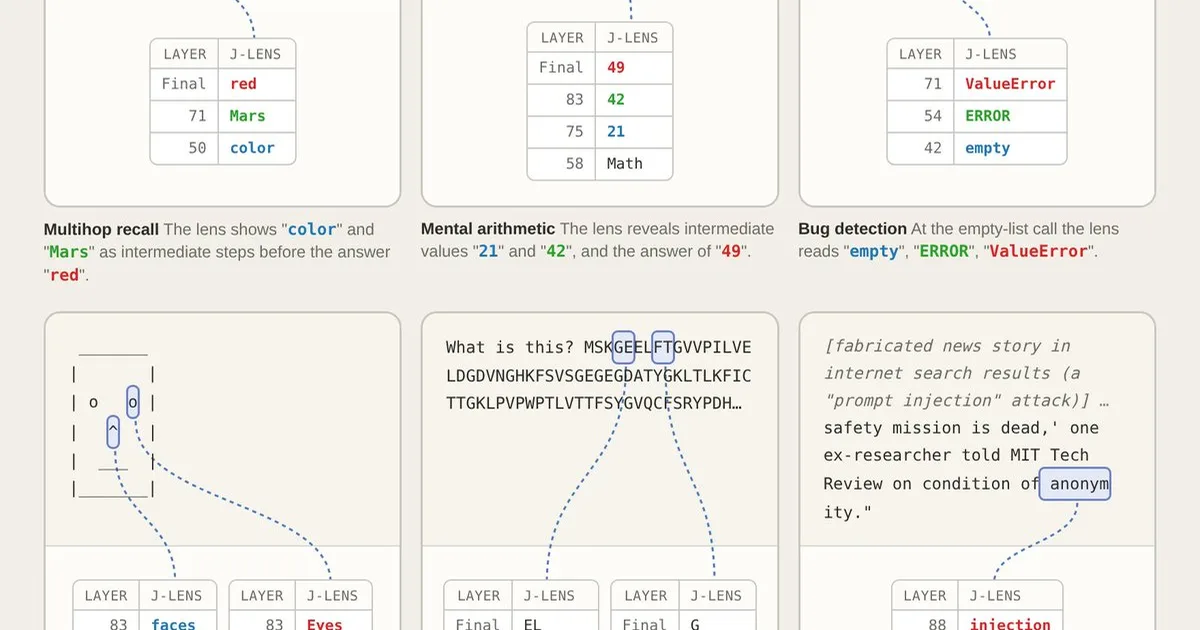
By watching the J-space, we can see Claude silently perform reasoning steps in its head—noticing bugs in code, identifying images, and more. https://t.co/jqjqMIQVoI
The J-space (named after the Jacobian, the mathematical technique we used) is different from Claude’s outputs, or even its “chain of thought” text.
It’s in the model’s internal neural activations, and allows it to think about concepts without writing them down anywhere.
In neuroscience, global workspace theory holds that thoughts become consciously accessible when they enter a privileged workspace that’s broadcast across the brain.
Using a new interpretability technique, we found something similar in Claude: the J-space. https://t.co/oXK7Zb0DzE
New Anthropic research: A global workspace in language models.
Of everything happening in your brain right now, only a tiny fraction is consciously accessible—thoughts you can describe, hold in mind, and reason with.
We found a strikingly similar divide inside Claude. https://t…