PulseAugur / Brief
EN
LIVE 21:59:38

Brief

last 24h
[28/28] 221 sources

Multi-source AI news clustered, deduplicated, and scored 0–100 across authority, cluster strength, headline signal, and time decay.

  1. NyayAI: Building an AI Legal Assistant for 1.4 Billion People — A Technical Deep Dive

    NyayAI is an AI-powered legal intelligence platform designed to make Indian law accessible and affordable for its 1.4 billion citizens. The platform addresses the critical issue of over 50 million pending court cases in India by providing lawyers and citizens with tools to navigate complex legal texts. Unlike general-purpose AI models that often hallucinate or lack legal depth, NyayAI is built from the ground up with a curated corpus of Indian legal documents, offering precise retrieval, summarization, and citation-grounded answers. AI

    IMPACT Aims to democratize legal access in India by providing an AI-powered tool specifically trained on Indian jurisprudence, potentially impacting millions of citizens and legal professionals.


  2. DCGAN inference on a microcontroller: 12.6M parameters, 512KB SRAM, 26-second generation, pure C [P]

    A project successfully implemented a 12.6 million parameter DCGAN model for generating 64x64 cat faces on a dual-core RISC-V microcontroller with only 512KB of SRAM. The inference engine, written entirely in C, achieved image generation in 26 seconds, with performance primarily limited by SD card access speed rather than computational power. This work is notable as it bypasses existing ecosystems like TFLite and CMSIS NN, offering a novel solution for running generative models on low-cost embedded hardware. AI

    IMPACT Enables generative AI capabilities on low-power, resource-constrained embedded devices.

  3. Orbax: Distributed Checkpointing with JAX

    A new JAX-native checkpointing library called Orbax has been introduced to address the lack of a standardized solution within the JAX framework for distributed machine learning systems. This library aims to simplify the management of distributed accelerator complexities and offer user-friendly checkpoint manipulations across the ML model lifecycle. Performance benchmarks indicate that Orbax can achieve savings up to 3.5x faster and loading up to 2x faster compared to similar PyTorch solutions. AI

    IMPACT Orbax offers a standardized, high-performance checkpointing solution for JAX, potentially improving efficiency for distributed ML model development and deployment.

  4. Why your diffusion model is slow at batch size 1 (and what actually helps)

    Single-image diffusion model inference is slowed by kernel launch overhead and attention memory traffic, rather than raw computational power. Optimizing with `torch.compile` in `reduce-overhead` mode, employing a fused attention backend, and batching classifier-free guidance can significantly reduce latency. Only after these optimizations should one consider distillation methods for further speed improvements, while carefully evaluating potential quality degradation. AI

    IMPACT Optimizing diffusion model inference speed can lower operational costs and enable new real-time applications.

  5. Fine-Tuning Llama 3.2 3B on Medical QA: Week 1 Setup and Baseline Inference

    A developer is undertaking a project to fine-tune Meta's Llama 3.2 3B Instruct model for medical question answering. The goal is to address the unreliability of general-purpose LLMs in healthcare by training the model on the MedQuAD dataset, which is sourced from USMLE board exam questions. The project will document the entire fine-tuning pipeline, from data preparation and LoRA training to evaluation and deployment via a public API, aiming to create a reproducible and domain-agnostic process. AI

    Fine-Tuning Llama 3.2 3B on Medical QA: Week 1 Setup and Baseline Inference

    IMPACT Demonstrates a practical approach to specializing LLMs for high-stakes domains like healthcare, improving reliability beyond general-purpose models.

  6. How to fix OOM crashes when running large open-source LLMs locally

    Running large open-source language models locally can lead to out-of-memory errors, even if the model's weights seem to fit within the available VRAM. This is primarily due to the significant memory required for the KV cache, which scales with context length, and intermediate activation memory during inference. Developers can address these issues by profiling memory usage with tools like PyTorch's memory snapshot, applying appropriate quantization techniques to model weights and the KV cache, and managing memory fragmentation. AI

    IMPACT Provides practical solutions for developers running large language models locally, addressing common memory issues.

  7. Domestic GPUs Start Making the World! The First Full-Stack Embodied Intelligence Simulation Platform in China is Here

    Moore Threads has launched MT Lambda, a comprehensive domestic simulation platform for embodied AI. This platform enables the training of robot control strategies entirely within a simulated environment, which are then seamlessly transferred to physical robots. The system integrates AI model training, high-fidelity physics simulation, and realistic rendering, addressing the high costs and risks associated with real-world robot training. Moore Threads aims to provide a complete hardware and software ecosystem, from cloud-based computing clusters to edge-side AI modules, to support the development and deployment of embodied AI. AI

    Domestic GPUs Start Making the World! The First Full-Stack Embodied Intelligence Simulation Platform in China is Here

    IMPACT Enables cost-effective, large-scale training of embodied AI agents, potentially accelerating robot development and deployment.

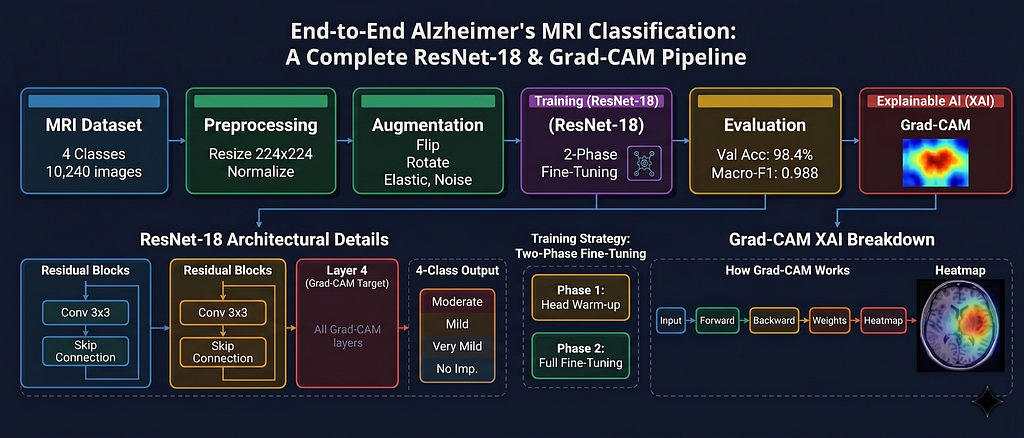
  8. Why Your 98% Accurate ResNet Needs Grad-CAM to Win Over Radiologists

    This tutorial demonstrates how to build and evaluate an Alzheimer's MRI classification pipeline using PyTorch's ResNet18 model. It highlights the common pitfall of models achieving high accuracy by exploiting dataset-specific artifacts rather than genuine medical features. The guide emphasizes the importance of using techniques like Grad-CAM to visualize model attention and ensure it's focusing on relevant anatomical regions before clinical deployment. AI

    Why Your 98% Accurate ResNet Needs Grad-CAM to Win Over Radiologists

    IMPACT Provides a practical method for validating AI models in sensitive domains like medical imaging, ensuring trustworthiness beyond simple accuracy metrics.

  9. The hardest part of building Hoovik — my open-source AI-powered meeting platform — wasn’t WebRTC signaling or media pipelines. It was managing real-time multimo

    Anupam Kumar, the creator of the open-source AI meeting platform Hoovik, found that the most challenging aspect of development was not the core WebRTC technology but managing real-time multimodal AI inference. This involved complex coordination of PyTorch, MediaPipe, and AudioWorklets across distributed services. Kumar aimed to achieve this without compromising performance through event loop blocking or memory exhaustion, especially when dealing with unstable network conditions and disappearing media streams. AI

    IMPACT Highlights the complex infrastructure challenges in deploying real-time multimodal AI for applications like meeting platforms.

  10. Quantizing Whisper-small: How design choices affect ASR performance

    A new study published on arXiv evaluates various post-training quantization (PTQ) techniques for the Whisper-small automatic speech recognition model. The research, which tested libraries like PyTorch, Optimum-Quanto, HQQ, and bitsandbytes, found that dynamic int8 quantization using Quanto provided the best balance of compression and accuracy. This method reduced model size by 57% while slightly improving word error rates on the LibriSpeech dataset, making Whisper-small more deployable on resource-constrained devices. AI

    IMPACT Enables more efficient deployment of speech recognition models on edge devices by reducing size and computational cost.

  11. The Neural Compiler: Program-to-Network Translation for Hybrid Scientific Machine Learning

    Researchers have developed "The Neural Compiler," a system that translates symbolic programs into differentiable PyTorch modules for scientific machine learning. This approach allows for the exact encoding of known physics within hybrid models, with learned components handling unknown aspects. The compiler demonstrated high accuracy and composability, significantly outperforming standard physics-informed neural networks (PINNs) in recovering physical constants and handling complex equation chains. AI

    IMPACT Enables more accurate and composable scientific machine learning models by integrating symbolic physics with neural networks.

  12. End of the semester

    The author plans to learn Clojure and PyTorch to gain a deeper understanding of AI fundamentals. They are exploring Clojure, a Lisp dialect, finding its functional programming paradigm a departure from their TypeScript and Dart background. The author is also diving into PyTorch through the "Deep Learning for Coders" book to better understand AI concepts and their practical application in development work. They believe this first-principles approach will help them cut through the noise of superficial AI discussions. AI

    End of the semester

    IMPACT Author aims to gain a foundational understanding of AI to better discern valid insights from superficial commentary.

  13. Check Your LLM's Secret Dictionary! Five Lines of Code Reveal What Your LLM Learned (Including What It Shouldn't Have)

    Researchers have developed a method using singular value decomposition (SVD) of a large language model's weight matrix to reveal interpretable semantic subspaces. This technique, requiring minimal code and no model inference, can expose the composition and curation of a model's training data. The analysis of models like GPT-OSS-120B, Gemma-2-2B, and Qwen2.5-1.5B showed systematic differences in their learned subspaces, with Qwen exhibiting ethically inappropriate vocabulary. The study proposes this SVD analysis as a standard pre-release safety auditing step and suggests its use for tokenizer optimization and more controllable LLM design. AI

    IMPACT Offers a novel, low-overhead method for auditing LLM training data and identifying potential ethical risks before deployment.

  14. FiLark: a streaming-first software framework for end-to-end exploration, annotation, and algorithm integration in distributed acoustic sensing

    Researchers have developed FiLark, a new Python framework designed for distributed acoustic sensing (DAS) data. This framework adopts a streaming-first approach, enabling continuous exploration, annotation, and integration of algorithms with DAS data streams. FiLark supports interactive visualization of long recordings with constant memory usage and allows for direct event labeling within streams to create machine-learning-ready datasets. It also includes GPU-accelerated signal processing and a standardized interface for integrating real-time detectors and models. AI

    FiLark: a streaming-first software framework for end-to-end exploration, annotation, and algorithm integration in distributed acoustic sensing

    IMPACT Enables more efficient processing and machine learning on continuous, high-volume sensor data streams.

  15. torchtune: PyTorch native post-training library

    Researchers have introduced torchtune, a new PyTorch-native library designed to simplify the post-training phase for large language models. This library emphasizes modularity and direct access to PyTorch components, aiming to facilitate efficient fine-tuning, experimentation, and deployment workflows. It is presented as a flexible foundation for reproducible research in LLM post-training, offering competitive performance and memory efficiency compared to existing frameworks like Axolotl and Unsloth. AI

    IMPACT Provides new tools for researchers to efficiently fine-tune and experiment with LLMs, potentially accelerating development.

  16. Sutra: Tensor-Op RNNs as a Compilation Target for Vector Symbolic Architectures

    Researchers have developed Sutra, a functional programming language that compiles into PyTorch neural networks. This system targets vector symbolic architectures by reducing programs to fused tensor-operation graphs. Sutra demonstrates high accuracy in decoding bundles and allows for differentiable training directly through the compiled graph, enabling code to be both a logic program and a trainable neural network. AI

    Sutra: Tensor-Op RNNs as a Compilation Target for Vector Symbolic Architectures

    IMPACT Introduces a novel programming paradigm that unifies logic programming with neural network training.

  17. Dissecting ThunderKittens, anatomy of a compact DSL for high-performance AI kernels

    A new article details ThunderKittens, a compact domain-specific language (DSL) developed at Stanford's Hazy Research Lab for creating high-performance AI kernels. The DSL aims to strike a balance between research productivity and hardware efficiency by abstracting repetitive GPU programming tasks like tile layouts and memory allocation. This allows developers to maintain close reasoning about data movement and scheduling while still enabling performance optimization for modern AI workloads on hardware like NVIDIA's Hopper and Blackwell architectures. AI

    IMPACT Enables more efficient AI model training and inference by optimizing low-level GPU kernel performance.

  18. ADC Japan Speaker: Tomek Roszczynialski Generative Instruments with Large Piano Models A hands-on approach to making music with AI trained on

    Researchers are exploring AI models for music generation, with one project focusing on creating generative instruments using large piano models trained on performance data. Another initiative details building an AI model from scratch using PyTorch and the Lakh MIDI Dataset, applying NLP techniques to MIDI data to generate melodies. AI

    ADC Japan Speaker: Tomek Roszczynialski Generative Instruments with Large Piano Models A hands-on approach to making music with AI trained on

    IMPACT These projects showcase novel approaches to AI-driven music creation, potentially leading to new tools for artists and musicians.

  19. 💻 the-incredible-pytorch: 12.5 k ⭐ I needed a single bookmark for the PyTorch ecosystem. The Incredible PyTorch is a curated list covering everything from LLMs

    The Incredible PyTorch is a curated list designed to serve as a comprehensive bookmark for the PyTorch ecosystem. It covers a wide range of applications, including LLMs, object detection, reinforcement learning, and medical imaging, all implemented with PyTorch. The list aims to be a valuable resource for developers seeking specific libraries and tools for their projects. AI

  20. I built a Mamba1 variant I call SM1 with d_state=1 that runs on Blackwell in pure PyTorch [P]

    A developer has created SM1, a variant of the Mamba1 architecture, optimized for PyTorch and capable of running on NVIDIA Blackwell hardware. SM1 replaces the selective scan with two native PyTorch operations, achieving the exact closed-form solution for the d_state=1 recurrence. This optimization significantly reduces memory usage, with a 130M parameter model requiring only 56 KB for its inference state, eliminating the need for a KV cache. AI

    IMPACT This optimized Mamba variant could lead to more efficient training and inference for certain sequence modeling tasks.

  21. optimize_anything: A Universal API for Optimizing any Text Parameter

    Researchers have developed "optimize_anything," a universal API that uses LLMs to solve a wide range of optimization problems by treating them as text-based improvements. This system demonstrates state-of-the-art results across diverse tasks, including enhancing AI agent architectures, optimizing cloud scheduling algorithms, and generating efficient CUDA kernels. The research highlights that providing actionable side information and employing multi-task learning significantly improves convergence and final scores compared to score-only feedback or independent optimization. AI

    optimize_anything: A Universal API for Optimizing any Text Parameter

    IMPACT This new optimization paradigm could unify diverse problem-solving tasks under a single LLM-based framework, potentially streamlining development and improving performance across various domains.

  22. Towards Code-Oriented LM Embeddings for Surrogate-Assisted Neural Architecture Search

    Researchers have developed a novel method called Code-Oriented LM Embeddings (COLE) to improve Neural Architecture Search (NAS). This technique uses off-the-shelf language models to generate embeddings from code representations of neural architectures, bypassing the need for expensive fine-tuning or complex feature engineering. Experiments on NAS-Bench-201 and einspace demonstrated that COLE embeddings outperform other text-based encodings and significantly reduce the evaluation budget required to find high-performing architectures. AI

    IMPACT Introduces a more efficient method for designing neural networks, potentially accelerating AI model development.

  23. Question about Forge Neo

    A user is encountering an error with Forge Neo, a Stable Diffusion interface, due to their NVIDIA GeForce GTX 1080 Ti graphics card not being compatible with the current PyTorch installation. The error message indicates that the PyTorch version supports newer CUDA capabilities (sm_75 and above) than what the 1080 Ti provides (sm_61). The user is seeking information on whether Forge Neo can work with their hardware and what steps might be necessary to resolve the compatibility issue. AI

  24. pipeline is really slow - consulting [D]

    A user on r/MachineLearning is seeking advice regarding a significantly slow training pipeline for imitation learning in robotics. Despite using a Diffusion Transformer (DiT) model with approximately 50 million parameters and modern hardware including an NVIDIA A4500 GPU, the training throughput is only about 10 iterations per second, leading to multi-day training times. The user has observed high CPU utilization and low GPU utilization, and attempts to optimize by freezing the encoder or using synthetic data have yielded minimal improvements. AI

  25. 📰 PyTorch vs TensorFlow: Why 2026 Reproductions Fall 4% Short on DermMNIST A researcher struggles to match a TensorFlow-based paper's 77% accuracy on DermMNIST

    A researcher found that reproducing a paper's results on the DermMNIST dataset using PyTorch yielded a 4% lower accuracy compared to the original TensorFlow implementation. This discrepancy is attributed to potential differences in preprocessing, normalization, and optimization techniques between the frameworks. Separately, advancements in quantization and fast inference, such as INT8 and KV cache, are transforming ML deployment but face real-world challenges that can limit benchmark gains. AI

    📰 PyTorch vs TensorFlow: Why 2026 Reproductions Fall 4% Short on DermMNIST A researcher struggles to match a TensorFlow-based paper's 77% accuracy on DermMNIST

    IMPACT Highlights potential framework-specific performance gaps and real-world deployment hurdles for ML models.

  26. How to run TorchForge reinforcement learning pipelines in the Together AI Native Cloud

    Together AI is enhancing its cloud platform to support advanced reinforcement learning (RL) pipelines, integrating TorchForge and Monarch for distributed training. The platform now offers low-latency GPU communication and heterogeneous scheduling for mixed CPU/GPU workloads, crucial for complex RL tasks. New integrations with Together CodeSandbox and Code Interpreter allow RL agents to interact with tools and execute code, expanding their capabilities beyond traditional game-playing scenarios. AI

    How to run TorchForge reinforcement learning pipelines in the Together AI Native Cloud

    IMPACT Enhances infrastructure for complex AI training, enabling more sophisticated RL applications and tool integration.

  27. Making new Python repls 100x faster to start up

    Replit has significantly improved the startup speed for new Python repls by implementing a new caching mechanism. This update addresses issues with large package sizes and lengthy installation times that previously made some Python environments unusable. The new system leverages content-addressable caching for individual files within packages, allowing for symbolic links instead of full copies, which drastically reduces disk space usage and speeds up repl initialization. AI

    Making new Python repls 100x faster to start up

    IMPACT Accelerates development workflows for AI/ML practitioners using Python on the Replit platform.