PulseAugur / Brief
EN
LIVE 08:01:38

Brief

last 24h
[12/12] 221 sources

Multi-source AI news clustered, deduplicated, and scored 0–100 across authority, cluster strength, headline signal, and time decay.

  1. Not All Transitions Matter: Evidence from PPO

    Researchers have developed a method to improve the stability of reinforcement learning training by randomly dropping a fraction of transitions from on-policy rollouts. This technique, applied to Proximal Policy Optimization (PPO), breaks the repetitive gradient structure caused by causally chained states. By dropping approximately 25% of transitions, the method maintains reward performance while yielding more consistent training dynamics across various metrics. AI

    IMPACT Enhances training stability for reinforcement learning agents, potentially leading to more reliable and efficient development of AI systems in complex environments.
  2. Bridging the Gap: Enabling Soft Actor Critic for High Performance Legged Locomotion

    Researchers have developed a modified version of the Soft Actor-Critic (SAC) algorithm that matches the performance of Proximal Policy Optimization (PPO) in training legged robots. This new approach addresses SAC's sample inefficiency by enabling it to reuse past experiences, making it suitable for sim-to-real transfer and online learning on physical hardware. The modifications include improvements to policy initialization, critic targets, and return estimation, which allow SAC to train stably at scale across various robot platforms and locomotion tasks. AI

    IMPACT Enables more efficient training of legged robots, potentially accelerating sim-to-real transfer and real-time adaptation.

  3. The More I Tuned My Reward Function, The Worse My RL Agent Got

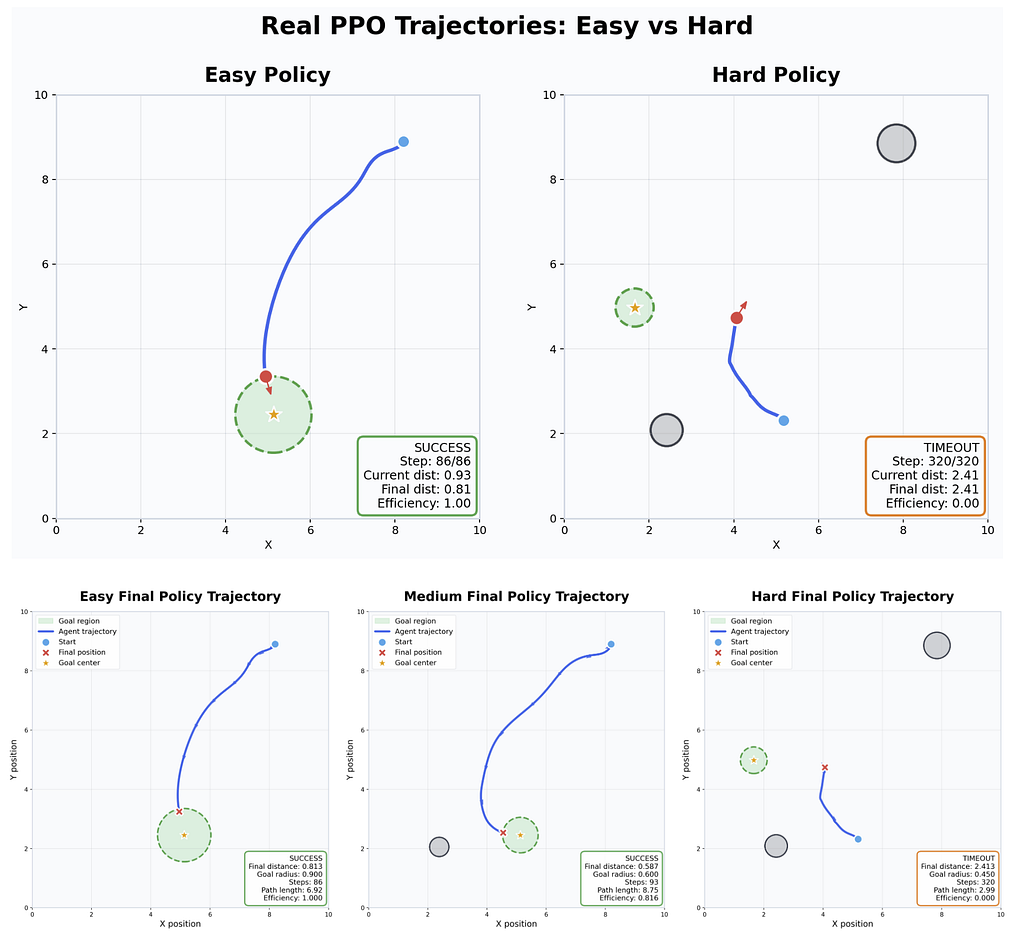
    A high school student encountered issues while training a reinforcement learning agent for drone navigation. The agent, designed to reach a goal while avoiding obstacles, became overly cautious and indecisive due to an overly complex reward function. By simplifying the reward to focus only on reaching the goal, progress towards it, and collision penalties, the agent's performance significantly improved. AI

    The More I Tuned My Reward Function, The Worse My RL Agent Got

    IMPACT Highlights the critical role of reward function design in reinforcement learning, suggesting simpler, less prescriptive rewards can lead to better agent performance.

  4. Introducing the Anyscale Agent Skill for LLM Post

    Anyscale has introduced a new Anyscale Agent Skill designed to simplify and automate the process of generating LLM post-training runs. This skill assists users in selecting the most appropriate post-training method, such as SFT, CPT, DPO, or RLVR, based on their model, dataset, and objectives. It then generates configuration files for popular frameworks like LLaMA-Factory and Ray Train, preparing them for deployment on Anyscale Jobs. AI

    Introducing the Anyscale Agent Skill for LLM Post

    IMPACT Simplifies the complex process of LLM post-training, potentially accelerating adoption of advanced alignment and optimization techniques.

  5. Ensemble RL through Classifier Models: Enhancing Risk-Return Trade-offs in Trading Strategies

    Researchers have developed an ensemble reinforcement learning (RL) approach for financial trading, integrating RL algorithms like A2C, PPO, and SAC with traditional classifiers such as SVM, Decision Trees, and Logistic Regression. This hybrid method aims to improve risk-return trade-offs and reduce drawdowns compared to standalone RL models. The study found that ensemble strategies consistently outperformed individual models, though performance was sensitive to the variance threshold parameter \(\tau\), suggesting a need for dynamic adjustment. AI

    IMPACT Introduces a novel ensemble approach for financial trading that improves risk-adjusted returns and stability.

  6. How does a # ReinforcementLearning agent decide what to do? Part 3 of my RL series tackles this by defining policies, MDPs and trajectories. We'll keep building

    This article explains how reinforcement learning agents make decisions by defining key concepts. It covers policies, Markov Decision Processes (MDPs), and trajectories. The series aims to build understanding towards the Proximal Policy Optimization (PPO) algorithm. AI

    How does a # ReinforcementLearning agent decide what to do? Part 3 of my RL series tackles this by defining policies, MDPs and trajectories. We'll keep building

    IMPACT Explains fundamental concepts in reinforcement learning, crucial for understanding agent behavior and advanced algorithms.

  7. Representation over Routing: Overcoming Surrogate Hacking in Multi-Timescale PPO

    Researchers have developed a new architecture called Target Decoupling to address issues in multi-timescale reinforcement learning. This approach separates short-term and long-term signals to improve policy updates, preventing common problems like surrogate objective hacking and policy collapse. Experiments on the LunarLander-v2 environment showed significant performance gains and reduced variance compared to existing methods. AI

    IMPACT Introduces a novel architecture that enhances performance and stability in reinforcement learning tasks.

  8. Deep Reinforcement Learning for Flexible Job Shop Scheduling with Random Job Arrivals

    Researchers have developed a new approach using Deep Reinforcement Learning (DRL) to tackle the complex Flexible Job Shop Scheduling Problem (FJSP), particularly when faced with random job arrivals. Their method, employing the Proximal Policy Optimization algorithm with Multi-Layer Perceptrons, aims to minimize the total completion time of all jobs. Simulations indicate that this DRL strategy surpasses individual dispatching rules and performs competitively against traditional mixed-integer linear programming solutions, especially in heterogeneous datasets. AI

    IMPACT Introduces a novel DRL application for optimizing complex scheduling problems, potentially improving efficiency in manufacturing and logistics.

  9. AGPO: Adaptive Group Policy Optimization with Dual Statistical Feedback

    Two new research papers introduce methods to improve the training of large language models using reinforcement learning. One paper addresses the issue of "advantage collapse" in Group Relative Policy Optimization (GRPO) by introducing a diagnostic metric and an adaptive extension called AVSPO. The other paper proposes Adaptive Group Policy Optimization (AGPO), which uses group-level statistics to dynamically adjust training parameters like clipping and decoding temperature, outperforming existing methods on several benchmarks. AI

    AGPO: Adaptive Group Policy Optimization with Dual Statistical Feedback

    IMPACT These new reinforcement learning techniques aim to enhance LLM reasoning capabilities and training stability, potentially leading to more robust and accurate models.

  10. Design for Manufacturing: A Manufacturability Knowledge-Integrated Reinforcement Learning Framework for Free-Form Pipe Routing in Aeroengines

    Researchers have developed a new reinforcement learning framework, called FPRO, to optimize the design and manufacturing of free-form pipes in aeroengines. This approach integrates domain-specific manufacturing knowledge as constraints within the reinforcement learning process. FPRO generates collision-free, manufacturable pipe paths that are then directly translated into fabrication instructions for a six-axis bending machine, demonstrating practical feasibility through real-world validation. AI

    Design for Manufacturing: A Manufacturability Knowledge-Integrated Reinforcement Learning Framework for Free-Form Pipe Routing in Aeroengines

    IMPACT This framework could streamline the complex pipe routing process in aeroengine manufacturing, reducing iteration time and improving design-to-fabrication accuracy.

  11. Reinforcement Learning-based Control via Y-wise Affine Neural Networks: Comparative Case Studies for Chemical Processes

    Researchers have developed a new reinforcement learning (RL) approach called Y-wise Affine Neural Network (YANN-RL) designed for control in chemical process systems. This method aims to overcome the typical challenges of trust and lengthy training times associated with RL in this domain. By providing confident and interpretable starting points for control schemes, YANN-RL demonstrated reduced training time and data requirements in case studies involving a CSTR, a four-tank system, and an extraction column. AI

    IMPACT This new RL approach could accelerate AI adoption in chemical engineering by reducing training time and increasing trust in AI control systems.

  12. RL²: Fast reinforcement learning via slow reinforcement learning

    OpenAI has published a series of research papers detailing advancements in reinforcement learning (RL). These include achieving superhuman performance in Dota 2 with OpenAI Five, developing benchmarks for safe exploration in RL environments, and quantifying generalization capabilities with a new CoinRun environment. The research also explores novel methods for encouraging exploration through curiosity, learning policy representations in multiagent systems, and evolving loss functions for faster training on new tasks. Additionally, OpenAI is working on variance reduction techniques for policy gradients and exploring the equivalence between policy gradients and soft Q-learning. AI

    RL²: Fast reinforcement learning via slow reinforcement learning

    IMPACT These advancements in reinforcement learning, including new benchmarks and methods for generalization and exploration, could accelerate the development of more capable and safer AI systems.