PulseAugur / Brief
EN
LIVE 15:12:59

Brief

last 24h
[50/9093] 224 sources

Multi-source AI news clustered, deduplicated, and scored 0–100 across authority, cluster strength, headline signal, and time decay.

  1. What Limits Does Quantization Place on Dense Top-$k$ Retrieval? A Theoretical Study

    A new theoretical study published on arXiv explores the limitations imposed by quantization on dense top-k retrieval systems. The research demonstrates that achieving perfect retrieval with B bits per coordinate requires the embedding dimension to grow logarithmically with the corpus size (N), contradicting previous assumptions of corpus independence at infinite precision. The findings suggest that practical vector databases and retrieval systems must increase embedding dimensions and potentially precision as their data corpus expands. AI

    IMPACT Highlights that practical vector databases need to scale embedding dimensions with corpus size due to quantization limits.
  2. Fast Speech Foundation Model Distillation Using Interleaved Stacking

    Researchers have developed a new method called interleaved stacking to accelerate the training of speech foundation models (SFMs). This technique aims to distill large SFMs into more efficient student models, reducing inference latency without the performance degradation seen in previous stacking methods. The interleaved stacking approach preserves layer position throughout the process, which is crucial for SFMs where each layer holds specific knowledge. The effectiveness of this method was validated on the SUPERB benchmark. AI

    IMPACT Accelerates the deployment of efficient speech foundation models for low-resource environments.

  3. Multi-View In-Cabin Monitoring System for Public Transport Vehicles

    Researchers have developed a new multi-view dataset for monitoring the interiors of public transport vehicles. This dataset includes synchronized RGB and depth images, along with LiDAR scans, to capture detailed information about the vehicle's interior and its occupants. The project also provides tools for calibration and pseudo-labeling, enabling the generation of 3D human pose estimates and bounding boxes, and benchmarks existing 3D detection models. AI

    IMPACT Provides a new dataset and benchmarks for developing in-cabin monitoring systems, potentially improving safety and automation in public transport.

  4. Hey Chat, Can You Teach Me? Structuring Socratic Dialogue for Human Learning in the Wild

    Researchers have developed a new method for structuring Socratic dialogue between large language models and students to improve learning. Their system separates curriculum sequencing, Socratic dialogue, and student knowledge inference into distinct components. This approach, which uses a PPO policy for curriculum management and an LLM for dialogue, demonstrated superior performance in helping students master topics compared to general-purpose LLMs and heuristic methods. AI

    IMPACT This structured approach to AI tutoring could significantly enhance online learning effectiveness by providing more personalized and curriculum-aligned educational experiences.

  5. UniReason-Med: A Shared Grounded Reasoning Interface for 2D-to-3D Transfer in Medical VQA

    Researchers have developed UniReason-Med, a novel framework designed to enhance 3D medical visual question answering (VQA) by leveraging supervision from 2D medical images. This system utilizes a shared reasoning interface that can process both 2D images and serialized 3D volumes, generating interleaved textual reasoning and localized visual evidence. The framework was trained on UniMed-CoT, a 220K sample instruction-tuning dataset, and demonstrated that joint 2D and 3D grounded supervision significantly improves 3D reasoning capabilities compared to 3D-only training. AI

    IMPACT This research could lead to more accurate diagnostic tools by improving the ability of AI to reason about 3D medical data.

  6. Substrate Asymmetry in User-Side Memory: A Diagnostic Framework

    Researchers have developed a new diagnostic framework to analyze user-side memory in large language models, revealing that personalization capabilities are not a single metric but rather factor into distinct axes: behavioral consistency, factual presence, and factual absence. Their findings indicate that different memory substrates excel at different axes, with parametric memory (gamma-LoRA) favoring style and retrieval-based methods (RAG) excelling at factual absence. The study also identified an "alignment tax" on parametric user-memory in heavily RLHF-tuned models and proposed that substrate selection is a question-classification task rather than calibration. AI

    IMPACT This research could lead to more nuanced evaluation of LLM personalization and improved memory systems by highlighting specific failure modes.

  7. Point-Wise Geometry-Aware Transformer for Partial-to-Full Point Cloud Registration in Computer-Assisted Surgery

    Two new research papers explore advanced techniques for point cloud registration. The first, Generalized-CVO, uses Riemannian optimization to achieve up to a 10x speedup over previous methods for LiDAR and RGB-D data, significantly reducing drift in challenging environments. The second, GAPR-Net, employs a transformer-based architecture for partial-to-full point cloud registration, demonstrating high accuracy for surgical applications involving bone structures like the tibia and femur. AI

    IMPACT Advances in point cloud registration can improve robotic perception and surgical precision.

  8. ERN-Net : Evolving Reason Node-Net for Document Binarization

    Researchers have developed ERN-Net, a novel approach for document binarization that improves the handling of degraded image regions. The method utilizes evolving reason nodes and multi-scale reasoning to enhance faint strokes, broken characters, and noisy backgrounds. Experiments indicate that ConvNeXt-Tiny offers a good balance of accuracy and memory efficiency, and pretraining on DIBCO datasets can boost performance with minimal additional training time. AI

    IMPACT Enhances document image processing capabilities, particularly for low-data and low-memory scenarios.

  9. MedCTA: A Benchmark for Clinical Tool Agents

    Researchers have introduced MedCTA, a new benchmark designed to evaluate the capabilities of AI agents in clinical settings. This benchmark focuses on tasks requiring planning, tool retrieval, and evidence acquisition, moving beyond simple recognition or single-turn question answering. MedCTA includes 107 real-world clinical tasks with clinician-verified trajectories across five deployed tools, assessing aspects like tool selection, execution stability, and outcome quality. Initial benchmarking of 18 models revealed that even advanced systems struggle with multi-step clinical tool use, exhibiting issues with protocol failures and incorrect tool recruitment. AI

    IMPACT Highlights limitations in current clinical AI agents' ability to reliably use tools, indicating a need for improved agentic behavior in healthcare.

  10. Evaluating Bias in Phoneme-Based Automatic Speech Recognition Systems: An Analysis of IPA Transcription Models

    A new research paper analyzes demographic biases in phoneme-based Automatic Speech Recognition (ASR) systems, specifically those generating International Phonetic Alphabet (IPA) transcriptions. The study evaluates two open-source systems, WhisperIPA and ZIPA, using diverse speech corpora and demographically annotated English data. Findings indicate persistent performance disparities across various demographic groups, including gender, accent, ethnicity, and age, even when accounting for linguistically similar phoneme substitutions. AI

    IMPACT Highlights potential biases in IPA transcription models, informing the development of more inclusive and robust phoneme-based ASR systems.

  11. CRAFTIIF: Cross-Resolution Analytic Four-Type Interpretable Isolation Forest for Multivariate Time Series Anomaly Detection

    Two new research papers explore advanced techniques for anomaly detection in multivariate time series data. The first paper introduces CRAFTIIF, a framework designed to identify four distinct types of anomalies (point, distributional, temporal, and collective) using a combination of wavelet features and Isolation Forests, achieving top performance on the mTSBench benchmark. The second paper investigates the impact of inference windowing strategies on reconstruction-based anomaly detection methods, demonstrating that overlapping windows consistently improve performance across various models and highlighting the importance of reproducible evaluation protocols. AI

    IMPACT These papers advance anomaly detection techniques, potentially improving reliability in complex systems and data analysis.

  12. When is Your LLM Steerable?

    Researchers have developed a method to predict the success of controlling large language models (LLMs) through activation steering. By analyzing a model's internal states early in the generation process, they can forecast whether steering interventions will be effective. This approach uses a Gradient Boosting Decision Trees classifier, achieving a 0.7 macro-F1 score on unseen concepts, and can optimize steering strength with reduced computational cost. AI

    IMPACT Enables more efficient and reliable control of LLM behavior, potentially improving safety and usability.

  13. Capacity-Constrained Online Convex Optimization with Delayed Feedback

    Researchers have developed a new framework for online convex optimization that addresses the challenge of delayed feedback under strict capacity constraints. The proposed method introduces a semi-clairvoyant model and a novel reduction to a "delayed and weighted" OCO problem. This approach establishes the first regret guarantees for capacity-constrained OCO with both first-order and bandit feedback, showing that logarithmic capacity is sufficient to approach standard rates. AI

    IMPACT Introduces theoretical advancements in online learning algorithms, potentially impacting future AI system design.

  14. RankVR: Low-Rank Structure Perception and Value Recalibration for Robust Composed Image Retrieval

    Researchers have introduced RankVR, a new framework designed to improve Composed Image Retrieval (CIR) models. RankVR addresses challenges in large datasets, specifically noisy triplet correspondence, by employing a Global Structure Consistency Perception module to identify and remove noisy samples based on correlation matrix rank. Additionally, an Adaptive Semantic Value Calibration module helps distinguish valuable hard samples for more effective training. Experiments on benchmark datasets show RankVR significantly outperforms existing methods in noisy environments. AI

    IMPACT Improves robustness of image retrieval models in noisy datasets, potentially leading to more accurate search results.

  15. Goal-Autopilot: A Verifiable Anti-Fabrication Firewall for Unattended Long-Horizon Agents

    Researchers have developed a new execution model called Autopilot designed to prevent large language model agents from fabricating success when operating without human supervision. This system acts as a firewall by externalizing agent state into a finite-state machine, ensuring that any claim of completion is tied to verified execution of specific gates. In tests, Autopilot significantly reduced fabrication rates compared to existing methods like Reflexion and StateFlow, particularly on challenging software development tasks. AI

    IMPACT Reduces the risk of autonomous agents falsely reporting task completion, enhancing reliability for unattended operations.

  16. DroneShield-AI: A Multi-Modal Sensor Fusion Framework for Real-Time Autonomous Drone Threat Detection, Behavioral Intent Classification, and Swarm Intelligence in Contested Airspace

    Researchers have developed DroneShield-AI, an open framework designed to detect and classify threats from autonomous drones in real-time. The system integrates multiple sensor inputs, including radio frequency signals, acoustic signatures, and visual data processed by YOLOv8. It features a novel behavioral intent classification engine and a graph neural network module for analyzing drone swarm intelligence. The framework demonstrated high accuracy in detecting drone threats and predicting their behavior, with all associated code and models made publicly available. AI

    IMPACT Enhances real-time threat detection capabilities for autonomous drone systems, potentially improving airspace security.

  17. UR-BERT: Scaling Text Encoders for Massively Multilingual TTS Through Universal Romanization and Speech Token Prediction

    Researchers have developed UR-BERT, a novel text encoder designed to significantly expand the capabilities of massively multilingual text-to-speech (TTS) systems. Unlike traditional methods limited by grapheme-to-phoneme resources, UR-BERT unifies diverse writing systems into a common Romanization format, enabling support for 495 languages. The system also incorporates a speech token prediction objective to improve phonetic accuracy and text-speech alignment, demonstrating superior performance over existing baselines and strong generalization to new languages. AI

    IMPACT Expands the reach of TTS technology to hundreds of new languages, potentially democratizing voice synthesis.

  18. 3-Key-Input: Exploring the Theoretical Minimum Keys for Text Entry

    Researchers have explored the theoretical minimum number of keys required for text entry by leveraging advanced language models. Their study found that a 3-key input system, when combined with GPT-4o for disambiguation, achieved a character error rate of 9.46%. This represents a significant improvement over 2-key systems, which had a much higher error rate. The findings suggest that 3 keys are a practical minimum for general English text entry in offline settings with strong language model priors. AI

    IMPACT Demonstrates how advanced language models can drastically reduce hardware requirements for text input devices.

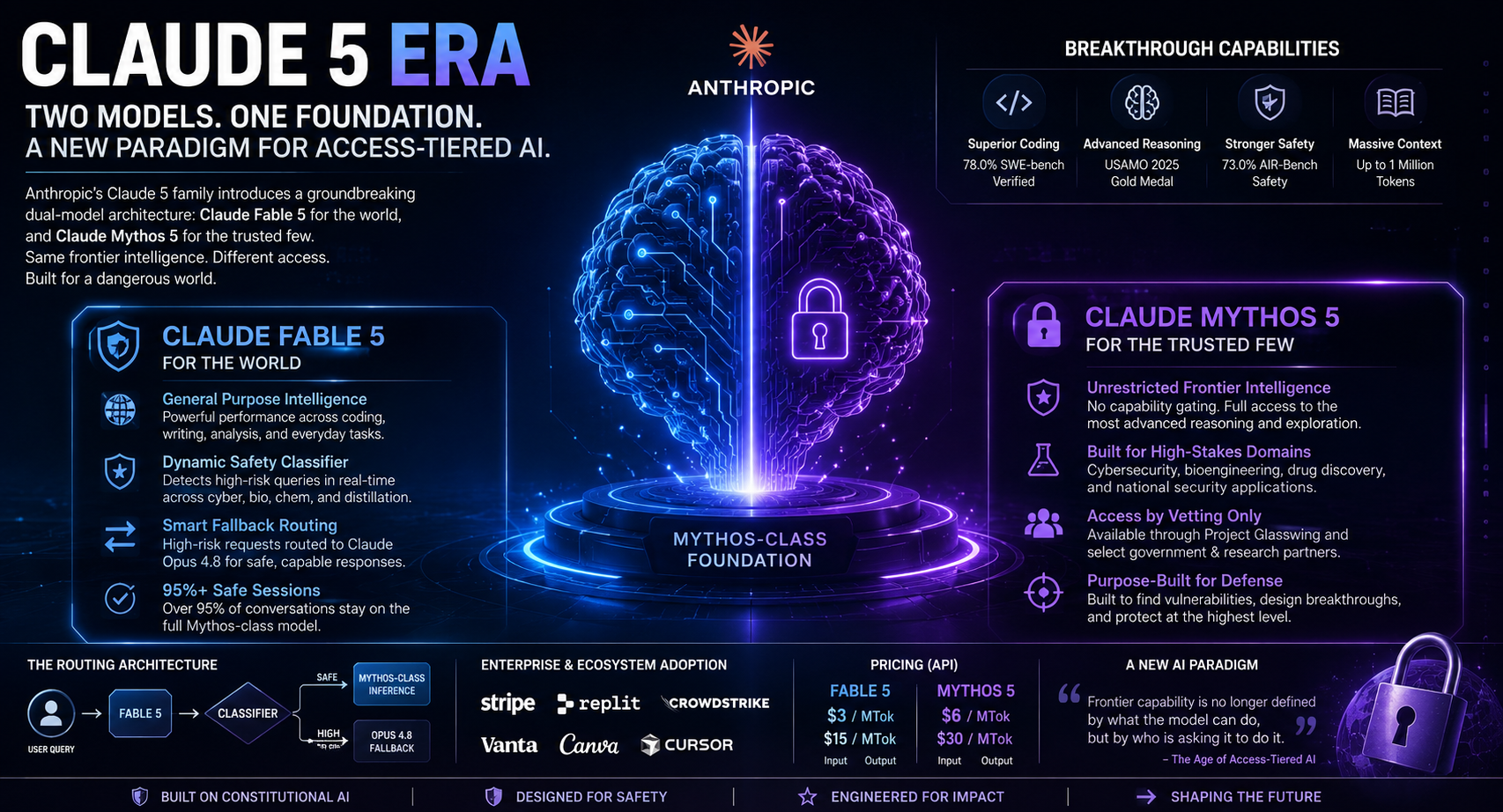
  19. Claude Fable 5 and Mythos 5: Technical Architecture, Performance Benchmarks, and Alignment Analysis

    A technical analysis explores the architecture, performance, and alignment of two hypothetical AI models, Claude Fable 5 and Mythos 5. The paper highlights the dual-use nature of advanced AI, noting its potential for both beneficial applications like gene therapy and malicious uses such as aiding threat actors in developing novel attacks. It delves into the technical underpinnings and benchmark results of these conceptual models. AI

    Claude Fable 5 and Mythos 5: Technical Architecture, Performance Benchmarks, and Alignment Analysis

    IMPACT Explores the dual-use potential of advanced AI, highlighting risks and benefits for AI operators.

  20. Conformal Bayes under Label Shift: Post-Hoc Calibration vs. In-Training Adaptation

    Researchers have introduced a new framework called Conformal Bayes that combines Bayesian posterior predictives with conformal calibration for more accurate prediction sets. The study explores two methods for handling label shift: post-hoc calibration, which adjusts predictions and thresholds without altering the model's core parameters, and in-training adaptation, which modifies the model's parameters directly to better suit the target domain. Experiments indicate that both approaches achieve valid coverage under unbiased training, while in-training adaptation offers improved efficiency by reducing interval width in optimization scenarios. AI

    IMPACT Introduces a novel statistical framework for improving the reliability of AI predictions under data distribution changes.

  21. The Long Tail, Not the Front Page: Cold-Start Prediction of Crowd Highlight Salience

    Researchers have developed a model capable of predicting which passages in a document will be highlighted by readers, even before those highlights accumulate. This model, trained on existing highlight data, outperforms a simple lead-based baseline by a small but statistically significant margin. The system shows particular promise for less popular content, where its predictive accuracy is more pronounced. AI

    IMPACT This research could improve content summarization and recommendation systems by predicting user interest in specific passages.

  22. TextHOI-3D: Text-to-3D Hand-Object Interaction via Discrete Multi-View Generation and Joint Mesh Optimization

    Researchers have developed TextHOI-3D, a novel framework for generating 3D hand-object interactions from text descriptions. This staged approach uses generated multi-view observations as an intermediate representation, bridging text-conditioned visual generation with geometry-aware recovery. The system significantly improves accuracy in object contact and reduces penetration volume compared to single-view methods, demonstrating the effectiveness of discrete multi-view tokens for this complex 3D generation task. AI

    IMPACT Advances text-to-3D generation for complex interactions, potentially impacting virtual reality and content creation.

  23. DeMix: Debugging Training Data with Mixed Data Error Types by Investigating Influence Vectors

    Researchers have introduced DeMix, a new framework designed to identify and categorize errors within machine learning training datasets. The system analyzes how individual training samples influence model predictions to detect erroneous data points and their specific error types, such as label or feature errors. DeMix demonstrated significant improvements in data debugging and subsequent model performance across various tasks, including LLM alignment. AI

    IMPACT Improves ML model reliability by enabling more effective identification and correction of data errors.

  24. SinkRec: Mitigating Semantic State Sink in Long Sequence Recommendation with Memory-Conditioned Gated Delta Networks

    Two new research papers address challenges in training recommendation models with extremely long user interaction histories. The first, "Versioned Late Materialization," proposes a system to reduce data infrastructure load by storing user history once and reconstructing sequences on demand, enabling longer sequences and improving model quality. The second paper, "SinkRec," introduces a hybrid memory-transition architecture to mitigate "semantic state sink" in linear attention models, preventing repetitive patterns from overwhelming the model's state and improving efficiency for long sequences. AI

    IMPACT These methods aim to improve the efficiency and effectiveness of recommendation systems by enabling them to process longer user interaction histories.

  25. IDP-Bench: Benchmarking ability of LLMs to protect personal information in interdependent privacy contexts

    Researchers have developed IDP-Bench, a new benchmark designed to evaluate how well large language models (LLMs) can protect personal information in interdependent privacy scenarios. The benchmark, which uses the Contextual Integrity framework, found that while many open-source LLMs recognize co-ownership of data, they struggle with identifying key privacy parameters and judging the appropriateness of data sharing. Separately, Ollama is gaining popularity as an open-source tool that allows users to run LLMs locally on their own machines, offering enhanced privacy and cost savings compared to cloud-based APIs. AI

    IMPACT New benchmark highlights LLM privacy gaps; local execution tools offer enhanced data security.

  26. YUBI: Yielding Universal Bidigital Interface for Bimanual Dexterous Manipulation at Scale

    Researchers have introduced DuoBench, a new framework for evaluating bimanual robot manipulation, implemented in simulation and partially in the real world. This benchmark includes eleven tasks and a novel evaluation scheme for detailed failure analysis, revealing current policies struggle with complex dual-arm coordination. Separately, the YUBI interface has been developed, featuring a yielding, finger-driven gripper designed for more intuitive and ergonomic data collection for bimanual tasks. YUBI offers advantages over existing systems like UMI in dexterity and efficiency, enabling a large-scale dataset that allows policies to transfer across different robotic platforms. AI

    IMPACT These advancements in bimanual manipulation benchmarks and data collection interfaces are crucial for developing more capable robotic foundation models.

  27. GRAU: Generic Reconfigurable Activation Unit Design for Neural Network Hardware Accelerators

    Researchers have developed two novel architectures, ReSCom and SupraSNN, designed to improve the energy efficiency and performance of Spiking Neural Networks (SNNs). ReSCom utilizes stochastic computing for multiplication operations to reduce hardware complexity while maintaining stable inference, offering dynamic trade-offs between accuracy, latency, and energy consumption. SupraSNN, inspired by superscalar processors, physically decouples synaptic and neuronal computations to exploit synapse-level parallelism, achieving lower latency and better energy efficiency than previous FPGA-based SNN accelerators. Separately, a new design called GRAU offers a generic reconfigurable activation unit for neural network hardware accelerators, significantly reducing hardware cost and increasing flexibility for low-precision quantization. AI

    IMPACT These architectural innovations promise more energy-efficient and performant hardware for AI inference, particularly for edge devices and specialized AI tasks.

  28. Multi-Agent Reasoning with Adaptive Worker Allocation for Stance Detection

    Researchers have developed a multi-agent reasoning framework for stance detection, which aims to improve accuracy by synthesizing explanations from multiple AI agents rather than relying on simple label aggregation. This Manager-Worker architecture adaptively assigns agents based on input complexity, with each worker providing a reasoning-only analysis. The framework demonstrated significant gains on challenging implicit and context-dependent stance detection tasks, achieving high Macro-F1 scores on datasets like COVID-19 Stance and SemEval-2016. AI

    IMPACT Enhances LLM capabilities in nuanced text analysis, potentially improving applications requiring understanding of authorial intent.

  29. Lius: Translation Model Based Instructional Lingustic Using Continual Instruction Tuning In Kupang Malay

    Researchers have developed a new translation model named Lius, specifically designed to improve translation for low-resource languages like Kupang Malay. The model utilizes a novel Continual Instruction Tuning (CIT) method, which iteratively trains the model with various instruction types. This approach significantly outperforms standard instruction-tuned models and existing Neural Machine Translation (NMT) and multilingual LLM models, demonstrating a promising way to overcome the limitations of scarce parallel data. AI

    IMPACT Enhances translation capabilities for underrepresented languages, potentially enabling wider access to information and communication.

  30. PianoKontext: Expressive Performance Rendering from Deadpan Context

    Researchers have developed PianoKontext, a novel flow matching model designed for expressive performance rendering in classical piano music. This model generates variable-length performances by operating within the latent space of a pre-trained Music2Latent model. PianoKontext addresses limitations in existing audio editing models by learning dependencies between musical scores and expressive timing through latent space alignment and DiT blocks. AI

    IMPACT Introduces a new method for generating expressive musical performances, potentially impacting AI music generation tools.

  31. Enhancing Spectral Embedding through Robust and Flexible Knowledge Transfer in Electronic Health Records

    Researchers have developed a new spectral-based framework for unsupervised representation learning, specifically designed to create low-dimensional embeddings for clinical concepts and patients within rare disease cohorts using electronic health records. This method addresses the challenge of high-dimensional data with limited sample sizes by incorporating a knowledge matrix from a broader population. Unlike previous approaches, it relaxes strict signal-alignment assumptions, allowing for more flexible knowledge sharing and demonstrating superior performance in simulations and a real-world multiple sclerosis cohort analysis, especially when shared signals are weak or misaligned. AI

    IMPACT Enhances analytical capabilities for rare disease research using EHR data, potentially leading to better insights and treatments.

  32. Range-Aware Bayesian Optimization for Discovering Diverse Designs within Target Property Windows

    Researchers have developed a new Bayesian optimization framework designed to discover diverse designs within specific property ranges. This range-aware approach directly scores the probability of a candidate meeting target specifications, enabling the parallel pursuit of multiple distinct design goals. The method has demonstrated its ability to find a wider and more varied set of valid designs compared to existing techniques, with applications in materials science and polymer synthesis. AI

    IMPACT Introduces a novel method for specification-driven design, potentially accelerating discovery in materials science and product development.

  33. Pretrained self-supervised speech models can recognize unseen consonants

    Researchers investigated whether self-supervised speech models can accurately recognize uncommon speech sounds, specifically click consonants found in Khoisan languages. By fine-tuning models like Wav2Vec2 and HuBERT on data from G|ui and West !Xoon, they found that these models could indeed recognize clicks more effectively than non-click sounds. This suggests that self-supervised learning allows these models to generalize across a wider range of human phonemes, even those rarely encountered in typical training data. AI

    IMPACT Demonstrates self-supervised models can generalize to rare phonemes, potentially improving low-resource language ASR.

  34. External Experience Serving in Production LLM Systems: A Deployment-Oriented Study of Quality-Cost Trade-offs

    A new study published on arXiv explores the trade-offs between quality and cost when incorporating external experience into production LLM systems. The research indicates that while external experience can enhance task quality, it also increases latency and serving pressure. The findings suggest that selective retrieval of experience is more effective than unconditional global injection, and that the benefits of external experience are realized only when quality gains outweigh the associated online costs. AI

    IMPACT This research offers insights into optimizing LLM deployment by balancing performance gains with operational costs.

  35. Measuring language complexity from hierarchical reuse of recurring patterns

    Researchers have developed a new metric called the ladderpath index to measure language complexity. This index quantifies the steps required to reconstruct a sequence by reusing recurring substructures, drawing from algorithmic information theory. When applied to 21 parallel corpora, the ladderpath index showed remarkable consistency across languages, suggesting a universal complexity level. The findings also indicate a trade-off between different linguistic levels, such as character inventory and vocabulary, supporting the idea that total complexity is conserved. AI

    IMPACT Provides a novel, representation-independent method for analyzing linguistic complexity, potentially informing future NLP model development.

  36. VAKRA's Internal Structure: Agent Reasoning, Tool Use, and Failure Modes https:// huggingface.co/blog/ibm-resear ch/vakra-benchmark-analysis ※AI-generated automatic post (headline + link) # AI # GenerativeAI # LLM # AIGenerated

    This cluster highlights three blog posts from Hugging Face, each focusing on a different aspect of AI infrastructure and research. The first post delves into the internal workings of Vakra, an AI agent developed by IBM Research, examining its reasoning, tool usage, and failure modes. The second post features DeepInfra discussing its role as an inference provider on Hugging Face. The third post explores the intricacies of asynchronicity within continuous batch processing. AI

    IMPACT These posts offer insights into AI agent architecture, inference services, and processing techniques, contributing to the broader understanding of AI development and deployment.

  37. SPEA2$^+$: Improved Density Estimation in SPEA2 with Provable Runtime Guarantees

    Researchers have introduced SPEA2$^+$, an enhanced version of the Strength Pareto Evolutionary Algorithm 2 (SPEA2) designed for multi-objective optimization problems. The new variant addresses limitations in SPEA2's density estimation for dominated solutions, which previously hindered its efficiency on certain benchmarks. SPEA2$^+$ utilizes all pairwise distances for fitness assignment, improving its performance and achieving comparable guarantees to other leading algorithms like NSGA-II and SMS-EMOA. AI

    IMPACT Enhances optimization algorithms, potentially improving performance in AI model training and other complex computational tasks.

  38. Feature-Aligned Speech Watermarking for Robustness to Reconstruction Distortions

    Researchers have developed a new method for embedding imperceptible watermarks into audio that are robust against speech reconstruction models. This feature-aligned approach aligns the watermark with the original speech's feature distribution, allowing for higher watermark energy without sacrificing perceptual quality. The technique involves fusing a pseudo-speech watermark, generated by a pretrained codec, into the audio's spectrogram, guided by VAD and perceptual losses. Experiments demonstrate significantly improved robustness compared to existing methods, even against unknown reconstruction models. AI

    IMPACT This watermarking technique could enhance the security and traceability of AI-generated audio content.

  39. Last-Iterate Convergence of Optimistic Multiplicative Weight Update

    A new paper demonstrates that the Optimistic Multiplicative-Weights Update (OMWU) algorithm converges asymptotically for smooth convex-concave saddle-point problems. This addresses a long-standing question about whether OMWU shares the same convergence properties as its predecessor, Optimistic Gradient Descent Ascent (OGDA). The research introduces a novel boundary argument to prove convergence without requiring strict conditions like uniqueness or initialization near a solution. AI

    IMPACT Establishes theoretical convergence guarantees for OMWU, potentially impacting the design of future optimization algorithms in machine learning.

  40. Continuous biome representations from Earth observation embeddings

    Researchers have developed a method to convert discrete biome maps into continuous representations using Earth observation foundation models. This approach leverages satellite image embeddings to better capture ecological variation, particularly at ecotones. The continuous representation demonstrated improved accuracy in predicting species occurrence compared to traditional discrete biome labels. AI

    IMPACT This research could lead to more accurate ecological modeling and conservation efforts by providing a nuanced view of biome transitions.

  41. When Roleplaying, Do Models Believe What They Say?

    A new research paper explores whether large language models internalize beliefs when role-playing different personas. The study found that while models can adopt personas and alter their statements, this role-playing has a limited impact on their underlying internal representations of truth. This contrasts with models trained on harmful advice, which show a greater shift in their internal representations and a tendency to defend false claims. AI

    IMPACT Investigates the distinction between model output manipulation and internal belief shifts, crucial for understanding AI safety and alignment.

  42. Tree-Structured Orthonormal Decomposition of the Aitchison Simplex

    Researchers have introduced PolyILR, a novel method for decomposing compositional data that accounts for hierarchical structures. This technique creates a canonical orthonormal decomposition of the Aitchison tangent space, aligning with any tree topology. PolyILR yields stable and interpretable features, enabling inference at various tree resolutions and showing potential applications in probabilistic modeling. AI

    IMPACT Introduces a new method for analyzing complex datasets, potentially improving machine learning model performance on hierarchical data.

  43. SAGE: Answer-Conditioned Uncertainty Targets for Verbal Uncertainty Alignment

    Researchers have introduced SAGE (Semantic-Answer Guided Entropy), a novel method for improving how large language models express uncertainty. SAGE treats verbal uncertainty as a calibration problem, using repeated model outputs to set appropriate uncertainty targets. This approach aims to ensure that a model's natural language expressions of uncertainty more accurately reflect its actual performance and confidence levels across various tasks. AI

    IMPACT Enhances LLM reliability by ensuring their stated uncertainty aligns with their performance, crucial for high-stakes applications.

  44. Identifiability Without Gaussianity: Symbolic World Models and Near-Infinite Temporal Consistency

    A new research paper introduces the Physics-Grounded Symbolic Architecture (PGSA), which overcomes limitations in current statistical World Models. Unlike existing models that require Gaussian dynamics for linear identifiability and temporal consistency, PGSA can achieve exact linear identifiability across all physical regimes. This new architecture also offers near-infinite temporal consistency, meaning its error is bounded only by numerical precision, even for non-Gaussian systems. AI

    IMPACT Introduces a novel architecture that could enable more robust and long-term predictive capabilities in AI systems.

  45. Hubs or Fringes: Pretraining Data Selection via Web Graph Centrality

    Researchers have developed a new method called WebGraphMix for selecting pretraining data for language models. This approach leverages the web graph's structure to identify central and peripheral documents, hypothesizing that central hosts offer reusable abstractions and peripheral ones provide specialized knowledge. Experiments show that a 1:1 mixture of central and peripheral data improves average performance across 23 tasks, outperforming uniform sampling and even further enhancing results when combined with document-level quality classifiers. AI

    IMPACT This method offers a computationally efficient way to curate pretraining data, potentially improving model performance by leveraging web graph topology.

  46. CRUMB: Efficient Prior Fitted Network Inference via Distributionally Matched Context Batching

    Researchers have developed CRUMB, a novel inference wrapper designed to improve the efficiency of prior-fitted networks (PFNs). PFNs are powerful tabular foundation models that can perform in-context learning, but their self-attention mechanisms lead to computationally expensive inference with large datasets. CRUMB addresses this by clustering test queries, selecting distributionally matched training subsets using MMD minimization, and then performing inference on these reduced batches. This method is architecture-agnostic and has demonstrated superior performance on the TabArena benchmark compared to existing context selection strategies, while also showing resilience to covariate drift. AI

    IMPACT Enhances efficiency for tabular foundation models, potentially enabling broader application of in-context learning.

  47. Probabilistic Salary Prediction with Graph Attention Networks and a Mixture Density Network

    Researchers have developed a new framework called GAT-MDN for more accurate salary prediction by considering the inherent uncertainty and multi-modal nature of compensation data. This approach utilizes Graph Attention Networks (GATs) to learn representations from job attributes like location and occupation, incorporating hierarchical and semantic relationships. The model then employs a Mixture Density Network (MDN) to output a full conditional salary distribution, outperforming traditional methods in experiments on a large Dutch job dataset. AI

    IMPACT This research offers a more nuanced approach to salary prediction by modeling uncertainty and relationships between job attributes, potentially benefiting job seekers and employers.

  48. Signed Compression Progress on a Sealed Audit is Goodhart-Resistant

    A new research paper proposes a method called "signed compression progress" as a more robust form of intrinsic motivation for AI agents. This approach aims to ensure that an agent's reward is directly tied to genuine learning and improvement, rather than exploitable metrics. The paper provides a formal proof and experimental evidence demonstrating that this method resists common failure modes like reward clipping and exploitation of easily predictable outcomes. AI

    IMPACT Introduces a theoretically sound method to prevent AI agents from gaming their reward systems, potentially leading to more reliable AI development.

  49. From Nominal Intensity to Equivalent Rainfall: A Path-Based Credibility Evaluation Framework for Simulated Rainfall in Autonomous-Driving Perception Tests

    Researchers have developed a new framework to evaluate the credibility of simulated rainfall in autonomous driving perception tests. The method uses a path-based approach, representing each simulated path with equivalent rainfall intensity, an uncertainty band, and a realism score for raindrop distribution. This framework aims to better align simulated conditions with real-world rainfall, enabling more accurate testing and risk assessment for self-driving systems. AI

    IMPACT Improves the reliability of perception system testing for autonomous vehicles in simulated adverse weather conditions.

  50. When to Align, When to Predict: A Phase Diagram for Multimodal Learning

    Researchers have developed a unified framework to understand when cross-modal alignment (CA) and cross-modal prediction (CP) are effective for multimodal learning. Their model identifies four distinct regimes: Both, CA only, CP only, and Neither, based on signal-to-noise ratios and cross-modal correlations. A data-driven procedure allows practitioners to diagnose their specific multimodal problem and select the appropriate objective before commencing training, potentially avoiding harmful cross-modal training in the 'Neither' regime. AI

    IMPACT Provides a diagnostic tool for practitioners to choose optimal multimodal learning objectives, potentially improving performance in scientific domains.