SemiAnalysis 报告称,AI硬件的瓶颈正从CoWoS等先进封装转向内存,因为晶圆供应难以满足需求。预计这一趋势将显著增加AI对N3系列晶圆的消耗,到2027年将达到约86%。分析表明,未来AI加速器的供应日益成为一项由政策驱动的决定,而非纯粹的技术决定。 AI
影响 强调了未来AI硬件可用性的潜在供应限制和政策影响。
排序理由 分析文章,讨论行业趋势和预测,而非直接发布或事件。
AI 生成摘要 · Google Gemini · 来自 4 个来源。 我们如何撰写摘要 →
SemiAnalysis 报告称,AI硬件的瓶颈正从CoWoS等先进封装转向内存,因为晶圆供应难以满足需求。预计这一趋势将显著增加AI对N3系列晶圆的消耗,到2027年将达到约86%。分析表明,未来AI加速器的供应日益成为一项由政策驱动的决定,而非纯粹的技术决定。 AI
影响 强调了未来AI硬件可用性的潜在供应限制和政策影响。
排序理由 分析文章,讨论行业趋势和预测,而非直接发布或事件。
AI 生成摘要 · Google Gemini · 来自 4 个来源。 我们如何撰写摘要 →
完整方法见我们的编辑标准。
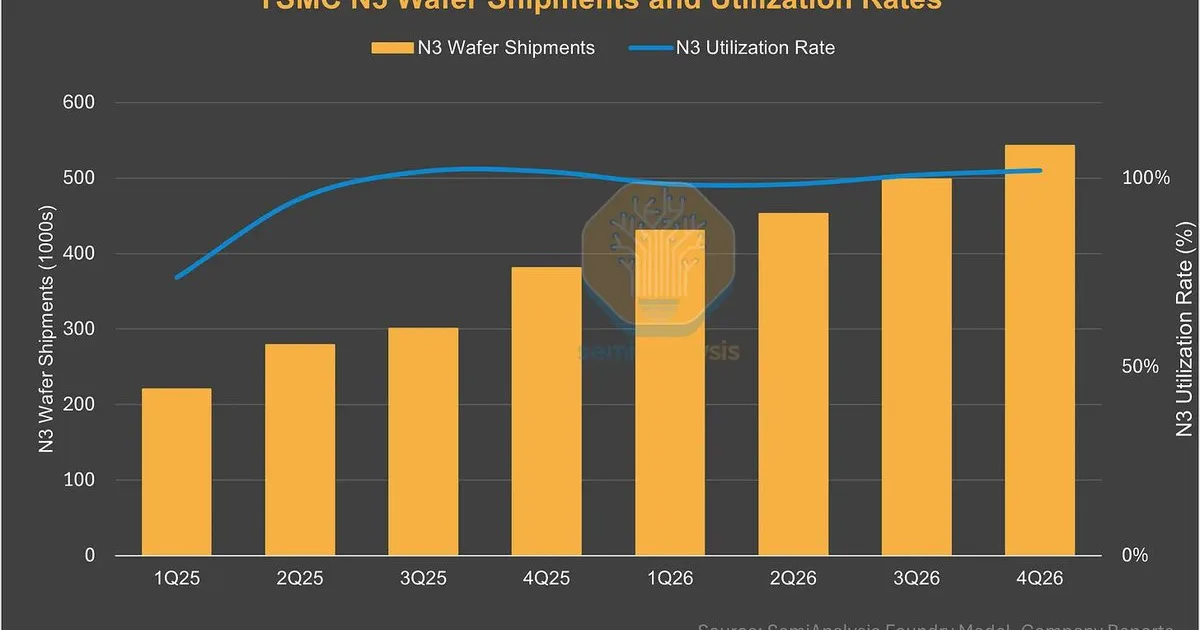
It also explains why the bottleneck conversation is migrating away from CoWoS, which is finally easing, and onto memory, where wafer supply cant keep up with HBM demand. The smartphone allocation tradeoff is real, and the full reallocation scenarios are in the article.
The broader implication, which we work through in detail in the piece, is that the supply curve for frontier accelerators is now effectively a policy decision inside two or three companies (TSMC, Apple, Samsung), not a capacity-investment question. That changes how you think http…
Our work shows AI taking roughly 60% of N3 family wafers in 2026 and stepping up to about 86% in 2027, which is a regime change. Once AI is consuming nearly all of a node, the elasticity that used to come from smartphone reallocation becomes a much bigger lever than it used to ht…
One of the throughlines in our Great AI Silicon Shortage piece is that the conversation about leading-edge capacity has shifted entirely, and most consensus accelerator models haven't caught up to where N3 demand is actually heading. (1/4) 🧵 https://t.co/mUNoX7Apdw