PulseAugur
实时 19:27:12
None A (Slightly) Mechanistic Theory for Exponentially Increasing AI Time Horizons?

AI时间跨度与任务复杂度相关,而非速度

LessWrong上的一项近期分析提出了一个机械论理论,用以解释所观察到的AI时间跨度呈指数级增长的现象,正如METR图所示。作者认为,“时间跨度”指标主要反映了给定任务中具有挑战性的子任务数量,而非AI的运行速度。这种观点表明,需要更多不同要求的长任务更有可能暴露AI的局限性,从而影响所测量的“时间跨度”。 AI

影响 该分析重塑了对AI进展指标的理解,表明任务复杂度,而不仅仅是速度,是预测未来能力的关键。

排序理由 该集群讨论了对现有AI进展指标的理论性解读,而非新的发布或经验性发现。

在 LessWrong (AI tag) 阅读 →

AI 生成摘要 · Google Gemini · 来自 1 个来源。 我们如何撰写摘要 →
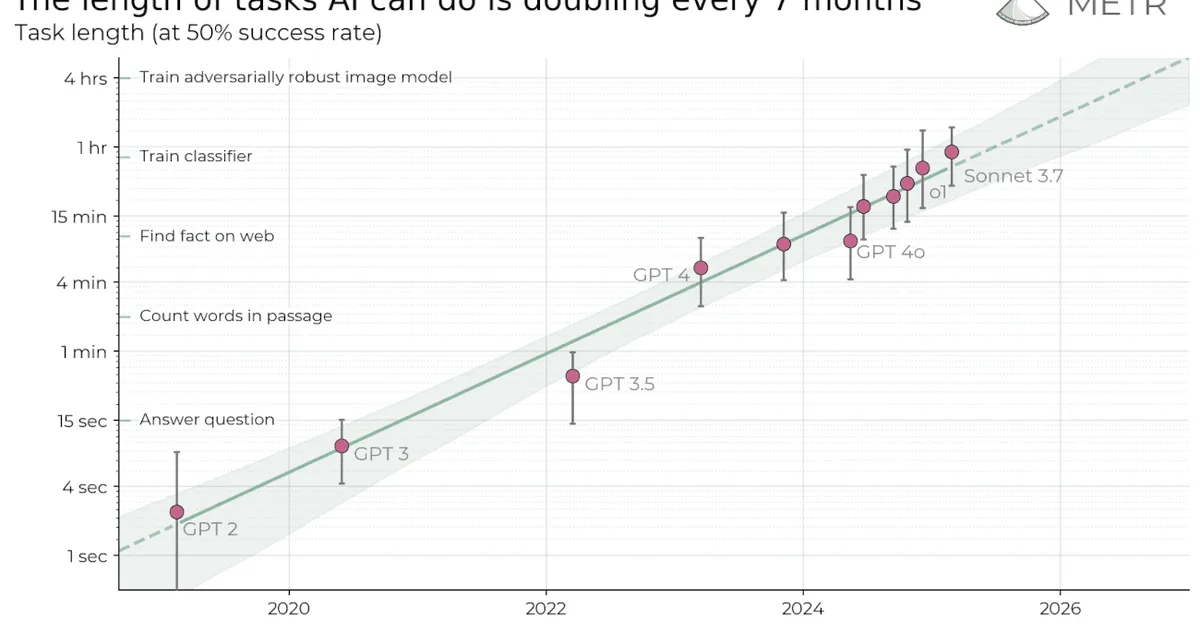
AI时间跨度与任务复杂度相关,而非速度

报道来源 [1]

  1. LessWrong (AI tag) TIER_1 · Oliver Sourbut ·

    A (Slightly) Mechanistic Theory for Exponentially Increasing AI Time Horizons?

    <p><i><span>AI ‘time horizons’ are mostly not about time (I think it’s mostly ‘data’, but you’ll see where I’m unsure).</span></i></p><p><span>One chart from 2025 has become perhaps the most (in)famous in modern AI commentary.</span></p><img alt="" src="https://res.cloudinary.com…