PulseAugur
实时 22:10:51
English(EN) If you want to learn more about RNG, please check our networking model. (7/7)

亚马逊部署新的 RNG 网络拓扑,声称节省 45% 的成本

亚马逊开发并部署了一种名为弹性网络图(RNG)的新网络拓扑,它偏离了传统的胖树架构。RNG 利用随机图的概念,使用混洗盒(shuffle boxes)代替机顶(ToR)交换机之间的直接连接。这种方法得到了亚马逊专有的路由协议 Spraypoint 的支持,声称与胖树相比,成本可节省高达 45%。 AI

影响 这种新的网络拓扑可以为 AI 工作负载提供更具成本效益和可扩展性的基础设施。

排序理由 这是来自一家主要科技公司的重大基础设施开发,详细介绍了新的网络拓扑及其声称的好处。

在 X — SemiAnalysis 阅读 →

AI 生成摘要 · Google Gemini · 来自 7 个来源。 我们如何撰写摘要 →

亚马逊部署新的 RNG 网络拓扑,声称节省 45% 的成本

报道来源 [7]

  1. X — SemiAnalysis TIER_1 English(EN) · SemiAnalysis_ ·

    If you want to learn more about RNG, please check our networking model. (7/7)

    If you want to learn more about RNG, please check our networking model. (7/7) https://t.co/kqt0IiSiFi

  2. X — SemiAnalysis TIER_1 English(EN) · SemiAnalysis_ ·

    Overall, with the reduction in layers, Amazon is claiming up to 45% cost saving compared to fat trees on a similar oversubscription ratio. As of now, RNG is the

    Overall, with the reduction in layers, Amazon is claiming up to 45% cost saving compared to fat trees on a similar oversubscription ratio. As of now, RNG is the first network based on random graphs concept deployed at scale. Amazon has currently deployed only 2 version of RNG:

  3. X — SemiAnalysis TIER_1 English(EN) · SemiAnalysis_ ·

    In RNG, the ToRs are not directly connected to each other, but via shuffle boxes, which are passive optical components. On the standard design, the datacenter i

    In RNG, the ToRs are not directly connected to each other, but via shuffle boxes, which are passive optical components. On the standard design, the datacenter is composed of 10 rooms, with 96 ToRs and 192 shuffle boxes per room, and 64 servers per ToR (6,144 total). (5/7) https:/…

  4. X — SemiAnalysis TIER_1 English(EN) · SemiAnalysis_ ·

    This implies major changes on the software stack as the infrastructure is fundamentally different from traditional networks. For RNG, Amazon introduced Spraypoi

    This implies major changes on the software stack as the infrastructure is fundamentally different from traditional networks. For RNG, Amazon introduced Spraypoint, their own routing protocol that maps all the routes from a source to a destination. Spraypoint also split packets ht…

  5. X — SemiAnalysis TIER_1 English(EN) · SemiAnalysis_ ·

    As its name suggests, random graphs networks are based on random cabling. This allows for a flat topology where the Top of Rack (ToR) switches are used as waypo

    As its name suggests, random graphs networks are based on random cabling. This allows for a flat topology where the Top of Rack (ToR) switches are used as waypoints to route packets within the network. (3/7)

  6. X — SemiAnalysis TIER_1 English(EN) · SemiAnalysis_ ·

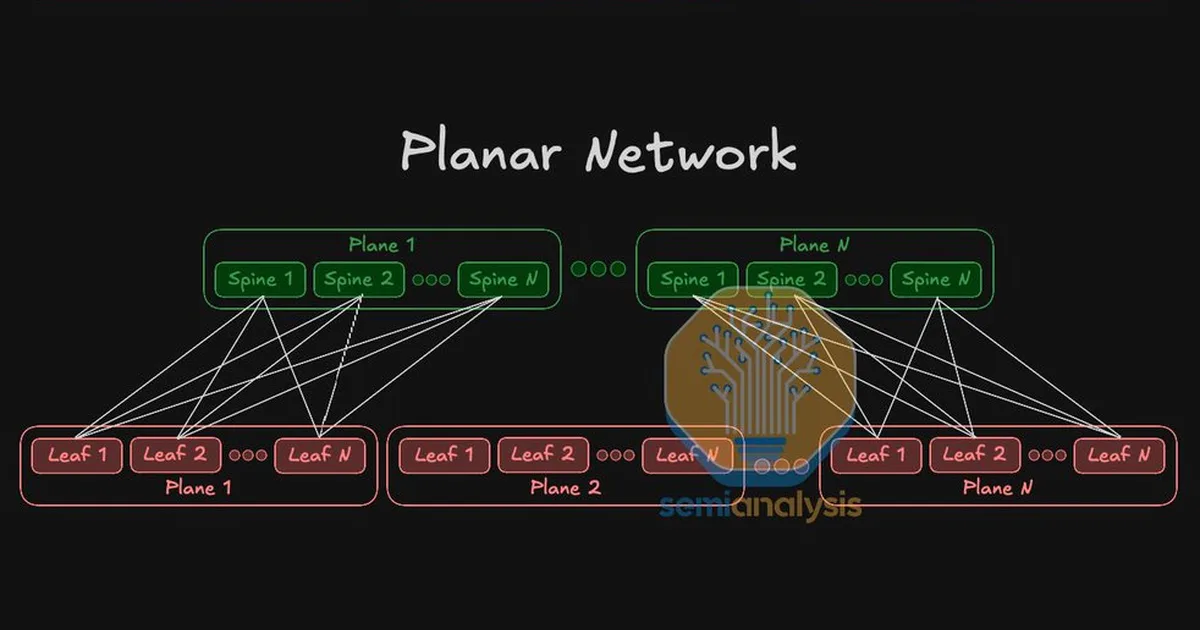
    Fat trees are hierarchy-like network topologies and various cabling strategies are applied (full mesh, rail-based or planar) depending on the network design to

    Fat trees are hierarchy-like network topologies and various cabling strategies are applied (full mesh, rail-based or planar) depending on the network design to balance between cost, radix and latency. (2/7) https://t.co/glvC29Kbzh

  7. X — SemiAnalysis TIER_1 English(EN) · SemiAnalysis_ ·

    In May, Amazon unveiled its latest network topology called RNG for Resilient Network Graphs. Unlike traditional fat trees, RNG relies on random graphs concept.

    In May, Amazon unveiled its latest network topology called RNG for Resilient Network Graphs. Unlike traditional fat trees, RNG relies on random graphs concept. (1/7)🧵 https://t.co/q44sc2ukhl