English(EN)GEAR: Guided End-to-End AutoRegression for Image Synthesis
新的自回归模型应对视频生成挑战 · 跟踪 8 个来源
作者PulseAugur 编辑部·[16 个来源]·
研究人员正在开发新方法来改进自回归视频生成,解决时间不一致和交互失败等问题。事件驱动视频生成 (EVD) 引入了显式的事件信号来指导采样器,从而提高动态和空间准确性。GEAR(引导式端到端自回归)联合训练分词器和生成器,以实现更快的收敛和更好的特征连贯性。Drift-AR 通过利用预测熵来加速自回归和扩散阶段,从而实现单步解码。TempAct 使用规划器-执行器强化学习框架来增强时间合理性和指令遵循能力,而“Directing the World”则侧重于组合式人类运动和相机轨迹控制,用于交互式世界模型。
AI
arXiv:2511.17089v2 Announce Type: replace-cross Abstract: We present Spanning Tree Autoregressive (STAR) modeling, which can incorporate prior knowledge of images, such as center bias and locality, to maintain sampling performance while also providing sufficiently flexible sequen…
arXiv:2603.13402v3 Announce Type: replace-cross Abstract: Current text-to-video models can make individual frames look convincing while still getting simple interactions wrong: objects move before contact, an intended action is skipped, a placed object keeps drifting, or a suppor…
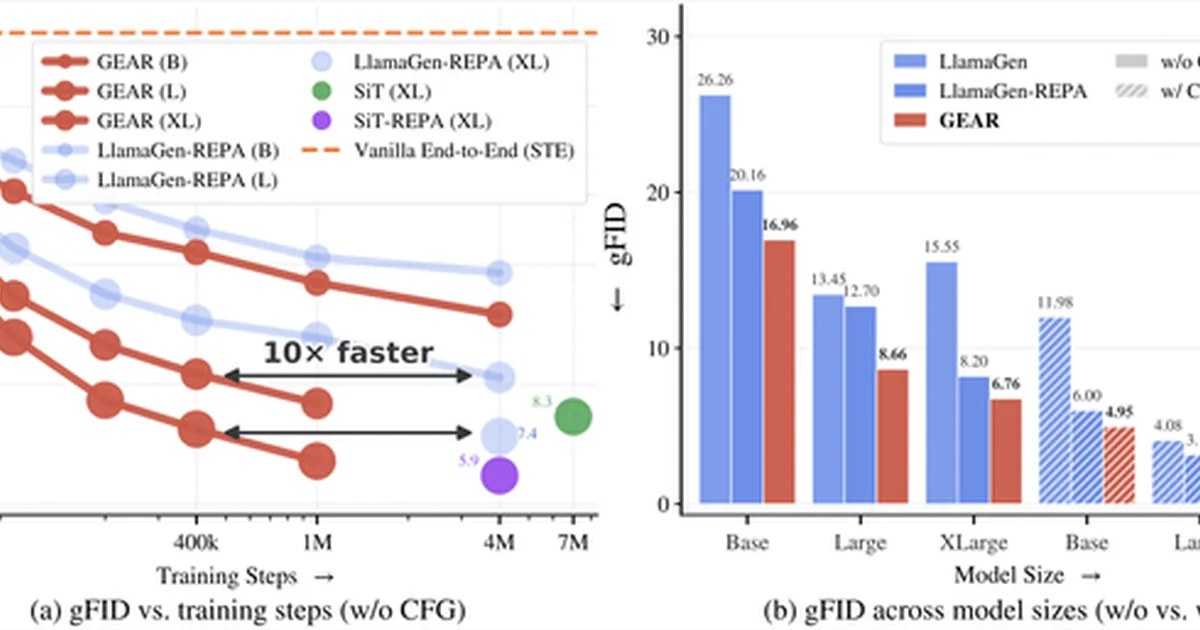
GEAR trains a vector-quantized tokenizer and autoregressive generator jointly end-to-end using representation alignment, overcoming non-differentiability issues through a dual read-out approach that improves convergence speed and feature quality.
arXiv cs.CV
TIER_1English(EN)·Xingtong Ge, Yi Zhang, Yushi Huang, Dailan He, Xiahong Wang, Bingqi Ma, Guanglu Song, Yu Liu, Jun Zhang·
arXiv:2607.00712v1 Announce Type: new Abstract: Autoregressive (AR) streaming models have emerged as a powerful paradigm for long video generation. However, the linearly growing Key-Value (KV) cache poses a significant bottleneck, leading to memory overload and degraded inference…
arXiv:2603.26661v2 Announce Type: replace Abstract: Most recent advances in 3D generative modeling rely on diffusion or flow-matching formulations. We instead explore a fully autoregressive alternative and introduce GaussianGPT, a transformer-based model that directly generates 3…
Autoregressive (AR) streaming models have emerged as a powerful paradigm for long video generation. However, the linearly growing Key-Value (KV) cache poses a significant bottleneck, leading to memory overload and degraded inference throughput. A common compression method is to d…
Visual generative models are typically trained in two stages. A tokenizer is first trained for reconstruction and then frozen, after which a generator is trained on its discrete indices or continuous latents. This decoupling leaves the tokenizer unaware of what the generator find…
arXiv:2603.28049v3 Announce Type: replace Abstract: Autoregressive (AR)-Diffusion hybrid paradigms combine AR's structured semantic modeling with diffusion's high-fidelity synthesis, yet suffer from a dual speed bottleneck: the sequential AR stage and the iterative multi-step den…
arXiv:2605.14382v4 Announce Type: replace Abstract: Interactive real-time autoregressive video generation is essential for applications such as content creation and world modeling, where visual content must adapt to dynamically evolving event conditions. A fundamental challenge l…
arXiv:2606.28016v1 Announce Type: new Abstract: Autoregressive (AR) video diffusion models enable low-latency streaming generation by synthesizing videos chunk by chunk with cached visual context, but this chunk-wise formulation makes temporal instruction following ambiguous. A s…
arXiv:2606.27964v1 Announce Type: new Abstract: Building interactive world models requires generating realistic videos while maintaining controllable dynamics over long horizons. Autoregressive video generation offers a scalable foundation, but suffers from error accumulation and…
Autoregressive (AR) video diffusion models enable low-latency streaming generation by synthesizing videos chunk by chunk with cached visual context, but this chunk-wise formulation makes temporal instruction following ambiguous. A single global prompt does not specify which sub-e…
Building interactive world models requires generating realistic videos while maintaining controllable dynamics over long horizons. Autoregressive video generation offers a scalable foundation, but suffers from error accumulation and temporal degradation during extended rollouts. …