PulseAugur
EN
LIVE 23:01:20

AI hardware bottleneck shifts to memory, consuming most advanced wafers

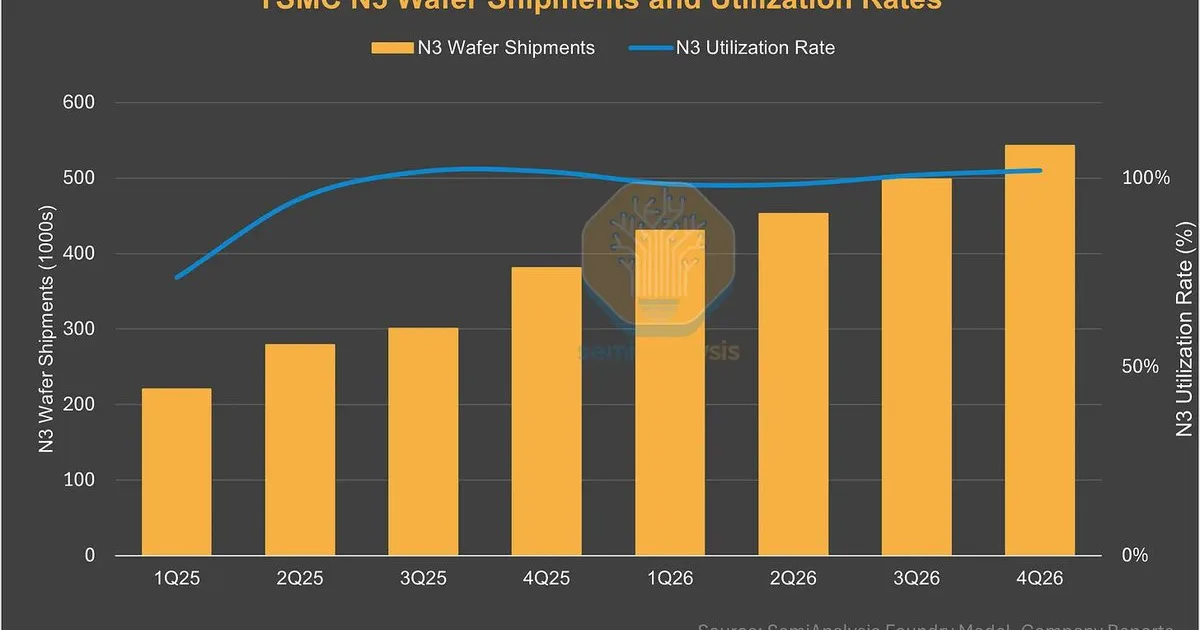
SemiAnalysis reports that the bottleneck in AI hardware is shifting from advanced packaging like CoWoS to memory, as wafer supply struggles to meet demand. This trend is projected to significantly increase AI's consumption of N3 family wafers, reaching approximately 86% by 2027. The analysis suggests that the future supply of AI accelerators is increasingly becoming a policy-driven decision rather than purely a technological one. AI

IMPACT Highlights potential supply constraints and policy influences on future AI hardware availability.

RANK_REASON Analysis piece discussing industry trends and projections, not a direct release or event.

Read on X — SemiAnalysis →

AI-generated summary · Google Gemini · from 4 sources. How we write summaries →
AI hardware bottleneck shifts to memory, consuming most advanced wafers

COVERAGE [4]

  1. X — SemiAnalysis TIER_1 English(EN) · SemiAnalysis_ ·

    It also explains why the bottleneck conversation is migrating away from CoWoS, which is finally easing, and onto memory, where wafer supply cant keep up with HB

    It also explains why the bottleneck conversation is migrating away from CoWoS, which is finally easing, and onto memory, where wafer supply cant keep up with HBM demand. The smartphone allocation tradeoff is real, and the full reallocation scenarios are in the article.

  2. X — SemiAnalysis TIER_1 English(EN) · SemiAnalysis_ ·

    The broader implication, which we work through in detail in the piece, is that the supply curve for frontier accelerators is now effectively a policy decision i

    The broader implication, which we work through in detail in the piece, is that the supply curve for frontier accelerators is now effectively a policy decision inside two or three companies (TSMC, Apple, Samsung), not a capacity-investment question. That changes how you think http…

  3. X — SemiAnalysis TIER_1 English(EN) · SemiAnalysis_ ·

    Our work shows AI taking roughly 60% of N3 family wafers in 2026 and stepping up to about 86% in 2027, which is a regime change. Once AI is consuming nearly all

    Our work shows AI taking roughly 60% of N3 family wafers in 2026 and stepping up to about 86% in 2027, which is a regime change. Once AI is consuming nearly all of a node, the elasticity that used to come from smartphone reallocation becomes a much bigger lever than it used to ht…

  4. X — SemiAnalysis TIER_1 English(EN) · SemiAnalysis_ ·

    One of the throughlines in our Great AI Silicon Shortage piece is that the conversation about leading-edge capacity has shifted entirely, and most consensus acc

    One of the throughlines in our Great AI Silicon Shortage piece is that the conversation about leading-edge capacity has shifted entirely, and most consensus accelerator models haven't caught up to where N3 demand is actually heading. (1/4) 🧵 https://t.co/mUNoX7Apdw