PulseAugur / Brief
EN
LIVE 07:27:50

Brief

last 24h
[25/25] 222 sources

Multi-source AI news clustered, deduplicated, and scored 0–100 across authority, cluster strength, headline signal, and time decay.

  1. READER: Reasoning-Enhanced AI-Generated Text Detection

    Researchers have developed READER, a novel system for detecting AI-generated text that outperforms larger models by incorporating a reasoning-based approach. This system, fine-tuned on a curated dataset of rationales and verdicts, provides explanations for its classifications. Concurrently, a comprehensive dataset has been released containing over 73,000 text samples, including authentic New York Times articles and synthetic versions generated by various state-of-the-art LLMs, to aid in developing more robust detection and attribution methods. AI

    IMPACT Advances in AI text detection are crucial for maintaining trust and combating misinformation in the digital age.
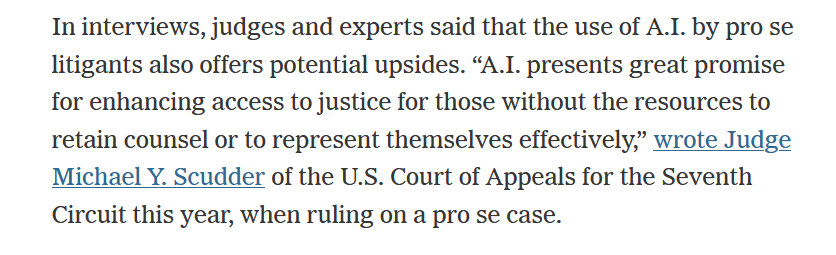

  2. AI is GOOD from NYT article on how "pro se" (people with out a lawyer, representing themselves) are using AI to file cases in court https://www. nytimes.com/202

    Artificial intelligence is proving beneficial for individuals representing themselves in legal proceedings. These "pro se" litigants are leveraging AI tools to assist in drafting and filing court documents. This integration of AI aims to democratize access to the legal system for those unable to afford legal representation. AI

    AI is GOOD from NYT article on how "pro se" (people with out a lawyer, representing themselves) are using AI to file cases in court https://www. nytimes.com/202

    IMPACT AI tools are making legal processes more accessible for individuals without legal representation.

  3. Video: Opinion | A Defense of a Liberal Arts Education in the Age of A.I. Via @nytimes #AI #ArtificialIntelligence 💻 🧠 Video: Opinion | A Defense of ...

    A New York Times opinion piece argues for the continued relevance of a liberal arts education despite the rise of artificial intelligence. The author contends that critical thinking, creativity, and ethical reasoning fostered by liberal arts are essential skills that AI cannot replicate. These skills are crucial for navigating a future increasingly shaped by AI technologies. AI

    IMPACT Argues that liberal arts skills are essential for navigating an AI-driven future, emphasizing human-centric capabilities.

  4. A Defense of a Liberal Arts Education in the Age of A.I. https://www.nytimes.com/video/opinion/100000010910563/a-defense-of-a-liberal-arts-education-in-the-age-

    A New York Times opinion piece argues for the continued relevance of liberal arts education despite the rise of artificial intelligence. The author contends that skills like critical thinking, creativity, and ethical reasoning, fostered by a liberal arts background, are essential for navigating an AI-driven future. These uniquely human capabilities are presented as crucial for understanding and guiding AI's development and societal impact. AI

    IMPACT Argues for the enduring value of humanistic skills in an AI-dominated world.

  5. On Being a Librarian: AI in Public Libraries: Useful, But Only If We Stay in Charge. “AI can be useful in public libraries when we treat it as a tool, not an au

    Pirated audiobooks created with AI are proliferating on YouTube, evading detection by current anti-piracy measures. These AI-generated versions often appear on the platform within hours of a legitimate release. Meanwhile, AI is also being considered as a tool for public libraries, but librarians emphasize the need for human oversight and strong privacy safeguards. AI

    IMPACT AI's dual use in content creation highlights challenges for copyright enforcement and prompts careful consideration of its integration into public services.

  6. This cartoon about # AI is via Jamian Gerard:

    A New York Times opinion piece argues that the US economy is resilient and capable of adapting to significant technological advancements, including AI. The article suggests that while concerns about AI-driven unemployment are valid, historical patterns indicate that economies can evolve and create new opportunities. This perspective counters widespread anxieties about the potential for widespread job displacement due to artificial intelligence. AI

    This cartoon about # AI is via Jamian Gerard:

    IMPACT Discusses the potential economic and employment impacts of AI, offering a perspective on societal adaptation.

  7. To A.I. Executives, We're All Just 'Meat Computers' https://www.nytimes.com/2026/05/24/business/meat-computer-brain-artificial-intelligence.html # AI # Business

    A New York Times article explores how AI executives increasingly view human intelligence as merely a biological precursor to artificial intelligence. This perspective, often termed 'meat-ism,' suggests that human brains are simply complex biological machines that will eventually be surpassed by more efficient AI systems. The article raises concerns about the potential dehumanizing effects of this viewpoint on societal values and ethical considerations. AI

    IMPACT Raises ethical questions about the perception of human value in an increasingly AI-driven world.

  8. Opinion | Graduating Into A.I. Pessimism https://www. byteseu.com/2047345/ # AI # ArtificialIntelligence # CampaignFinance # Companies # Layoffs ;Furloughs # Mi

    The author reflects on the growing pessimism surrounding artificial intelligence, particularly as individuals graduate into a job market increasingly shaped by AI's influence. This sentiment is amplified by concerns over AI's impact on campaign finance and the economy, alongside widespread layoffs and furloughs attributed to the technology. AI

    Opinion | Graduating Into A.I. Pessimism https://www. byteseu.com/2047345/ # AI # ArtificialIntelligence # CampaignFinance # Companies # Layoffs ;Furloughs # Mi

    IMPACT Discusses growing negative sentiment towards AI's economic and job market impact.

  9. Lawyers are worried about the potential of # AI notes of a meeting — almost entirely unvetted by humans — coming up in discovery. I actually have a different co

    Legal professionals are concerned about AI-generated meeting notes appearing in discovery, as these notes may be unvetted by humans. A related worry is the potential loss of these notes if subscription services are terminated before discovery requests are made. This situation introduces new challenges for record retention in legal proceedings. AI

    IMPACT Raises concerns about the admissibility and preservation of AI-generated records in legal discovery.

  10. It is fraud to publish and distribute a book purportedly by a human author that is extensively written by imitation intelligence software, without disclosing th

    Publishing a book extensively written by AI without disclosing its origin is considered fraudulent. This applies to both distributing the finished work and submitting it for publication. The New York Times article highlights this issue, emphasizing the importance of transparency regarding AI's role in content creation. AI

    IMPACT Establishes a legal and ethical precedent for AI-generated content, impacting authors, publishers, and consumers.

  11. Which Has Better Taste: A.I. or Humans? https://www.nytimes.com/video/opinion/100000010910614/which-has-better-taste-ai-or-humans.html # AI # Technology # Ethic

    A New York Times opinion piece explores whether artificial intelligence or humans possess superior taste in culture and aesthetics. The article, presented in both text and video formats, delves into the subjective nature of taste and how AI models are beginning to engage with and potentially influence cultural production. It raises questions about the role of AI in creative fields and the future of human artistic expression. AI

    IMPACT Explores the subjective nature of AI's cultural output and its potential influence on human aesthetics.

  12. @ newyorktimes writes a totally non critical article about the White House's investment in AI surveillance and war technology. Not one word about democratic or

    The White House is reportedly increasing its investment in AI technologies for surveillance and military applications. A critical article notes the lack of discussion regarding the potential democratic or environmental repercussions of this technological push. The focus appears to be on the acquisition of AI chips by spy agencies amidst a broader shortage. AI

    IMPACT Raises concerns about the ethical and environmental implications of government AI investments in surveillance and military tech.

  13. Russia’s economy is much worse than it seems, and ‘elites are increasingly alarmed’ as alternate GDP gauge shows huge contraction

    Sweden's government has presented alternative economic data for Russia, suggesting its economy has contracted by 8% since 2020, contrary to official Kremlin figures indicating growth. Swedish analysis also indicates significantly higher inflation and lower purchasing power than reported by Moscow. These findings suggest Russia's military spending capacity is weaker than perceived, despite some relief from higher oil prices due to the conflict in Iran. AI

    Russia’s economy is much worse than it seems, and ‘elites are increasingly alarmed’ as alternate GDP gauge shows huge contraction
  14. The pig in the python: Baby Boomers are strangling the economy they built by refusing to move or retire

    Baby Boomers, a large demographic cohort, have significantly influenced the U.S. economy for decades by distorting labor markets and housing prices. Their prolonged presence in the workforce suppressed wages for younger generations, and their ownership of larger homes has limited housing availability for millennials. As this generation now enters retirement, their departure is expected to create a substantial worker shortage and reshape labor markets, leaving younger generations to manage the economic transitions they initiated. AI

    The pig in the python: Baby Boomers are strangling the economy they built by refusing to move or retire
  15. AI keeps inventing fake cases. Lawyers keep citing them

    AI systems are repeatedly generating inaccurate information, leading to significant problems in professional fields like law and journalism. Lawyers have been sanctioned for citing fabricated legal cases produced by AI, and a database tracks over 1,400 instances of AI errors in court filings over the last three years. This issue stems from a human tendency to over-trust AI outputs, even when aware of their fallibility, which can lead to dismissed cases, fines, and other professional repercussions. AI

    IMPACT Highlights the risks of over-reliance on AI in professional settings, particularly in legal and journalistic fields, due to its tendency to fabricate information.

  16. Starbucks Drops AI As Meta And Intuit Cut 11,000 Jobs

    Major tech companies like Meta and Intuit are implementing significant layoffs, totaling over 11,000 jobs, to reallocate resources towards AI development. This trend contradicts the narrative that automation primarily transitions workers to new roles, as many affected are knowledge workers, and entry-level positions crucial for skill development are being eliminated. While new AI-focused roles are emerging, they often require several years of experience, creating a skills gap that prevents those laid off from transitioning into these positions. AI

    Starbucks Drops AI As Meta And Intuit Cut 11,000 Jobs

    IMPACT Accelerates AI development by reallocating talent, but widens the skills gap for entry-level workers.

  17. # AI generated legal filings threaten to overwhelm courts and cause legal costs to explode: https:// futurism.com/artificial-intell igence/mit-expert-ai-generat

    The increasing use of artificial intelligence in generating legal filings is overwhelming court dockets and driving up legal costs. Experts are concerned about the accuracy and authenticity of these AI-generated lawsuits, which can be produced rapidly and cheaply. This trend poses a significant challenge to the judicial system's ability to manage its caseload and ensure fair legal processes. AI

    IMPACT AI-generated legal filings are straining court systems and increasing legal expenses, necessitating new regulatory and procedural responses.

  18. College students are booing commencement speakers celebrating AI, but the wave of hate hasn’t stopped them from using it to cheat on their exams

    College students are exhibiting a dual attitude towards AI, simultaneously booing commencement speakers who celebrate the technology while also widely using it for coursework and, in some cases, academic dishonesty. This phenomenon, described as cognitive dissonance, stems from a fear of falling behind peers if AI tools are not used, despite concerns about hindering critical thinking skills. In response to widespread cheating, institutions like Princeton and Stanford are reverting to proctored exams and traditional methods like blue books, as AI detection tools have proven unreliable. AI

    College students are booing commencement speakers celebrating AI, but the wave of hate hasn’t stopped them from using it to cheat on their exams

    IMPACT Highlights the ethical challenges and adaptive strategies emerging in higher education due to widespread AI adoption by students.

  19. Hating AI Is Good

    An opinion piece argues that a growing segment of the population is actively rejecting artificial intelligence, viewing it as a liability rather than an inevitability. The author suggests that this 'anti-AI evangelist' movement is a legitimate constituency that should be taken seriously, especially as public opinion on AI appears to be souring rapidly. The piece highlights instances of graduates booing speakers who promote AI, indicating a generational divide and a desire to resist the technology's perceived imposition. AI

    IMPACT Suggests a growing public backlash against AI could influence its adoption and development.

  20. Gizmodo: The Scandal Over a Supposedly AI-Written, Award-Winning Short Story Is Troubling. Or Just Mean?. “When there was social media chatter on Monday about a

    A literary scandal has erupted over allegations that a short story, which purportedly won a prestigious award, was actually written by an AI. Initial skepticism arose due to the lack of concrete proof and reliance on AI detection tools, but the controversy has since escalated. The situation has drawn attention from major news outlets, highlighting concerns about AI's role in creative fields and the ethics surrounding its use in literature. AI

    IMPACT Raises ethical questions about AI authorship in creative works and the integrity of literary awards.

  21. # AI # MedicalAdvice . . . **Doctors, This Is Why Our Patients Are Using ChatGPT** https://www. nytimes.com/2026/05/24/opinion /doctor-ai-chatgpt.html?unlocked_

    A physician author for The New York Times expresses understanding for why patients turn to AI tools like ChatGPT for medical information, even when it frustrates their doctors. The author notes that AI can explain complex conditions in ways that resonate with patients, providing context that may be missing from traditional medical consultations. However, this reliance on AI can lead to challenging interactions with healthcare providers, as exemplified by the author's own experience where AI-generated questions caused their primary care physician to terminate the patient relationship. AI

    IMPACT Patients are increasingly using AI tools like ChatGPT to understand their health, potentially leading to more informed discussions with doctors but also creating friction in the patient-provider relationship.

  22. What A.I. Philanthropists Can Learn From the Gilded Age. Via @nytimes #AI #ArtificialIntelligence 💻 🧠 nytimes.com/2026/05/23/opi...

    An opinion piece in The New York Times draws parallels between modern AI philanthropists and the "robber barons" of the Gilded Age. The article suggests that the immense wealth and influence concentrated in the hands of a few AI philanthropists echo the unchecked power of industrialists from a century ago. It calls for a more critical examination of how these individuals and their motivations shape the future of artificial intelligence. AI

    IMPACT Examines the potential for concentrated power in AI philanthropy, drawing historical parallels to the Gilded Age.

  23. White House working group on AI – Statement from FLI’s Anthony Aguirre

    The White House is reportedly considering a new executive order to establish an AI working group focused on pre-deployment testing of advanced AI systems. This move is seen as a significant step towards regulating powerful AI, prompted by recent concerns over the potential risks posed by models like Anthropic's Mythos. The Future of Life Institute expressed encouragement, emphasizing the need for a comprehensive, government-led approach to safety and oversight, akin to regulations in other high-risk industries. AI

    IMPACT Potential government oversight of advanced AI could shape future development and deployment, prioritizing safety and national security.

  24. Today’s Wordle #1782 Hints And Answer For Wednesday, May 6

    Forbes contributor Erik Kain provides daily guides for the popular word game Wordle, offering hints, clues, and the answer for each day's puzzle. These articles also include a bonus custom Wordle challenge and analysis of the author's gameplay against the Wordle Bot. The guides detail the game's mechanics, scoring for competitive play, and etymological origins of the daily words. AI

    Today’s Wordle #1782 Hints And Answer For Wednesday, May 6

    IMPACT Minimal direct impact on AI operators; focuses on a popular word game.

  25. NYT Connections Answers Explained For Wednesday, May 6 (#1,060)

    Forbes is publishing daily guides for several New York Times Games, including the Mini crossword, Pips, Connections, and Strands. These articles provide hints, walkthroughs, and solutions for the puzzles, catering to players seeking assistance or wanting to check their answers. The content is aimed at helping users solve the daily challenges and improve their gameplay, with some articles also offering insights into the puzzle mechanics and strategies. AI

    NYT Connections Answers Explained For Wednesday, May 6 (#1,060)

    IMPACT These articles provide assistance for popular word games, offering tips and solutions to players.