PulseAugur / Brief
EN
LIVE 09:53:51

Brief

last 24h
[16/16] 221 sources

Multi-source AI news clustered, deduplicated, and scored 0–100 across authority, cluster strength, headline signal, and time decay.

  1. Character-trained models can struggle to generalise

    Researchers found that models fine-tuned for specific personas in a chat format struggle to maintain those personas when used in agentic settings. When these character-trained models were prompted to generate emails as part of a simulated agentic task, their persona expression significantly degraded. This suggests that the persona training, often done via SFT or DPO on chat data, does not generalize well to different output formats or task contexts. AI
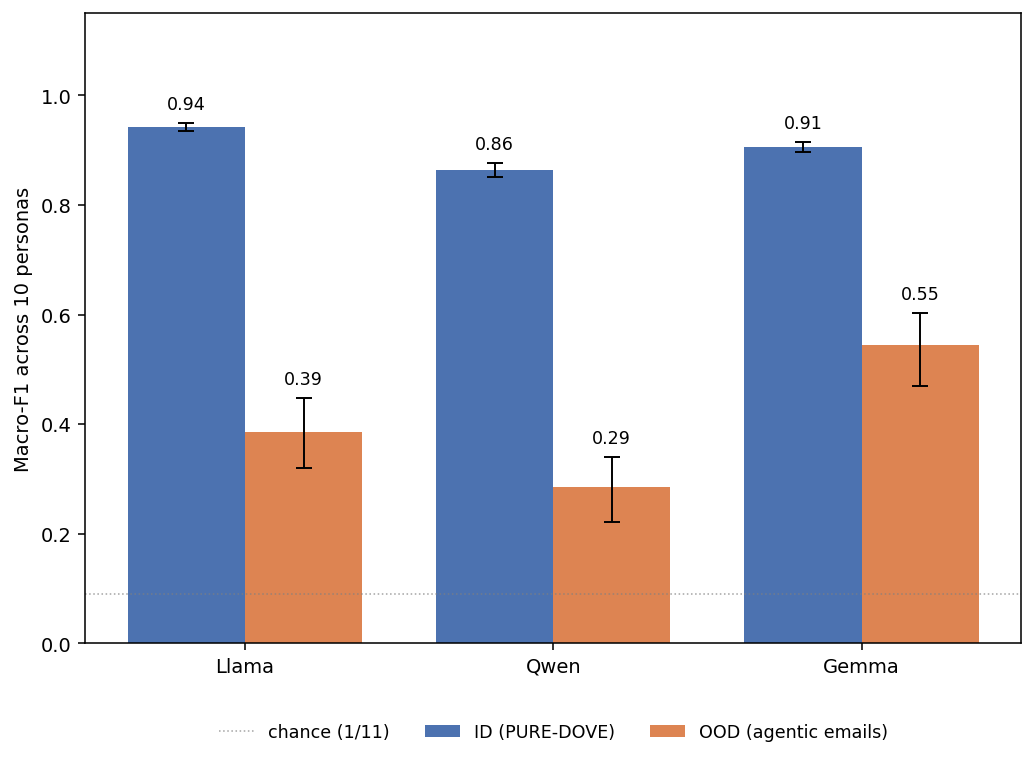
    Character-trained models can struggle to generalise

    IMPACT Persona training in chat formats may not transfer to agentic tasks, limiting the reliability of character-consistent AI agents.

  2. Can you jailbreak Llama 3.1 8B? (Red-Teaming Challenge)

    A challenge has been issued to test the safety guardrails of Meta's Llama 3.1 8B model. The goal is to see if users can successfully "jailbreak" the model, forcing it to deviate from its programmed directive of guiding students through science and math problems without providing direct answers. Participants have a limited number of prompts to attempt to break the agent, with success defined as either eliciting a direct answer or causing the agent to go off-topic. The challenge is part of an effort to test a runtime governance engine designed to enforce alignment. AI

    IMPACT Tests the effectiveness of safety guardrails on open-source models, potentially influencing future alignment strategies.

  3. RoIt-XMASA: Multi-Domain Multilingual Sentiment Analysis Dataset for Romanian and Italian

    Researchers have introduced RoIt-XMASA, a new dataset designed for multilingual sentiment analysis in Romanian and Italian. This dataset includes 36,000 labeled reviews across books, movies, and music, along with over 200,000 unlabeled samples. To tackle cross-lingual and cross-domain challenges, they developed a multi-target adversarial training framework that achieved an F1-score of 66.23% with XLM-R, surpassing the baseline by 4.64%. AI

    IMPACT Enhances multilingual NLP capabilities, particularly for under-resourced languages like Romanian and Italian.

  4. Convex Optimization for Alignment and Preference Learning on a Single GPU

    Researchers have developed a new method called COALA, which uses convex optimization to fine-tune large language models for human preferences. This approach significantly reduces the computational resources and training time required compared to existing methods like DPO, enabling efficient training on a single GPU. COALA demonstrates competitive performance across multiple datasets and models, achieving stable reward increases and faster convergence. AI

    IMPACT Enables more efficient fine-tuning of LLMs on limited hardware, potentially democratizing access to preference alignment techniques.

  5. I spent 31 hours on the math behind TurboQuant so you don't have to

    A technical deep dive explains the inner workings of TurboQuant, a novel method for compressing large language model KV caches. TurboQuant utilizes a technique called PolarQuant, which transforms KV embeddings into polar coordinates and quantizes the resulting angles. This approach aims to significantly reduce the memory footprint of the KV cache, a major bottleneck for long-context LLMs, by compressing it over 4.2x. AI

    I spent 31 hours on the math behind TurboQuant so you don't have to

    IMPACT Compressing LLM KV caches with methods like TurboQuant could enable longer context windows and more efficient inference, reducing memory bottlenecks.

  6. Q8_0 isn't slow because of swap

    A benchmark of Llama 3.1 8B on an Apple M4 Mac Mini with 16GB unified memory revealed that the Q8_0 quantization, despite fitting entirely in memory, suffers from slow token generation due to memory bandwidth limitations. The analysis showed that the 8-bit weights saturate the memory bus, causing the GPU to spend most of its time transferring data rather than computing. The study identified Q4_K_M as a practical sweet spot, offering nearly the same quality as Q8_0 but at a significantly faster speed without hitting swap. AI

    Q8_0 isn't slow because of swap

    IMPACT Identifies memory bandwidth as a key bottleneck for local LLM deployment, influencing hardware choices and quantization strategies for enterprise applications.

  7. Our AI Inference Bill Dropped 65% After We Stopped Treating Every Query the Same

    SentinelOps AI implemented a routing layer called CascadeFlow to optimize LLM inference costs. This system directs queries to different models based on complexity, sending simple lookups to a cheaper, faster 8B parameter model and complex operational or compliance questions to a more powerful 70B parameter model. This tiered approach reduced their AI inference bill by 65%, though initial misclassification rates required adjustments like keyword pre-checks and confidence thresholds to maintain accuracy for critical queries. AI

    Our AI Inference Bill Dropped 65% After We Stopped Treating Every Query the Same

    IMPACT Optimizing LLM inference costs through tiered routing can significantly reduce operational expenses for AI-powered applications.

  8. Context Memorization for Efficient Long Context Generation

    Researchers have developed a new method called attention-state memory to improve how large language models handle long context inputs. This training-free approach externalizes the prefix into a memory of precomputed attention states, addressing limitations like fading influence and linear scaling of attention computation. Experiments show it enhances accuracy and significantly reduces attention latency compared to existing methods, even outperforming full-attention RAG with a smaller memory footprint. AI

    Context Memorization for Efficient Long Context Generation

    IMPACT This new method could enable more efficient and accurate processing of long documents and conversations by LLMs.

  9. APM: Evaluating Style Personalization in LLMs with Arbitrary Preference Mappings

    Researchers have developed a new benchmark called Arbitrary Preference Mapping (APM) to evaluate how well large language models can adapt to users' implicit style preferences. The APM benchmark uses a randomized mapping to decouple user attributes from response principles, preventing models from relying on stereotypes and forcing them to infer preferences from conversation history. Experiments using this methodology on Llama-3.1-8B and Qwen-3.5-27B showed that routing-based personalization methods were the most effective, while other approaches like RAG and soft prompt optimization showed limited improvement. AI

    APM: Evaluating Style Personalization in LLMs with Arbitrary Preference Mappings

    IMPACT Introduces a novel evaluation method for LLM personalization, potentially improving user experience and model adaptability.

  10. DrugRAG: Enhancing Pharmacy LLM Performance Through A Novel Retrieval-Augmented Generation Pipeline

    Researchers have developed DrugRAG, a novel retrieval-augmented generation pipeline designed to enhance the performance of large language models (LLMs) on pharmacy-related question-answering tasks. In their study, they evaluated ten LLMs, finding that GPT-5 and o3 performed best on a 141-question dataset. DrugRAG, which integrates structured drug information without altering model architecture, significantly improved accuracy across several models, particularly smaller open-source ones, by up to 21 percentage points. AI

    IMPACT Provides a practical method to enhance LLM accuracy for specialized knowledge domains like pharmacy.

  11. How Much Online RL is Enough? Informative Rollouts for Offline Preference Optimization in RLVR

    Researchers have developed G2D, a three-stage pipeline that combines GRPO and DPO for more efficient offline preference optimization in language models. This method involves a brief GRPO warm-up, followed by constructing a static preference dataset and then fine-tuning with DPO. Experiments on Qwen2.5-7B and Llama-3.1-8B models demonstrated that G2D can match or exceed the performance of full online GRPO with significantly reduced computational cost, by focusing on the informativeness of the preference data rather than just the quantity. AI

    IMPACT Offers a compute-efficient alternative to online RL for language model training by improving data informativeness.

  12. Camouflage Injection Paper: Camouflage Detection Gap

    A new research paper reveals a significant vulnerability in current Large Language Model (LLM) safety systems, termed the Camouflage Detection Gap. This gap occurs when malicious injection payloads are rewritten to mimic the domain-specific language and structure of the target document, causing standard detectors to fail. For instance, detection rates for Llama 3.1 8B dropped from 93.8% to 9.7%, and for Gemini 2.0 Flash from 100% to 55.6%, with a dedicated classifier, Llama Guard 3, catching zero camouflaged payloads. Furthermore, multi-agent debate architectures, intended as a defense, can amplify these attacks on smaller models. AI

    IMPACT Current LLM safety detectors are vulnerable to domain-camouflaged injection attacks, potentially undermining agent security and requiring new defense strategies.

  13. Multilingual Steering by Design: Multilingual Sparse Autoencoders and Principled Layer Selection

    Researchers have developed a new method for improving multilingual language control in large language models using sparse autoencoders (SAEs). Their approach involves training SAEs on multilingual data to enhance cross-lingual representations and introduces a principled rule for selecting effective layers for intervention. This method stabilizes the balance between language identification accuracy and generation quality, offering a more reliable way to steer LLMs across different languages. AI

    IMPACT This research offers a more principled and reliable method for controlling multilingual LLMs, potentially improving cross-lingual tasks like translation and summarization.

  14. Variational Linear Attention: Stable Associative Memory for Long-Context Transformers

    Researchers are developing new attention mechanisms to handle increasingly long contexts in large language models. One approach, Runtime-Certified Bounded-Error Quantized Attention, uses tiered KV caches to compress memory while guaranteeing fallback to exact attention, ensuring quality for tasks like language modeling and retrieval. Another method, DashAttention, employs differentiable sparse hierarchical attention to adaptively select relevant tokens, achieving high sparsity with comparable accuracy to full attention and offering improved performance over existing hierarchical methods. Variational Linear Attention (VLA) reframes linear attention as a regularized least-squares problem, limiting state norm growth and improving associative recall accuracy, while also achieving significant speedups. AI

    Variational Linear Attention: Stable Associative Memory for Long-Context Transformers

    IMPACT These advancements in attention mechanisms promise to significantly improve the efficiency and capability of LLMs in processing and understanding long contexts.

  15. Translate or Simplify First: An Analysis of Cross-lingual Text Simplification in English and French

    Researchers are exploring how large language models (LLMs) align with human brain activity across different languages and tasks. Studies show that intermediate LLM layers best predict brain responses, and this alignment is influenced by training data language dominance rather than inherent model typology. Furthermore, instruction-tuned multimodal LLMs demonstrate stronger brain alignment, particularly when organized around task-specific demands rather than just surface semantics. AI

    Translate or Simplify First: An Analysis of Cross-lingual Text Simplification in English and French

    IMPACT Investigates how LLMs process and represent information, offering insights into their cognitive alignment and potential for cross-lingual and multimodal tasks.

  16. Fine

    Together AI has enhanced its fine-tuning platform to support a wider array of large language models, including recent releases from DeepSeek, Qwen, and Meta, alongside OpenAI's gpt-oss. The platform now offers expanded context lengths, up to 131k tokens for some models, at no additional cost, facilitating tasks like long-document processing and complex code editing. Separately, Together AI researchers have explored LLM behavior using minimal, topic-neutral prompts to uncover inherent model preferences, finding that GPT-OSS favors programming and math, Llama leans literary, DeepSeek often produces religious content, and Qwen tends toward multiple-choice questions. AI

    Fine

    IMPACT Together AI's platform updates enable developers to fine-tune a broader range of large models with extended context, potentially lowering costs and improving performance on complex tasks.