PulseAugur / Brief
EN
LIVE 21:06:27

Brief

last 24h
[50/301] 221 sources

Multi-source AI news clustered, deduplicated, and scored 0–100 across authority, cluster strength, headline signal, and time decay.

  1. 🐧 Debian-based Besgnulinux 4-0 launches with multiple improvements With a focus on stability and lightness, Besgnulinux 4-0 is now available with plenty of upda

    Cerebras Systems' wafer-scale chips are specifically designed for large language model (LLM) and generative AI workloads, rather than general AI applications. This focus positions Cerebras as a key player in the specialized infrastructure required for advanced AI development. The company's hardware approach aims to provide efficient and powerful solutions for training and deploying these complex models. AI

    IMPACT Cerebras' specialized hardware could accelerate the development and deployment of large language models by providing optimized infrastructure.

  2. Capacitor: From Web to Mobile Apps. Part 4. Integrating a Local LLM into the Project In this 5th article, we will discuss the relevance of local AI

    This article explores the integration of local Large Language Models (LLMs) into mobile applications using the Capacitor framework. It discusses the current relevance of on-device AI for mobile development and provides a practical guide for incorporating an LLM plugin into a Capacitor project. The content is presented as the fifth part of a series on building mobile apps with Capacitor. AI

    IMPACT Provides a technical guide for developers integrating local LLMs into mobile applications.

  3. Your AI Agent from Mail, systemd, and LLM. In previous articles, I built a home cloud on Proxmox. Now, something more interesting lives inside it – fully autonomous

    A developer has created an autonomous AI agent named Threlium, which can be controlled via email or Telegram messages. This agent is designed to perform multi-step reasoning, maintain long-term memory, and execute commands. Notably, Threlium is capable of self-modification and is built using systemd and LLMs within a self-hosted environment. AI

    IMPACT Details a novel approach to building self-modifying AI agents for personal use.

  4. Most people starting with local LLMs jump straight to 4-bit quantization because it's fast and uses

    New analysis suggests that users often prioritize speed over quality when running local Large Language Models, opting for 4-bit quantization without considering the task at hand. While 4-bit offers the fastest inference, it significantly degrades performance on tasks requiring precision like math or code generation. For such applications, 8-bit quantization provides a better balance, delivering nearly the same speed as 4-bit with minimal quality loss. The choice should be guided by the specific task and then by hardware constraints, rather than solely by available VRAM. AI

    IMPACT Guides users on optimizing local LLM performance by choosing appropriate quantization levels based on task requirements.

  5. Bridging the Last Mile of Circuit Design: PostEDA-Bench, a Hierarchical Benchmark for PPA Convergence and DRC Fixing

    Researchers have developed PostEDA-Bench, a new benchmark designed to evaluate the performance of Large Language Model (LLM) agents in the final stages of circuit design. This benchmark addresses limitations in existing tools by incorporating Design Rule Check (DRC) fixing and focusing on hierarchical task structures. Initial tests across eight LLMs revealed that while agents perform well on simpler DRC and single-objective PPA tasks, they struggle significantly with complex reasoning and multi-objective optimization, indicating a need for further development in these areas. AI

    IMPACT Introduces a benchmark to measure LLM agent capabilities in complex circuit design tasks, highlighting current limitations and future research directions.

  6. I turned an LLM into a Cinematic Visual Prompt Architect — Sharing the Framework

    A user has developed a framework that transforms a large language model into a "Visual Prompt Architect" for AI image generation. This framework guides the LLM to act more like a film director and cinematographer, focusing on composition, emotional consistency, and understanding the specific capabilities of different image models. The goal is to produce more coherent, cinematic, and less generic AI-generated images by leveraging the LLM's planning abilities rather than simple keyword generation. AI

    IMPACT Enhances AI image generation by providing a structured method for prompt creation, leading to more artistic and coherent visuals.

  7. Content-Aware Attack Detection in LLM Agent Tool-Call Traffic: An Empirical Study of Features, Architectures, and Evaluation Protocols

    Researchers have developed a novel framework for detecting attacks within the tool-call traffic of Large Language Model (LLM) agents. This system represents agent sessions as graphs, incorporating sentence-embedding features from tool arguments and responses to classify traffic as benign or malicious. The study found that content-level features are crucial for effective detection, significantly outperforming metadata-only approaches, and highlighted a common evaluation pitfall that can inflate performance metrics. AI

    IMPACT This research introduces a more robust method for securing LLM agents by detecting malicious tool-use, which could improve the safety and reliability of AI systems interacting with external services.

  8. Strategic Coercion Within Alliances: The Greenland Sovereignty Game as an AI Stress Test

    Researchers have developed a novel AI stress test using the Greenland sovereignty dispute to evaluate geopolitical decision-making in large language models. The study simulated thousands of games where eight frontier LLMs played various international roles, revealing that all models escalated conflict more frequently when framed as coercion. Notably, Chinese-origin models exhibited distinct power dynamics compared to Western models when acting as the United States, and peaceful acquisition of Greenland was rare across simulations. AI

    IMPACT Establishes a new benchmark for evaluating LLM geopolitical reasoning and potential for escalation in international relations.

  9. LLM Code Smells: A Taxonomy and Detection Approach

    Researchers have developed a new taxonomy and detection method for "LLM code smells," which are poor integration practices of large language models in software systems. Their static analysis tool, SpecDetect4LLM, was evaluated on over 690 open-source projects. The findings indicate that these code smells are prevalent, affecting over 73% of analyzed systems, with the detection tool achieving high precision. AI

    IMPACT Identifies and provides tools to mitigate common software engineering pitfalls when integrating LLMs, potentially improving the quality and reliability of AI-powered applications.

  10. Efficient and Transferable Agentic Knowledge Graph RAG via Reinforcement Learning

    Researchers have developed KG-R1, a novel framework that uses reinforcement learning to optimize knowledge-graph retrieval-augmented generation (KG-RAG) systems. Unlike existing methods that employ fixed pipelines of multiple large language model (LLM) modules, KG-R1 utilizes a single agent that learns to interact with knowledge graphs. This approach reduces inference costs and improves accuracy, even when using smaller models like Qwen 2.5-3B, by integrating retrieval and generation into a unified process. The framework also demonstrates strong transferability, maintaining performance on unseen knowledge graphs without retraining. AI

    IMPACT This research could lead to more efficient and accurate LLM applications by reducing hallucination and inference costs in knowledge-intensive tasks.

  11. GradingAttack: Exposing Security Vulnerabilities in LLM Based Educational Grading Agents

    Researchers have developed a new framework called GradingAttack to expose security vulnerabilities in large language model (LLM) based educational grading agents. The study introduces token-level and prompt-level attack strategies designed to manipulate grading outcomes with high stealth. Experiments showed that these attacks can effectively compromise grading agents, highlighting the urgent need for more secure LLM systems in education. AI

    IMPACT Highlights critical security flaws in LLM-based educational tools, necessitating the development of more robust and trustworthy AI systems for academic integrity.

  12. Automatic Construction of Clinical Scoring Systems with LLM Agents

    Researchers have developed AgentScore, a novel method for automatically constructing clinical scoring systems using LLM agents. This approach addresses the challenge of creating interpretable and deployable clinical guidelines by leveraging LLMs to propose rules and a verification loop to ensure statistical validity. AgentScore demonstrated superior performance compared to existing methods across eight clinical prediction tasks and outperformed established scores on two external validation tasks. AI

    IMPACT Automates the creation of interpretable clinical scoring systems, potentially improving guideline deployment and patient care.

  13. Eval Set Drift: How to Know When Your Golden Set Went Stale

    The author discusses two common challenges in managing LLM applications: eval set drift and per-customer cost reporting. For eval set drift, they propose using Maximum Mean Discrepancy (MMD) on embeddings to detect when evaluation datasets no longer represent production data. For cost reporting, they suggest leveraging OpenTelemetry baggage to propagate customer IDs across services, avoiding costly pipeline rearchitectures. AI

    Eval Set Drift: How to Know When Your Golden Set Went Stale

    IMPACT Provides practical techniques for developers to improve LLM evaluation accuracy and cost management, crucial for operationalizing AI applications.

  14. ByteDance study finds that asking LMMs questions beats making it transcribe text for long document training

    A ByteDance study demonstrates that a 7B parameter model can effectively process and answer questions about lengthy, image-rich documents. This approach, which involves the model learning by answering questions and locating relevant passages, proved more reliable than traditional transcription methods, even for documents significantly longer than the model's training data. The research suggests this question-answering method enhances performance for large language models (LLMs) when dealing with extensive and multimodal content. AI

    ByteDance study finds that asking LMMs questions beats making it transcribe text for long document training

    IMPACT This research suggests a more efficient training method for LLMs to handle long, image-heavy documents, potentially improving their ability to extract information from complex texts.

  15. Prompt Diff Testing: A/B Your Prompts Without Changing the Model

    This post introduces a method for testing changes to large language model prompts, treating them as code migrations rather than simple edits. It proposes a 50-line Python script that runs evaluations against two prompt versions, calculates the difference in output scores, and uses bootstrapping to determine statistical significance. This approach aims to prevent subtle prompt changes from degrading model performance without immediate detection, ensuring quality is maintained across different user segments. AI

    Prompt Diff Testing: A/B Your Prompts Without Changing the Model

    IMPACT Enables more robust evaluation of LLM prompt changes, preventing regressions and improving model reliability in production.

  16. Skillpunk Architecture: Distributed Skill Autonomy vs. the LLM Orchestrator

    The Skillpunk architecture proposes a shift from centralized LLM orchestrators to a distributed model where individual skills possess autonomy. Unlike current LLM integrations that treat tool calls as one-off events, Skillpunk enables skills to manage their own state, triggers, and multi-step behaviors over time. This approach allows for persistent, background actions like monitoring prices or scheduling alerts without constant LLM intervention, by embedding the intelligence directly within each skill. AI

    IMPACT This architecture could enable more persistent and autonomous AI agents capable of complex, long-term tasks beyond simple query-response cycles.

  17. How to Evaluate Your RAG Pipeline

    This article outlines a comprehensive framework for evaluating Retrieval-Augmented Generation (RAG) pipelines, emphasizing the need to assess both the retrieval and generation components independently. It highlights common failure modes, such as retrieval of outdated or irrelevant documents, and generation that deviates from the provided context. The proposed RAG Triad framework uses three core metrics: context precision, faithfulness, and answer relevance, to ensure accurate and reliable responses. AI

    IMPACT Provides a structured approach to improve RAG system reliability by identifying and addressing specific failure points in retrieval and generation.

  18. Why RAG Pipelines Silently Hallucinate — And The Decay Score That Catches It Before The LLM Does

    A new 'decay score' has been developed to address the issue of outdated information in Retrieval-Augmented Generation (RAG) pipelines. This score measures the temporal staleness of documents retrieved by vector databases, which can lead to LLMs hallucinating with superseded information. The decay score, calculated based on document age and a source-specific half-life, is applied before the LLM synthesizes an answer, providing a warning for aging content without altering the existing pipeline. A free tier is available for testing this new gate. AI

    IMPACT Addresses a critical flaw in RAG systems, potentially improving the reliability of LLM outputs by managing data freshness.

  19. LLM Trace Storage Cost: Why Your S3 Bill Exploded, and 3 Fixes

    A significant cost issue has emerged for teams using LLM tracing, primarily due to the large storage requirements of prompts and responses. Storing full LLM trace payloads without a retention policy can drastically increase AWS S3 bills. The article proposes three solutions: sampling successful traces while retaining all errors, implementing tiered storage with lifecycle policies for older data, and optimizing the data stored by focusing on critical information. AI

    LLM Trace Storage Cost: Why Your S3 Bill Exploded, and 3 Fixes

    IMPACT Optimizing LLM tracing storage can significantly reduce operational costs for AI development teams.

  20. Calibrated LLM-as-judge: how I made my LLM give honest 4/10 scores instead of always-an-8

    A developer created a system to generate ad scripts, where the LLM initially assigned overly high scores to the generated hooks. To address this, the developer implemented a three-layer approach within the system prompt. This involved providing a calibrated scoring rubric with clear definitions for each score, including worked examples, and enforcing structured JSON output to ensure the LLM adhered to the scoring guidelines, resulting in more realistic score distributions. AI

    IMPACT Provides a practical method for improving LLM evaluation accuracy without fine-tuning, enabling more reliable AI-generated content assessment.

  21. I Added a /recovery Endpoint to My LLM Proxy So Agents Never Lose Progress Mid-Task

    A new Go-based LLM proxy called Trooper has introduced a novel recovery endpoint designed to prevent agents from losing progress during multi-agent workflows. Unlike traditional proxies that simply retry requests or fall back to other providers, Trooper tracks completed steps in real-time. When a failure occurs, its `/recovery/{session_id}` endpoint provides orchestration layers with a list of completed tasks and the exact step to resume from, thereby avoiding redundant work. AI

    IMPACT Enhances the reliability of multi-agent AI systems by preventing data loss during task execution.

  22. Building Marksmith: lessons from making Markdown bearable in VS Code

    A developer created a VS Code extension called Marksmith to improve the Markdown writing experience by addressing common workflow frustrations. The extension features 'Smart Paste' to automatically format copied tables into Markdown and create links from selected text and URLs. It also implements bidirectional scrolling synchronization between the editor and preview panes and includes a 'Document X-Ray' feature to estimate LLM token counts for documents. AI

    IMPACT Enhances developer workflows for AI-related documentation and prompt engineering.

  23. Building a Markdown-to-JSON Pipeline with Structured LLM Output

    This article details a Python pipeline designed to extract structured data from unstructured markdown documents using large language models. It emphasizes the limitations of traditional markdown parsers for semantic content extraction and proposes an LLM-based approach for greater resilience to formatting variations. The process involves defining a Pydantic schema for the desired JSON output, embedding this schema directly into prompts for the LLM, and implementing a robust extraction and validation layer to ensure the model returns only valid JSON. AI

    IMPACT Provides a practical method for integrating LLMs into data processing pipelines for structured information extraction.

  24. AI Inside the Monolith: Delivering a Lightweight, Modern UI for Oracle EBS with Zero Core Rewrite

    A new architectural approach has been developed to integrate generative AI with monolithic enterprise systems like Oracle E-Business Suite (EBS) without altering the core legacy code. This method involves creating a lightweight semantic layer that acts as a plugin, translating complex technical data structures into understandable business terms for AI models. This abstraction layer prevents AI hallucinations and ensures accurate data interpretation, even in heavily customized environments, by operating on virtual data marts instead of direct database access. AI

    AI Inside the Monolith: Delivering a Lightweight, Modern UI for Oracle EBS with Zero Core Rewrite

    IMPACT Enables AI integration with legacy enterprise systems, potentially unlocking new analytical capabilities without costly system overhauls.

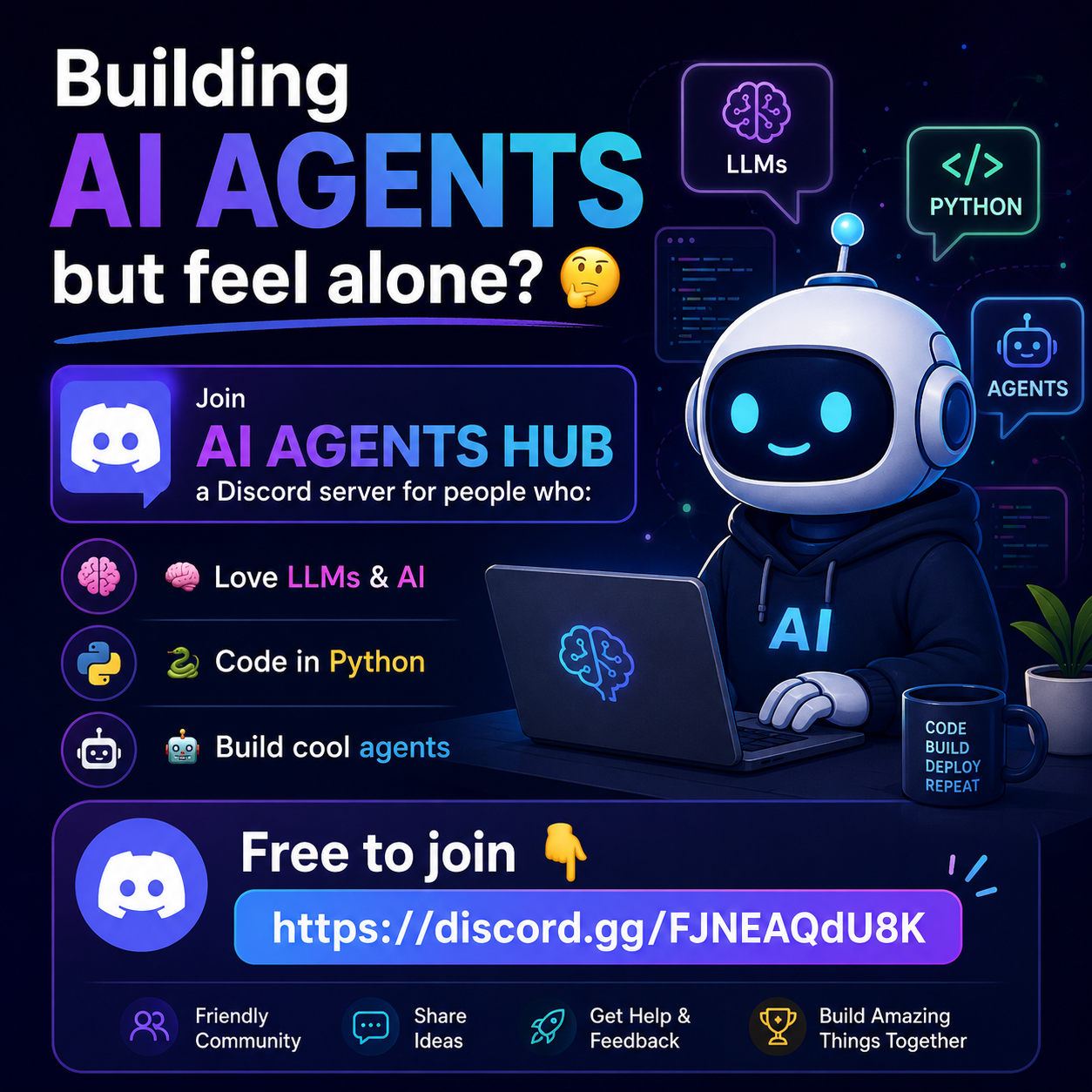
  25. Building AI Agents but feel alone? 🤔 Join AI AGENTS HUB — a Discord community for: 🧠 LLM & AI lovers 🐍 Python coders 🤖 Agent builders ✅ Friendly community ✅ Sha

    A new Discord community called AI AGENTS HUB has been created for individuals interested in building AI agents. The community aims to connect LLM and AI enthusiasts, Python coders, and agent builders. It offers a friendly space to share ideas, get help, and receive feedback on projects. AI

    Building AI Agents but feel alone? 🤔 Join AI AGENTS HUB — a Discord community for: 🧠 LLM & AI lovers 🐍 Python coders 🤖 Agent builders ✅ Friendly community ✅ Sha

    IMPACT Provides a dedicated space for AI developers to collaborate and share knowledge.

  26. 🧠 A 1 trillion parameter LLM is back in business thanks to old Optane memories: innovation also comes from intelligent hardware reuse. # AI # Te

    A large language model with one trillion parameters has been successfully re-enabled using Intel Optane memory. This innovative approach leverages older hardware to run complex AI models, demonstrating the potential for intelligent reuse of existing technology. The project highlights how advancements in AI can be supported by creative solutions in hardware utilization. AI

    IMPACT Demonstrates novel hardware utilization for running large AI models, potentially lowering costs and increasing accessibility.

  27. The key point about AI is that there is no technical barrier to aiming research and development at enhancing human skills instead of reducing human beings to th

    The development of AI presents a choice between enhancing human capabilities or diminishing human value. Focusing research on augmenting skills offers a path forward that respects human agency, contrasting with approaches that might devalue individuals. AI

    IMPACT Highlights the ethical considerations and strategic choices in AI development, urging a focus on human augmentation.

  28. I work as an ML engineer (NLP and audio). Unsurprisingly, we are moving away from training custom models to finding a good prompt for an LLM. I sometimes miss b

    An ML engineer specializing in NLP and audio is shifting focus from training custom models to optimizing prompts for large language models. While they miss building models from scratch, the current work with LLMs presents new, challenging problems, particularly in evaluating text outputs where even human judgment is difficult. AI

    IMPACT Reflects a shift in ML engineering focus towards prompt engineering over custom model development.

  29. These days...these days, the Pnictogen Wing is attempting to maintain a delicate balance between skepticism and credulity. I myself would like to think that cla

    The Pnictogen Wing is navigating a complex stance between skepticism and belief regarding extraordinary claims. This group aims to avoid the default cynical dismissal often employed by professional skeptics, preferring an open mind to genuine unusual phenomena. However, societal decay, attributed to capitalism and corruption, fuels desperation for miraculous solutions, making people more susceptible to false promises, including those surrounding large language models and generative AI. AI

    IMPACT Critiques generative AI as a potentially false promise exploited by capitalism, reflecting a skeptical viewpoint on its transformative potential.

  30. LLM-driven design of physics-constrained constitutive models: two agents are better than one

    Researchers have developed a novel multi-agent system for generating physics-constrained constitutive models using large language models. This approach employs a "Creator" agent to propose models and an "Inspector" agent to rigorously audit them against nine physical constraints, ensuring validity. The system demonstrated a significant improvement in the proportion of physically sound models, achieving 100% for Claude Opus 4.7 and 56% for Kimi K2.5, while maintaining accuracy and generalization capabilities. AI

    IMPACT Enables automated discovery of physically valid and accurate material models, accelerating scientific research and engineering applications.

  31. One Policy, Infinite NPCs: Persona-Traceable Shared RL Policies for Scalable Game Agents

    Researchers have developed a novel reinforcement learning policy called pcsp, designed to enable scalable and controllable non-player characters (NPCs) in life-simulation games. This single policy is conditioned on LLM embeddings of persona descriptions, allowing for distinct and consistent NPC behaviors. The method significantly outperforms chance in zero-shot persona identification and achieves faster inference times compared to LLM-based policies, demonstrating its viability in commercial game engines. AI

    IMPACT Enables more dynamic and controllable NPCs in games, potentially enhancing player immersion and game design possibilities.

  32. Naturalistic measure of social norms alignment

    Researchers have developed a new framework to measure how well AI models align with social norms in naturalistic, free-form conversations. This approach uses solution matching to assess agreement between different responses, including LLM-to-human and LLM-to-LLM interactions. A dataset of 3,000 Danish social dilemmas was created with reference solutions from cultural judges to evaluate LLM performance, revealing variations in alignment across different dilemma types. AI

    IMPACT Introduces a novel method for evaluating AI's cultural and social reasoning capabilities in open-ended interactions.

  33. Automated Kernel Discovery Towards Understanding High-dimensional Bayesian Optimization

    Researchers have developed new methods to improve Bayesian optimization, a technique used for optimizing complex functions. One approach, Dynamic Shared Embedding Bayesian Optimization (DSEBO), automatically adjusts the dimensionality of the search space to handle high-dimensional problems more effectively. Another method, Kernel Discovery, uses LLMs to automatically generate and select optimal kernel functions for these optimization tasks, outperforming existing baselines. A third framework, BOOST, automates the joint selection of kernel and acquisition functions, demonstrating robustness across various optimization landscapes. AI

    IMPACT These advancements in Bayesian optimization could lead to more efficient and effective tuning of complex models and systems in various AI applications.

  34. DART: Semantic Recoverability for Structured Tool Agents

    Researchers have introduced DART, a new runtime system designed to improve the reliability of structured tool agents, particularly in commitment-sensitive scenarios. DART addresses the challenge of recovering from agent failures when downstream systems have already acted on the agent's output. It achieves this by certifying semantically recoverable boundaries, aligning checkpoints, and selecting admissible restore points to preserve downstream work, thereby preventing data inconsistencies that simpler rollback methods might miss. AI

    IMPACT Enhances the robustness of LLM-driven agents, making them more reliable for complex, multi-step tasks with downstream dependencies.

  35. Robust LLM Watermarking with Minimal Semantic Distortion for IP Protection

    Researchers have developed new methods for watermarking large language models (LLMs) to protect intellectual property and track usage. ArcMark, one new technique, embeds multiple bytes of information into text without altering the LLM's output distribution or perplexity. Another approach, SAFESEAL, uses key-conditioned sampling to preserve semantic fidelity and detect ownership, even against adversarial attacks. TextSeal, a third method, offers localized detection and can transfer its watermark signal through model distillation, making it effective against unauthorized use and replication. AI

    IMPACT These watermarking advancements could enable better tracking of LLM-generated content and protect against unauthorized use and distillation.

  36. FastKernels: Benchmarking GPU Kernel Generation in Production

    Researchers have introduced FastKernels, a new benchmark designed to better evaluate GPU kernel generation agents used in production LLM inference. Existing benchmarks are misaligned with real-world systems, leading agents to produce kernels that perform poorly outside of testing environments. FastKernels aims to bridge this gap by serving as a production-grade inference framework that mirrors real-world deployment needs and covers a vast majority of HuggingFace Transformers architectures. AI

    IMPACT Addresses a critical bottleneck in LLM inference by improving the alignment of GPU kernel generation benchmarks with production systems.

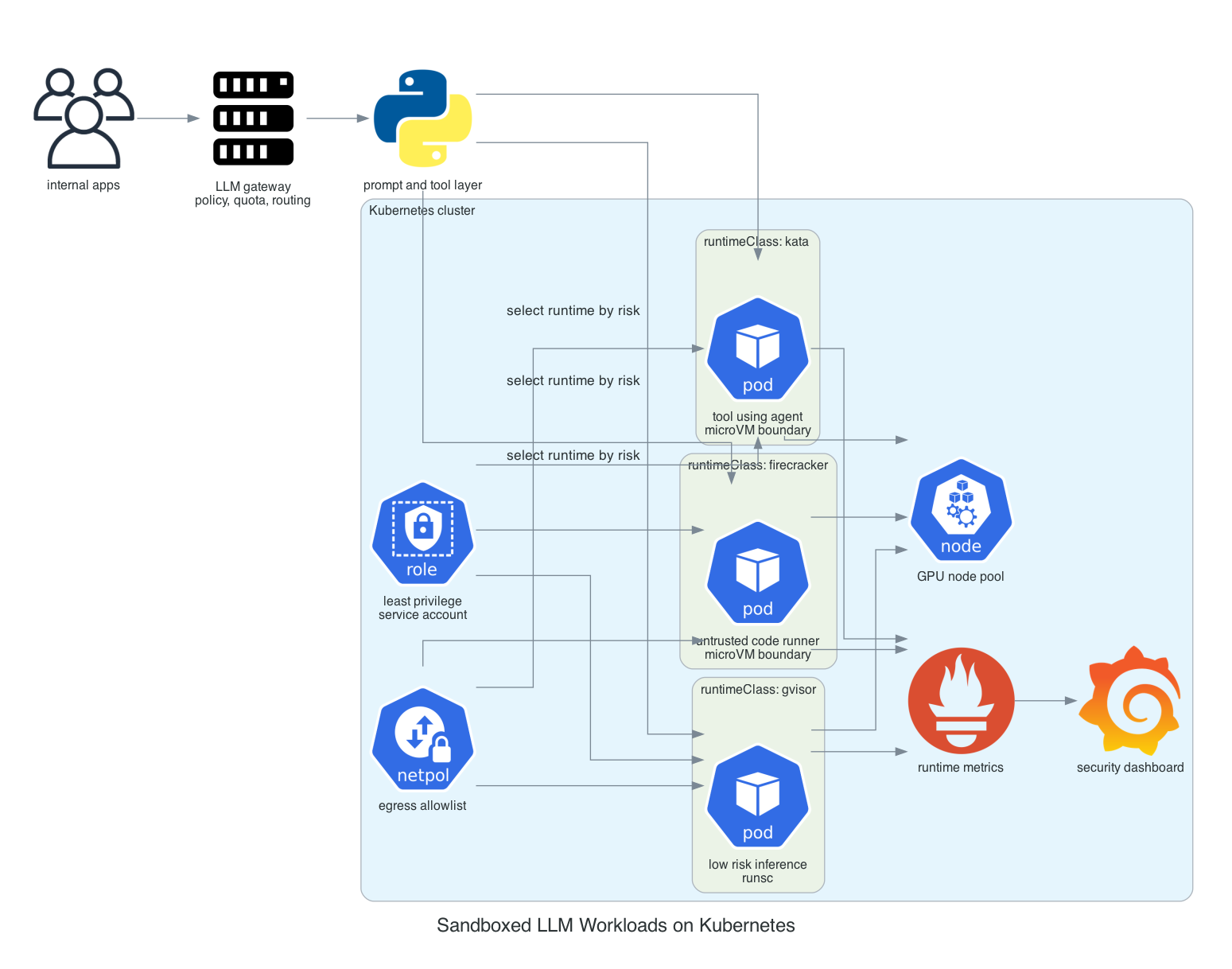
  37. Stop Running LLM Workloads on Vanilla Kubernetes

    Running large language model (LLM) workloads on standard Kubernetes presents significant security risks due to insufficient isolation. While Kubernetes excels at orchestration, it lacks the necessary containment for LLM agents that can execute code and interact with external systems. To address this, developers can leverage Kubernetes' RuntimeClass feature with options like gVisor or Kata to create stronger isolation boundaries for these dynamic workloads. AI

    Stop Running LLM Workloads on Vanilla Kubernetes

    IMPACT Highlights the need for specialized infrastructure to securely run advanced AI workloads, impacting how AI agents are deployed and managed.

  38. Building Production RAG Pipelines: Practical Lessons

    Building effective production RAG pipelines requires careful attention to retrieval quality, latency, and operational visibility, rather than just demo performance. Key decisions involve how content is ingested, chunked, embedded, and indexed, with retrieval quality often proving more critical than the LLM itself. Techniques like hybrid search, metadata filtering, query rewriting, and reranking can significantly improve results, while prompt design must guide the LLM on how to use the retrieved context and avoid unsupported claims. AI

    Building Production RAG Pipelines: Practical Lessons

    IMPACT Provides practical guidance for developers building and deploying RAG systems, emphasizing key operational considerations for improved performance and reliability.

  39. The tokens-per-byte trap: character-level 'compression' adds tokens

    An AI sysadmin discovered that randomly deleting characters from LLM prompts to save on token costs actually increases the token count. This occurs because tokenizers, like Byte Pair Encoding (BPE) and SentencePiece, are trained on clean text and struggle with corrupted input. When characters are deleted, the tokenizer falls back to encoding smaller fragments, often at the byte level, leading to more tokens than the original text. An experiment showed that deleting 25% of characters resulted in a 23% increase in prompt tokens and a significant drop in bytes-per-token efficiency. AI

    IMPACT Random character deletion in prompts increases token costs, contrary to intuition, due to tokenizer behavior.

  40. We prevented our agents going rogue at runtime.

    A developer details how they built a more reliable AI agent for enterprise compliance by implementing strict JSON schema enforcement for all outputs. This method prevents the agent from generating freeform text and instead forces it to populate specific fields, enabling programmatic guardrails and UI alerts. The system also incorporates historical data grounding via the Hindsight library to combat hallucinations and uses a routing mechanism to direct sensitive queries to more powerful, steered models. AI

    We prevented our agents going rogue at runtime.

    IMPACT Developers can build more trustworthy AI agents for enterprise use by enforcing structured outputs and grounding models in historical data.

  41. Why Your LLM Eval Harness Is Lying to You (And How to Fix It)

    A new approach to evaluating Large Language Models (LLMs) has been proposed to address the issue of static evaluation harnesses failing to detect model regressions. This method involves refreshing evaluation datasets weekly with real production traces, stratified by intent cluster to ensure representative sampling. Additionally, a permanent adversarial set, curated from actual customer support tickets indicating model failures, is weighted heavily in the evaluation process to prioritize real-world performance. AI

    IMPACT Improves LLM reliability by ensuring evaluation methods accurately reflect real-world performance and detect regressions.

  42. AI-Enabled Cyber Attacks Hit 600+ Firewalls: The 9 Autonomous Breaches That Redefined Security in 2026

    In early 2026, a series of nine coordinated cyberattacks, driven by LLM-powered agents, successfully breached over 600 enterprise firewalls. These autonomous systems discovered and exploited zero-day vulnerabilities at machine speed, utilizing AI assistants for covert command and control. The attacks highlighted a critical shift where AI interfaces became active threats, outpacing traditional security measures and human-operated defenses. AI

    IMPACT Confirms AI's growing role in sophisticated cyberattacks, necessitating a paradigm shift in defense strategies towards AI-on-AI capabilities.

  43. Problem Framing: The Cost of Naiveté

    Developers building applications with large language models (LLMs) face unique challenges with traditional rate limiting. Standard request-per-second limits are insufficient because LLM API calls vary drastically in cost and processing time, from a few cents to dollars and seconds. A naive approach can lead to budget overruns and unfair resource allocation, where one expensive call blocks many cheaper ones. Effective LLM rate limiting requires a cost-aware or resource-aware strategy that assigns 'cost units' based on tokens, monetary value, or estimated processing time, rather than just request counts. AI

    Problem Framing: The Cost of Naiveté

    IMPACT Developers need to implement cost-aware rate limiting for LLM APIs to manage budgets and ensure fair resource allocation.

  44. Introducing the Anyscale Agent Skill for LLM Post

    Anyscale has introduced a new Anyscale Agent Skill designed to simplify and automate the process of generating LLM post-training runs. This skill assists users in selecting the most appropriate post-training method, such as SFT, CPT, DPO, or RLVR, based on their model, dataset, and objectives. It then generates configuration files for popular frameworks like LLaMA-Factory and Ray Train, preparing them for deployment on Anyscale Jobs. AI

    Introducing the Anyscale Agent Skill for LLM Post

    IMPACT Simplifies the complex process of LLM post-training, potentially accelerating adoption of advanced alignment and optimization techniques.

  45. UltraProbe Is Live — The World's First Free AI Security Scanner That Finds Your LLM Vulnerabilities in 5 Seconds

    UltraProbe, a new free AI security scanner, has been released by Ultra Lab to address the growing threat of prompt injection attacks on LLM applications. The tool offers two scanning modes: one that analyzes a system prompt for vulnerabilities in under five seconds, and another that scans a website's URL to detect risks associated with integrated AI chatbots. UltraProbe aims to provide accessible and comprehensive security testing for developers, covering major attack vectors identified by OWASP. AI

    IMPACT Provides a free, accessible tool for developers to test and mitigate prompt injection vulnerabilities in LLM applications, addressing a critical security gap.

  46. I built an open-source LLM eval framework as a BCA student — hallucination detection, red-teaming, regression tracking

    A BCA student has developed an open-source framework to evaluate Large Language Models (LLMs), addressing the challenge of ensuring AI product performance. The framework includes a 27-test suite for accuracy, safety, and hallucination detection, utilizing a three-tier scoring system. It also features automated adversarial prompt generation for red-teaming and regression tracking across model versions, all presented through a live dashboard. AI

    I built an open-source LLM eval framework as a BCA student — hallucination detection, red-teaming, regression tracking

    IMPACT Provides a free, open-source tool for developers to monitor and improve LLM performance, potentially accelerating AI product development.

  47. AI Red-Teaming Techniques: A Practical Starting Point for Security Teams

    AI red-teaming offers a structured approach for security teams to identify vulnerabilities in large language model applications. Key steps include defining the system's purpose, input/output capabilities, and potential adversaries to tailor testing. Prompt injection, both direct and indirect, is a primary attack vector to explore, alongside testing layered controls like content filters and output validation. AI

    AI Red-Teaming Techniques: A Practical Starting Point for Security Teams

    IMPACT Provides actionable techniques for security professionals to proactively identify and mitigate risks in AI systems.

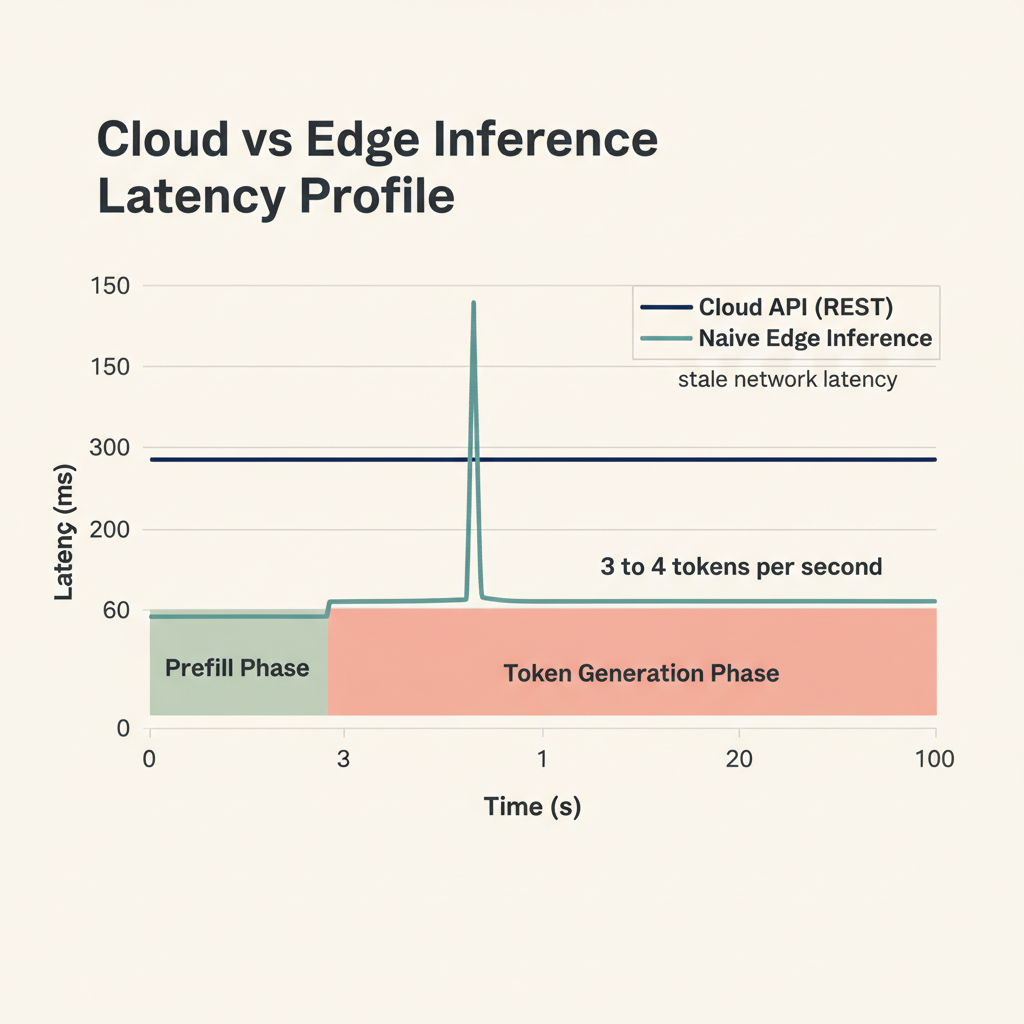
  48. Your Edge LLM is Memory Bound: Trading Compute for Bandwidth to Hit 30 Tokens per Second via LiteRT…

    Researchers have developed a new method called LiteRT to improve the performance of edge LLMs, which are often constrained by memory bandwidth. By trading compute for bandwidth, LiteRT enables these models to achieve speeds of up to 30 tokens per second. This approach addresses a key bottleneck in deploying powerful AI models on resource-limited devices. AI

    Your Edge LLM is Memory Bound: Trading Compute for Bandwidth to Hit 30 Tokens per Second via LiteRT…

    IMPACT Enables faster and more efficient deployment of LLMs on edge devices, overcoming memory bandwidth limitations.

  49. Local RAG: Chat With Your Documents (Open Source, Private)

    This article introduces Retrieval-Augmented Generation (RAG) as a method for enhancing Large Language Models (LLMs) by allowing them to access and cite information from user-provided documents. It details three open-source, private options for implementing RAG: Open WebUI, AnythingLLM, and a manual approach using LangChain. These tools enable users to upload various file types, such as PDFs and code, and then query their content with local LLMs without sending data externally. AI

    IMPACT Enables users to privately query their own documents with local LLMs, enhancing data privacy and customizability.

  50. Running Flux Schnell (12B) + LLMs on a Legacy AMD RX 580 (8GB) via Native Vulkan — Full Architecture Guide [2026]

    A technical guide demonstrates how to run large language models (LLMs) on older AMD RX 580 graphics cards, which were previously considered obsolete for AI tasks. The method utilizes native Vulkan, bypassing the need for CUDA or ROCm, and employs a dual-architecture approach. This involves using the GPU for smaller models via Vulkan acceleration and the CPU for larger, more demanding models, with NVMe storage identified as a critical factor for reducing model load times. AI

    IMPACT Enables running LLMs on older, less powerful hardware, potentially lowering the barrier to entry for AI experimentation.