PulseAugur / Brief
EN
LIVE 23:50:09

Brief

last 24h
[50/153] 221 sources

Multi-source AI news clustered, deduplicated, and scored 0–100 across authority, cluster strength, headline signal, and time decay.

  1. Qwen 3.6 Has Four Tiers. Here's How to Route Without Burning Cash.

    Alibaba has released four tiers of its Qwen 3.6 model, with pricing varying by a factor of 41x between the cheapest and most expensive options. The article provides guidance on how to route requests to the appropriate tier to optimize costs and performance, suggesting that a dynamic routing strategy can significantly reduce monthly expenses without sacrificing quality for most tasks. It also highlights the risks associated with the 'Max-Preview' tier, recommending fallback mechanisms for production environments. AI

    IMPACT Optimizing LLM costs through intelligent routing can significantly reduce operational expenses for AI applications.

  2. Distilling Linearized Behavior into Non-Linear Fine-Tuning for Effective Task Arithmetic

    Researchers have developed a method to combine the benefits of linear and non-linear fine-tuning for large language models. Their approach distills the desirable properties of linearized models, which are good for task arithmetic like model merging, into standard non-linear fine-tuned models. This allows for effective task composition and strong performance on benchmarks without the inference-time costs associated with purely linearized models. AI

    IMPACT Enables more efficient and effective task arithmetic in language models without increased inference costs.

  3. DocRevive: A Unified Pipeline for Document Text Restoration

    Researchers have developed DocRevive, a novel pipeline designed to restore damaged or incomplete text in documents. This system integrates Optical Character Recognition (OCR), image analysis, masked language modeling, and diffusion models to reconstruct text while maintaining visual fidelity. A new dataset of over 30,000 degraded document images was created to benchmark this restoration process, and a Unified Context Similarity Metric (UCSM) was proposed to evaluate the quality of the reconstructed text. AI

    IMPACT Advances document restoration techniques, potentially improving digital preservation and archival research.

  4. 【Open Evaluation Standard: Benchmarking NVIDIA Nemotron 3 Nano using NeMo Evaluator】 https:// huggingface.co/blog/nvidia/nem otron-3-nano-evaluation-recipe ※AI-generated automatic post (headline + link) # AI # Generation

    NVIDIA has released Nemotron 3 Nano, a new family of open-source large language models. These models are designed for efficient deployment and are benchmarked using the NeMo Evaluator framework. The release emphasizes transparency and community evaluation through Hugging Face. AI

    IMPACT Provides new open-source models for efficient deployment, fostering community evaluation and development.

  5. (Yet Another) KV cache calculator - kvanta.vcerny.cz

    A new web-based tool called KVANTA has been released to calculate KV cache sizes for large language models. The developer created KVANTA because they found existing calculators to be inadequate. The tool is designed to support any model available on Hugging Face and is open-source under the Apache 2.0 license. AI

    (Yet Another) KV cache calculator - kvanta.vcerny.cz

    IMPACT Provides a new utility for users running local LLMs, simplifying resource management.

  6. Towards Speed-of-Light Text Generation with Nemotron-Labs Diffusion Language Models

    NVIDIA has introduced a new family of diffusion language models (DLMs) called Nemotron-Labs Diffusion, designed to overcome the limitations of traditional autoregressive models. These DLMs generate text by creating multiple tokens in parallel and then iteratively refining them, offering potential speed improvements and the ability to revise previous outputs. The models are available in 3B, 8B, and 14B parameter scales, with both base and instruction-tuned chat variants, and include a vision-language model. AI

    IMPACT Offers potential for significantly faster text generation and improved revision capabilities, impacting latency-sensitive applications and developer workflows.

  7. Let's Liberate OpenClaw https:// huggingface.co/blog/liberate-your-openclaw *AI-generated automatic post (headline + link) #AI #GenerativeAI #LLM #AIGenerated

    Hugging Face has released three new projects: Daggr, which allows users to programmatically connect and visually inspect applications; a system for creating custom CUDA kernels using Codex and Claude; and OpenClaw, a new open-source initiative. These releases aim to enhance AI development and application integration. AI

    IMPACT These tools aim to improve AI development workflows and application integration.

  8. Multilingual Knowledge Transfer under Data Constraints via Lexical Interventions

    Researchers have developed a novel data-level intervention method called LINK to enhance cross-lingual knowledge transfer in multilingual language models, particularly for languages with limited training data. This technique involves substituting words in the high-resource language (e.g., English) training corpus with their translations, using only a bilingual vocabulary. The method requires no additional model training or parallel data, significantly reducing the cost and complexity of improving performance on downstream tasks in low-resource languages. Evaluations across eight languages and five model sizes demonstrated notable improvements and up to a twofold training speedup to achieve equivalent performance. AI

    IMPACT This method could significantly lower the barrier to creating high-performing multilingual models for languages with scarce data.

  9. Unleashing the Power of ONNX for Speedier SBERT Inference

    This article explores how the ONNX framework can accelerate inference times for Sentence-BERT (SBERT) models, which are commonly used for generating sentence embeddings. The author demonstrates this by converting the `all-MiniLM-L6-v2` SBERT model to ONNX format and comparing its inference speed against the vanilla model on both CPU and GPU using a dataset of 1000 movie descriptions from Kaggle. The post provides installation instructions for ONNX and related libraries, and outlines the experimental setup for measuring performance. AI

    Unleashing the Power of ONNX for Speedier SBERT Inference

    IMPACT Optimizing SBERT inference with ONNX can lead to faster processing of text data for applications requiring sentence embeddings.

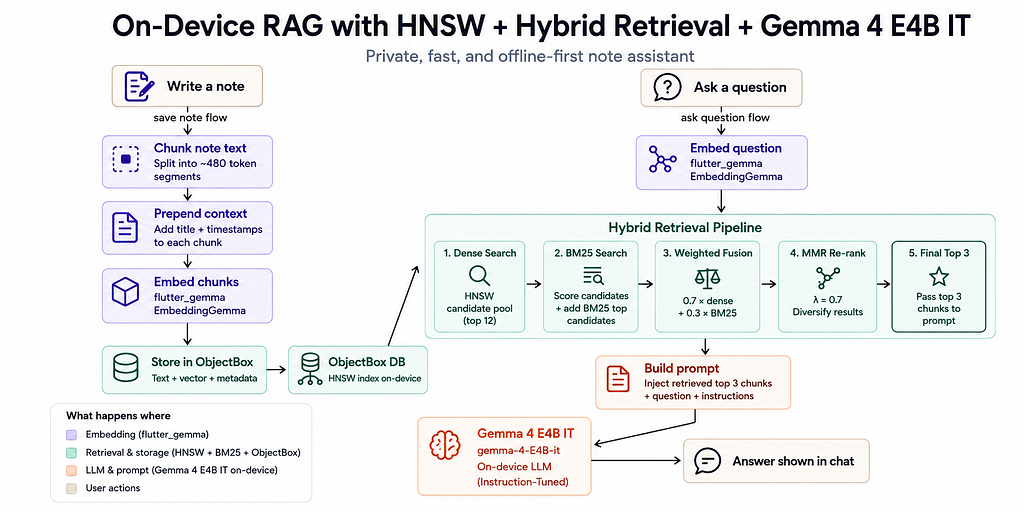
  10. I Crammed RAG, a Vector Database, and a Gemma LLM into a Mobile App. Here’s What Happened.

    A developer built a mobile app called Smart Notes that allows users to query their personal notes without an internet connection. The app utilizes two Gemma models for local inference and embedding generation, storing vector data in an on-device database. This approach ensures user privacy by keeping all data and processing entirely on the mobile device, avoiding the need for cloud APIs or network access after the initial model download. AI

    I Crammed RAG, a Vector Database, and a Gemma LLM into a Mobile App. Here’s What Happened.

    IMPACT Enables private, offline querying of personal data using on-device LLMs, reducing reliance on cloud services for note-taking applications.

  11. Towards Light-Speed Text Generation with Nemotron-Labs' Diffusion Language Model https:// huggingface.co/blog/nvidia/nem otron-labs-diffusion *AI-generated auto-post (headline + link) # AI # GenerativeAI # LLM # AIGenerated

    DeepSeek has released its V4 model, boasting a 1 million token context window that is usable by agents. This release marks one year since DeepSeek's initial significant moment in the open-source AI ecosystem. The announcement also touches upon the broader architectural choices within China's open-source AI landscape, looking beyond DeepSeek's contributions. AI

    IMPACT Sets a new standard for context window length, potentially enabling more complex agentic tasks and long-form content generation.

  12. Specialization Beats Scale: A Strategic Variable Most AI Procurement Decisions Overlook

    A specialized 3-billion-parameter AI model has outperformed leading commercial frontier APIs in structured OCR tasks, demonstrating that domain-specific fine-tuning can surpass sheer model scale. This specialized model was also significantly cheaper to operate, challenging the long-held procurement strategy of defaulting to the largest available models. The findings suggest that for specific enterprise applications, tailored smaller models offer a more cost-effective and higher-performing solution than general-purpose large models. AI

    IMPACT Specialized models can offer superior performance and cost-efficiency for specific enterprise tasks, challenging the dominance of large frontier models.

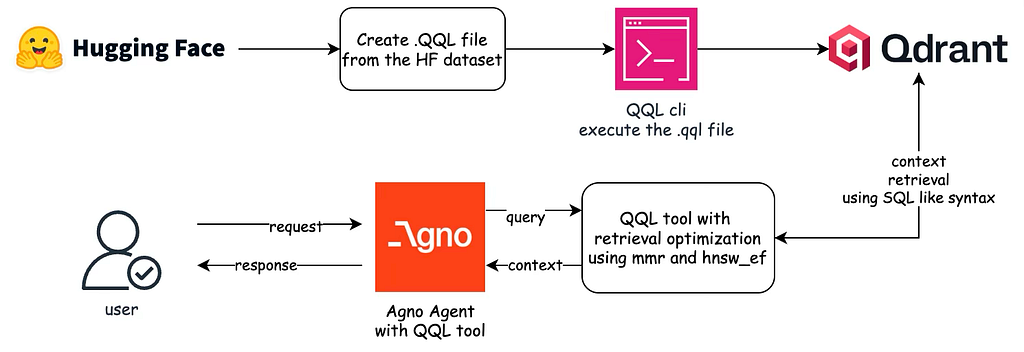
  13. Building an Agentic Healthcare Retrieval System Using QQL and Qdrant

    Researchers have developed an agentic healthcare retrieval system that semantically understands patient-doctor conversations. This system utilizes Qdrant for vector database storage and QQL, a SQL-like language, for declarative retrieval. The architecture integrates with Hugging Face datasets and employs an Agno agent for orchestration, aiming to provide more accurate and contextually grounded responses than traditional keyword search. AI

    Building an Agentic Healthcare Retrieval System Using QQL and Qdrant

    IMPACT This system demonstrates a novel approach to semantic retrieval in healthcare, potentially improving the accuracy and contextuality of responses derived from patient-doctor conversations.

  14. NanoClaw creator turns down $20M buyout offer, raises $12M seed instead

    NanoCo, the developer of the security-focused AI tool NanoClaw, has secured $12 million in seed funding after a rapid viral launch. The company declined a $20 million acquisition offer, opting instead to build out its open-source project. The funding round was led by Valley Capital Partners and included investments from notable tech figures and companies. NanoClaw's popularity surged following endorsements from AI researcher Andrej Karpathy and Singapore's foreign minister, leading to significant community growth and early enterprise adoption. AI

    NanoClaw creator turns down $20M buyout offer, raises $12M seed instead

    IMPACT Accelerates adoption of secure AI agent tooling and validates community-driven open-source development models.

  15. KVBoost – chunk-level KV cache reuse for HuggingFace, 5–48x faster TTFT https:// pythongiant.github.io/KVBoost/ # HackerNews # KVBoost # HuggingFace # AI # Perf

    KVBoost is a new technique that reuses KV cache at the chunk level, significantly speeding up HuggingFace models. This optimization can lead to performance improvements of 5x to 48x in time-to-first-token (TTFT). The project is open-source and available for developers to integrate into their AI applications. AI

    IMPACT This optimization could significantly reduce inference latency for HuggingFace models, enabling faster and more efficient AI applications.

  16. Added Benchmaxxer Repellant to Open ASR Leaderboard https:// huggingface.co/blog/open-asr-l eaderboard-private-data *AI-generated automatic post (headline + link) # AI # GenerativeAI # LLM # AIGenerate

    Hugging Face has introduced a new benchmark called Benchmaxxer Repellant to its Open ASR Leaderboard. This addition aims to evaluate the performance of automatic speech recognition systems, particularly in handling AI-generated content. The leaderboard is designed to track and compare the capabilities of various ASR models. AI

    Added Benchmaxxer Repellant to Open ASR Leaderboard https:// huggingface.co/blog/open-asr-l eaderboard-private-data *AI-generated automatic post (headline + link) # AI # GenerativeAI # LLM # AIGenerate

    IMPACT Enhances evaluation of ASR systems, particularly for AI-generated speech.

  17. vLLM V0 to V1: Correctness Before Reinforcement Learning https:// huggingface.co/blog/ServiceNow -AI/correctness-before-corrections ※AI-generated auto-post (headline + link) # AI # GenerativeAI # LLM # AIGenerated

    A blog post details the transition of vLLM from version 0 to version 1, focusing on its accuracy before reinforcement learning corrections. The post highlights the model's performance and improvements in this area. AI

    vLLM V0 to V1: Correctness Before Reinforcement Learning https:// huggingface.co/blog/ServiceNow -AI/correctness-before-corrections ※AI-generated auto-post (headline + link) # AI # GenerativeAI # LLM # AIGenerated

    IMPACT Details advancements in vLLM's accuracy, potentially influencing the development and deployment of large language models.

  18. 【Alyah ⭐️: Towards Robust Evaluation of Emirati Dialect Capabilities in Arabic LLMs】 https:// huggingface.co/blog/tiiuae/emirati-benchmarks ※AI-generated auto-post (headline + link) # AI # GenerativeAI # LLM # AIGenerated

    Researchers have developed a new benchmark to rigorously evaluate the Emirati dialect capabilities of large language models. This benchmark aims to provide a robust assessment of how well AI models understand and generate Arabic spoken in the United Arab Emirates. The effort is part of a broader initiative to improve AI's performance across diverse linguistic and dialectal variations. AI

    IMPACT Establishes a new standard for evaluating LLM performance on specific Arabic dialects, potentially driving improvements in multilingual AI.

  19. RT @coffeecup2020: TurboQuant - Qwopus3.6-27B-v2-TQ34S.gguf mehr auf Arint.info # AI # HuggingFace # MachineLearning # OpenSource # Qwopus # TurboQuant # arint_

    A new open-source model named Qwopus3.6-27B-v2-TQ34S has been released, available in the TurboQuant format. Further details and usage information can be found on Arint.info. AI

    IMPACT Provides a new open-source model for researchers and developers.

  20. Introducing the Ettin Reranker Family https:// huggingface.co/blog/ettin-rera nker * AI-generated automatic post (headline + link) # AI # GenerativeAI # LLM # AIGenerated

    Hugging Face has released new tools and features for building custom front-ends with Gradio. These updates allow developers to create flexible interfaces for AI applications, leveraging Gradio's backend capabilities. The company also introduced the Ettin Relinker, further expanding the possibilities for AI-generated content and application development. AI

    Introducing the Ettin Reranker Family https:// huggingface.co/blog/ettin-rera nker * AI-generated automatic post (headline + link) # AI # GenerativeAI # LLM # AIGenerated

    IMPACT Enables developers to build more flexible and custom interfaces for AI applications.

  21. Storage Buckets Arrive on Hugging Face Hub https://huggingface.co/blog/storage-buckets *AI-generated auto-post (headline + link) #AI #GenerativeAI #LLM #AIGenerated

    Hugging Face has introduced storage buckets, a new feature designed to help users manage and organize their AI models and datasets more effectively. This enhancement aims to streamline workflows for developers and researchers working with large AI projects on the platform. The new storage buckets provide a dedicated space for project assets, improving accessibility and collaboration. AI

    IMPACT Simplifies asset management for AI developers and researchers on the Hugging Face platform.

  22. New Features in llama.cpp: Model Management https:// huggingface.co/blog/ggml-org/m odel-management-in-llamacpp *AI-generated auto-post (headline + link) # AI # GenerativeAI # LLM # AIGenerated

    Hugging Face is highlighting new developments in open-source AI models and tools. One post details how Codex is making its AI models available to the public, while another introduces new model management features within the llama.cpp project. AI

    New Features in llama.cpp: Model Management https:// huggingface.co/blog/ggml-org/m odel-management-in-llamacpp *AI-generated auto-post (headline + link) # AI # GenerativeAI # LLM # AIGenerated

    IMPACT Highlights advancements in open-source AI, potentially enabling broader community development and adoption.

  23. Airbnb CEO Brian Chesky Called Chinese AI Fast And Cheap. Now, Congress Wants Answers

    Airbnb CEO Brian Chesky is facing scrutiny from U.S. lawmakers regarding the company's use of Chinese AI models, specifically Alibaba's Qwen. Chesky defended the practice, stating that Airbnb primarily uses open-source models and does not share data with Chinese companies, arguing that concerns about data access are a misunderstanding of the technology. This situation highlights the growing tension between U.S. national security interests and the availability of cost-effective AI solutions from China, as evidenced by a recent bipartisan bill aimed at promoting American technology procurement among allies. AI

    Airbnb CEO Brian Chesky Called Chinese AI Fast And Cheap. Now, Congress Wants Answers

    IMPACT Highlights geopolitical tensions in AI development and the trade-offs between cost-effectiveness and national security for AI adoption.

  24. Tencent Hunyuan open-sources new translation model Hy-MT2, launches mini-program "Tencent Hy Translation"

    Tencent Hunyuan has released its new Hy-MT2 translation model, available in three sizes (1.8B, 7B, and 30B-A3B) and supporting 33 languages. The model demonstrates strong performance, with the 7B and 30B versions outperforming many open-source models and even competing with commercial APIs like Microsoft's. Notably, Hy-MT2 shows improved instruction-following capabilities, allowing for more customized translation styles and formats, and its lightweight 1.8B version is optimized for on-device deployment with minimal storage requirements. AI

    IMPACT Enhances translation capabilities with improved instruction following and on-device deployment options.

  25. Meet Stable Audio 3.0, the model family built for artistic experimentation with open

    Stability AI has launched Stable Audio 3.0, a family of open-weight models designed for creative audio generation and experimentation. These models are trained on licensed data, allowing users to own and commercialize their outputs under specific licenses. Key advancements include variable-length generation up to six minutes and the capability for full song composition on portable devices. AI

    Meet Stable Audio 3.0, the model family built for artistic experimentation with open

    IMPACT Enables broader experimentation and commercial use of generative audio tools, potentially fostering new community-driven innovation in music creation.

  26. Open-Source Software Is Starting to Help Robots Think

    The open-source movement, which previously accelerated AI development, is now being applied to robotics to enhance robot intelligence. Companies like Hugging Face, Nvidia, and Alibaba are investing in open-source tools and models to enable robots to reason, decide, and act. The Robot Operating System (ROS), established in 2007, serves as a foundational framework, and recent advancements in AI, particularly in computer vision and simulation, are further lowering the barrier to entry for robotics development. AI

    Open-Source Software Is Starting to Help Robots Think

    IMPACT Accelerates robot development and capability by democratizing access to advanced AI tools and pre-trained models.

  27. Self-supervised local learning rules learn the hidden hierarchical structure of high-dimensional data

    Researchers have explored biologically plausible learning rules for artificial neural networks to understand how the brain learns hierarchical structures from high-dimensional data. They tested two types of local learning rules on the Random Hierarchy Model (RHM) dataset. While rules approximating error propagation failed, layerwise self-supervised contrastive or non-contrastive methods successfully learned the data's hidden structure with data efficiency comparable to supervised backpropagation. AI

    Self-supervised local learning rules learn the hidden hierarchical structure of high-dimensional data

    IMPACT This research offers a new path for developing AI systems that can learn complex data structures more efficiently and in a biologically plausible manner.

  28. SPIKE: An Adaptive Dual Controller Framework for Cost-Efficient Long-Horizon Game Agents

    Researchers have developed SPIKE, an adaptive dual controller framework designed to improve the efficiency of long-horizon agents in complex game environments. SPIKE utilizes a strategic controller for global planning and a reactive controller for immediate actions, with an event trigger system to manage when to switch between them. This approach significantly reduces token consumption and latency while enhancing success rates in tasks requiring extended decision-making. AI

    SPIKE: An Adaptive Dual Controller Framework for Cost-Efficient Long-Horizon Game Agents

    IMPACT SPIKE's adaptive control could enable more efficient and capable AI agents in complex, long-horizon tasks, reducing computational costs.

  29. How to Use Transformers.js in a Chrome Extension https:// huggingface.co/blog/transforme rsjs-chrome-extension *AI-generated auto-post (headline + link) # AI # GenerativeAI # LLM # AIGenerated

    This cluster highlights two blog posts from Hugging Face, one celebrating the one-year anniversary of Deepseek's "moment" and another detailing how to use Transformers.js within a Chrome extension. Both posts are noted as AI-generated automated posts, including their headlines and links. AI

    IMPACT These posts offer technical insights and a retrospective, providing value to developers and researchers in the AI community.

  30. SAME: A Semantically-Aligned Music Autoencoder

    Researchers have developed SAME, a new autoencoder for stereo music and general audio that achieves a high temporal compression ratio while preserving reconstruction quality. This model combines a transformer backbone with semantic regularization, phase-aware losses, and improved discriminator designs. SAME offers significant computational cost benefits and is released in open-weights with two variants: SAME-L and a CPU-deployable SAME-S. AI

    SAME: A Semantically-Aligned Music Autoencoder

    IMPACT New open-weight audio autoencoder could reduce computational costs for generative audio tasks.

  31. PH-Dreamer: A Physics-Driven World Model via Port-Hamiltonian Generative Dynamics

    Researchers have developed PH-Dreamer, a novel physics-driven world model that integrates principles of Port-Hamiltonian dynamics. This framework embeds physical priors into recurrent transitions, enabling more structured and physically consistent latent imagination. The model estimates Hamiltonian and power balance from observations, using energy gradients to guide policy optimization for smoother control and reduced energy consumption. In visual control benchmarks, PH-Dreamer demonstrated superior returns and improved simulator fidelity while reducing phase space volume and energy usage. AI

    PH-Dreamer: A Physics-Driven World Model via Port-Hamiltonian Generative Dynamics

    IMPACT Introduces a new framework for world models that improves physical consistency and efficiency in simulations.

  32. CRAFT: Conflict-Resolved Aggregation for Federated Training

    Researchers have developed a new framework called CRAFT (Conflict-Resolved Aggregation for Federated Training) to address a key challenge in federated learning: aggregating conflicting updates from different clients. Traditional methods can degrade performance for some clients while improving the global model. CRAFT reformulates aggregation as a geometric correction problem, finding an update that aligns with a reference direction while respecting client-specific constraints. This approach offers a closed-form solution, avoiding complex iterative solvers and improving both global model accuracy and client-level performance consistency. AI

    IMPACT Introduces a novel aggregation method to improve performance and reduce disparity in federated learning models.

  33. Neural Negative Binomial Regression for Weekly Seismicity Forecasting: Per-Cell Dispersion Estimation and Tail Risk Assessment

    Researchers have developed a new neural network architecture called EarthquakeNet to improve the forecasting of weekly earthquake occurrences. This model addresses limitations in standard approaches by estimating an endogenous per-cell overdispersion parameter, capturing spatial heterogeneity in seismic clustering. Evaluations show EarthquakeNet reduces prediction errors by 8.6% compared to existing methods, with a 12.5% improvement in forecasting extreme events. AI

    IMPACT Introduces a novel neural network architecture for seismic forecasting, potentially improving accuracy and risk assessment for extreme events.

  34. Latent Dynamics for Full Body Avatar Animation

    Researchers have developed a new method for animating full-body avatars, particularly focusing on the realistic deformation of loose clothing. Their approach augments a pose-conditioned 3D Gaussian avatar with a transformer-based decoder and a dynamics residual latent. This latent component captures temporal variations beyond simple pose, evolving based on history, inertia, and contact forces to produce coherent and history-dependent motion rollouts with minimal computational overhead. AI

    IMPACT Introduces a novel approach to avatar animation, improving realism for dynamic elements like clothing, which could enhance virtual environments and digital content creation.

  35. Enhancing Scientific Discourse: Machine Translation for the Scientific Domain

    Researchers have developed new parallel and monolingual corpora specifically for scientific machine translation. These corpora focus on Spanish-English, French-English, and Portuguese-English language pairs, with specialized subsets for Cancer Research, Energy Research, Neuroscience, and Transportation. The created datasets were used to fine-tune general-purpose neural machine translation systems, and the paper details the corpus creation, fine-tuning methods, and evaluation results. AI

    Enhancing Scientific Discourse: Machine Translation for the Scientific Domain

    IMPACT Facilitates broader access to scientific research by improving translation quality for specialized terminology.

  36. RoadTones: Tone Controllable Text Generation from Road Event Videos

    Researchers have developed a new method for tone-controllable text generation from road event videos, addressing the limitations of existing video-language models that only provide factual descriptions. The project introduces the RoadTones-51K dataset, which includes diverse tonal annotations and multi-tone captions derived from a human-validated data generation pipeline. They also propose RoadTones-VL-CoT, a model capable of generating tone-conditioned Chain-of-Thought drafts for improved interpretability, alongside a new evaluation suite called RoadTones-Eval to measure both factual consistency and tone adherence. AI

    IMPACT Enables more nuanced and context-aware video captioning for critical communication scenarios.

  37. TinySAM 2: Extreme Memory Compression for Efficient Track Anything Model

    Researchers have developed TinySAM 2, a more efficient version of the Segment Anything Model 2 (SAM 2) for video segmentation and object tracking. TinySAM 2 employs a memory quality management mechanism and joint spatial-temporal token compression to significantly reduce memory storage and computational costs. This optimization allows the model to achieve 90% of SAM 2.1's performance using only 7% of the memory tokens and 3% of the training data, making it more suitable for deployment on resource-constrained devices. AI

    TinySAM 2: Extreme Memory Compression for Efficient Track Anything Model

    IMPACT Enables wider deployment of advanced video segmentation models on devices with limited computational resources.

  38. Structured Layout Priors for Robust Out-of-Distribution Visual Document Understanding

    Researchers have developed a new method to improve how Vision-Language Models (VLMs) understand document layouts, particularly for documents with structures not seen during training. The approach pre-resolves layout information using a lightweight detector and injects it into the VLM's prompt, allowing the model to better distinguish between layout and content processing. This technique significantly boosts performance on out-of-distribution benchmarks, reducing errors and improving structural accuracy with only a minor increase in latency. AI

    Structured Layout Priors for Robust Out-of-Distribution Visual Document Understanding

    IMPACT Improves VLM robustness for document analysis, potentially enabling better information extraction from diverse document types.

  39. Structural Energy Guidance for View-Consistent Text-to-3D Generation

    Researchers have developed a new method called Structural Energy-Guided Sampling (SEGS) to address the Janus problem in text-to-3D generation. This issue causes inconsistent geometry across different viewpoints. SEGS works by identifying viewpoint bias in diffusion models and introducing a structural energy gradient into the denoising process, improving multi-view consistency without retraining. Experiments show SEGS reduces the Janus Rate by approximately 10% and enhances scores on various baselines like DreamFusion and Magic3D. AI

    Structural Energy Guidance for View-Consistent Text-to-3D Generation

    IMPACT Improves 3D content generation by reducing viewpoint inconsistencies, potentially enhancing realism and usability in applications.

  40. The Open Agent Leaderboard

    Hugging Face has launched the Open Agent Leaderboard, a new framework for evaluating the performance and cost of AI agent systems. This benchmark focuses on assessing an agent's generality across diverse tasks and settings, rather than just the underlying model's capabilities. The leaderboard utilizes six established benchmarks, including SWE-Bench Verified and AppWorld, to test agents in areas like coding, customer service, and research, providing a more holistic view of their real-world applicability. AI

    The Open Agent Leaderboard

    IMPACT Provides a new standardized method for evaluating AI agent generality and cost, potentially guiding development towards more practical applications.

  41. Introducing the Ettin Reranker Family

    Hugging Face has released a new family of six Ettin Reranker models, built on top of Ettin ModernBERT encoders. These models offer state-of-the-art performance for their respective sizes and are designed for the retrieve-then-rerank pattern in information retrieval systems. The release includes the models, their training data, and a full training recipe, enabling users to integrate them or even train their own rerankers. AI

    Introducing the Ettin Reranker Family

    IMPACT Enhances information retrieval systems by providing more accurate and efficient reranking capabilities.

  42. Correctly Understanding Terminology Related to Harnesses, Scaffolds, and AI Agents https:// huggingface.co/blog/agent-glos sary * AI-generated automatic post (headline + link) # AI # GenerativeAI # LLM # AIGenerated

    Hugging Face has published a glossary to clarify terminology surrounding AI agents, including concepts like harnesses and scaffolds. This resource aims to ensure accurate understanding of these evolving terms. Separately, a TechCrunch article discusses the Pope's recent encyclical on artificial intelligence, suggesting it does not deeply engage with the technical aspects of AI. AI

    IMPACT Clarifies key terms in AI agent development and discusses the societal implications of AI as addressed by religious leadership.

  43. Stabilizing, Scaling & Enhancing MeanFlow for Large-scale Diffusion Distillation

    Researchers have developed a new framework to stabilize and enhance MeanFlow, a technique used for distilling large-scale diffusion models. The method introduces a warm-up phase with a discrete solution before switching to the differential solution for refinement. Additionally, it incorporates trajectory distribution alignment to mitigate "mean-seeking bias" during few-step inference. This approach has demonstrated superior performance when applied to models like FLUX.1-dev and the 80B-parameter HunyuanImage 3.0. AI

    Stabilizing, Scaling & Enhancing MeanFlow for Large-scale Diffusion Distillation

    IMPACT Enhances distillation efficiency for large diffusion models, potentially speeding up inference and deployment.

  44. Reliable Automated Triage in Spanish Clinical Notes: A Hybrid Framework for Risk-Aware HIV Suspicion Identification

    Researchers have developed a hybrid framework for identifying potential HIV cases in Spanish clinical notes, addressing the limitations of standard NLP benchmarks that can overstate accuracy on ambiguous data. This new approach uses a dual-verification method, combining conformal prediction for aleatoric uncertainty and a Mahalanobis distance veto for epistemic uncertainty. The framework aims to establish a reliable operational domain for medical triage by ensuring clinical narratives meet both probabilistic and geometric safety standards, outperforming traditional uncertainty metrics and classifiers. AI

    IMPACT Introduces a novel risk-aware NLP framework for safer medical triage, potentially improving diagnostic accuracy in sensitive clinical applications.

  45. OlmoEarth v1.1: A more efficient family of models

    Allen AI has released OlmoEarth v1.1, an updated family of models designed for processing satellite imagery more efficiently. These new models reduce compute costs by up to 3x for inference and require 1.7x fewer GPU hours for training, while maintaining performance on remote sensing tasks. The efficiency gains are achieved by optimizing the tokenization process for transformer-based architectures, specifically by merging resolution-based tokens without significant performance degradation. AI

    OlmoEarth v1.1: A more efficient family of models

    IMPACT Offers significant cost reductions for satellite imagery analysis, potentially enabling wider adoption of AI for environmental monitoring and mapping.

  46. PiG-Avatar: Hierarchical Neural-Field-Guided Gaussian Avatars

    Researchers have introduced PiG-Avatar, a novel method for generating realistic 3D avatars. This approach decouples avatar geometry from body template surfaces, allowing for more accurate representation of complex clothing and non-rigid movements. PiG-Avatar utilizes a neural field to guide Gaussian representations, enabling real-time rendering and achieving state-of-the-art quality on benchmarks. AI

    PiG-Avatar: Hierarchical Neural-Field-Guided Gaussian Avatars

    IMPACT Enables more realistic and dynamic 3D avatar generation, potentially impacting virtual reality, gaming, and digital content creation.

  47. Ishigaki-IDS-Bench: A Benchmark for Generating Information Delivery Specification from BIM Information Requirements

    Researchers have introduced Ishigaki-IDS-Bench, a new benchmark designed to evaluate the capability of large language models (LLMs) in generating Information Delivery Specification (IDS) XML from Building Information Modeling (BIM) requirements. The benchmark includes 166 expert-verified examples across various construction domains and languages, along with gold IDS files for comparison. Initial evaluations show that while LLMs can partially express information requirements, they struggle to consistently generate XML that adheres to IDS standards and IFC vocabulary constraints, with the best model achieving only 65.6% content agreement. AI

    IMPACT This benchmark will help advance LLM capabilities in generating domain-specific, standardized structured data, crucial for industries like construction.

  48. Towards UAV Detection in the Real World: A New Multispectral Dataset UAVNet-MS and a New Method

    Researchers have introduced UAVNet-MS, a novel multispectral dataset designed for the detection of small unmanned aerial vehicles (UAVs). This dataset includes 15,618 RGB-MSI data cubes with bounding box annotations, specifically addressing the challenges of detecting small objects under low contrast conditions. To complement the dataset, a new dual-stream baseline model called MFDNet was proposed, which integrates spatial and spectral information. Evaluations showed MFDNet achieved a 6.2% improvement in AP50 over existing RGB-only methods, highlighting the value of spectral data for UAV monitoring. AI

    IMPACT Provides a new benchmark and method for detecting small objects using multispectral data, potentially improving surveillance and monitoring systems.

  49. FruitEnsemble: MLLM-Guided Arbitration for Heterogeneous ensemble in Fine-Grained Fruit Recognition

    Researchers have developed FruitEnsemble, a novel framework for fine-grained fruit classification that addresses challenges like limited datasets and visual similarity between fruit types. The system utilizes a two-stage approach, beginning with a weighted ensemble of different models to create a candidate pool. For difficult cases, a multimodal large language model (MLLM) is employed to verify classifications by cross-referencing botanical descriptions with Chain-of-Thought reasoning, achieving a 70.49% accuracy rate. AI

    IMPACT Enhances agricultural computer vision by improving the accuracy and efficiency of fruit classification for sorting and quality inspection.

  50. Direct Translation between Sign Languages

    Researchers have developed a novel method for direct translation between different sign languages, addressing a gap in current sign language technology. Their approach utilizes back-translation to create synthetic parallel corpora, enabling the training of a single model for both text-to-sign and sign-to-sign translation. This direct method significantly outperforms cascaded systems in accuracy and speed, showing promise for improved cross-lingual communication among deaf and hard-of-hearing individuals. AI

    Direct Translation between Sign Languages

    IMPACT Enables cross-lingual communication for 1.5 billion deaf and hard-of-hearing individuals by directly translating between sign languages.