PulseAugur / Brief
EN
LIVE 06:42:31

Brief

last 24h
[11/11] 221 sources

Multi-source AI news clustered, deduplicated, and scored 0–100 across authority, cluster strength, headline signal, and time decay.

  1. Claude's Pass Rate Under 4%, SaaS-Bench Tears Apart Computer-Use's 'Fully Automated Office' Fantasy

    A new benchmark called SaaS-Bench has revealed that current AI agents struggle significantly with real-world, long-horizon tasks, with top models like Claude Opus 4.7 achieving less than 4% success rate on fully completing tasks. The benchmark uses actual SaaS systems and data, exposing four key failure modes: inability to maintain performance over extended tasks, cascading errors from single mistakes, a lack of self-checking mechanisms, and inconsistent performance across multiple runs. These findings suggest that the current paradigm for AI agents is insufficient for true automation and that software interfaces may need to be redesigned for AI agents rather than expecting them to operate human-centric interfaces. AI

    IMPACT Reveals significant limitations in current AI agents for real-world automation, suggesting a need for new paradigms and software redesigns for AI interaction.
  2. Gemini 3.5 Flash Looks Good For How Fast It Is

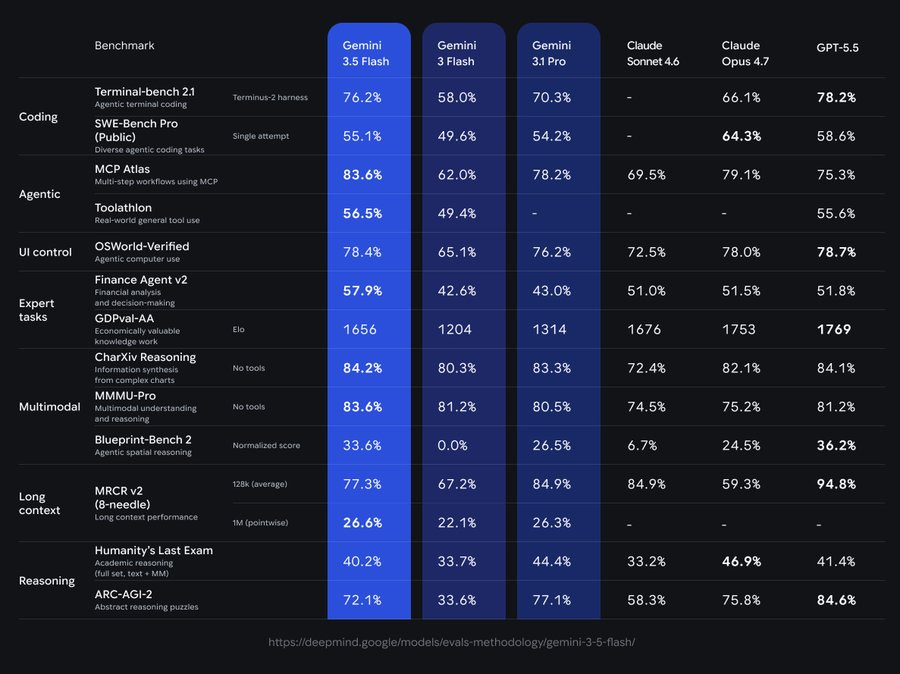
    Google has released Gemini 3.5 Flash, a new AI model designed for speed and agentic tasks. It is positioned as a faster and cheaper alternative to models like Anthropic's Claude Opus 4.7 and OpenAI's GPT-5.5 for tasks where peak intelligence is not required. The model demonstrates significant speed improvements, running up to 12x faster in certain applications like Google's Antigravity city-building simulation, and shows promise for daily AI workflows and complex, long-horizon agentic tasks. AI

    Gemini 3.5 Flash Looks Good For How Fast It Is

    IMPACT Accelerates agentic workflows and daily AI tasks by offering a faster, cheaper alternative to top-tier models for non-SOTA use cases.

  3. Gemini 3.5 Flash beat 3.1 Pro on coding and agents

    Google's Gemini 3.5 Flash model has surpassed its predecessor, Gemini 3.1 Pro, on several key benchmarks, particularly in coding and agentic tasks. This new tier offers a significant cost reduction of 40% and approximately four times faster output generation compared to 3.1 Pro. While Gemini 3.5 Flash excels in tool-use and agentic performance, Gemini 3.1 Pro still maintains an edge in pure reasoning and novel problem-solving benchmarks. AI

    IMPACT Accelerates adoption of cheaper, faster models for agentic tasks, potentially lowering costs for AI-powered applications.

  4. Beating Frontier Models on a Turkish Classification task for $30 of GPU + RL

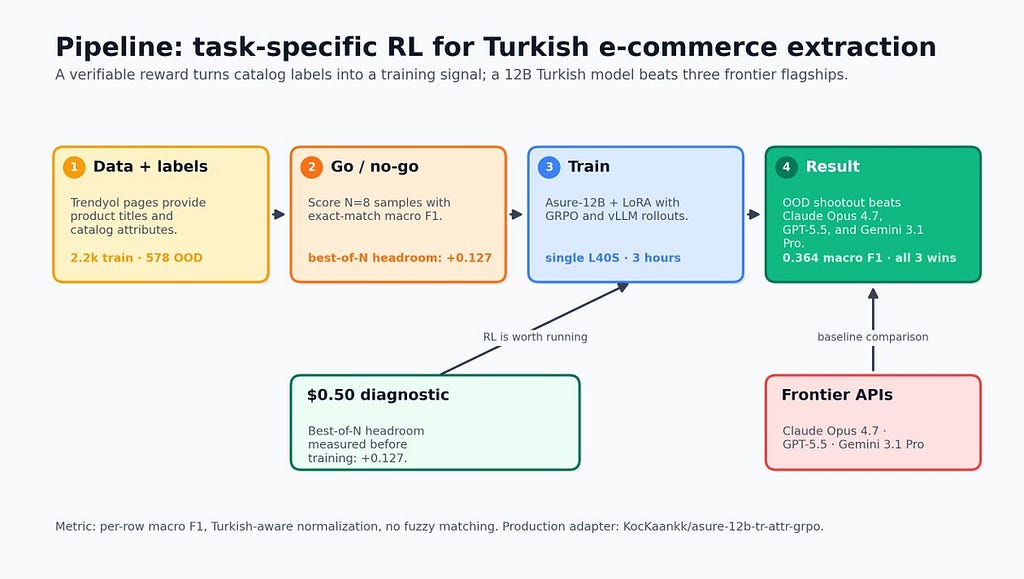
    A researcher has demonstrated that a smaller, open-source Turkish language model can outperform frontier models like Claude Opus 4.7, GPT-5.5, and Gemini 3.1 Pro on a specific e-commerce attribute extraction task. By fine-tuning the Trendyol-LLM-Asure-12B model with Reinforcement Learning from Human Feedback (RLHF) and using scraped product data for training, the researcher achieved statistically significant improvements in macro F1 scores. This approach offers a more cost-effective and accurate solution for specialized tasks compared to relying on general-purpose large language models. AI

    Beating Frontier Models on a Turkish Classification task for $30 of GPU + RL

    IMPACT Demonstrates that specialized, smaller models can outperform frontier models on specific tasks, suggesting cost-effective alternatives for niche applications.

  5. Qwen 3.6 Reviewed: The Open-Weight Coder That Just Crashed the Frontier Party

    Alibaba's Qwen 3.6 model family, particularly the 27B dense variant, has demonstrated performance competitive with leading frontier models like GPT-5.4 and Claude 4.6 on coding tasks. This open-weight model, runnable on consumer hardware with a modest GPU, has generated significant buzz in the AI community for its accessibility and capability. The Qwen 3.6 lineup includes several variants, with the Apache 2.0 license for the 27B model offering broad commercial use. AI

    Qwen 3.6 Reviewed: The Open-Weight Coder That Just Crashed the Frontier Party

    IMPACT Accelerates the trend of powerful open-weight models running on consumer hardware, challenging frontier API dominance for coding tasks.

  6. Tencent Hunyuan open-sources new translation model Hy-MT2, launches mini-program "Tencent Hy Translation"

    Tencent Hunyuan has released its new Hy-MT2 translation model, available in three sizes (1.8B, 7B, and 30B-A3B) and supporting 33 languages. The model demonstrates strong performance, with the 7B and 30B versions outperforming many open-source models and even competing with commercial APIs like Microsoft's. Notably, Hy-MT2 shows improved instruction-following capabilities, allowing for more customized translation styles and formats, and its lightweight 1.8B version is optimized for on-device deployment with minimal storage requirements. AI

    IMPACT Enhances translation capabilities with improved instruction following and on-device deployment options.

  7. Ranked AI models by what people actually use instead of benchmark scores - the benchmark champion barely makes the top 20

    A new ranking system based on actual user adoption and discussion, rather than solely benchmark scores, reveals a significant divergence in AI model popularity. GPT-5 emerges as the top-ranked model by usage, despite newer versions like GPT-5.5 and Gemini 3.1 Pro scoring higher on benchmarks. The data suggests that factors like cost, speed, and availability heavily influence user choices, often leading them to opt for less powerful but more accessible models like Google's Flash Lite over top-tier benchmark performers. AI

    IMPACT Highlights the disconnect between benchmark performance and real-world AI model adoption, emphasizing cost and speed as key user drivers.

  8. Preferences Order, Ratings Anchor: From Fused Expert Aesthetic Ground Truth to Self-Distillation

    Researchers have developed a new benchmark called PPaint for image aesthetic assessment, which uses both pairwise preferences and pointwise ratings from experts. This dual-protocol approach revealed that preferences provide more consistent rankings, while ratings anchor the absolute score scale. By fusing these signals, they created a unified expert ground truth and extended the principle to training vision-language models (VLMs) without labels. A self-distillation method using this approach significantly improved an open-source VLM's aesthetic scoring capabilities, matching a closed-source model's performance with lower inference costs. AI

    Preferences Order, Ratings Anchor: From Fused Expert Aesthetic Ground Truth to Self-Distillation

    IMPACT Introduces a new benchmark and training method that significantly improves VLM aesthetic scoring, potentially impacting content generation and curation tools.

  9. Are Frontier LLMs Ready for Cybersecurity? Evidence for Vertical Foundation Models from Dual-Mode Vulnerability Benchmarks

    A new research paper evaluates the readiness of frontier large language models for cybersecurity tasks, finding that general-purpose models struggle with both vulnerability detection and security testing. The study tested models like GPT-5.4 and Claude Opus 4.6, revealing high false positive rates in white-box detection and low ground-truth coverage in black-box testing. Domain-specialized models, however, demonstrated significantly higher detection rates, suggesting that tailored methodology and data are more critical than sheer model scale for cybersecurity applications. AI

    IMPACT Suggests that specialized models and methodologies, not just general LLM scale, are needed for effective AI-driven cybersecurity.

  10. LivePI: More Realistic Benchmarking of Agents Against Indirect Prompt Injectio

    Researchers have developed LivePI, a new benchmark designed to more realistically assess the risks of indirect prompt injection in AI agents. This benchmark simulates real-world scenarios across various input channels like email, web pages, and chat, evaluating twelve attack families and five malicious goals. Initial tests on leading models such as GPT-5.3-Codex and Claude Opus 4.6 revealed significant vulnerabilities, with group-chat injections proving universally successful and repository link attacks causing high-severity failures. A proposed two-layer defense, combining prompt filtering and tool-call authorization, demonstrated effectiveness in blocking malicious actions without compromising agent utility. AI

    LivePI: More Realistic Benchmarking of Agents Against Indirect Prompt Injectio

    IMPACT Highlights critical security vulnerabilities in current AI agents, necessitating robust defenses for safe deployment.

  11. Gemini 3.5 Flash: more expensive, but Google plan to use it for everything

    Google has launched Gemini 3.5 Flash, a new model designed for agentic workflows and coding tasks, available immediately across its consumer and developer platforms. This release also introduces Gemini Omni for multimodal generation, particularly video, and the Antigravity agent stack. While Gemini 3.5 Flash offers significant speed and a 1 million token context window, its pricing has increased substantially compared to previous versions, aligning with a trend of rising costs among major AI labs. AI

    Gemini 3.5 Flash: more expensive, but Google plan to use it for everything

    IMPACT Sets a new standard for agentic AI performance and multimodal capabilities, potentially accelerating enterprise adoption and pushing competitors.