PulseAugur / Brief
EN
LIVE 04:53:21

Brief

last 24h
[5/5] 221 sources

Multi-source AI news clustered, deduplicated, and scored 0–100 across authority, cluster strength, headline signal, and time decay.

  1. Nvidia’s Vera chip is the US$200 billion bet Jensen Huang doesn’t want you to overlook

    Nvidia CEO Jensen Huang has introduced the Vera chip, a new CPU designed specifically for agentic AI, targeting a substantial $200 billion market segment. This initiative aims to diversify Nvidia's revenue beyond its dominant AI GPU offerings, with Huang projecting Vera to become the company's second-largest sales contributor. The chip is positioned to address the growing demand for efficient inference workloads, a space where custom silicon from hyperscalers presents increasing competition. AI

    Nvidia’s Vera chip is the US$200 billion bet Jensen Huang doesn’t want you to overlook

    IMPACT Nvidia's new Vera chip could shift inference workload dynamics and create a new competitive front against hyperscaler custom silicon.

  2. What the China-US stability pact means for Southeast Asia

    Taiwan has initiated its first formal crackdown on the illicit export of AI chips, raiding 12 locations and seeking three fugitives accused of document forgery and fraudulent declarations. This action is part of a broader effort to prevent restricted NVIDIA hardware, particularly from Super Micro Computer Inc. servers, from reaching China and other restricted regions, in direct violation of US trade restrictions. The crackdown signifies a major policy shift by Taiwan's government under President Lai Ching-te, aimed at securing the global AI supply chain and responding to pressure from Washington. AI

    What the China-US stability pact means for Southeast Asia

    IMPACT Tightens restrictions on AI chip exports, potentially impacting supply chains and increasing costs for restricted markets.

  3. Dissecting ThunderKittens, anatomy of a compact DSL for high-performance AI kernels

    A new article details ThunderKittens, a compact domain-specific language (DSL) developed at Stanford's Hazy Research Lab for creating high-performance AI kernels. The DSL aims to strike a balance between research productivity and hardware efficiency by abstracting repetitive GPU programming tasks like tile layouts and memory allocation. This allows developers to maintain close reasoning about data movement and scheduling while still enabling performance optimization for modern AI workloads on hardware like NVIDIA's Hopper and Blackwell architectures. AI

    IMPACT Enables more efficient AI model training and inference by optimizing low-level GPU kernel performance.

  4. Nvidia: This year's CPU revenue is expected to reach $20 billion

    Google has launched its Gemini 3.5 series of models, including updates to its large context window capabilities. Separately, Nvidia's CFO expressed confidence in significant revenue from their Blackwell and Vera Rubin chips, projecting substantial income between 2025 and 2027. Airbnb is expanding its offerings to include grocery delivery, car rentals, and AI-powered tools for trip planning and property comparison. AI

    IMPACT Major AI model updates and hardware revenue projections signal continued industry growth and innovation.

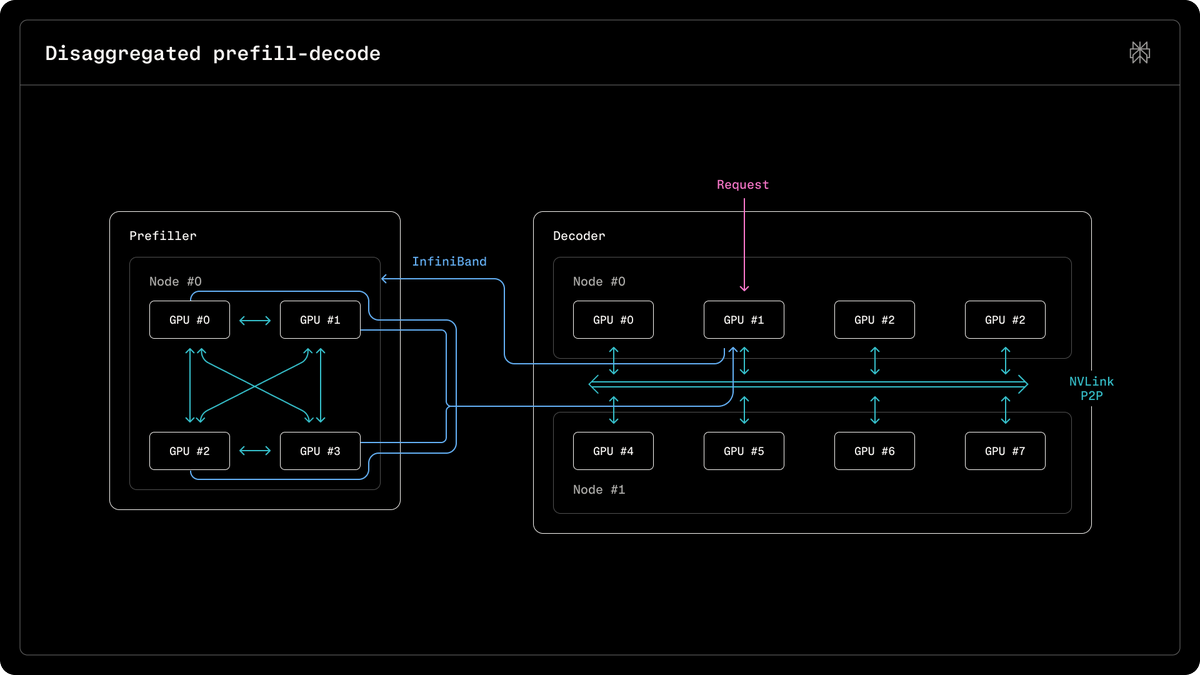
  5. We published new research on how we serve post-trained Qwen3 235B models on NVIDIA GB200 NVL72 Blackwell racks.

    Perplexity has published research detailing how they serve large language models, specifically Qwen3 235B, on NVIDIA's GB200 NVL72 Blackwell racks. The findings indicate that the GB200 platform offers significant improvements over previous NVIDIA hardware for large-model inference, boasting reduced latency and higher throughput. This research highlights the GB200's capabilities for both training and high-throughput inference, particularly for Mixture-of-Experts (MoE) models. AI

    We published new research on how we serve post-trained Qwen3 235B models on NVIDIA GB200 NVL72 Blackwell racks.

    IMPACT NVIDIA's GB200 Blackwell platform shows significant gains in LLM inference speed and cost-efficiency, potentially accelerating deployment of large models.