PulseAugur / Brief
EN
LIVE 19:44:48

Brief

last 24h
[50/3918] 224 sources

Multi-source AI news clustered, deduplicated, and scored 0–100 across authority, cluster strength, headline signal, and time decay.

  1. TGI Multi-LoRA: Deploy Once, Serve 30 Models

    Hugging Face has introduced TGI Multi-LoRA, a new feature for its Text Generation Inference (TGI) solution. This enhancement allows users to serve up to 30 different LoRA (Low-Rank Adaptation) models simultaneously from a single deployment. This significantly improves efficiency and reduces the computational resources needed for serving multiple specialized models. AI


    TGI Multi-LoRA: Deploy Once, Serve 30 Models
  2. Vectoring in on Pinecone

    This podcast episode features Roie Schwaber-Cohen of Pinecone discussing the necessity and function of vector databases within machine learning pipelines. The conversation highlights how these databases enable efficient storage, retrieval, and management of vector data, which is crucial for AI applications. The discussion also touches upon Pinecone's specific offerings in this domain. AI

    Vectoring in on Pinecone
  3. Experimenting with Automatic PII Detection on the Hub using Presidio

    Hugging Face is exploring the integration of Presidio, an open-source tool for detecting and anonymizing Personally Identifiable Information (PII), into its platform. This initiative aims to enhance user privacy and data security across the Hugging Face Hub. The company is experimenting with Presidio's capabilities to identify and manage sensitive data within model repositories and datasets. AI

    Experimenting with Automatic PII Detection on the Hub using Presidio
  4. Google Cloud TPUs made available to Hugging Face users

    Hugging Face has integrated Google Cloud's Tensor Processing Units (TPUs) into its platform, offering users enhanced capabilities for AI model inference. This collaboration allows Hugging Face users to leverage TPUs for faster and more efficient deployment of machine learning models. The integration aims to provide a more powerful and cost-effective infrastructure for the AI community. AI

    Google Cloud TPUs made available to Hugging Face users
  5. Banque des Territoires (CDC Group) x Polyconseil x Hugging Face: Enhancing a Major French Environmental Program with a Sovereign Data Solution

    Banque des Territoires, Polyconseil, and Hugging Face have collaborated to develop a sovereign data solution for a significant French environmental program. This initiative aims to enhance the program's capabilities by leveraging a secure and independently managed data infrastructure. The project underscores a commitment to data sovereignty within critical national initiatives. AI

    Banque des Territoires (CDC Group) x Polyconseil x Hugging Face: Enhancing a Major French Environmental Program with a Sovereign Data Solution
  6. Announcing New Dataset Search Features

    Hugging Face has introduced new search features for its dataset platform, aiming to improve discoverability and organization. These updates allow users to filter datasets by specific criteria, making it easier to find relevant data for their AI projects. The enhancements are expected to streamline the workflow for researchers and developers working with large-scale datasets. AI

    Announcing New Dataset Search Features
  7. Improved Dependency Management

    Replit has overhauled its dependency management system, introducing a unified pane for configuring languages, packages, and system dependencies. This update simplifies the process for developers by bundling language-specific tools and allowing the installation of native libraries and programs via Nix packages. The goal is to streamline the coding experience and reduce configuration overhead. AI

    Improved Dependency Management

    IMPACT Simplifies development workflows for users of the Replit platform, potentially increasing productivity.

  8. Gemini launches context caching... or does it?

    Google's Gemini has reportedly introduced context caching, a feature designed to improve the efficiency of large language models by storing and reusing previously processed information. However, there is some uncertainty regarding the exact implementation and effectiveness of this new capability. The development aims to enhance Gemini's performance in handling long conversations or complex tasks by reducing redundant computations. AI

  9. Using edge models to find sensitive data

    Tausight is deploying edge AI models to help healthcare organizations locate sensitive data, such as private health information (PHI). This technology enables companies to efficiently search through vast amounts of records to identify and secure this data. The approach aims to address the challenge of knowing where all sensitive information is stored within an organization's systems. AI

    Using edge models to find sensitive data
  10. From DeepSpeed to FSDP and Back Again with Hugging Face Accelerate

    Hugging Face Accelerate has introduced new integrations with DeepSpeed and Fully Sharded Data Parallel (FSDP). This update allows users to seamlessly switch between these two popular distributed training frameworks. The goal is to provide greater flexibility and performance optimization for large-scale model training. AI

    From DeepSpeed to FSDP and Back Again with Hugging Face Accelerate
  11. Talaria: Apple's new MLOps Superweapon

    Apple has reportedly developed a new internal MLOps platform named Talaria. This platform is designed to streamline the machine learning development lifecycle, enabling faster training and deployment of AI models. Talaria aims to improve efficiency and scalability for Apple's AI initiatives across its product lines. AI

  12. Making sense of this mess

    Hugging Face has launched a significant redesign of its Transformers documentation, aiming to improve user experience and accessibility. The update introduces a more intuitive navigation system and enhanced search capabilities. This effort is part of Hugging Face's ongoing commitment to supporting the open-source AI community by making powerful tools and models easier to discover and utilize. AI

    Making sense of this mess
  13. Elixir and Machine Learning in 2024 so far: MLIR, Arrow, structured LLM, etc.

    The Elixir programming language community is expanding its machine learning capabilities with several key project updates. Numerical Elixir (Nx) now supports MLIR, enabling broader hardware compatibility and quantization, while Explorer, an Elixir data manipulation library, has achieved full compatibility with Apache Arrow numeric types. Additionally, the Scholar project, focused on traditional machine learning, has introduced new algorithms for visualization, classification, and dimensionality reduction, enhancing the ecosystem's ability to handle diverse ML tasks. AI

    Elixir and Machine Learning in 2024 so far: MLIR, Arrow, structured LLM, etc.

    IMPACT Enhances the Elixir ecosystem's tooling for data analysis and traditional machine learning, potentially broadening its adoption for ML tasks.

  14. Dell Enterprise Hub is all you need to build AI on premises

    Dell has launched a new enterprise hub designed to simplify the process of building and deploying AI applications on-premises. This platform aims to provide a comprehensive solution for organizations looking to leverage AI without relying on cloud infrastructure. The hub integrates various tools and resources to streamline the AI development lifecycle, from data preparation to model deployment. AI

    Dell Enterprise Hub is all you need to build AI on premises
  15. Introducing Spaces Dev Mode for a seamless developer experience

    Hugging Face has launched a new "Dev Mode" for its Spaces platform, designed to streamline the development process for AI applications. This feature aims to provide a more integrated and efficient environment for developers building and deploying models. The update focuses on improving the user experience for those working with AI projects on the Hugging Face platform. AI

    Introducing Spaces Dev Mode for a seamless developer experience
  16. Show HN: Spin up populated test databases in seconds

    Tonic.ai has released a new feature that allows developers to quickly create populated test databases. This tool aims to streamline the development process by providing realistic data for testing purposes. The feature is accessible through their documentation and is designed for integration into existing workflows. AI

    IMPACT Streamlines database testing for AI development workflows.

  17. Subscribe to Enterprise Hub with your AWS Account

    Hugging Face has launched Enterprise Hub, a new offering that allows users to subscribe directly through AWS Marketplace. This integration aims to streamline the procurement and deployment of AI models and tools for businesses. Customers can now access Hugging Face's extensive model repository and MLOps capabilities with the convenience of their existing AWS billing and management. AI

    Subscribe to Enterprise Hub with your AWS Account
  18. Launch HN: Baselit (YC W23) – Automatically Reduce Snowflake Costs

    Baselit, a Y Combinator-backed startup, has launched a tool designed to automatically reduce costs associated with using Snowflake, a popular data warehouse. The platform focuses on optimizing Snowflake's compute resources, specifically by minimizing warehouse idle time and offering custom scaling policies. This aims to address a growing concern among users about escalating data processing expenses. AI

    IMPACT Offers a solution for optimizing cloud data warehousing costs, a common challenge for organizations leveraging AI/ML workloads.

  19. Introducing Object Storage

    Replit has launched a new Object Storage service designed for developers to easily persist unstructured data like media assets and user-uploaded files. This service integrates directly into the Replit workspace, allowing for minimal configuration and seamless use across both the development environment and deployed applications. Developers can interact with Object Storage using Python and Typescript libraries, with Google Cloud Storage serving as a foundational technology. AI

    Introducing Object Storage

    IMPACT Simplifies data persistence for developers, potentially enabling more complex AI applications within the Replit ecosystem.

  20. Private, open source chat UIs

    LibreChat, an open-source chat UI, is gaining traction among enterprise users seeking private AI solutions. The project focuses on features like Retrieval-Augmented Generation (RAG) and plugins, enabling users to host their own secure chat interfaces. This approach addresses the growing demand for customized and controlled AI deployments within organizations. AI

    Private, open source chat UIs
  21. Introducing more enterprise-grade features for API customers

    OpenAI has introduced several new enterprise-focused features for its API customers, aiming to enhance security, control, and cost management. New additions include Private Link for secure Azure-OpenAI communication, native Multi-Factor Authentication, and a Projects feature for granular oversight of API keys and model access. The Assistants API has also been updated with improved file ingestion limits, streaming support, and better cost controls, alongside new options for discounted usage and asynchronous workloads via a Batch API. AI

    Introducing more enterprise-grade features for API customers
  22. AI Apps in a Flash with Gradio's Reload Mode

    Gradio has introduced a new 'Reload Mode' feature designed to accelerate the development of AI applications. This mode allows developers to see changes in their Gradio interface instantly without needing to restart the entire application. The update aims to streamline the workflow for building and iterating on AI demos and applications. AI

    AI Apps in a Flash with Gradio's Reload Mode
  23. Advanced port configuration

    Replit has enhanced its port configuration system to simplify the development of complex applications. Previously, developers faced challenges previewing localhost ports and accessing non-standard ports due to Replit's cloud environment, which involves multiple layers of port routing. The platform has now addressed these issues, allowing for more predictable application development and easier access to various ports without manual configuration. AI

    Advanced port configuration

    IMPACT Streamlines development workflows for applications, potentially including AI-powered ones, by simplifying network configuration.

  24. Klarna's AI assistant does the work of 700 full-time agents

    Klarna has significantly enhanced its customer service and shopping experience by integrating OpenAI's technology into its operations. The company's AI assistant, powered by ChatGPT, now handles two-thirds of customer service chats, performing the work of 700 full-time agents with comparable customer satisfaction and a 25% reduction in repeat inquiries. Additionally, Klarna has made ChatGPT Enterprise available to all employees, with 90% using generative AI tools daily to improve productivity across various departments. AI

    Klarna's AI assistant does the work of 700 full-time agents

    IMPACT Demonstrates significant operational efficiency gains and enhanced customer experience through the application of existing generative AI tools.

  25. Blazing Fast SetFit Inference with 🤗 Optimum Intel on Xeon

    Hugging Face has released an update to its Optimum Intel library, enhancing the performance of SetFit models on Intel Xeon processors. This optimization significantly speeds up inference times, making it more efficient to deploy these models in production environments. The improvements leverage specific hardware features of Xeon CPUs to achieve these gains. AI

    Blazing Fast SetFit Inference with 🤗 Optimum Intel on Xeon
  26. Get early access to Replit Teams

    Replit is launching a beta program for its new Teams product, designed to enhance collaborative software development with AI. The platform will offer features like AI-powered code completion and RAG across teams, high-performance workspaces, and shared deployment capabilities. It also includes a collaborative dashboard, streamlined code review tools, role-based access control, and centralized billing to improve team workflows and project security. AI

    Get early access to Replit Teams

    IMPACT Enhances team-based AI-assisted software development workflows.

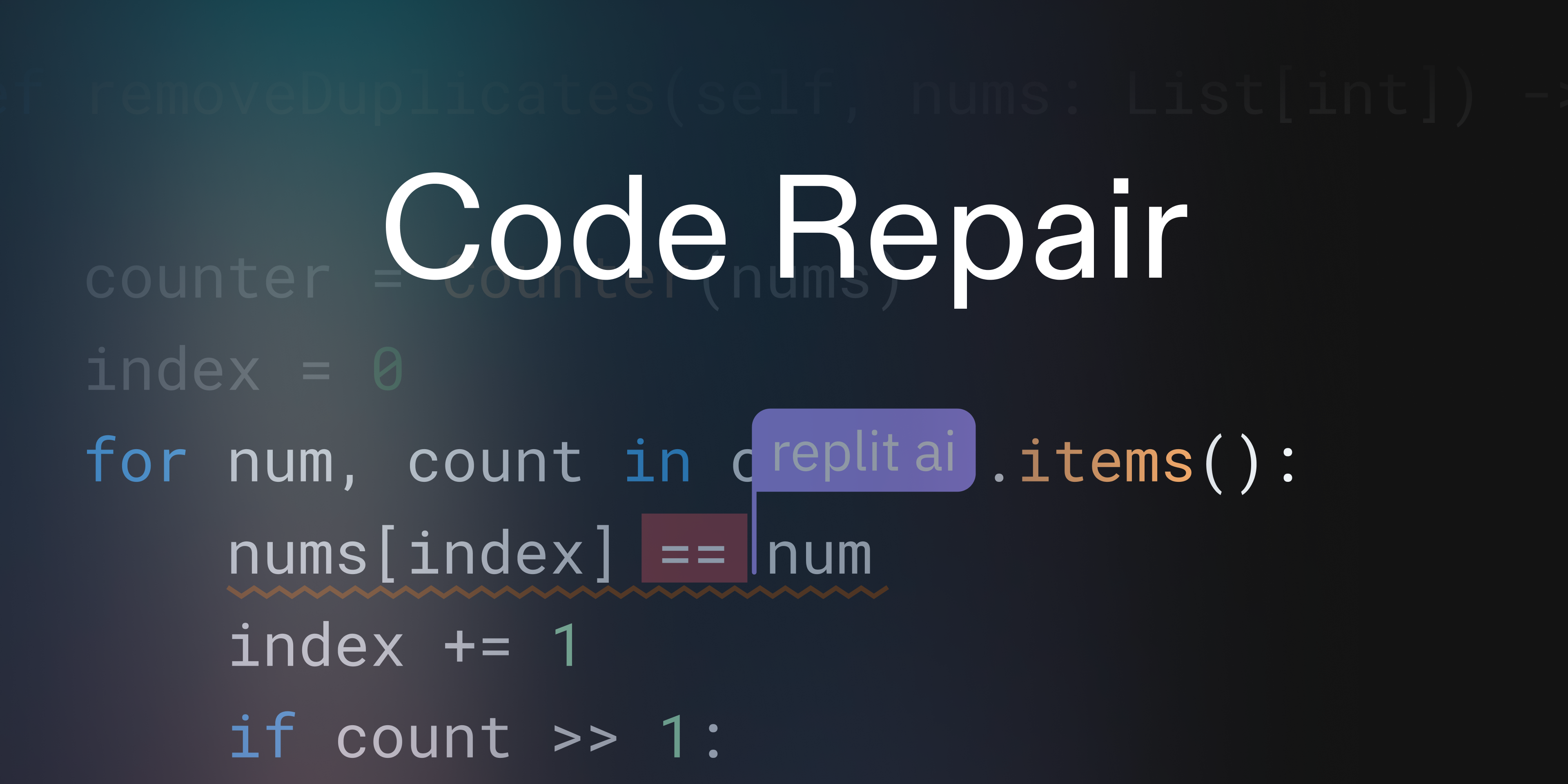
  27. Building LLMs for Code Repair

    Replit has developed a new AI model specifically trained to understand and operate within its development environment, aiming to enhance developer tools. This model's initial application is code repair, leveraging the vast amount of data from Language Server Protocol (LSP) diagnostics generated daily on the platform. The system reconstructs project states using Operational Transformations and synthesizes diffs with large language models to generate and verify code fixes. AI

    Building LLMs for Code Repair

    IMPACT This research could lead to more context-aware AI coding assistants that directly integrate with IDEs, improving developer efficiency in bug fixing.

  28. How Zinus Saves $140,000+ and Cuts Development Time by 50% with Replit

    Zinus, an e-commerce company, significantly reduced development costs and time by building an internal quality assurance tool using Replit. The company saved over $140,000 in licensing fees and development expenses, while also cutting development time by 50%. This was achieved by leveraging Replit's AI-powered coding platform and conversational agent to rapidly prototype and refine the tool, which analyzes customer service conversations and generates performance metrics. AI

    How Zinus Saves $140,000+ and Cuts Development Time by 50% with Replit

    IMPACT Enables companies to build custom AI-powered tools more efficiently, reducing reliance on third-party software and external development.

  29. Searching Nixpkgs in Under 30 Milliseconds

    Replit has released rippkgs, a new command-line tool designed to significantly speed up the search for packages within the Nixpkgs repository. The tool, along with its indexing companion rippkgs-index, can generate an SQLite database of Nix expressions in under 30 milliseconds. This aims to provide a faster and more accurate search experience for Replit users who may find existing tools too slow or restrictive. AI

    Searching Nixpkgs in Under 30 Milliseconds

    IMPACT Improves developer tooling for a popular package manager, potentially speeding up development workflows.

  30. Show HN: Spice.ai – materialize, accelerate, and query SQL data from any source

    Spice.ai has released version 1.0-stable, an open-source engine designed to simplify the creation of data-driven AI applications and agents. The engine allows developers to query, federate, and accelerate data from various sources using SQL, while also providing OpenAI-compatible APIs for local model serving and inference. Key features include data federation across different databases, enterprise search capabilities with vector similarity search, and an AI-native runtime that combines data query with AI inference. AI

    Show HN: Spice.ai – materialize, accelerate, and query SQL data from any source

    IMPACT Simplifies building data-grounded AI applications and agents by unifying data querying and AI inference.

  31. Introducing Scheduled Deployments

    Replit has launched a new feature called Scheduled Deployments, allowing users to automate application execution at specific times or intervals. This service simplifies the process of scheduling tasks, eliminating the need for complex workarounds like infinite loops on virtual machines. Developers can now define schedules in natural language, with Replit handling the underlying cron job generation. The feature is priced based on machine runtime, scheduler cost per deployment, and data transfer, with Replit Core members receiving monthly credits. AI

    Introducing Scheduled Deployments

    IMPACT Simplifies automation for developers, potentially improving efficiency in AI-related background tasks and data processing.

  32. More Reliable Connections to Your Repls

    Replit has introduced a new service called Eval to improve connection reliability for its users. Previously, Conman, the container manager, also handled reverse WebSocket proxying, leading to connection drops during updates and complex autoscaling logic. Eval separates these functions, acting solely as a reverse proxy between the user's client and the Conman VMs that host the Repls. This new architecture aims to abstract away infrastructure failures and simplify scaling. AI

    More Reliable Connections to Your Repls

    IMPACT Improves user experience for developers using Replit's platform.

  33. The Future of Email: Superhuman CTO on Your Inbox As the Real AI Agent (Not ChatGPT) — Loïc Houssier

    Superhuman has integrated OpenAI's API to enhance its email client, introducing AI-powered features designed to significantly reduce the time professionals spend managing their inboxes. These new capabilities include AI-assisted email composition, voice-to-email generation, automatic summarization, and one-click replies, with over 85% of users adopting the AI features. The company reports that these tools are doubling inbox processing speed and email writing speed for users. Superhuman's CTO also discussed the potential for inboxes to become central AI agents, leveraging vast amounts of personal data for proactive assistance. AI

    The Future of Email: Superhuman CTO on Your Inbox As the Real AI Agent (Not ChatGPT) — Loïc Houssier
  34. Show HN: Richard – A CNN written in C++ and Vulkan (no ML or math libs)

    Richard is a new command-line application for performing classification using a neural network, written entirely in C++ and Vulkan. It supports dense and convolutional layers, with GPU acceleration via Vulkan compute shaders. The project also includes profiling tools for performance analysis. AI

    Show HN: Richard – A CNN written in C++ and Vulkan (no ML or math libs)

    IMPACT Provides a low-level, custom implementation for ML classification, potentially useful for developers seeking fine-grained control or learning purposes.

  35. CPU Optimized Embeddings with 🤗 Optimum Intel and fastRAG

    Hugging Face has released an optimization for its fastRAG library, enabling CPU-optimized embeddings through integration with 🤗 Optimum Intel. This enhancement allows for faster retrieval of information from large language models without requiring dedicated GPUs. The update aims to make RAG systems more accessible and efficient for a wider range of hardware. AI

    CPU Optimized Embeddings with 🤗 Optimum Intel and fastRAG
  36. Gaudi processors & Intel's AI portfolio

    Hugging Face has released new resources and guides detailing how to leverage Intel's Gaudi 2 AI accelerators for efficient AI model training and deployment. These collaborations focus on optimizing performance for tasks like assisted generation and Retrieval-Augmented Generation (RAG) applications, aiming to provide cost-effective solutions for enterprises. The initiative also explores running generative AI models on Intel's CPU and Xeon processors, broadening the accessibility of AI hardware. AI

    Gaudi processors & Intel's AI portfolio
  37. Welcome Interconnects and OpenRouter

    Smol AI News has launched a new feature called Interconnects, which allows users to connect different AI models together. This feature aims to enable more complex and customized AI workflows. Additionally, the platform has integrated with OpenRouter, providing users with access to a wider range of AI models through a single interface. AI

  38. Launch HN: Dart (YC W22) – Project management with automatic report generation

    Dart, a project management tool, has launched with generative AI features designed to automate repetitive tasks. The tool aims to reduce the time spent on chores like backlog cleanup and changelog updates by leveraging models such as GPT-4. While Dart can generate suggestions for breaking down large tasks and drafting updates, it currently functions as a helpful assistant rather than a full replacement for a product manager. AI

    IMPACT Automates project management tasks, potentially saving users significant time on administrative work.

  39. 🤗 PEFT welcomes new merging methods

    Hugging Face's PEFT library has introduced new methods for merging adapter weights. These techniques allow for more efficient integration of fine-tuned models, potentially reducing computational costs and simplifying deployment. The update aims to enhance the usability and performance of parameter-efficient fine-tuning. AI

    🤗 PEFT welcomes new merging methods
  40. Replit + pip

    Replit has introduced first-class support for pip, the standard Python package manager, enhancing its Universal Package Manager (UPM) infrastructure. This change aims to resolve issues where packages installed via pip were not consistently recorded, leading to deployment errors. The platform now parses requirements.txt files and manages dependencies more effectively, improving the user experience for developers working with Python projects. AI

    Replit + pip

    IMPACT Improves developer experience for Python projects on Replit, potentially increasing adoption of the platform for AI development.

  41. Sharding Infrastructure: The Regional Goval Project

    Replit has redesigned its core infrastructure, known as Goval, to improve reliability and scalability. The company moved from a single failure domain to multiple isolated clusters, initially partitioning by user membership. This new approach, dubbed Regional Goval, uses consistent hashing for uniform cluster sizing and places each cluster within a single cloud region to minimize cross-region connections and fault scope. AI

    Sharding Infrastructure: The Regional Goval Project

    IMPACT Infrastructure improvements at Replit may indirectly support AI development by providing a more stable platform for AI-powered coding tools.

  42. AMD Pervasive AI Developer Contest!

    Hugging Face and AMD have launched a developer contest focused on pervasive AI applications. The competition encourages developers to create innovative AI solutions that can be widely integrated into various systems and devices. Participants will showcase their work, with a focus on practical and scalable AI implementations. AI

    AMD Pervasive AI Developer Contest!
  43. Flexible Credits and Usage-Based Billing

    Replit is introducing a new usage-based billing system and flexible credits for its Core plan members. This change allows developers to pay only for the cloud services they consume beyond their plan's allotment, offering greater cost control and transparency. Core members will receive $8 in flexible credits monthly, applicable to various services like deployments and data transfer, ensuring more value and flexibility in managing project expenses. AI

    Flexible Credits and Usage-Based Billing

    IMPACT Enhances developer control over cloud service costs on a popular coding platform.

  44. Easier Editing for .replit Files

    Replit has introduced enhanced editing capabilities for its .replit configuration files, integrating intelligent code completion and documentation directly within the Workspace. This improvement is powered by Taplo, a Language Server Protocol (LSP) server for TOML files, which provides real-time assistance to users. The implementation involved generating a JSON schema from Go struct definitions, with custom logic to handle complex types like commands that can be strings, arrays, or objects, thereby simplifying the configuration process for developers. AI

    Easier Editing for .replit Files

    IMPACT Improves developer experience for configuring development environments.

  45. Run ComfyUI workflows for free with Gradio on Hugging Face Spaces

    Hugging Face Spaces now allows users to run ComfyUI workflows without charge. This integration enables the execution of complex Stable Diffusion workflows directly within the Hugging Face ecosystem. The feature aims to make advanced AI image generation tools more accessible to a wider audience. AI

    Run ComfyUI workflows for free with Gradio on Hugging Face Spaces
  46. Building agricultural database for farmers

    Digital Green has launched Farmer.Chat, an AI-powered tool built on OpenAI's GPT-4, designed to assist agricultural extension agents in India and Kenya. This system leverages a vast database of agricultural information, including training videos and government-validated documents, to provide context-specific advice to farmers. The AI aims to significantly reduce the cost of agricultural extension services and is being piloted as an assistant to human agents to ensure accuracy, with plans for multimodal input and real-time data integration. AI

    Building agricultural database for farmers
  47. A guide to setting up your own Hugging Face leaderboard: an end-to-end example with Vectara's hallucination leaderboard

    Hugging Face has released a guide detailing how to establish a custom leaderboard, using Vectara's hallucination leaderboard as a practical example. This guide provides an end-to-end walkthrough for developers interested in creating their own leaderboards to track and compare model performance on specific tasks. It aims to empower the community to build more transparent and measurable AI development ecosystems. AI

    A guide to setting up your own Hugging Face leaderboard: an end-to-end example with Vectara's hallucination leaderboard
  48. Make LLM Fine-tuning 2x faster with Unsloth and 🤗 TRL

    Hugging Face has integrated Unsloth, a library designed to accelerate the fine-tuning of large language models, into its Transformers Reinforcement Learning (TRL) framework. This collaboration aims to make the fine-tuning process up to two times faster, enabling developers to train models more efficiently. The integration allows for quicker experimentation and deployment of customized LLMs. AI

    Make LLM Fine-tuning 2x faster with Unsloth and 🤗 TRL
  49. Dec 12 Incident Update: Secrets and repl.co Static Hosting Unavailable

    Replit experienced a data loss incident between December 12th and 16th, where user Secrets and files on its legacy repl.co static hosting became unavailable. The issue stemmed from an update to Google Cloud Storage configuration that was misinterpreted, leading to data eviction. While all known user Secrets have been recovered, Replit is implementing improved validation for infrastructure-as-code and enhancing its storage systems to prevent future occurrences. AI

    Dec 12 Incident Update: Secrets and repl.co Static Hosting Unavailable

    IMPACT Minimal direct impact on AI operations; primarily an infrastructure reliability issue for a development platform.