PulseAugur
实时 12:08:29

MIT robots learn new physical tasks using LLMs without full retraining

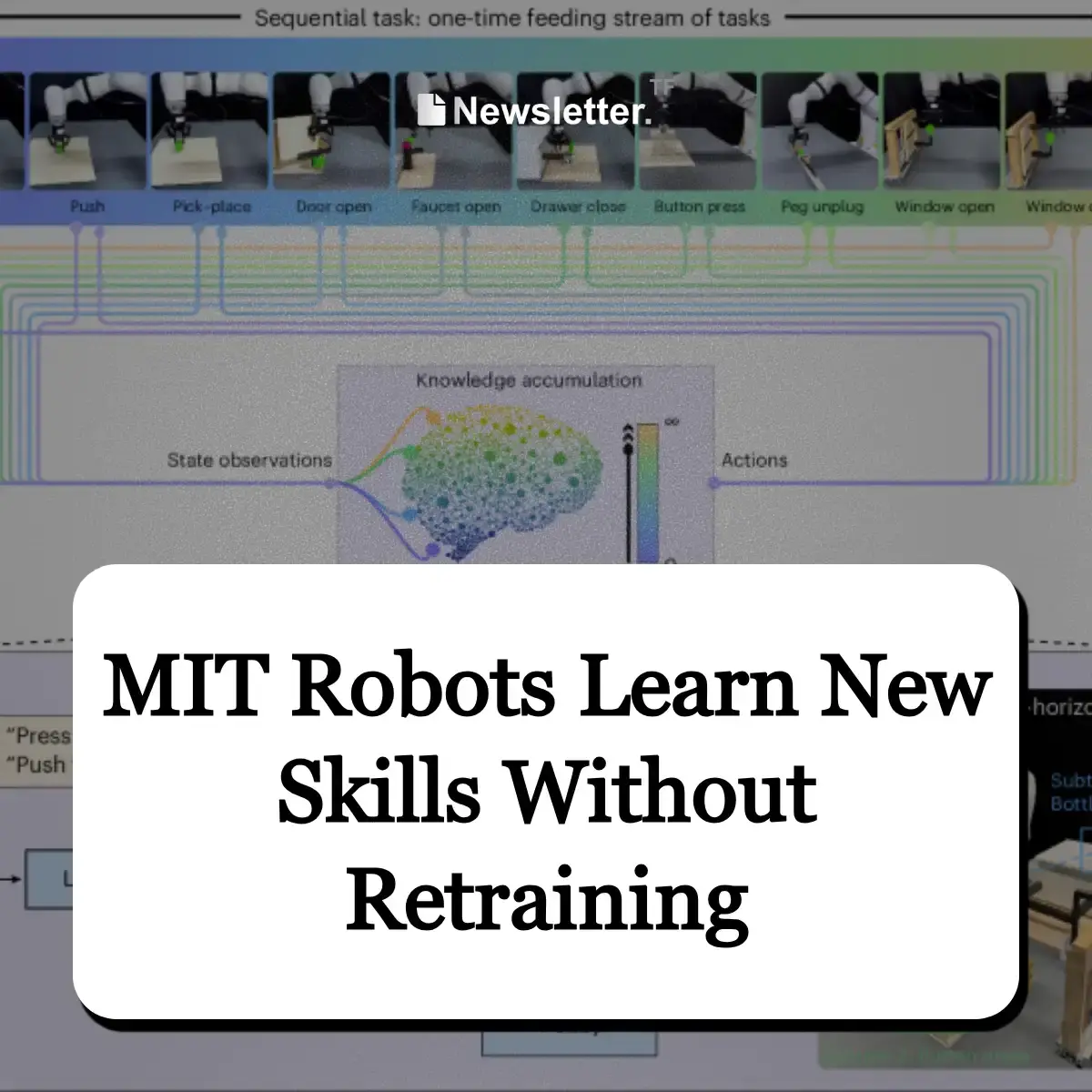
Researchers at MIT have developed a new method for robots to learn physical tasks more efficiently, similar to how humans acquire new skills. By leveraging large language models (LLMs), these robots can bridge the gap between language instructions and physical actions, enabling them to adapt to new tasks without requiring complete retraining. This advancement moves beyond robots that were previously limited to performing only pre-programmed, fixed tasks. AI

影响 Enables robots to acquire new physical skills more rapidly and adapt to novel tasks, potentially accelerating automation in dynamic environments.

排序理由 The cluster describes a new research method from a university lab for improving robot learning capabilities.

在 Mastodon — sigmoid.social 阅读 →

AI 生成摘要 · Google Gemini · 来自 2 个来源。 我们如何撰写摘要 →
MIT robots learn new physical tasks using LLMs without full retraining

报道来源 [2]

  1. Mastodon — sigmoid.social TIER_1 English(EN) · [email protected] ·

    Robotics at the Boundary of Continuous Adaptation MIT robots can now learn new physical tasks like humans without full retraining, using LLMs to bridge language

    Robotics at the Boundary of Continuous Adaptation MIT robots can now learn new physical tasks like humans without full retraining, using LLMs to bridge language and action. # Robotics , # MIT , # AI , # LifelongLearning , # RobotSkills https:// newsletter.tf/mit-robots-learn -new…

  2. Mastodon — sigmoid.social TIER_1 English(EN) · [email protected] ·

    Robots at MIT are learning new skills faster than before. This is a big step from robots that could only do fixed tasks. # Robotics , # MIT , # AI , # LifelongL

    Robots at MIT are learning new skills faster than before. This is a big step from robots that could only do fixed tasks. # Robotics , # MIT , # AI , # LifelongLearning , # RobotSkills https:// newsletter.tf/mit-robots-learn -new-skills-without-retraining/