PulseAugur / Pulse
LIVE 08:32:19

Pulse

last 48h
[42/42] 89 sources

What AI is actually talking about — clusters surfacing on Bluesky, Reddit, HN, Mastodon and Lobsters, re-ranked to elevate originality and crush noise.

  1. Claude plans will get a dedicated monthly credit for programmatic usage

    Anthropic is introducing a new credit system for its Claude API, offering a dedicated monthly credit for programmatic usage. This move aims to provide more predictable costs for developers and businesses relying on Claude for automated tasks and applications. The new plan is designed to simplify budgeting and ensure consistent access to the AI model's capabilities. AI

    IMPACT Simplifies cost management for developers using Claude programmatically, potentially encouraging wider adoption for automated tasks.

  2. Launch HN: Ardent (YC P26) – Postgres sandboxes in seconds with zero migration

    Ardent has launched a new platform designed to provide AI agents with instant, isolated sandboxes of production PostgreSQL databases. This allows for safe and efficient testing of database code and data manipulation tasks without impacting live systems. The service emphasizes speed, scalability, and zero drift from production, aiming to accelerate development workflows for AI-native data teams. AI

    IMPACT Accelerates AI agent development by providing safe, instant database testing environments.

  3. Show HN: Headless Cloud Security – Headless SaaS has come to security

    Headless cloud security architecture decouples a platform's user interface from its data and capabilities, exposing them via APIs for AI agents. This approach addresses the need for faster response times in cloud security, as traditional dashboard-centric models are too slow for AI-driven attacks. The architecture comprises an extension layer for external access, a data layer for agent reasoning, an agentic layer for procedural knowledge, and a secure control plane for coordination. AI

    IMPACT Enables faster, agent-driven cloud security operations to counter rapidly evolving AI-powered threats.

  4. Launch HN: Voker (YC S24) – Analytics for AI Agents

    Voker, a startup backed by Y Combinator's S24 batch, has launched an analytics platform specifically designed for AI agents. The platform aims to provide insights and data analysis tools tailored to the unique operational needs of artificial intelligence agents. AI

    IMPACT Provides specialized analytics tools to help operators monitor and improve AI agent performance.

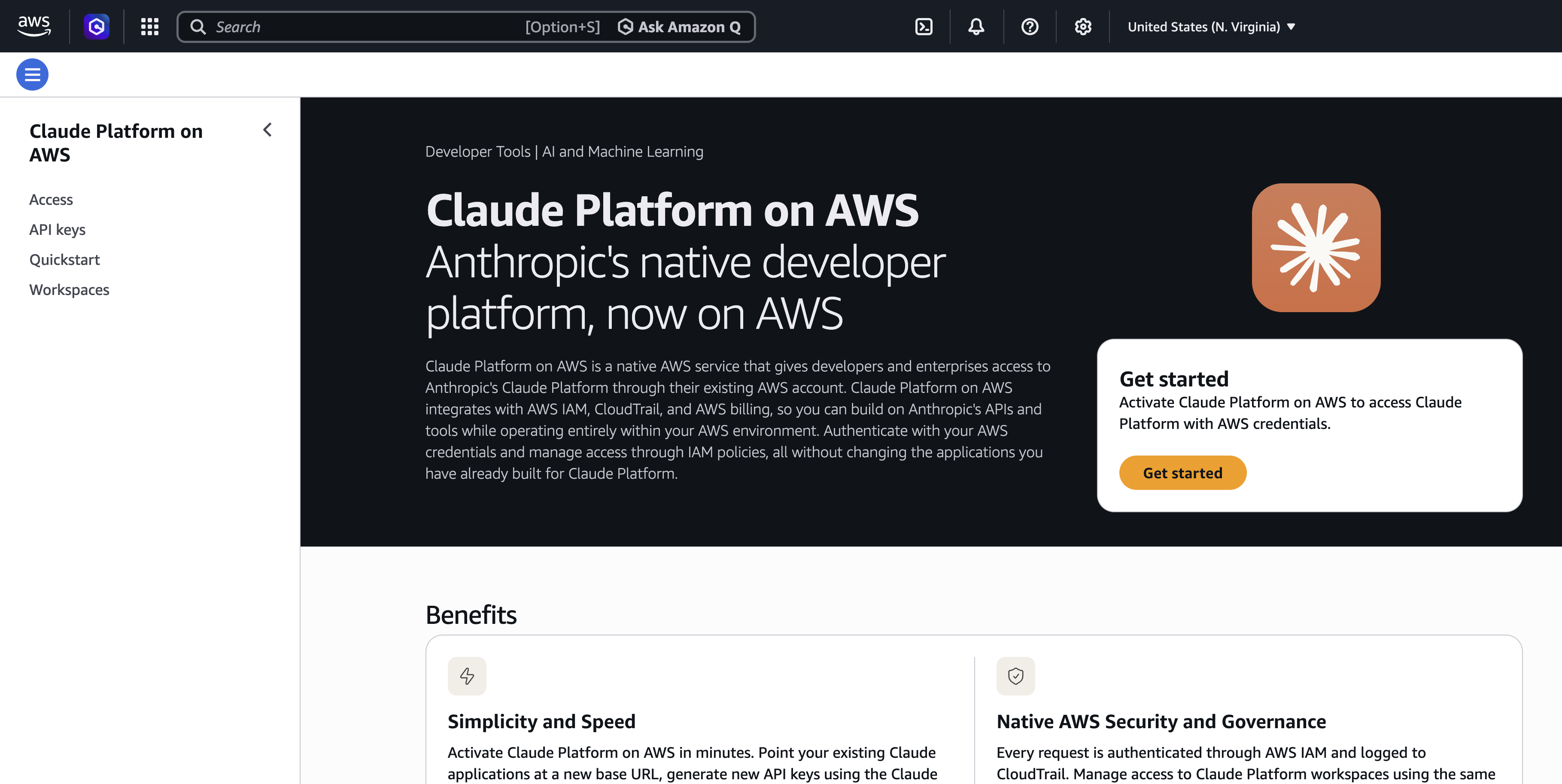
  5. Introducing Claude Platform on AWS: Anthropic’s native platform, through your AWS account

    Anthropic has launched the Claude Platform on AWS, allowing customers to access its native Claude Platform experience directly through their AWS accounts. This integration provides unified billing, authentication via AWS IAM, and audit logging through CloudTrail, simplifying cost management and security for AWS users. While Claude models are also available on Amazon Bedrock with AWS as the data processor, the new platform is operated by Anthropic, with data processed outside the AWS boundary, making it suitable for users without strict regional data residency requirements. AI

    Introducing Claude Platform on AWS: Anthropic’s native platform, through your AWS account

    IMPACT Simplifies AI integration for AWS customers by consolidating billing and authentication, while offering direct access to Anthropic's latest features.

  6. The US is winning the AI race where it matters most: commercialization

    The United States is leading the global AI race primarily through its dominance in commercialization, cloud infrastructure, and data platforms, rather than solely on model development or engineer count. American companies like OpenAI and Anthropic are rapidly integrating AI into products and services, leveraging existing platforms such as AWS, Azure, and Google Cloud. While energy costs and supply chain autonomy are factors, the US's advantage lies in its comprehensive ecosystem, from chips to enterprise software, enabling faster application and adoption across the economy. AI

    IMPACT Confirms that commercialization and infrastructure, not just model performance, are key differentiators in the global AI race.

  7. GPT-5.5 costs 49 to 92 percent more than its predecessor, depending on the input length

    OpenAI has significantly increased the pricing for its GPT-5.5 model, with real-world costs rising by 49% to 92% depending on input length, despite claims of shorter responses offsetting the hike. This price increase, mirroring Anthropic's earlier adjustments to Claude Opus 4.7, is attributed to both companies preparing for potential IPOs. In response, developers are exploring multi-model routing strategies to manage costs by directing simpler tasks to cheaper models like Kimi K2.6 or DeepSeek V4-Pro, while reserving premium models for complex or critical operations. AI

    GPT-5.5 costs 49 to 92 percent more than its predecessor, depending on the input length

    IMPACT Frontier model price hikes are driving adoption of cost-optimization strategies like multi-model routing, potentially lowering overall AI operational expenses.

  8. Musk sells 220,000 GPUs to Claude for use: 5-hour quota doubles, cooperation to build space computing power

    Anthropic has secured a significant compute deal with SpaceX, taking over the entire capacity of the Colossus 1 data center, which houses over 220,000 NVIDIA GPUs. This partnership immediately doubles the rate limits for paid Claude Code users and removes peak-hour restrictions, addressing user complaints about service strain. The agreement also includes Anthropic's interest in developing orbital AI compute capacity with SpaceX, signaling a strategic move to secure infrastructure amidst rapid growth and intense competition. AI

    IMPACT Secures critical compute resources for Anthropic, potentially enabling faster model development and wider user access, while also highlighting the growing importance of strategic infrastructure partnerships.

  9. SparseBalance: Load-Balanced Long Context Training with Dynamic Sparse Attention

    Multiple research papers are exploring novel techniques to enhance the efficiency and performance of Large Language Model (LLM) inference and training. These advancements include queueing-theoretic frameworks for stability analysis, capacity-aware data mixture laws for optimization, and overhead-aware KV cache loading for on-device deployment. Other research focuses on secure inference over encrypted data, accelerating long-context inference with asymmetric hashing, and optimizing distributed training with dynamic sparse attention. Additionally, systems are being developed for multi-SLO serving and fast scaling, alongside hardware accelerators integrating NPUs and PIM for edge LLM inference. AI

    IMPACT These research efforts aim to significantly reduce the computational and memory costs associated with LLMs, potentially enabling wider deployment and more efficient use of resources.

  10. Prompt-caching – auto-injects Anthropic cache breakpoints (90% token savings)

    A new plugin called prompt-caching has been released that significantly reduces token costs when using Anthropic's Claude models, particularly for developers. The plugin automatically identifies and caches stable content like system prompts and file reads, lowering costs by up to 90% on repeated interactions. While Anthropic has introduced its own auto-caching feature, prompt-caching offers enhanced observability and can be applied to custom applications built with the Anthropic SDK, addressing a different layer of cost optimization. AI

    IMPACT Developers can significantly reduce their Claude API costs by using this plugin for applications and agents.

  11. An Interview with Google Cloud CEO Thomas Kurian About the Agentic Moment

    Anthropic has committed to spending approximately $200 billion over the next five years with Google Cloud, securing 5 gigawatts of next-generation TPU compute capacity starting in 2027. This deal, which represents over 40% of Google Cloud's current backlog, also includes a potential additional investment of up to $40 billion from Google. The agreement positions Google's custom TPUs as a significant competitor to NVIDIA's GPUs and highlights Anthropic's rapid revenue growth, which has surged to an annualized $30 billion. AI

    An Interview with Google Cloud CEO Thomas Kurian About the Agentic Moment

    IMPACT This deal reshapes the AI infrastructure race, potentially breaking NVIDIA's GPU monopoly and solidifying Google Cloud's position.

  12. Is Amazon crazy for giving more money to 'competitors' than to 'allies'?

    Amazon is significantly deepening its partnership with Anthropic through a substantial investment and a long-term cloud computing commitment. This move, totaling up to $33 billion in investment and $100 billion in AWS spending over 10 years, positions Anthropic as a primary infrastructure user for Amazon's custom AI chips like Trainium. The deal contrasts with Amazon's conditional investment in OpenAI, highlighting a strategic focus on Anthropic for its core AI ecosystem while using OpenAI as a hedge against Microsoft's dominance. AI

    Is Amazon crazy for giving more money to 'competitors' than to 'allies'?

    IMPACT This deepens Anthropic's reliance on AWS infrastructure, potentially accelerating custom chip adoption and solidifying cloud provider alliances in the AI race.

  13. Show HN: Context Gateway – Compress agent context before it hits the LLM

    Compresr.ai has launched Context Gateway, a tool designed to optimize and compress the context window for AI agents before it reaches the LLM. This aims to prevent delays caused by long conversations hitting context limits. The tool integrates with popular agents like Claude Code and Cursor, offering background compression and a TUI wizard for configuration. AI

    IMPACT Streamlines AI agent performance by optimizing context window usage, potentially improving response times and efficiency.

  14. Nscale Gets $790M in Financing for Norway AI Buildout

    Nscale, a UK-based AI infrastructure startup, has secured $790 million in debt financing to build an AI data center in Narvik, Norway. This facility was previously intended for OpenAI's Stargate Norway project. Microsoft is set to rent Nvidia chips at this new data center. Nscale's latest valuation stands at $14.6 billion following a $2 billion Series C funding round. AI

    Nscale Gets $790M in Financing for Norway AI Buildout

    IMPACT Accelerates AI infrastructure buildout, potentially impacting compute availability and pricing for major tech players.

  15. MCP Marketplace Brings Real-Time Intelligence to Agentic Applications

    The Model Context Protocol (MCP) is emerging as a standardized interface for AI agents to interact with external tools and data. Several open-source projects and platforms are facilitating this, including Databricks' MCP Marketplace for real-time intelligence, Apify's `mcpc` CLI for universal MCP access, and Klavis AI's SDKs for integrating MCP servers. These developments aim to enable agents to access live data, perform complex tasks, and even engage in inter-agent communication and payments, moving towards a more robust and interconnected AI ecosystem. AI

    IMPACT The widespread adoption of MCP is poised to standardize how AI agents interact with external tools and data, fostering interoperability and enabling more sophisticated agentic applications.

  16. New Compute Partnership with Anthropic

    Anthropic has launched ten specialized AI agents designed for financial services, aiming to automate tasks like financial statement auditing and client presentation drafting. This move coincides with a significant shift in investor sentiment, with demand for Anthropic's equity surging while interest in OpenAI's shares wanes. Anthropic is also making substantial investments in AI infrastructure, including a $50 billion commitment to U.S. data centers and a partnership with SpaceX for orbital compute capacity. AI

    New Compute Partnership with Anthropic

    IMPACT Anthropic's expansion into specialized financial AI agents and infrastructure investments signal a move towards deeper enterprise integration and potentially increased competition with OpenAI for lucrative enterprise contracts.

  17. Launch HN: Channel3 (YC S25) – A database of every product on the internet

    Channel3, a startup founded by George and Alex, has launched an API designed to provide developers with a comprehensive database of internet products. The service addresses the difficulty of accessing clean, structured product data from various retailers, which is often protected by bot detection. Channel3 uses computer vision and LLMs to identify, normalize, and de-duplicate product listings across multiple vendors, offering a unified API for developers to integrate product recommendations and affiliate monetization into their applications. The platform supports text and image-based searches, provides product details like price and specifications, and aims to facilitate developer earnings through commissions. AI

    IMPACT Enables developers to integrate product search and affiliate monetization into applications using AI-powered data processing.

  18. Show HN: Cactus – Ollama for Smartphones

    Cactus has released an open-source AI engine designed for mobile devices and wearables, prioritizing low latency and reduced RAM usage. The engine supports multimodal capabilities, including speech, vision, and language models, with an option to fall back to cloud-based models. It features NPU acceleration for energy efficiency and offers OpenAI-compatible APIs for integration into various applications. AI

    IMPACT Enables on-device AI processing, potentially reducing reliance on cloud services and improving user privacy for mobile applications.

  19. Launch HN: Infra.new (YC W23) – DevOps copilot with guardrails built in

    Infra.new, a Y Combinator-backed startup, has launched a DevOps copilot designed to configure and deploy applications on major cloud platforms like AWS, GCP, and Azure. The tool uses natural language prompts to generate infrastructure-as-code and CI/CD configurations, with built-in static analysis for cost estimation and hallucination detection. While aiming to simplify complex cloud infrastructure management, one commentator noted potential challenges in competing with direct platform offerings and the need to avoid simply mirroring underlying systems. AI

    IMPACT Simplifies cloud infrastructure management for AI application deployment, allowing teams to focus on model development.

  20. Companies Can Win With AI

    Meta is undergoing significant workforce reductions, with approximately 8,000 employees being laid off and 6,000 open positions eliminated. CEO Mark Zuckerberg has framed these layoffs as a necessary reallocation of resources, with the cost savings directly funding the company's substantial investments in AI infrastructure and development. This strategic shift prioritizes capital expenditure on AI, particularly GPUs and power, over personnel costs, a trend also observed at other major tech companies like Amazon, Microsoft, and Google. AI

    Companies Can Win With AI

    IMPACT Meta's strategic shift highlights the growing trend of prioritizing AI compute resources over personnel, potentially signaling a broader industry move towards capital-intensive AI development.

  21. Launch HN: Dart (YC W22) – Project management with automatic report generation

    Dart, a project management tool, has launched with generative AI features designed to automate repetitive tasks. The tool aims to reduce the time spent on chores like backlog cleanup and changelog updates by leveraging models such as GPT-4. While Dart can generate suggestions for breaking down large tasks and drafting updates, it currently functions as a helpful assistant rather than a full replacement for a product manager. AI

    IMPACT Automates project management tasks, potentially saving users significant time on administrative work.

  22. Computer-Using Agent

    OpenAI has introduced AgentKit, a suite of tools designed to streamline the development, deployment, and optimization of AI agents. This toolkit includes an Agent Builder for visual workflow creation, a Connector Registry for managing data sources, and ChatKit for embedding agentic UIs. Google DeepMind has also unveiled two AI agents: CodeMender, which automatically patches software vulnerabilities, and AlphaEvolve, an agent that uses Gemini models to discover and optimize algorithms for applications in mathematics and computing. Additionally, OpenAI's Computer-Using Agent (CUA) demonstrates advanced capabilities in interacting with digital interfaces, setting new benchmark results for computer use tasks. AI

    Computer-Using Agent

    IMPACT These advancements in AI agents, coding tools, and security patches signal a shift towards more autonomous AI systems capable of complex tasks and software development, potentially accelerating innovation and improving software reliability.

  23. Show HN: SuperDuperDB – Open-source framework for integrating AI with databases

    SuperDuperDB has released an open-source framework designed to integrate AI capabilities with existing databases. The framework supports various backends like MongoDB, SQL, Snowflake, and Redis, with additional plugins available for specific use cases. The project encourages community contributions and is distributed under the Apache 2.0 license. AI

    IMPACT Enables developers to integrate AI features directly into their database workflows.

  24. The first two custom silicon chips designed by Microsoft for its cloud

    Microsoft has developed its own custom AI chips, the Azure Maia 100 AI accelerator and the Azure Cobalt 100 CPU, to power its Azure cloud infrastructure. These in-house designed chips aim to reduce reliance on third-party providers like Nvidia and optimize performance and cost for AI workloads, including training and inference for large language models. The Maia chip is being developed in collaboration with OpenAI, with CEO Sam Altman highlighting its potential to make model training more capable and affordable. AI

    IMPACT Microsoft's custom silicon for Azure aims to reduce AI training costs and improve performance, potentially impacting cloud infrastructure economics.

  25. How We'll build sustainable, scalable, secure infrastructure for an AI future

    Google is focusing on building sustainable, scalable, and secure infrastructure to support the growing demands of AI. The company is actively involved in industry collaborations like the Net Zero Innovation Hub and efforts to decarbonize concrete. Google is also contributing to open hardware initiatives, such as the Caliptra IP block for root-of-trust management, to enhance system security. AI

    IMPACT Google's focus on sustainable and secure AI infrastructure could accelerate responsible AI deployment and reduce operational costs.

  26. Show HN: Graphite – Stacked Diffs on GitHub

    Graphite, a developer tool built by former engineers from Meta, Google, and Airbnb, has officially launched after a two-year beta period. The platform streamlines code development and shipping through a workflow called "stacking," which breaks down large pull requests into smaller, independently reviewable units. Graphite integrates seamlessly with GitHub, offering features like a PR inbox, AI-powered PR descriptions via OpenAI, and stack-aware merging, aiming to boost developer productivity. AI

    IMPACT Enhances developer productivity by automating PR descriptions and streamlining code review processes.

  27. Launch HN: Argonaut (YC S21) – Easily Deploy Apps and Infra to AWS and GCP

    Argonaut, a Y Combinator-backed startup, has launched a platform designed to simplify the deployment and management of applications and infrastructure on cloud providers like AWS and GCP. The service integrates Kubernetes PaaS, CI pipeline building, and Terraform state management, aiming to reduce the complexity and duplication of effort in building and maintaining internal infrastructure tooling. Argonaut targets startups across various sectors, including AI, by enabling them to scale their engineering teams and manage multiple environments without a dedicated DevOps team. AI

    IMPACT Simplifies infrastructure management for AI startups, potentially accelerating development cycles.

  28. Launch HN: Helicone.ai (YC W23) – Open-source logging for OpenAI

    Helicone.ai has launched an open-source logging solution designed for applications utilizing OpenAI's models. The tool acts as a proxy, integrating with a single line of code to capture prompts, completions, latencies, and costs. Beyond basic observability, Helicone offers features like caching, prompt formatting, and planned additions such as user rate limiting and model provider backoff to enhance application reliability. AI

    IMPACT Provides developers with enhanced visibility and control over their AI application's performance and costs.

  29. Launch HN: Flower (YC W23) – Train AI models on distributed or sensitive data

    Flower, an open-source framework for federated learning, has launched to enable AI model training on distributed or sensitive data without moving it. This approach, where the model is brought to the data, addresses challenges in areas like healthcare, finance, and generative AI where data privacy and regulatory compliance are paramount. The framework aims to overcome barriers for ML projects by simplifying federated learning, with plans to offer a managed enterprise version. AI

    IMPACT Enables new AI use cases by allowing model training on sensitive or distributed data, bypassing privacy and regulatory hurdles.

  30. Launch HN: CodeComplete (YC W23) – Copilot for Enterprise

    CodeComplete AI has launched a self-hosted AI coding assistant designed for enterprise companies that cannot use tools like GitHub Copilot due to security and privacy concerns. The product fine-tunes open-source models on a company's private codebase, offering in-line code completions directly within the IDE. This approach ensures sensitive intellectual property remains within the company's firewall, addressing a key limitation of cloud-based AI development tools. AI

    IMPACT Provides enterprises with a secure, self-hosted alternative to cloud-based AI coding assistants, enabling broader adoption of AI tools.

  31. Launch HN: JumpWire (YC W22) – Easily encrypt customer data in your databases

    JumpWire, a Y Combinator-backed startup, has launched a new tool designed to automatically encrypt sensitive customer data within databases. The system acts as a transparent proxy, intercepting queries and encrypting specified data fields without requiring changes to existing applications. This approach aims to simplify data security for companies struggling with managing access to PII and avoiding costly custom logic or data vault solutions. AI

    IMPACT Automates data security for PII, reducing the need for manual application changes and potentially improving compliance.

  32. Switching to AWS Graviton slashed our infrastructure bill

    Squeaky.ai reduced its infrastructure costs by 35% by migrating its AI workloads to AWS Graviton processors. The company found that Graviton instances offered a better price-performance ratio compared to x86-based instances for their specific use cases. This move allowed them to reallocate savings towards further AI development and experimentation. AI

    IMPACT Demonstrates potential for significant cost savings in AI operations through hardware optimization.

  33. Launch HN: Patterns (YC S21) – A much faster way to build and deploy data apps

    Patterns, a startup founded by former data scientists and engineers, has launched a platform designed to streamline the development and deployment of data and AI applications. The service aims to provide a 10x productivity boost by abstracting away complexities like compute management, orchestration, and visualization, functioning similarly to Heroku but specifically for AI apps. It targets data engineers and scientists frustrated with existing tools like Jupyter notebooks and Airflow, offering a reactive graph architecture with various node abstractions to simplify the creation of end-to-end data pipelines and automations. AI

    IMPACT Simplifies AI app development, potentially accelerating adoption of AI-powered automations and analytics.

  34. Launch HN: Sieve (YC W22) – Pluggable APIs for Video Search

    Sieve, a video data research lab, has launched its platform offering petabytes of curated video data for AI applications. The service provides various data types, including general, cinematic, and paired media, with dense annotations and embeddings for instant searchability. Sieve's API is designed for scalability and security, catering to AI labs, Fortune 100 companies, and generative AI startups. AI

    IMPACT Provides specialized video data infrastructure crucial for training advanced AI models.

  35. Launch HN: Nyckel (YC W22) – Train and deploy ML classifiers in minutes

    Nyckel, a Y Combinator-backed startup, has launched a platform designed to simplify the creation and deployment of machine learning classifiers for developers without prior ML experience. The service allows users to train models for image and text classification in minutes using minimal labeled data, abstracting away complex ML concepts. Nyckel's AutoML engine utilizes meta transfer learning and parallel processing to achieve rapid training times, with deployed models accessible via a REST API. AI

    IMPACT Simplifies ML adoption for developers, potentially increasing the use of AI in applications.

  36. Show HN: Morning Brief – Track any topic on HN, Reddit and others

    Morning Brief is a new product from two indie cofounders designed to aggregate and deliver personalized, summarized articles based on user-specified interests. The service ingests content from platforms like Hacker News, Reddit, and Twitter, employing custom semantic tagging and summarization models to ensure relevance and quality. While initially conceived as a weekend project, it has evolved into a significant undertaking requiring custom infrastructure and AI components to deliver timely, curated content effectively. AI

    IMPACT Offers a personalized content aggregation service using custom AI models for tagging and summarization.

  37. CVPR panels on the future of data and ML infra (R.Socher, HF, W&B, Google, MSFT)

    Two panels are scheduled to coincide with the CVPR conference, focusing on the future of datasets and next-generation ML infrastructure. The first panel, on data-centric approaches, will feature experts from ImageNet, Hugging Face, Google, and Microsoft. The second panel will delve into ML infrastructure for computer vision, with speakers from Weights & Biases, Anyscale, OctoML, Paperspace, Gantry, and Activeloop. AI

    IMPACT Discusses key trends in ML data and infrastructure, offering insights into future development directions.

  38. Launch HN: Xix.ai (YC W17) – Securely authenticate in web apps by face

    Xix.ai has launched "Entry," a biometric identity provider that uses facial recognition for secure web application authentication. The system supports standard protocols like SAML 2.0 and OIDC, aiming to prevent phishing and account takeovers by adding a facial biometric factor to workforce single sign-on. The company's expertise in computer vision, initially applied to combat human trafficking by searching online ads for missing children, informed their approach to developing a privacy-preserving, user-controlled biometric authentication solution. AI

    IMPACT Enhances web application security by enabling biometric authentication, potentially reducing reliance on passwords and mitigating phishing risks.

  39. IBM looking for 12 years’ experience in Kubernetes administration

    IBM is seeking an experienced Cloud Native Infrastructure Engineer/Architect with a minimum of 12 years of experience in Kubernetes administration. The role emphasizes expertise in managing and optimizing cloud-native infrastructure, likely for AI-related workloads. This position highlights the growing demand for specialized skills in managing complex containerized environments essential for modern AI development and deployment. AI

    IMPACT Highlights the need for specialized infrastructure skills to support AI development and deployment.

  40. Launch HN: Terusama (YC W20) – We help warehouses schedule trucks

    Terusama, a startup founded by former Uber Freight and industry consultants, has launched a new truck appointment system designed to modernize warehouse logistics. The platform aims to automate the coordination of truck arrivals, check-ins, and tracking, addressing inefficiencies that cost the U.S. $30 billion annually and contribute to significant CO2 emissions. By streamlining communication and providing better visibility, Terusama seeks to improve the sustainability of the trucking industry and reduce driver turnover. AI

    IMPACT Modernizes critical logistics infrastructure, potentially enabling future AI applications in freight.

  41. Ubuntu 19.10

    Canonical has released Ubuntu 19.10, focusing on enhancing AI/ML development and edge computing capabilities. The update includes improved support for Kubernetes at the edge via MicroK8s and integrates Kubeflow for machine learning workflows. Additionally, it offers better multi-cloud infrastructure economics and an improved desktop experience with performance enhancements and experimental ZFS support. AI

    IMPACT Enhances developer productivity for AI/ML tasks and edge computing deployments.

  42. MLIR Primer: A Compiler Infrastructure for the End of Moore’s Law

    Google researchers have published a primer on MLIR, a compiler infrastructure designed to address the challenges posed by the end of Moore's Law in AI development. MLIR aims to provide a unified framework for optimizing machine learning workloads across diverse hardware architectures. This approach is crucial for maintaining performance gains as traditional hardware scaling slows down. AI

    IMPACT MLIR offers a unified approach to optimize AI workloads across diverse hardware, crucial for continued performance gains as traditional hardware scaling slows.