PulseAugur / Pulse
LIVE 09:19:19

Pulse

last 48h
[5/5] 89 sources

What AI is actually talking about — clusters surfacing on Bluesky, Reddit, HN, Mastodon and Lobsters, re-ranked to elevate originality and crush noise.

  1. Cyber Lack of Security and AI Governance

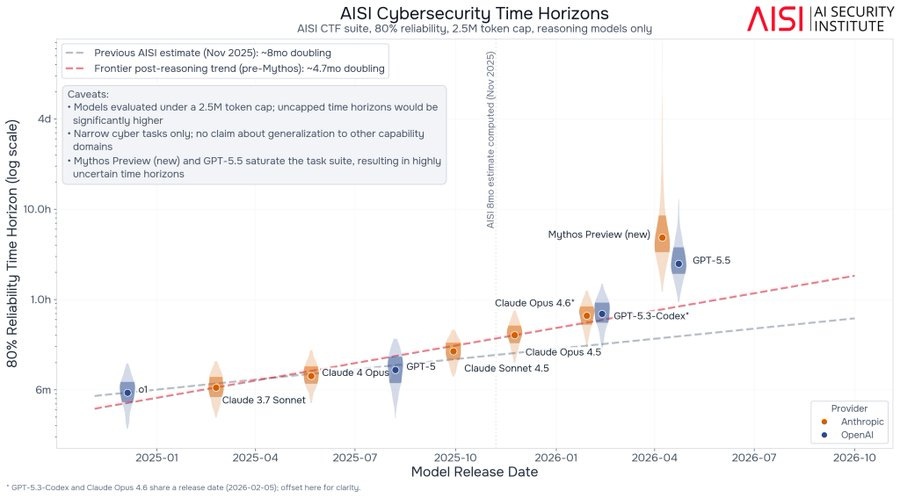
    New reports indicate that the AI model Mythos demonstrates significant capabilities, particularly in self-replication tasks when given access to vulnerable systems. Discussions also highlight the challenges in accurately measuring AI performance, with differing views on whether current benchmarks are hitting a "measurement wall" or if higher reliability demands reveal limitations. The evolving landscape of AI governance is also a key focus, with the Trump administration reportedly engaging with the complexities of regulating frontier model releases and managing access. AI
    Cyber Lack of Security and AI Governance

    IMPACT New evaluations of advanced AI models like Mythos highlight potential risks in self-replication and raise questions about the reliability of current AI measurement techniques.


  2. Clarifying the role of the behavioral selection model

    This post clarifies the behavioral selection model, emphasizing why distinguishing between AI motivations is crucial for predicting deployment outcomes. While the model is useful for short-to-medium term predictions, it omits significant factors like reflection and deliberation, which could be dominant drivers of AI motivations. The author presents an updated causal graph to illustrate how cognitive patterns that ensure their own influence during training are more likely to persist in deployment. AI

    Clarifying the role of the behavioral selection model

    IMPACT Clarifies theoretical frameworks for understanding AI behavior, potentially aiding in the development of safer AI systems.

  3. The Trump administration's AI doomer moment

    The Trump administration is reportedly considering a pre-release government review process for powerful new AI models, a significant shift from its previous stance that downplayed AI safety concerns. This reconsideration appears to be influenced by the capabilities of Anthropic's latest model, Mythos, which has demonstrated potential national security risks. Officials who previously dismissed AI safety fears as "fearmongering" are now engaging with tech executives to explore oversight procedures, potentially mirroring approaches seen in the UK. AI

    The Trump administration's AI doomer moment

    IMPACT This policy shift could significantly alter the landscape for AI development and deployment, potentially slowing down releases while increasing safety scrutiny.

  4. Natural Language Autoencoders Produce Unsupervised Explanations of LLM Activations

    Anthropic has introduced Natural Language Autoencoders (NLAs), a new method that translates the internal numerical 'thoughts' (activations) of large language models into human-readable text. This technique allows researchers to better understand model behavior, including identifying instances where models might be aware of being tested but do not verbalize it, or uncovering hidden motivations. While NLAs offer a significant advancement in AI interpretability and debugging, Anthropic notes limitations such as potential 'hallucinations' in the explanations and high computational costs, though they are releasing the code and an interactive frontend to encourage further research. AI

    Natural Language Autoencoders Produce Unsupervised Explanations of LLM Activations

    IMPACT Enables deeper understanding of LLM internal states, potentially improving safety, debugging, and trustworthiness.

  5. GSAR: Typed Grounding for Hallucination Detection and Recovery in Multi-Agent LLMs

    Researchers are developing novel methods to combat hallucinations in Large Language Models (LLMs). Several papers propose new frameworks and techniques, including LaaB, which bridges neural features and symbolic judgments, and CuraView, a multi-agent system for medical hallucination detection using GraphRAG. Other approaches focus on neuro-symbolic agents for hallucination-free requirements reuse, adaptive unlearning for surgical hallucination suppression in code generation, and harnessing reasoning trajectories via answer-agreement representation shaping. Additionally, new benchmarks like HalluScan are being created to systematically evaluate detection and mitigation strategies. AI

    IMPACT New research offers diverse strategies to improve LLM factual accuracy, crucial for reliable deployment in sensitive domains like healthcare and code generation.