PulseAugur / Pulse
LIVE 09:14:22

Pulse

last 48h
[6/6] 89 sources

What AI is actually talking about — clusters surfacing on Bluesky, Reddit, HN, Mastodon and Lobsters, re-ranked to elevate originality and crush noise.

  1. 😺 Google is killing the prompt box

    Google has unveiled Gemini Intelligence for Android, a new suite of AI-powered features designed to automate app tasks, summarize web content, and fill forms. A key component is the "Magic Pointer," a Gemini-powered cursor that understands context and can act on pointed-to elements without explicit prompts. This innovation aims to shift the user interface by allowing the cursor itself to convey user intent, potentially reducing reliance on traditional text-based prompts and enabling more natural interactions with technology. AI

    😺 Google is killing the prompt box

    IMPACT Redefines user interaction with AI by making interfaces more intuitive and context-aware, potentially reducing reliance on traditional prompts.

  2. Cyber Lack of Security and AI Governance

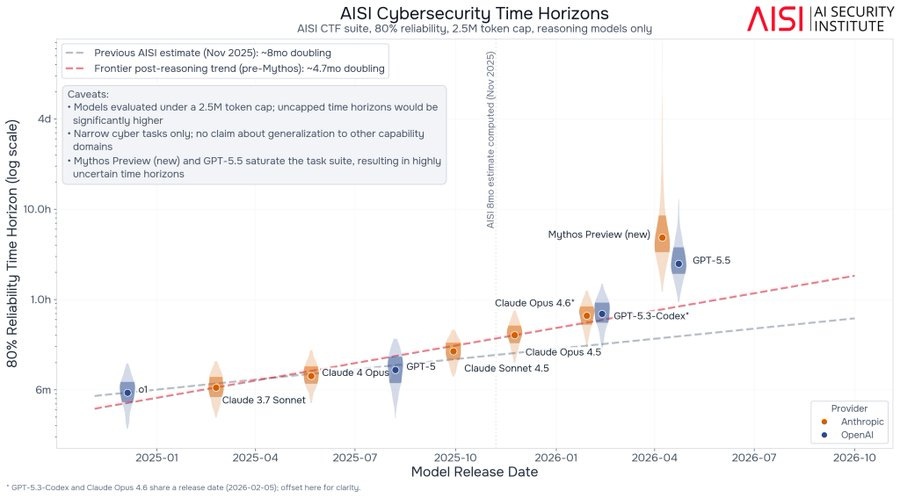
    New reports indicate that the AI model Mythos demonstrates significant capabilities, particularly in self-replication tasks when given access to vulnerable systems. Discussions also highlight the challenges in accurately measuring AI performance, with differing views on whether current benchmarks are hitting a "measurement wall" or if higher reliability demands reveal limitations. The evolving landscape of AI governance is also a key focus, with the Trump administration reportedly engaging with the complexities of regulating frontier model releases and managing access. AI

    Cyber Lack of Security and AI Governance

    IMPACT New evaluations of advanced AI models like Mythos highlight potential risks in self-replication and raise questions about the reliability of current AI measurement techniques.

  3. Google's 'AI Collaborating Mathematician' Arrives! It Breaks the SOTA on the Toughest Math AI Benchmark, and an Oxford Professor Used It to Solve a Long-Standing Problem in Group Theory

    Google DeepMind has released an AI system called "AI Co-Mathematician" designed to collaborate with human mathematicians on complex problems. This system, built on Gemini 3.1 Pro, achieved a new state-of-the-art score of 48% on the challenging FrontierMath Tier 4 benchmark, significantly outperforming existing models like GPT-5.5 Pro. The AI functions as an asynchronous workspace with a coordinator agent that breaks down tasks, manages parallel research streams, and persistently stores failed hypotheses, mirroring workflows seen in software development. AI

    IMPACT This system demonstrates a new paradigm for AI collaboration in research, potentially accelerating discoveries in complex fields like mathematics.

  4. The Trump administration's AI doomer moment

    The Trump administration is reportedly considering a pre-release government review process for powerful new AI models, a significant shift from its previous stance that downplayed AI safety concerns. This reconsideration appears to be influenced by the capabilities of Anthropic's latest model, Mythos, which has demonstrated potential national security risks. Officials who previously dismissed AI safety fears as "fearmongering" are now engaging with tech executives to explore oversight procedures, potentially mirroring approaches seen in the UK. AI

    The Trump administration's AI doomer moment

    IMPACT This policy shift could significantly alter the landscape for AI development and deployment, potentially slowing down releases while increasing safety scrutiny.

  5. Making LLMs more accurate by using all of their layers

    Google Research has developed a framework to evaluate the alignment of Large Language Models (LLMs) with human behavioral dispositions, using established psychological assessments adapted into situational judgment tests. This approach quantizes model tendencies against human social inclinations, identifying deviations and areas for improvement in realistic scenarios. Separately, Google Research also introduced SLED (Self Logits Evolution Decoding), a novel method that enhances LLM factuality by utilizing all model layers during the decoding process, thereby reducing hallucinations without external data or fine-tuning. AI

    Making LLMs more accurate by using all of their layers

    IMPACT New methods from Google Research offer improved LLM alignment and factuality, potentially increasing trust and reliability in AI applications.

  6. NPHardEval Leaderboard: Unveiling the Reasoning Abilities of Large Language Models through Complexity Classes and Dynamic Updates

    Recent research explores novel methods to enhance the reasoning capabilities and efficiency of large language models (LLMs). Papers introduce techniques like speculative exploration for Tree-of-Thought reasoning to break synchronization bottlenecks and achieve significant speedups. Other work focuses on improving tool-integrated reasoning by pruning erroneous tool calls at inference time and developing frameworks for robots to perform physical reasoning in latent spaces before acting. Additionally, research investigates the effectiveness of different reasoning protocols, such as debate and voting, for LLMs, finding that while some methods improve safety, they don't always enhance usefulness. AI

    IMPACT New methods for efficient reasoning and tool integration could enhance LLM performance and applicability in complex tasks.