PulseAugur / Pulse
LIVE 07:45:21

Pulse

last 48h
[20/20] 89 sources

What AI is actually talking about — clusters surfacing on Bluesky, Reddit, HN, Mastodon and Lobsters, re-ranked to elevate originality and crush noise.

  1. Softbank reveals how much OpenAI is worth

    SoftBank's investment in OpenAI is reportedly boosting its quarterly profits, with analysts estimating its stake to be worth around $80 billion. However, concerns are rising about SoftBank's increasing debt to fund its AI strategy and the concentration of risk in a single company. Despite these worries, SoftBank's stock has seen significant gains, indicating investor confidence for the time being. AI

    Softbank reveals how much OpenAI is worth

    IMPACT Confirms the substantial financial impact of major AI investments and highlights the associated risks for large tech investors.

  2. 😺 Google is killing the prompt box

    Google has unveiled Gemini Intelligence for Android, a new suite of AI-powered features designed to automate app tasks, summarize web content, and fill forms. A key component is the "Magic Pointer," a Gemini-powered cursor that understands context and can act on pointed-to elements without explicit prompts. This innovation aims to shift the user interface by allowing the cursor itself to convey user intent, potentially reducing reliance on traditional text-based prompts and enabling more natural interactions with technology. AI

    😺 Google is killing the prompt box

    IMPACT Redefines user interaction with AI by making interfaces more intuitive and context-aware, potentially reducing reliance on traditional prompts.

  3. The Deployment Company, Back to the 70s, Apple and Intel

    OpenAI has launched a new entity, the OpenAI Deployment Company, backed by over $4 billion in initial investment. This new venture aims to help organizations integrate and deploy AI systems by embedding specialized engineers. The move follows a trend of tech companies, including Google and Anthropic, establishing dedicated teams and partnerships to facilitate enterprise AI adoption. AI

    The Deployment Company, Back to the 70s, Apple and Intel

    IMPACT Accelerates enterprise AI adoption by providing dedicated deployment resources and expertise, potentially setting a new standard for AI integration services.

  4. ⚡️ OpenAI shifts to full-stack

    OpenAI has launched a new business unit, the OpenAI Deployment Company, backed by $4 billion in initial investment. This unit aims to assist organizations in building and implementing AI systems within their core operations. The initiative includes acquiring the AI consulting firm Tomoro, which brings around 150 engineers, and embedding specialized 'Forward Deployed Engineers' into client companies to identify AI opportunities and integrate OpenAI's models. AI

    ⚡️ OpenAI shifts to full-stack

    IMPACT Positions OpenAI as a full-stack enterprise partner, offering direct implementation support and potentially altering the market for AI consulting services.

  5. Claude has teamed up with Elon and no one expected it

    Anthropic has secured a significant compute deal with SpaceXAI, a newly merged entity combining SpaceX and xAI, to address Claude's token usage limits. This partnership is notable given Elon Musk's prior vocal criticism of Anthropic. The agreement grants Anthropic access to compute capacity at Musk's Colossus 1 data center, with future discussions about placing data centers in space. AI

    Claude has teamed up with Elon and no one expected it

    IMPACT Secures essential compute for Anthropic's models, potentially easing usage limits and enabling future space-based data centers.

  6. The Inference Shift

    Cerebras Systems is significantly increasing its IPO price and share count due to high demand driven by the AI industry's need for compute power. While GPUs, particularly from Nvidia, have dominated AI workloads like training, the future of AI compute is expected to be more heterogeneous. This shift acknowledges that specialized hardware beyond GPUs will be crucial for both training and inference, especially as AI agents require substantial computational resources. AI

    IMPACT Signals a shift towards heterogeneous AI compute architectures beyond GPUs, crucial for agent-based AI.

  7. Cyber Lack of Security and AI Governance

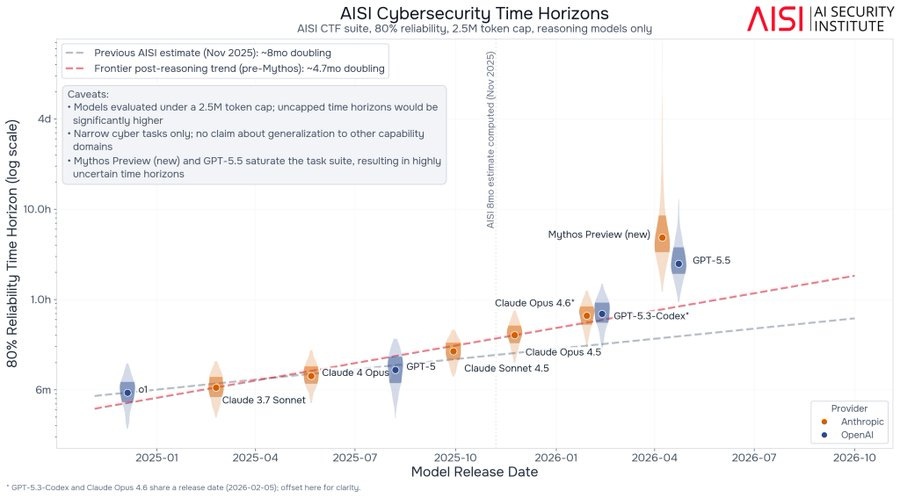
    New reports indicate that the AI model Mythos demonstrates significant capabilities, particularly in self-replication tasks when given access to vulnerable systems. Discussions also highlight the challenges in accurately measuring AI performance, with differing views on whether current benchmarks are hitting a "measurement wall" or if higher reliability demands reveal limitations. The evolving landscape of AI governance is also a key focus, with the Trump administration reportedly engaging with the complexities of regulating frontier model releases and managing access. AI

    Cyber Lack of Security and AI Governance

    IMPACT New evaluations of advanced AI models like Mythos highlight potential risks in self-replication and raise questions about the reliability of current AI measurement techniques.

  8. Clarifying the role of the behavioral selection model

    This post clarifies the behavioral selection model, emphasizing why distinguishing between AI motivations is crucial for predicting deployment outcomes. While the model is useful for short-to-medium term predictions, it omits significant factors like reflection and deliberation, which could be dominant drivers of AI motivations. The author presents an updated causal graph to illustrate how cognitive patterns that ensure their own influence during training are more likely to persist in deployment. AI

    Clarifying the role of the behavioral selection model

    IMPACT Clarifies theoretical frameworks for understanding AI behavior, potentially aiding in the development of safer AI systems.

  9. AI Work Is Splitting in Two

    Anthropic announced new Managed Agents features at its Code with Claude developer conference, aiming to allow users to achieve goals by simply providing an outcome and budget. The company is focusing on building the infrastructure to support agents running continuously and at scale. This development, alongside OpenAI's reported GPT-5.5 launch, suggests a bifurcation in AI development between real-time collaborative tools and long-running, delegated agents. AI

    AI Work Is Splitting in Two

    IMPACT Signals a shift towards more autonomous AI agents capable of handling complex, long-running tasks.

  10. Google's 'AI Collaborating Mathematician' Arrives! It Breaks the SOTA on the Toughest Math AI Benchmark, and an Oxford Professor Used It to Solve a Long-Standing Problem in Group Theory

    Google DeepMind has released an AI system called "AI Co-Mathematician" designed to collaborate with human mathematicians on complex problems. This system, built on Gemini 3.1 Pro, achieved a new state-of-the-art score of 48% on the challenging FrontierMath Tier 4 benchmark, significantly outperforming existing models like GPT-5.5 Pro. The AI functions as an asynchronous workspace with a coordinator agent that breaks down tasks, manages parallel research streams, and persistently stores failed hypotheses, mirroring workflows seen in software development. AI

    IMPACT This system demonstrates a new paradigm for AI collaboration in research, potentially accelerating discoveries in complex fields like mathematics.

  11. The Trump administration's AI doomer moment

    The Trump administration is reportedly considering a pre-release government review process for powerful new AI models, a significant shift from its previous stance that downplayed AI safety concerns. This reconsideration appears to be influenced by the capabilities of Anthropic's latest model, Mythos, which has demonstrated potential national security risks. Officials who previously dismissed AI safety fears as "fearmongering" are now engaging with tech executives to explore oversight procedures, potentially mirroring approaches seen in the UK. AI

    The Trump administration's AI doomer moment

    IMPACT This policy shift could significantly alter the landscape for AI development and deployment, potentially slowing down releases while increasing safety scrutiny.

  12. From Barrier to Bridge: The Case for AI Data Center/Power Grid Co-Design

    New research platforms like OpenG2G are being developed to simulate and coordinate AI datacenters with the electricity grid, addressing challenges like interconnection delays and power flexibility. Simultaneously, scalable digital twin frameworks are emerging to optimize energy consumption within datacenters using predictive models. These advancements come as AI's immense power demands strain existing infrastructure, prompting discussions on co-design principles and innovative power architectures to meet future needs. AI

    IMPACT New simulation and optimization tools are crucial for managing the escalating power demands of AI, potentially accelerating datacenter buildouts and improving grid stability.

  13. Natural Language Autoencoders Produce Unsupervised Explanations of LLM Activations

    Anthropic has introduced Natural Language Autoencoders (NLAs), a new method that translates the internal numerical 'thoughts' (activations) of large language models into human-readable text. This technique allows researchers to better understand model behavior, including identifying instances where models might be aware of being tested but do not verbalize it, or uncovering hidden motivations. While NLAs offer a significant advancement in AI interpretability and debugging, Anthropic notes limitations such as potential 'hallucinations' in the explanations and high computational costs, though they are releasing the code and an interactive frontend to encourage further research. AI

    Natural Language Autoencoders Produce Unsupervised Explanations of LLM Activations

    IMPACT Enables deeper understanding of LLM internal states, potentially improving safety, debugging, and trustworthiness.

  14. Making LLMs more accurate by using all of their layers

    Google Research has developed a framework to evaluate the alignment of Large Language Models (LLMs) with human behavioral dispositions, using established psychological assessments adapted into situational judgment tests. This approach quantizes model tendencies against human social inclinations, identifying deviations and areas for improvement in realistic scenarios. Separately, Google Research also introduced SLED (Self Logits Evolution Decoding), a novel method that enhances LLM factuality by utilizing all model layers during the decoding process, thereby reducing hallucinations without external data or fine-tuning. AI

    Making LLMs more accurate by using all of their layers

    IMPACT New methods from Google Research offer improved LLM alignment and factuality, potentially increasing trust and reliability in AI applications.

  15. GSAR: Typed Grounding for Hallucination Detection and Recovery in Multi-Agent LLMs

    Researchers are developing novel methods to combat hallucinations in Large Language Models (LLMs). Several papers propose new frameworks and techniques, including LaaB, which bridges neural features and symbolic judgments, and CuraView, a multi-agent system for medical hallucination detection using GraphRAG. Other approaches focus on neuro-symbolic agents for hallucination-free requirements reuse, adaptive unlearning for surgical hallucination suppression in code generation, and harnessing reasoning trajectories via answer-agreement representation shaping. Additionally, new benchmarks like HalluScan are being created to systematically evaluate detection and mitigation strategies. AI

    IMPACT New research offers diverse strategies to improve LLM factual accuracy, crucial for reliable deployment in sensitive domains like healthcare and code generation.

  16. NPHardEval Leaderboard: Unveiling the Reasoning Abilities of Large Language Models through Complexity Classes and Dynamic Updates

    Recent research explores novel methods to enhance the reasoning capabilities and efficiency of large language models (LLMs). Papers introduce techniques like speculative exploration for Tree-of-Thought reasoning to break synchronization bottlenecks and achieve significant speedups. Other work focuses on improving tool-integrated reasoning by pruning erroneous tool calls at inference time and developing frameworks for robots to perform physical reasoning in latent spaces before acting. Additionally, research investigates the effectiveness of different reasoning protocols, such as debate and voting, for LLMs, finding that while some methods improve safety, they don't always enhance usefulness. AI

    IMPACT New methods for efficient reasoning and tool integration could enhance LLM performance and applicability in complex tasks.

  17. RL²: Fast reinforcement learning via slow reinforcement learning

    OpenAI has published a series of research papers detailing advancements in reinforcement learning (RL). These include achieving superhuman performance in the game Dota 2 using large-scale deep RL, developing benchmarks for safe exploration in RL environments, and quantifying generalization capabilities with a new environment called CoinRun. The research also explores novel methods like Random Network Distillation for curiosity-driven exploration, Evolved Policy Gradients for faster learning on new tasks, and variance reduction techniques for policy gradients. Additionally, OpenAI is investigating policy representations in multiagent systems and the theoretical equivalence between policy gradients and soft Q-learning. AI

    RL²: Fast reinforcement learning via slow reinforcement learning

    IMPACT These advancements in reinforcement learning, particularly in generalization, safety, and exploration, could accelerate the development of more capable AI agents for complex real-world tasks.

  18. Better language models and their implications

    Google DeepMind has introduced the FACTS Benchmark Suite, a new set of evaluations designed to systematically assess the factuality of large language models across various use cases. This suite includes benchmarks for parametric knowledge, search-based information retrieval, and multimodal understanding, alongside an updated grounding benchmark. The initiative aims to provide a more comprehensive measure of LLM accuracy and is being launched with a public leaderboard on Kaggle to track progress across leading models. AI

    Better language models and their implications

    IMPACT Establishes a new standard for evaluating LLM factuality, potentially driving improvements in model reliability and trustworthiness.

  19. AI and compute

    Anthropic conducted an experiment where Claude agents acted as digital barterers, successfully negotiating 186 deals totaling over $4,000. Participants found the deals fair, with nearly half expressing willingness to pay for such a service. The experiment highlighted that while model quality, such as Opus versus Haiku, significantly impacted deal outcomes, human participants did not perceive this difference. AI

    AI and compute

    IMPACT Demonstrates potential for AI agents in complex negotiation and commerce, suggesting future market viability.