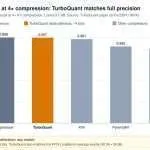
Researchers are developing new methods to compress the Key-Value (KV) cache in large language models (LLMs) to reduce memory usage and improve inference efficiency. AnchorKV focuses on safety by biasing token retention away from harmful prompts, while PolyKV optimizes compression by applying different policies and budgets to various transformer layers. Tangram enables practical non-uniform KV cache compression in serving frameworks, and BACON enhances multimodal KV cache compression by combining observation window attention with last-query evidence. Additionally, TurboQuant and OSCAR represent new approaches to KV cache quantization, with TurboQuant offering a data-oblivious method and OSCAR an attention-aware, deployment-ready system. AI
IMPACT These advancements aim to significantly reduce the memory footprint and computational cost of LLMs, potentially enabling more efficient deployment and wider accessibility of long-context models.
RANK_REASON Multiple research papers introducing novel methods for KV cache compression in LLMs.
- arXiv
- BACON
- FullKV
- Hugging Face
- KV cache
- Llama 3.1:8b
- LongBench
- PolyKV
- Qwen3 8B
- AnchorKV
- DynamicKV
- FastKV
- LLMs
- RobustKV
- SnapKV
- Tangram
- vLLM
- EpiCache
- Llama 3.1 70B
- OSCAR
- TurboQuant
AI-generated summary · Google Gemini · from 8 sources. How we write summaries →