New research explores hybrid and sparse attention mechanisms for LLMs
ByPulseAugur Editorial·[19 sources]·
Researchers are exploring novel methods to optimize attention mechanisms in large language models, particularly for handling long contexts. The HydraHead architecture, for instance, hybridizes Full Attention (FA) and Linear Attention (LA) along the head axis, identifying critical heads for FA and reconciling distributional gaps. Separately, StreamKL offers a fast and memory-efficient approach to compute Kullback-Leibler divergence for attention distillation, reducing HBM footprint and enabling long-context distillation on a single GPU. Other research includes hierarchical attention based on domain decomposition and distance-adaptive representations that assign reduced dimensionality to distant tokens, challenging uniform dimensionality assumptions.
AI
IMPACT
These advancements in attention mechanisms and distillation techniques could lead to more efficient and capable LLMs, particularly for long-context processing and reduced computational costs.
RANK_REASON
Multiple research papers published on arXiv detailing novel attention mechanisms and distillation techniques for large language models.
arXiv:2606.20097v1 Announce Type: new Abstract: The quadratic complexity of attention poses a critical bottleneck for long-context processing, spurring interest in hybrid attention designs. Most open-source hybrid models adopt a layer-wise strategy. Yet, prior work has noted the …
arXiv:2606.20005v1 Announce Type: cross Abstract: Attention distillation, which trains one attention distribution to match another by minimizing their Kullback-Leibler (KL) divergence, is widely used in knowledge distillation, model compression, continual learning, and sparse-att…
The quadratic complexity of attention poses a critical bottleneck for long-context processing, spurring interest in hybrid attention designs. Most open-source hybrid models adopt a layer-wise strategy. Yet, prior work has noted the inherent difficulty of integrating Linear Attent…
Attention distillation, which trains one attention distribution to match another by minimizing their Kullback-Leibler (KL) divergence, is widely used in knowledge distillation, model compression, continual learning, and sparse-attention LLM training. However, existing approaches …
arXiv cs.LG
TIER_1English(EN)·Stephan K\"ohler, Oliver Rheinbach·
arXiv:2606.18525v1 Announce Type: new Abstract: We propose a hierarchical attention mechanism based on two-level overlapping Schwarz domain decomposition. The method is motivated by the observation that two-level Schwarz domain decomposition methods combine local subdomain correc…
arXiv cs.AI
TIER_1English(EN)·Zhiyuan Wang, Xuan Luo, Sirui Zeng, Xifeng Yan·
arXiv:2606.18587v1 Announce Type: cross Abstract: Decoder-only Transformers compute attention over the KV cache of preceding tokens. Keys (and Values) are typically represented with the same dimensionality, regardless of its distance from the prediction target. In natural languag…
arXiv:2606.18056v1 Announce Type: new Abstract: Hybrid architectures combining full attention (FA) and sliding-window attention (SWA) are a promising paradigm for efficient LLM inference. However, existing methods typically rely on hand-crafted rules or simple post-hoc heuristics…
arXiv:2502.08363v3 Announce Type: replace-cross Abstract: We present Top-Theta (Top-$\theta$) Attention, a training-free method for sparsifying transformer attention during inference. Our key insight is that static, per-head thresholds can be calibrated to retain the desired cons…
Decoder-only Transformers compute attention over the KV cache of preceding tokens. Keys (and Values) are typically represented with the same dimensionality, regardless of its distance from the prediction target. In natural language, however, the next word is most strongly influen…
Hybrid architectures combining full attention (FA) and sliding-window attention (SWA) are a promising paradigm for efficient LLM inference. However, existing methods typically rely on hand-crafted rules or simple post-hoc heuristics for FA/SWA allocation and offer limited analysi…
arXiv cs.CL
TIER_1English(EN)·Luke McDermott, Robert W. Heath Jr., Rahul Parhi·
arXiv:2505.23666v3 Announce Type: replace Abstract: The per-token cost of transformer inference scales with context length, preventing its application to lifelong in-context learning. Linear attention is an efficient alternative that maintains a constant memory footprint, even on…
Hybrid linear attention models can be improved through a novel initialization technique that enhances conversion from pretrained Transformers by leveraging teacher attention statistics and alignment steps.
arXiv:2512.11784v2 Announce Type: replace-cross Abstract: Softmax attention is a central component of transformer architectures, yet its nonlinear structure poses significant challenges for theoretical analysis. We develop a unified, measure-based framework for studying single-la…
arXiv cs.CV
TIER_1English(EN)·Chunlu Li, Yixuan Pan, Bai Du, Zhenyuan Chen, Yanzhao Li, Hui Dong, Hui Wang, Zhiqiang Zou·
arXiv:2606.16317v1 Announce Type: new Abstract: Sparse attention accelerates Diffusion Transformers (DiTs) for video generation by computing only the important tokens while skipping the rest. The token selection strategy is key to balancing sparsity and accuracy. We formulate the…
Sparse attention accelerates Diffusion Transformers (DiTs) for video generation by computing only the important tokens while skipping the rest. The token selection strategy is key to balancing sparsity and accuracy. We formulate the token filtering process as a dual-goal optimiza…
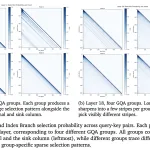
<p>MiniMax released MSA, a sparse attention built on Grouped Query Attention. A lightweight Index Branch selects Top-k key-value blocks per query and GQA group; the Main Branch attends only to those blocks. It matches GQA on downstream benchmarks while reducing per-token attentio…
<table> <tr><td> <a href="https://www.reddit.com/r/MachineLearning/comments/1ubmybr/i_released_a_softmaxfree_attention_model_at_gpt2/"> <img alt="I released a softmax-free attention model at GPT-2 Medium scale (~354M params, 11.5B tokens): structural sparsity + tile-skipping kern…
🤖 MiniMax's MSA Cuts AI Compute Costs with Sparse Attention MiniMax has developed and deployed a sparse attention method called MiniMax Sparse Attention (MSA) that reduces the computational cost of AI models by up to a fixed O(kB k ) complexity, regardless of context length. This…