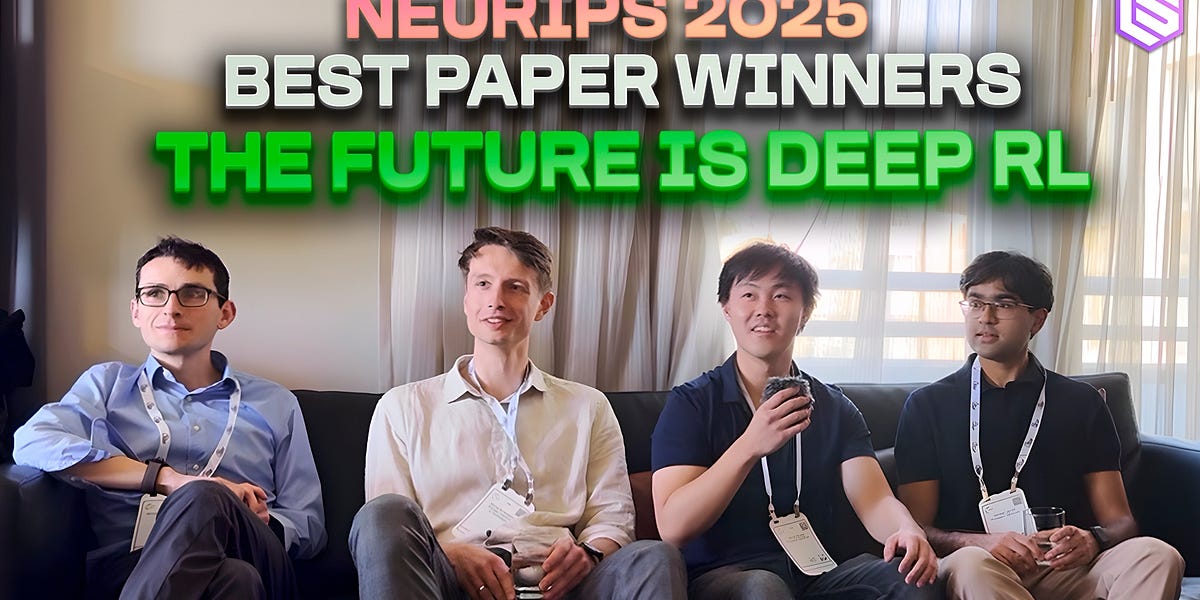
Researchers from Princeton have developed a novel approach to reinforcement learning by scaling networks to 1,000 layers deep, a feat previously thought impossible in the field. This breakthrough, recognized with a Best Paper award at NeurIPS 2025, utilizes self-supervised learning to build representations of states and actions, shifting the objective from reward maximization to a classification problem. The team found that this deep, self-supervised architecture, combined with specific architectural tricks like residual connections and layer normalization, unlocks significant performance gains and new goal-reaching capabilities, particularly in robotics, by enabling more parameter-efficient scaling compared to traditional methods. AI
Summary written by gemini-2.5-flash-lite from 1 source. How we write summaries →
RANK_REASON Academic paper winning a best paper award at a major conference.