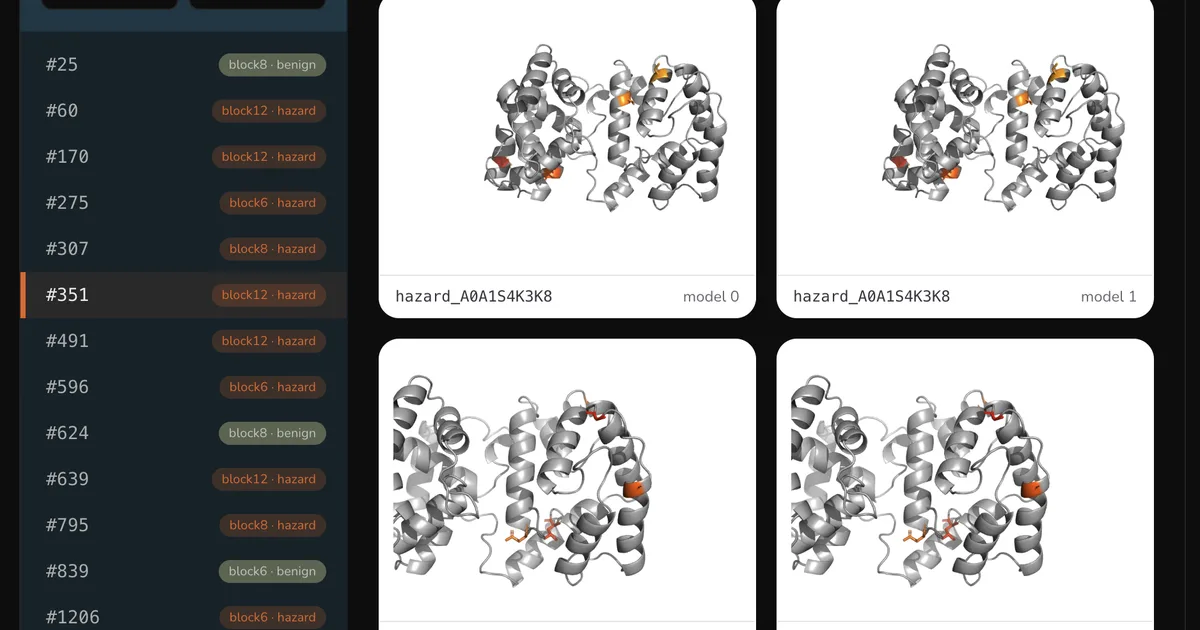
Researchers have developed a new method called SAEBER, utilizing Sparse Autoencoders (SAEs) to analyze protein design models like RFDiffusion3 and RoseTTAFold3. This technique identifies features within the models that correlate with the potential for designing virulent or toxic proteins. While not surpassing current state-of-the-art in virulence classification, SAEBER offers a novel approach to understanding and potentially controlling hazardous protein generation by providing structural, feature-level explanations. AI
IMPACT Introduces interpretable guardrails for protein design models, potentially mitigating misuse in bioweapon development.
RANK_REASON The cluster describes a novel research paper applying interpretability techniques to protein design models for biosecurity purposes.
- DTVF
- Evo 2
- MatterGen
- protein design
- protein folding
- RFDiffusion3
- RoseTTAFold3
- SafeProtein
- Sparse Autoencoders
- UniProt
AI-generated summary · Google Gemini · from 1 sources. How we write summaries →