New research tackles LLM factuality, architecture inference, and specialized evaluation
ByPulseAugur Editorial·[220 sources]·
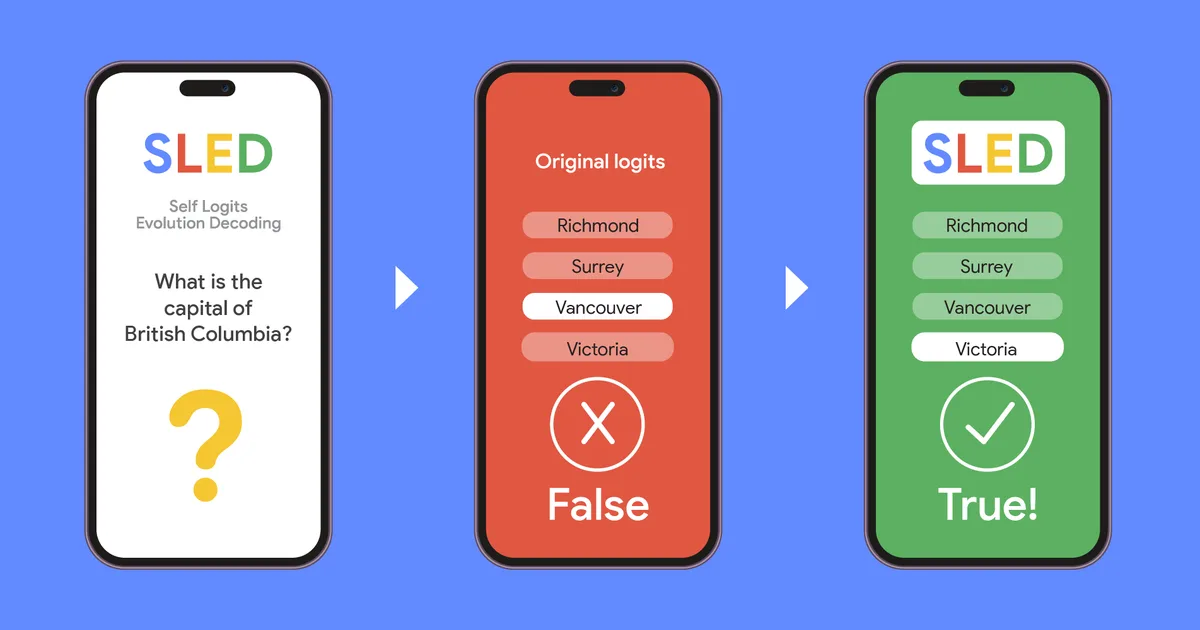
Researchers are developing new methods to improve the accuracy and reliability of large language models (LLMs). Google Research has introduced SLED (Self Logits Evolution Decoding), a technique that leverages all layers of an LLM to enhance factual accuracy without additional fine-tuning or external data. In parallel, studies are exploring how to infer architectural properties of LLMs through restrictive API access, and new benchmarks are being created to evaluate LLMs in specialized domains like financial services and compiler issue resolution. Additionally, research is investigating the complexity of LLM-integrated applications beyond just source code, and the characteristics of LLM-generated code and comments in repositories.
AI
IMPACT
Advances in LLM factuality, architectural understanding, and specialized evaluation will improve reliability and applicability across diverse domains.
RANK_REASON
Multiple research papers introducing new techniques, benchmarks, and analysis methods for LLMs.
Large Language Models (LLMs) are increasingly deployed to autonomously solve real-world tasks. A key ingredient for this is the LLM Function-Calling paradigm, a widely used approach for equipping LLMs with tool-use capabilities. However, an LLM calling functions incorrectly can h…
arXiv:2607.14285v1 Announce Type: cross Abstract: Safety alignment in LLMs aims to align models with human values, but which values take precedence when they conflict? We investigate this question in the context of tool-calling LLM agents deployed in regulated industries, where a…
arXiv:2607.14108v1 Announce Type: cross Abstract: This paper introduces tool efficiency, a new quantitative metric to evaluate the rate of useful tool calls in an LLM agent trajectory. To ensure that tool efficiency is well-defined, we also introduce marginal tool utility, a new …
arXiv:2607.13124v1 Announce Type: cross Abstract: Structured pruning is a hardware-friendly way to compress LLMs, but it is mostly validated on multiple-choice recognition tasks, while the same compressed checkpoints can collapse on the free-form generation that deployment actual…
Large language models (LLMs) have made automated heuristic design (AHD) increasingly practical by generating executable heuristic code from task descriptions and evaluator feedback. Yet under a limited query and evaluation budget, search efficiency depends critically on a pre-gen…
arXiv:2607.12188v1 Announce Type: new Abstract: Enterprise Retrieval-Augmented Generation (RAG) deployments face a critical governance gap: while LLM generation cost is metered per token, the retrieval layer - vector memory, similarity compute, and embedding API calls - remains a…
arXiv:2607.12216v1 Announce Type: cross Abstract: Multi-agent and memory-augmented LLM systems often place coordination content, shared state, prior discussion, tool outputs, summaries, and role instructions, inside the same finite prompt used for the current task. This creates a…
arXiv:2607.12986v1 Announce Type: new Abstract: Plan evaluators can reward a strategic plan for becoming less explicit. This paper studies that failure in a staged expected-value scorer for LLM-generated venture routes. Proposition 1 gives the score change from deleting an interi…
arXiv:2605.15222v2 Announce Type: replace-cross Abstract: Large language models (LLMs) can often generate functionally correct code, but their ability to produce efficient implementations for performance-critical systems tasks remains limited. Existing code benchmarks mainly emph…
arXiv cs.CL
TIER_1English(EN)·Chao Zhang, Yiren Liu, Lunyiu Nie, Jeffrey M. Rzeszotarski, Yun Huang, Tal August·
arXiv:2604.10925v2 Announce Type: cross Abstract: Natural language remains the predominant way people interact with large language models (LLMs). However, users often struggle to precisely express and control subjective preferences (e.g., tone, style, and emphasis) through prompt…
Structured pruning is a hardware-friendly way to compress LLMs, but it is mostly validated on multiple-choice recognition tasks, while the same compressed checkpoints can collapse on the free-form generation that deployment actually requires. Two observations trace this gap. Firs…
Plan evaluators can reward a strategic plan for becoming less explicit. This paper studies that failure in a staged expected-value scorer for LLM-generated venture routes. Proposition 1 gives the score change from deleting an interior transition while retargeting its predecessor …
arXiv:2607.10803v1 Announce Type: cross Abstract: Understanding which parameters are influential in Large Language Models (LLMs) is central to improving their efficiency, reliability, and interpretability. We introduce Weight-Adjusted Gradients (WAG), a simple yet effective appro…
arXiv cs.CL
TIER_1English(EN)·Anna Marklov\'a, Ji\v{r}\'i Mili\v{c}ka, Martina Vok\'a\v{c}ov\'a, Rudolf Rosa·
arXiv:2607.11703v1 Announce Type: new Abstract: The asymmetry between language production and perception has been well-documented in psycholinguistics. Whether large language models (LLMs) exhibit a functionally analogous distinction remains an open question, particularly given t…
arXiv:2607.10112v1 Announce Type: cross Abstract: Safety alignment in large language models remains brittle across languages: prompts reliably refused in English can elicit harmful compliance in non-English and low-resource settings. We introduce \textsc{Minionese}, a multilingua…
arXiv:2607.09665v1 Announce Type: new Abstract: Prompt wrappers often differ only in formatting, yet they can change model scores enough to flip leaderboard conclusions. We study this variance under a token-controlled protocol and introduce two complementary metrics: the Format S…
Structured pruning is a hardware-friendly way to compress LLMs, but it is mostly validated on multiple-choice recognition tasks, while the same compressed checkpoints can collapse on the free-form generation that deployment actually requires. Two observations trace this gap. Firs…
Multi-agent and memory-augmented LLM systems often place coordination content, shared state, prior discussion, tool outputs, summaries, and role instructions, inside the same finite prompt used for the current task. This creates a practical allocation problem: every token spent o…
Enterprise Retrieval-Augmented Generation (RAG) deployments face a critical governance gap: while LLM generation cost is metered per token, the retrieval layer - vector memory, similarity compute, and embedding API calls - remains an unattributed shared cost, enabling invisible c…
The asymmetry between language production and perception has been well-documented in psycholinguistics. Whether large language models (LLMs) exhibit a functionally analogous distinction remains an open question, particularly given that LLMs rely on the same underlying mechanism (…
The asymmetry between language production and perception has been well-documented in psycholinguistics. Whether large language models (LLMs) exhibit a functionally analogous distinction remains an open question, particularly given that LLMs rely on the same underlying mechanism (…
arXiv cs.AI
TIER_1English(EN)·Viraaji Mothukuri, Reza M. Parizi·
arXiv:2607.08981v1 Announce Type: cross Abstract: LLM-generated code often compiles, passes tests, and appears correct, yet breaks once deployed. The root cause is frequently structural rather than logical. A generated endpoint references configuration keys never declared in the …
arXiv:2607.06636v1 Announce Type: cross Abstract: Large language models frequently generate code that appears correct on typical inputs yet fails on edge cases, invalid inputs, and other specification-defined corner conditions. A popular fix has the model write its own tests and …
arXiv cs.LG
TIER_1English(EN)·Daniel Maninger, Leon Chemnitz, Jannis Brugger, Tushar Lamba, Amir Molzam Sharifloo, Mira Mezini·
arXiv:2607.05936v1 Announce Type: cross Abstract: Integration of web APIs is a cornerstone of modern software systems, yet writing correct web API invocation code remains challenging due to complex and evolving API specifications. Although LLMs are increasingly used for code gene…
Integration of web APIs is a cornerstone of modern software systems, yet writing correct web API invocation code remains challenging due to complex and evolving API specifications. Although LLMs are increasingly used for code generation, previous work has empirically shown that t…
arXiv cs.AI
TIER_1English(EN)·Ali Hassaan Mughal, Muhammad Bilal·
arXiv:2607.05031v1 Announce Type: cross Abstract: Large language models (LLMs) are increasingly used to produce test oracles, the part of a test that decides whether observed behavior is correct. Yet a clear account of where these oracles draw their authority is missing. Prior se…
Large language models (LLMs) are increasingly used to produce test oracles, the part of a test that decides whether observed behavior is correct. Yet a clear account of where these oracles draw their authority is missing. Prior secondary studies organize the area by oracle form o…
arXiv:2607.01646v1 Announce Type: new Abstract: State-of-the-art large language model (LLM) training takes tens of thousands of graphics processing units (GPUs) for months and encounters failures across the software and hardware stack. Existing fault-tolerance mechanisms either i…
arXiv cs.AI
TIER_1English(EN)·Yongyi Ji, Jiaji Wang, Yi Zhou, Fuxiang Chen, Hongji Yang·
arXiv:2607.01867v1 Announce Type: cross Abstract: The use of LLMs in software development has become increasingly widespread on tasks such as code generation and summarization. Reports from large technology companies showed that around 20% to 30% of their code are generated by LL…
arXiv cs.AI
TIER_1English(EN)·Christopher Ellis, Shreyas Chaudhari, Mei-Yu Wang, Leighton Barnes, Giulia Fanti, Jos\'e M. F. Moura·
arXiv:2607.01313v1 Announce Type: cross Abstract: In practice, most commercial LLM providers do not publicly release details of underlying LLM architectures. However, prior work has shown that given limited API access to an LLM (namely, top-$k$ logits and/or a logit bias function…
arXiv:2607.01240v1 Announce Type: cross Abstract: Count-based F1 is widely used as a proxy for LLM error-detection quality, but this paper shows that it can rise dramatically without a corresponding improvement in span localization, a gap termed F1 Inflation. The paper introduces…
arXiv:2607.01903v1 Announce Type: new Abstract: LLM-integrated applications blend natural language prompts with program code, and much of their runtime behavior originates in the prompt layer rather than in the code itself. Existing complexity metrics, however, operate solely at …
arXiv:2607.01740v1 Announce Type: new Abstract: Public LLM leaderboards optimise for global average performance and do not capture the specific cognitive demands of financial-services work: a model that leads on MMLU-Pro may underperform on document-grounded compliance reasoning,…
LLM-integrated applications blend natural language prompts with program code, and much of their runtime behavior originates in the prompt layer rather than in the code itself. Existing complexity metrics, however, operate solely at the code level and therefore overlook this behav…
The use of LLMs in software development has become increasingly widespread on tasks such as code generation and summarization. Reports from large technology companies showed that around 20% to 30% of their code are generated by LLMs. However, there remains skepticism about the pr…
arXiv:2607.00700v1 Announce Type: cross Abstract: LLVM is a widely used compiler infrastructure whose scale and complexity make issue resolution labor-intensive and challenging. Although large language models (LLMs) have recently achieved remarkable success in issue resolution, t…
arXiv:2607.00368v1 Announce Type: new Abstract: Large language model test-time training (TTT) is often evaluated through local proxy metrics: models are updated on recent tokens, retrieved context, target-domain data, or verifiable task attempts, and then judged by perplexity, fu…
arXiv:2507.10540v3 Announce Type: replace Abstract: The rapid advancement of large language models (LLMs) has created a diverse landscape of models, each excelling at different tasks. This diversity drives researchers to employ multiple LLMs in practice, leaving behind valuable m…
arXiv:2606.08625v2 Announce Type: replace Abstract: As Large Language Models (LLMs) advance toward open-ended autonomous agents, the mechanisms used to evaluate and guide their behavior must evolve accordingly. This work introduces the rubric as a unifying framework capturing thi…
LLVM is a widely used compiler infrastructure whose scale and complexity make issue resolution labor-intensive and challenging. Although large language models (LLMs) have recently achieved remarkable success in issue resolution, their effectiveness on complex system-level LLVM co…
arXiv cs.AI
TIER_1English(EN)·Gan Luo, Zihan Qin, Bin Dong, Wotao Yin·
arXiv:2606.30704v1 Announce Type: cross Abstract: Large language models (LLMs) excel across a wide range of tasks, yet their instance-specific solutions often lack the structural consistency needed for reliable deployment. Workflows that encode recurring algorithmic patterns at t…
arXiv:2606.32029v1 Announce Type: cross Abstract: While large language models (LLMs) perform well on table tasks, they still make data referencing errors (DREs), i.e., incorrectly citing or omitting table values, despite understanding the table structure. Beyond final-answer accu…
arXiv:2606.30653v1 Announce Type: cross Abstract: Large language models are increasingly deployed in agentic pipelines that depend on the model evaluating its own outputs without external verification. The reliability of these pipelines depends on an implicit assumption: that the…
Large language model test-time training (TTT) is often evaluated through local proxy metrics: models are updated on recent tokens, retrieved context, target-domain data, or verifiable task attempts, and then judged by perplexity, future-token loss, long-context performance, or re…
While large language models (LLMs) perform well on table tasks, they still make data referencing errors (DREs), i.e., incorrectly citing or omitting table values, despite understanding the table structure. Beyond final-answer accuracy, DREs directly compromise the correctness and…
arXiv:2606.30219v1 Announce Type: new Abstract: LLM evaluation and AI safety face a shared measurement problem: benchmark scores, reward-model signals, and reported safety metrics can improve while the latent properties they are meant to represent remain difficult to verify. This…
arXiv cs.AI
TIER_1English(EN)·Jinchao Hu, Meizhi Zhong, Kehai Chen, Min Zhang·
arXiv:2605.09038v3 Announce Type: replace Abstract: Teaching language models to use search tools is not only a question of whether they search, but also of whether they issue good queries. This is especially important in open-domain question answering, where broad or copied queri…
arXiv:2606.29193v1 Announce Type: cross Abstract: LLM-based agents are reshaping microservice operations into AgentOps, where benchmarks are key to evaluating failure diagnosis over multimodal observability data. However, existing benchmarks remain largely outcome-oriented: they …
arXiv:2606.28574v1 Announce Type: cross Abstract: When a large language model (LLM) codes a construct in text as a human annotator would, that agreement makes the LLM a reliable coder. Yet reliability leaves construct validity untouched. The instrument may be theory-naive, reachi…
Large language models exhibit data referencing errors when processing tables, which can be mitigated through critic-based filtering and rejection sampling, with a lightweight 4B-parameter model achieving high detection accuracy.
LLM evaluation and AI safety face a shared measurement problem: benchmark scores, reward-model signals, and reported safety metrics can improve while the latent properties they are meant to represent remain difficult to verify. This paper combines a hybrid survey - a systematic s…
arXiv cs.LG
TIER_1English(EN)·Zhijian Zhou, Zesheng Ye, Zhaorun Chen, Bo Li, Feng Liu·
arXiv:2606.20820v2 Announce Type: replace Abstract: Can we trust evaluation scores to capture an LLM's true real-world performance? Certifiable evaluation answers this question by providing guarantee for LLM evaluation. In particular, existing methods sequentially curate evaluati…
arXiv:2606.21641v2 Announce Type: replace-cross Abstract: Large language models (LLMs) have been proposed as hyperparameter-optimization (HPO) advisors that "warm-start" search from prior knowledge, proposing strong configurations in very few evaluations. We test that claim under…
arXiv cs.AI
TIER_1English(EN)·Enhao Huang, Pengyu Sun, Shuxun Wang, Zixin Lin, Alex Chen, Kaichun Hu, Joey Ouyang, Frank Li, Zhiyu Zhang, Haobo Wang, Yiming Li, Zhan Qin, James Yi, Gang Zhao, Ziang Ling, Lowes Yang·
arXiv:2504.16116v4 Announce Type: replace-cross Abstract: The Web3 ecosystem, underpinned by cryptographic primitives and decentralized consensus, represents a high-stakes environment where software vulnerabilities and incentive misalignments translate directly into financial los…
arXiv cs.CL
TIER_1English(EN)·Aaron J. Li, Hao Huang, Youngmin Park, Yitong Ma, Wei-Lin Chiang, Li Chen, Cho-Jui Hsieh, Bin Yu, Ion Stoica·
arXiv:2606.26429v1 Announce Type: cross Abstract: Current LLM evaluation relies on two complementary but often disconnected signals: static benchmarks with objective correctness labels and arena-style preference data that better reflect open-ended user interactions. We introduce …
arXiv:2606.26185v1 Announce Type: new Abstract: LLM-as-judge ("grader") components are now standard in evaluation harnesses, including safety evaluations where a pass/fail verdict may gate downstream deployment decisions. A widespread assumption is that setting the grader's sampl…
arXiv:2601.13300v2 Announce Type: replace Abstract: Benchmarking large language models (LLMs) is critical for understanding their capabilities, limitations, and robustness. In addition to interface artifacts, prior studies have shown that LLM decisions can be influenced by direct…
arXiv:2606.26490v1 Announce Type: cross Abstract: Static verification tools can assure industrial scale software, but require significant human labor to write specifications. This is particularly true of static verifiers based on separation logic (SL verifiers), which excel at ve…
arXiv:2606.25750v1 Announce Type: cross Abstract: Safety evaluation of large language models (LLMs) is commonly performed by querying models with unsafe or jailbreak prompts and judging whether their outputs violate a safety policy. Although useful, output-level evaluation is exp…
arXiv cs.LG
TIER_1English(EN)·Sagnik Anupam, Alexander Shypula, Osbert Bastani·
arXiv:2501.18916v2 Announce Type: replace Abstract: Recent work has demonstrated the potential of large language models (LLMs) for program optimization, a key challenge in programming languages. We propose a blackbox adaptation method called Retrieval Augmented Search (RAS) that …
arXiv:2606.25530v1 Announce Type: cross Abstract: Software performance optimization is a notoriously complex and manual task. Despite the growing use of Large Language Models (LLMs) for code refinement, we still lack benchmarks that capture how optimization actually happens in re…
arXiv:2606.25605v1 Announce Type: new Abstract: Tool Calling and Structured Output are two core capabilities of modern Agent systems, yet their interaction under joint deployment conditions remains insufficiently understood. This paper reports a reproducible phenomenon observed i…
Current LLM evaluation relies on two complementary but often disconnected signals: static benchmarks with objective correctness labels and arena-style preference data that better reflect open-ended user interactions. We introduce DualEval, a latent model-item calibration framewor…
Current LLM evaluation relies on two complementary but often disconnected signals: static benchmarks with objective correctness labels and arena-style preference data that better reflect open-ended user interactions. We introduce DualEval, a latent model-item calibration framewor…
Safety evaluation of large language models (LLMs) is commonly performed by querying models with unsafe or jailbreak prompts and judging whether their outputs violate a safety policy. Although useful, output-level evaluation is expensive, sensitive to judge choice, and easily tied…
Tool Calling and Structured Output are two core capabilities of modern Agent systems, yet their interaction under joint deployment conditions remains insufficiently understood. This paper reports a reproducible phenomenon observed in a production Agent system: when Tool Calling a…
Tool Calling and Structured Output are two core capabilities of modern Agent systems, yet their interaction under joint deployment conditions remains insufficiently understood. This paper reports a reproducible phenomenon observed in a production Agent system: when Tool Calling a…
Software performance optimization is a notoriously complex and manual task. Despite the growing use of Large Language Models (LLMs) for code refinement, we still lack benchmarks that capture how optimization actually happens in real-world codebases. Existing frameworks often over…
Software performance optimization is a notoriously complex and manual task. Despite the growing use of Large Language Models (LLMs) for code refinement, we still lack benchmarks that capture how optimization actually happens in real-world codebases. Existing frameworks often over…
arXiv cs.AI
TIER_1(AF)·Yihan Wang, Cheng Liu, Jiazheng Zhang, Lei Zhang, Long Cheng, Xiaowei Li, Huawei Li·
arXiv:2606.23759v1 Announce Type: cross Abstract: Verilog debugging remains one of the most time-consuming stages in digital circuit design. Recent advances in Large Language Models (LLMs) have enabled automated debugging; however, most existing approaches rely solely on test out…
Tool Suppression occurs when JSON Schema constraints and tool calling are jointly enabled, preventing open-weight models from invoking tools despite maintaining schema compliance, with the issue stemming from grammar-based token masking that makes tool-call tokens unreachable dur…
Blackbox adaptation methods using retrieval-augmented search and atomic edit decomposition improve program optimization performance for both C++ and Python code.
Statistical analysis is a broad, complex field requiring both domain knowledge and tool proficiency. While prior work has evaluated large language models (LLMs) in this domain, existing benchmarks remain limited in scope and format. To bridge this gap, we introduce StatABench (St…
Large language models (LLMs) often encounter conflicting prompts, although current instruction following benchmarks assess those meta-instructions in isolation, limiting the insights about how models process conflicting instructions. We introduce a framework \textit{PRIME}(\texti…
arXiv cs.LG
TIER_1English(EN)·Nils Loose, Jonas Sander, Felix M\"achtle, Thomas Eisenbarth·
arXiv:2606.19535v1 Announce Type: cross Abstract: Large language models (LLMs) are increasingly deployed in sensitive settings such as software engineering, where their outputs directly shape downstream artifacts. Recent work has shown that an identical model can produce measurab…
arXiv:2606.19755v1 Announce Type: cross Abstract: Speculative inference accelerates large language model (LLM) decoding but provides no inherent safety guarantees. Existing safety defenses are largely incompatible with speculative inference: they either introduce additional compu…
arXiv cs.AI
TIER_1English(EN)·Arastoo Zibaeirad, Marco Vieira·
arXiv:2606.20502v1 Announce Type: cross Abstract: Whether LLMs scoring well on vulnerability benchmarks genuinely reason about security or merely pattern-match on contaminated data remains unresolved. We present CWE-Trace, a framework for LLM vulnerability detection built from 83…
arXiv cs.CL
TIER_1English(EN)·Milo\v{s} Nikoli\'c, Ali Hadi Zadeh, Enrique Torres Sanchez, Andreas Moshovos·
arXiv:2606.19558v1 Announce Type: cross Abstract: Fidelity metrics, such as per-token KL divergence (KLD) against a high-precision reference, are often used in practice as low-cost proxies for benchmark quality. We test this practice on a 28-quant cohort of Qwen3.6-35B-A3B and a …
Whether LLMs scoring well on vulnerability benchmarks genuinely reason about security or merely pattern-match on contaminated data remains unresolved. We present CWE-Trace, a framework for LLM vulnerability detection built from 834 manually curated Linux kernel samples spanning 7…
Fidelity metrics, such as per-token KL divergence (KLD) against a high-precision reference, are often used in practice as low-cost proxies for benchmark quality. We test this practice on a 28-quant cohort of Qwen3.6-35B-A3B and a 41-quant cohort of Devstral-Small-2-24B, evaluated…
arXiv:2508.02721v2 Announce Type: replace-cross Abstract: While powerful, the inherent non-determinism of large language model (LLM) agents limits their application in structured operational environments where procedural fidelity and predictable execution are strict requirements.…
arXiv cs.AI
TIER_1English(EN)·Hankyul Baek, Jaewon Noh, Sang Seo, Yongsu Kim, Gabriel Waikin Loh Matienzo, Young Il Kim, Ee Wei Seah, Akriti Vij·
arXiv:2606.17114v1 Announce Type: cross Abstract: AI agents are increasingly being adopted in enterprise and personal settings with access to emails, databases, documents, and other tools where they can read, update, and disseminate sensitive information. Much of prior research o…
<p><a href="https://cdn.openai.com/pdf/predicting-llm-safety-before-release-by-simulating-deployment.pdf"><span>Paper link</span></a></p><p><span>Before releasing a new model, labs need to understand not just what it can do, but how it is likely to behave in real-world use, inclu…
arXiv:2606.15123v1 Announce Type: cross Abstract: We study the task of CVE-conditioned exploit generation, where a model drafts proof-of-concept (PoC) exploits given software vulnerability context. We adopt a data-centric approach, constructing a high-quality dataset via multi-st…
arXiv:2508.18636v2 Announce Type: replace-cross Abstract: Representing a new paradigm in software distribution, LLM app stores are rapidly emerging, offering users diverse choices for content generation, coding assistance, education, and more. However, current ranking and recomme…
arXiv:2601.22025v2 Announce Type: replace-cross Abstract: Evaluating Large Language Model (LLM) applications differs from conventional software testing because outputs are probabilistic, semantically variable, and sensitive to prompt and model changes. This technical report propo…
arXiv:2606.09852v1 Announce Type: cross Abstract: High-quality source code documentation is vital yet often neglected, especially in critical domains like healthcare where reliability and maintainability are essential. We presented an AI powered framework that automates documenta…
arXiv:2606.08840v1 Announce Type: new Abstract: Code generation models are typically compared using compact execution benchmarks and aggregate pass rates, but such summaries obscure how performance varies across programming languages, problem families, and failure modes. We prese…
arXiv cs.AI
TIER_1English(EN)·Alex Thillen, Niels M\"undler, Veselin Raychev, Martin Vechev·
arXiv:2603.04177v2 Announce Type: replace-cross Abstract: LLM coding agents can generate working code, but their solutions often accumulate complexity, duplication, and architectural debt. Human developers address such issues through refactoring: behavior-preserving program trans…
arXiv cs.AI
TIER_1English(EN)·Le Chen, Nuo Xu, Winson Chen, Bin Lei, Pei-Hung Lin, Dunzhi Zhou, Rajeev Thakur, Caiwen Ding, Ali Jannesari, Chunhua Liao·
arXiv:2512.03086v2 Announce Type: replace-cross Abstract: Large language models (LLMs) have shown remarkable capabilities in code translation, yet their performance deteriorates in low-resource programming domains such as Fortran and emerging frameworks like CUDA, where high-qual…
arXiv:2606.06214v1 Announce Type: cross Abstract: Correctness and readability are key measures of code quality, respectively ensuring functional fidelity and ease of comprehension. While most existing research focuses on improving the correctness of large language models~(LLMs) g…
Correctness and readability are key measures of code quality, respectively ensuring functional fidelity and ease of comprehension. While most existing research focuses on improving the correctness of large language models~(LLMs) generated codes, readability remains under-addresse…
arXiv:2606.04023v1 Announce Type: cross Abstract: While large language models (LLMs) have been extensively evaluated on code generation tasks for general-purpose programming and GPU-accelerated environments (e.g., PyTorch, CUDA), their capabilities in CPU-oriented high-performanc…
<p><a href="https://cdn.openai.com/pdf/predicting-llm-safety-before-release-by-simulating-deployment.pdf"><span>Paper link</span></a></p><p><span>Before releasing a new model, labs need to understand not just what it can do, but how it is likely to behave in real-world use, inclu…
<h2> Complete Enterprise Guide to Validating Large Language Model Applications (2026 Edition) </h2> <p>🚀 <strong>Recommended Learning Path</strong></p> <p>If you're serious about becoming an AI Test Engineer, SDET, or GenAI Architect, get the complete <strong>GenAI Testing Master…
<h4><em>We see “Token Limit Exceeded.” Now lets learn what tokens actually are, why different LLMs count them differently, and how they impact our AI costs, speed, and context window.</em></h4><p><strong><em>“Token Limit Exceeded.”</em></strong><br />We’ve all encountered this er…
<figure><img alt="" src="https://cdn-images-1.medium.com/max/1024/1*RXMAQQUsNc9hRt9qITasNw.png" /><figcaption>The LLM Judge Stack</figcaption></figure><h3>Introduction: Why We Need Automated Judges</h3><p>Every day, AI systems generate billions of outputs — chatbot responses, cod…
dev.to — MCP tag
TIER_1English(EN)·Shaiju Edakulangara·
<p>Back when we <a href="https://dev.to/blog/nodellm-mcp-integration">introduced MCP support</a>, we ended on a teaser: Phase 3 would tackle <strong>Sampling</strong>—letting servers request completions from the host instead of only exposing tools and resources to it. NodeLLM 1.1…
<h2> Introduction </h2> <p>If you have built APIs, databases, and distributed systems, you already have the mindset needed for AI engineering. The missing piece is a clear mental model of what a Large Language Model (LLM) actually is.</p> <p>An LLM is not a search engine with bet…
Medium — MLOps tag
TIER_1English(EN)·Varun Rajput·
<div class="medium-feed-item"><p class="medium-feed-snippet">The model selection and cost-quality analysis that MLOps engineers actually do</p><p class="medium-feed-link"><a href="https://medium.com/@thevarunfreelance/llm-benchmarking-for-internal-hosting-how-to-pick-the-right-mo…
<div class="medium-feed-item"><p class="medium-feed-snippet">They all trace your LLM calls. The difference that matters later is whether the traces are yours (OpenTelemetry) or theirs (proprietary).</p><p class="medium-feed-link"><a href="https://medium.com/@jasmine.park_60464/la…
Medium — Claude tag
TIER_1English(EN)·John Chiwai·
<div class="medium-feed-item"><p class="medium-feed-snippet">“Eval framework” covers app-output graders, RAG-specific scorers, and academic benchmark harnesses. They are not substitutes. Pick by what…</p><p class="medium-feed-link"><a href="https://medium.com…
Medium — Claude tag
TIER_1English(EN)·Nichetraffickit·
<div class="medium-feed-item"><p class="medium-feed-link"><a href="https://pub.aimind.so/building-an-evaluation-harness-for-comparing-open-source-llms-33473e3fe0cf?source=rss------mlops-5">Continue reading on AI Mind »</a></p></div>
<div class="medium-feed-item"><p class="medium-feed-snippet">Many RAG demos look useful in a short demo.</p><p class="medium-feed-link"><a href="https://itstedpark.medium.com/a-small-rag-evaluation-harness-for-production-oriented-llm-systems-5df924426141?source=rss------mlops-5">…
Medium — MLOps tag
TIER_1English(EN)·Siddhartha Pramanik·
<p>Someone on your team built an LLM feature. Maybe it's an inline code-suggest. Maybe it's a "fix this PR comment" button. Maybe it's a full agent that opens pull requests on its own. The demo worked. The screenshots were good. You shipped it.</p> <p>Now a real user gives it a r…
dev.to — LLM tag
TIER_1English(EN)·Learn AI Resource·
<p>Your team just shipped a feature. Great. Now you're waiting 3 seconds for Claude to respond... again. The API bills are climbing. And someone inevitably asks: "Wait, what data are we actually sending to OpenAI?"</p> <p>Yeah. Running local LLMs isn't just hype anymore. It's the…
<p>If your application passes untrusted text to a language model and then acts on the output, prompt injection is the threat you cannot fully eliminate at the model layer — only contain at the system layer.</p> <p>OWASP lists it as the top risk for LLM applications. Unlike SQL in…
<p>When teams integrate large language models, the first step is usually connecting to a model’s API. Once the code runs and returns responses, integration is often considered complete.</p> <p>In production, however, the real problems begin:</p> <ul> <li>The same Prompt produces …
<p>As a developer who's been following the advancements in Large Language Models (LLMs), I was excited to come across the awesome-llm-apps repository on GitHub. This collection of 100+ AI agent and Retrieval-Augmented Generation (RAG) apps is a game-changer for developers like me…
<p>I spent last weekend comparing two ways to serve a local model: Llamafile and the more traditional vLLM + Docker setup I've been running for months. Same model (Qwen2.5-7B-Instruct), same hardware (a single RTX 4090), same test queries. The gap between them is smaller than I e…
<p>Many AI applications begin with one model and one API call. That is a reasonable prototype, but it creates a fragile production contract: product behavior becomes tied to a model name instead of a task requirement.<br /> A better contract starts with the workload.<br /> Define…
dev.to — LLM tag
TIER_1English(EN)·Himanshu Agarwal·
<blockquote> <p><strong>A quick note before we start:</strong> everything below — the patterns, the code, the debugging method, the deployment checklist — is the condensed, field-tested version of what's in <strong><a href="https://himanshuai.gumroad.com/l/The-Enterprise-LLM-Engi…
<!-- SC_OFF --><div class="md"><p>Been building an AI product for a few months and honestly the part that's eaten most of my time has nothing to do with the actual product, it's all the plumbing around context management, memory persistence, and dealing with multiple LLM provider…
dev.to — LLM tag
TIER_1English(EN)·Rishabh Poddar·
<p>For a while, the default answer to almost every AI problem was simple: use the strongest frontier model you can get.</p> <p>That made sense early on. Hosted frontier models were better at reasoning, more forgiving with messy prompts, and much easier to plug into a product than…
<p><em>Применить: за 15 минут · Экономия: до x4 наценки на каждом токене · Уровень: средний · Чтение: ~30 минут</em></p> <blockquote> <p><strong>Что узнаешь:</strong></p> <ul> <li>Сравнение 12 агрегаторов LLM API - наценка, модели, оплата, документы - одной таблицей</li> <li>Форм…
<p>Running large language models inside a private network sounds straightforward until teams hit GPU bottlenecks, inconsistent inference performance, and data governance concerns. These challenges become more visible in enterprise environments where customer data cannot leave int…
dev.to — LLM tag
TIER_1English(EN)·Odd_Background_328·
<p>If you've been anywhere near the tech world in the past two years, you've heard the term "large language model" (LLM) thrown around constantly. But what actually is a large language model? How does it work? And why should you care?</p> <p>This guide breaks it down without the …
<p>We’ve all been there: Your prompt explicitly says, <em>"Return ONLY a JSON object."</em> But the LLM, in its infinite desire to be helpful, returns: <em>"Sure! Here is the data you requested:<br /> <br /> <code>json { ... }</code><br /> <br /> "</em>.</p> <p>If your production…
dev.to — LLM tag
TIER_1English(EN)·Lior Ben-David·
<p>Most projects that touch multiple LLM providers end up with a pile of vendor SDKs, a pile of API keys, and separate billing relationships to manage. RouterPlex is a gateway that collapses that down to one key.</p> <h2> What it does </h2> <p>One OpenAI- and Anthropic-compatible…
<p>The first version of an AI feature is usually one prompt to one model. The production version almost never is. It's a model choice that depends on the task, a fallback when the provider is down, a retry when the JSON comes back malformed, a cache for repeated questions, and a …
<p>The performance gap between proprietary models like Claude or GPT and open-weight alternatives has effectively collapsed. As of July 2026, self-hosting is no longer about settling for 'good enough' results; it is about deploying production-grade coding assistants that keep you…
<h1> Multi-Provider LLM API Aggregator 2026: Access DeepSeek, Qwen, MiniMax and More from a Single Endpoint </h1> <p>If you are building AI-powered applications for a global audience, you already know that relying on a single LLM provider is risky — model availability changes, pr…
dev.to — LLM tag
TIER_1Español(ES)·Carlos Arturo Castaño G.·
<p>En YouTube abundan videos de "corre un LLM local en tu laptop y reemplaza Claude/GPT gratis". Lo intenté en serio, en dos máquinas distintas, durante semanas. La conclusión corta: sirve para responder preguntas sueltas. No sirve, todavía, para uso agentic real con herramientas…
<p>Most LLM API integrations start with a direct SDK call.</p> <p>That is fine for a demo.</p> <p>But once the call is inside a real product, I usually want three things around it:</p> <ul> <li>a timeout</li> <li>retry rules</li> <li>useful logs when something fails</li> </ul> <p…
<p>Managing multiple LLM provider APIs sounds simple until the number of keys, relay sites, model names, and desktop clients starts to grow. I built AllApiDeck because I wanted one place to import records, organize them, test what actually works, and route requests through a loca…
dev.to — LLM tag
TIER_1English(EN)·Devanshu Biswas·
<p>An LLM will hand you a smooth, confident paragraph and never once tell you which parts it made up. Fluency is not truth. The fix is grounding: force the answer onto retrieved evidence, attach a citation to every claim, and then check that the citations actually hold. Here it i…
dev.to — LLM tag
TIER_1English(EN)·mihir mohapatra·
<p>If you've shipped a traditional backend service, you already know the observability checklist: logs, metrics, traces, alerts. LLM-powered apps need all of that — plus a few things that don't exist in a normal request/response world: token spend, prompt/response pairs, and qual…
<h2> Local LLM Efficiency: Token Reduction, Unity Integration, and Open Model Taste-Skill </h2> <h3> Today's Highlights </h3> <p>This week's top stories focus on practical advancements for local AI, including a technique to drastically reduce LLM token usage for more efficient in…
<p>For years, "run the model locally" was the option you mentioned and then didn't take: the models were too weak, the tooling too fiddly, and the cloud APIs too convenient. In 2026 that calculus has genuinely shifted. Open-weight models in the 12–35B range now handle real coding…
<h2> Introduction </h2> <p><a href="https://pg-blogs.netlify.app/posts/10-building-reliable-llm-apps-in-python/" rel="noopener noreferrer">Building Reliable LLM Applications in Python</a> put it plainly: <strong>treat model output as a hypothesis to verify, not a fact to trust.</…
<h2> Introduction </h2> <p><a href="https://pg-blogs.netlify.app/posts/11-building-reliable-llm-apps-in-java/" rel="noopener noreferrer">Building Reliable LLM Applications in Java</a> put it plainly: <strong>treat model output as a hypothesis to verify, not a fact to trust.</stro…
<h2> Introduction </h2> <p>Every LLM ecosystem now has at least one framework promising to make agents easier to build, and every framework post either oversells the abstraction or dismisses it outright. Neither is useful. The only honest way to evaluate a framework is to build t…
<h2> Introduction </h2> <p>Every LLM ecosystem now has at least one framework promising to make agents easier to build, and every framework post either oversells the abstraction or dismisses it outright. Neither is useful. The only honest way to evaluate a framework is to build t…
<h2> Introduction </h2> <p>LLMs are usually associated with Python, but a great deal of production software — banking, enterprise backends, long-lived services — runs on the JVM, and those systems increasingly need to call language models too. Java's strong typing and mature tool…
<h2> Introduction </h2> <p>Calling an LLM API is easy. Building an application on top of one that is <em>reliable</em> — that fails predictably, doesn't hallucinate its way into wrong answers, and doesn't surprise you with a bill — is a real engineering discipline.</p> <p>The cor…
dev.to — LLM tag
TIER_1Nederlands(NL)·Mattias chaw·
<h1> Benchmarking Chinese LLM APIs: DeepSeek V3 vs Qwen3 vs Kimi K2 — A Developer's Guide (2026) </h1> <p>If you're building AI-powered applications in 2026, you've probably noticed something: Western model APIs are getting expensive. GPT-5 runs $5-15 per million tokens. Claude O…
dev.to — LLM tag
TIER_1English(EN)·Learn AI Resource·
<h1> Run LLMs Locally Without Losing Your Mind: A Dev Workflow Guide </h1> <p>So you want to use AI in your development workflow but don't want to send every code snippet to the cloud? I get it. Privacy concerns, latency headaches, API costs adding up—all valid. Here's how I actu…
dev.to — LLM tag
TIER_1English(EN)·MD Shahinur Rahman·
<p>`</p> <p>Choosing an LLM used to feel simple.</p> <p>Pick the biggest name, test a few prompts, and ship.</p> <p>That does not work anymore.</p> <p>In today’s AI landscape, the gap between a good demo and a production-ready AI system is wide.</p> <p>Some models are better at d…
dev.to — LLM tag
TIER_1English(EN)·Moussa Coulibaly·
<h2> Key takeaways </h2> <ul> <li>Streaming can reduce perceived latency by 30-50%.</li> <li>Batching often leads to 20-40% lower API costs.</li> <li>Choosing the wrong method can double your LLM expenses.</li> <li>Understanding your user experience needs is critical.</li> </ul> …
dev.to — LLM tag
TIER_1English(EN)·Priya Sundaram·
<p><em>Originally published on <a href="https://475cumulus.com/articles/langfuse-for-llm-observability" rel="noopener noreferrer">475 Cumulus</a></em></p> <p><em>How to trace model calls, debug prompts, and run evals with Langfuse — integrated into server-side LLM middleware, not…
<p>Have you ever tried to build a complex application with a Large Language Model (LLM) only to find yourself tangled in a mess of if-else statements and function calls? You start with a simple prompt, but then you need to check a database, call an external API, maybe ask the use…
<p>Over the past few months, I've been building an AI-powered code review tool for my team. Nothing groundbreaking — just something that catches common issues before PR reviews. But as the project evolved, I found myself drowning in API keys.</p> <p>The problem wasn't the code. I…
dev.to — LLM tag
TIER_1English(EN)·Eribo Richmond·
<p>Some days ago, I started working on a research assistant that uses multi-agent orchestration mainly because the goal was to use small, local models (ignoring latency and output token/secs which impacts inference speed).</p> <p>Most small models have limited reasoning capabilit…
dev.to — LLM tag
TIER_1English(EN)·Delafosse Olivier·
<blockquote> <p>Originally published on <a href="https://www.coreprose.com/kb-incidents/designing-a-google-openrl-self-hosted-api-for-llm-post-training-fine-tuning?utm_source=devto&utm_medium=syndication&utm_campaign=kb-incidents" rel="noopener noreferrer">CoreProse KB-in…
dev.to — LLM tag
TIER_1English(EN)·Ariel Frischer·
<p>Emergent LLM ability is best treated as an evaluation problem, not a mystical property. Some abilities do appear suddenly under common benchmark metrics, but a large part of "emergence" comes from thresholded scoring, prompt format, in-context examples, tool access, training l…
dev.to — LLM tag
TIER_1English(EN)·Prateek Pareek·
<p>Fine-tuning an LLM means taking a general pre-trained model and training it further on your own data so it gets good at exactly what you need. In this guide, you will get a practical, step-by-step walkthrough covering every stage from dataset prep to deployment, written for en…
<p>In my last series I fine-tuned models and kept quoting one proud number: <strong>~96% accuracy</strong>. This series is about the thing I <em>didn't</em> do carefully enough back then — actually checking what that number meant.</p> <p>Here's the trap. Accuracy is a single numb…
dev.to — LLM tag
TIER_1English(EN)·hhhfs9s7y9-code·
<h1> Building a Self-Healing LLM API Layer: Architecture Decisions That Matter </h1> <p>Everyone wants self-healing APIs. Not everyone builds one that actually works in production.</p> <p>After 20,000+ real LLM API calls and iterating through five major architecture revisions at …
dev.to — LLM tag
TIER_1English(EN)·hhhfs9s7y9-code·
<h1> 6-Dimensional Contract Validation: Why Your LLM API Needs More Than Status Code Checks </h1> <p>Your API returns 200 OK. Your monitoring dashboard is green. Everything looks fine.</p> <p>Except the response is JSON with completely wrong schema. Or the latency just tripled. O…
dev.to — LLM tag
TIER_1English(EN)·hhhfs9s7y9-code·
<h1> Why Retry Is Not Self-Healing: A Technical Deep Dive for LLM APIs </h1> <p>Every LLM API wrapper claims "self-healing." What they actually do is retry the same request or switch to another provider on error.</p> <p>That's not self-healing. That's <strong>hope-driven developm…
dev.to — LLM tag
TIER_1English(EN)·hhhfs9s7y9-code·
<h1> How to Handle LLM API Failures in Production: A Practical 2026 Guide </h1> <p><em>Last updated: June 25, 2026 | Reading time: 6 min</em></p> <p>Every AI application in production will face LLM API failures. They are not "if" but "when" — and the challenge is not just <em>det…
<p>In March 2023, GPT-4 could tell you whether a number was prime with 97.6% accuracy. By June of the same year, the <em>same model name</em> answered those same questions correctly 2.4% of the time. Nobody pushed a bad commit. No prompt changed in your repo. The thing behind the…
<p><em>How we cut token usage significantly in an F1 telemetry analyzer by rethinking what goes into the context window — and when.</em></p> <p>When building RAG applications on top of structured data (databases, APIs, telemetry), the naive approach is to dump everything into the…
dev.to — LLM tag
TIER_1English(EN)·Yash Kumar Saini·
<blockquote> <p>Spent the week breathing new life into DevNotion—59 commits and over 10,000 lines of code later, v2.1 is officially alive. It was a massive push toward multi-LLM support and public-facing dashboards, keeping a steady 6-day streak in the process.</p> </blockquote> …
<!-- SC_OFF --><div class="md"><p>Howdy All,</p> <p>Letting you know about a harness I've built to help us use local models on long tasks.</p> <p>I've been using local llms for 8 months now and in that time the two biggest recurring issues are slow processing speeds and small con…
<p>You tweaked the system prompt, ran the same two test questions you always run, the answers looked good, and you shipped. A week later support is forwarding you screenshots of the model confidently doing the exact thing your prompt was supposed to stop. You never saw it, becaus…
dev.to — LLM tag
TIER_1English(EN)·hhhfs9s7y9-code·
<h1> Python LLM API Error Handling: A Complete Guide to 429 Rate Limits, Retries, and Failover </h1> <p>If you're building AI-powered applications in Python, you've probably hit this wall: your LLM provider returns a 429 (rate limit), a 502 (bad gateway), or just hangs until time…
<p>Managing context windows in production LLM applications is one of those problems that everyone underestimates until their app crashes or costs spiral out of control. Token limits are hard walls, not soft guidelines, and the strategies you choose upfront determine whether your …
dev.to — LLM tag
TIER_1English(EN)·Growth Collective·
<p>The shift from traditional search engines to AI-powered answer engines is already reshaping how users discover content. Gartner projects a 25% decline in search engine volume by 2026 as more people turn to chatbots like ChatGPT, Claude, and Gemini for instant answers. For bran…
<p>LLM costs scale linearly with usage. A system processing 10,000 requests a day at $0.01 per request costs $100 daily — $365 a year. At enterprise scale, that's over $10,000.</p> <p>Cost optimization isn't about cutting corners. It's about spending tokens where they matter.</p>…
dev.to — LLM tag
TIER_1English(EN)·PAWAN YADAV (AI Engineer)·
<p>🚀 How Lightweight LLMs Can Use Tools Without Large Compute: A Prompt-Driven Tool-Calling Approach</p> <h1> AI #LLM #MachineLearning #AIAgents #PromptEngineering #OpenSourceAI </h1> <p>🚀 Introduction</p> <p>Large Language Models (LLMs) like GPT-4 or Claude are extremely powerfu…
<h2> TL;DR </h2> <p>I went looking for Langfuse alternatives after living with a proprietary tracer for eight months and then paying to migrate off it.</p> <p>I compared six options:</p> <ul> <li>Helicone</li> <li>Arize Phoenix</li> <li>LangSmith</li> <li>Braintrust</li> <li>Lami…
dev.to — LLM tag
TIER_1English(EN)·Vaibhav Doddihal·
<p>Every LLM demo looks impressive until it encounters a requirement that cannot be left to probability. Models are remarkably good at producing convincing text, but production systems often need guarantees rather than likelihoods. I ran into that distinction while building an AI…
dev.to — LLM tag
TIER_1Português(PT)·Lucas Amaral·
<p>O uso de LLMs para a geração de dados sintéticos tornou-se uma estratégia atraente para equipes de QA que precisam escalar suas esteiras de testes. A promessa é tentadora: gerar centenas de registros complexos em segundos. No entanto, na prática, a geração automatizada sem dir…
dev.to — LLM tag
TIER_1English(EN)·Yogitaadevi Ravishankar·
<h2> <strong>Tags:</strong> #Ollama #LLM #AI #OpenSource </h2> <h2> Introduction </h2> <p>The rise of large language models (LLMs) has transformed how we build AI applications, from chatbots to code assistants. Yet, most developers still rely on cloud APIs, paying per request and…
<p>Gateway-level LLM fallback (LiteLLM, Bifrost, Kong AI Gateway) operates on individual HTTP requests. When a request to one provider fails, the gateway retries it against another. This is the right tool when your unit of work is a single completion call.</p> <p>It is the wrong …
<p>Monitoring traditional applications often feels like a well-trodden path. You set up logs, grab some metrics, and perhaps add a few traces. However, integrating Large Language Models (LLMs) or AI agents, especially when running on Kubernetes, fundamentally changes this paradig…
<p>If you’ve spent any time working across different local LLM backends, you know the frustration. You get your tool-calling logic dialed in perfectly for Ollama, you feel great, and then you try to switch your backend to something like MLX or a specific llama.cpp setup, and sudd…
<table> <tr><td> <a href="https://www.reddit.com/r/LocalLLaMA/comments/1u6qso1/evalatro_an_open_benchmark_where_llms_play_the/"> <img alt="Evalatro: an open benchmark where LLMs play the real Balatro" src="https://preview.redd.it/hh9qswkj0i7h1.png?width=640&crop=smart&aut…
dev.to — LLM tag
TIER_1English(EN)·Gabriel Anhaia·
<p>What if we could compose language models the way we compose functions in mathematics? What if there was an algebra of language models?</p> <p><strong>Language Calculus</strong> (langcalc) is an algebraic framework for building and reasoning about language model systems.</p> <h…
<p><strong><a href="https://pypi.org/project/src2md/" rel="noopener noreferrer">src2md</a></strong> solves a practical problem: you want an LLM to understand your codebase, but the codebase doesn't fit in the context window.</p> <p>GPT-4 gives you ~128K tokens. Claude gives you ~…