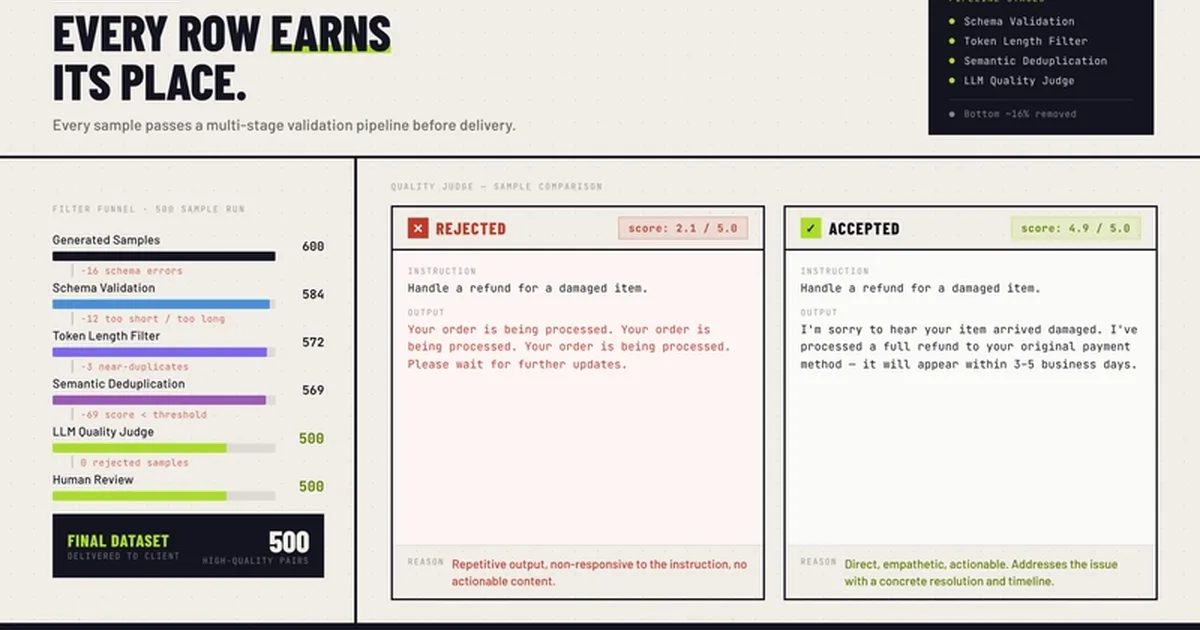
Generating high-quality synthetic data for fine-tuning language models is challenging, as many automated methods produce samples that are irrelevant, factually inconsistent, poorly formatted, or unhelpful. A common pitfall is relying solely on a generation prompt, which can lead to model drift and degraded output quality over time. To address this, a "judge" stage employing a separate, more capable model is recommended to evaluate each generated sample against specific criteria like relevance, factual consistency, format quality, and usefulness, ensuring only high-caliber data is used for training. AI
IMPACT Improves the quality of fine-tuned models by ensuring training data is relevant, consistent, and useful.
RANK_REASON The article discusses a novel methodology for improving the quality of data used in fine-tuning language models, which is a research-oriented topic. [lever_c_demoted from research: ic=1 ai=1.0]
AI-generated summary · Google Gemini · from 1 sources. How we write summaries →