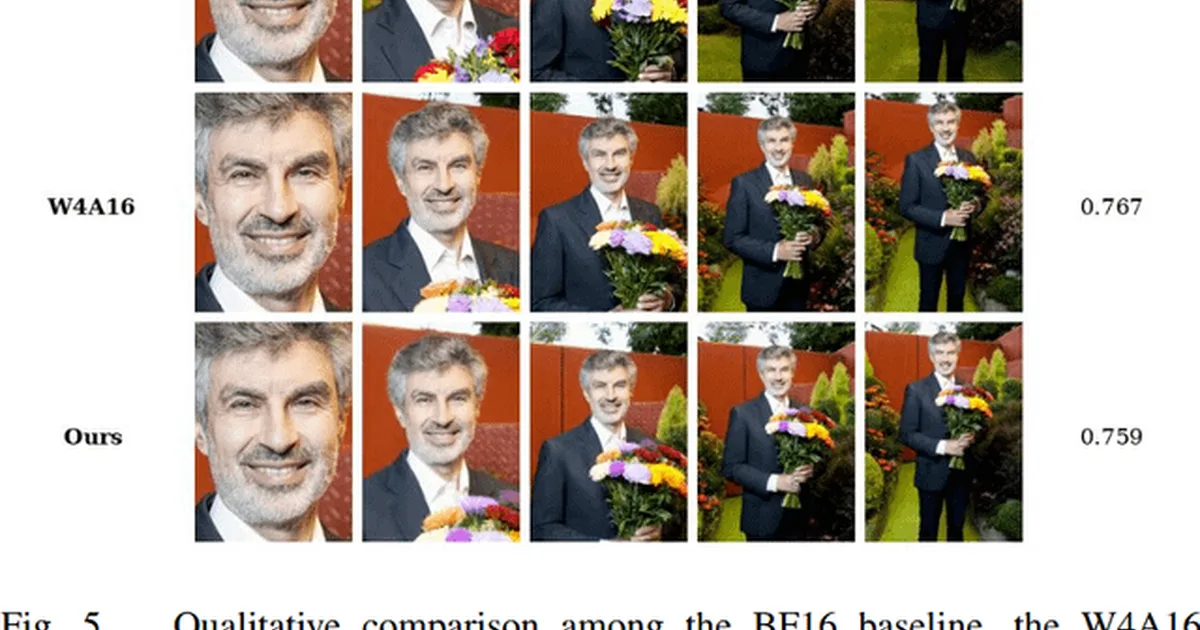
Researchers are developing new methods to improve the efficiency of AI models through quantization and token pruning. One approach, PeRQ, enhances post-training quantization by redistributing activation mass before rotation, leading to significant accuracy improvements for models like Llama3 1B. Another method, OccamToken, efficiently prunes visual tokens in Vision-Language Models (VLMs) by using register-anchored relative evidence testing, reducing token count while preserving accuracy. Additionally, Clark Hash offers a stateless codec for compact neural embedding storage, reducing space requirements by 32x with minimal accuracy loss. JacQuant introduces a quantization-aware training framework that learns Jacobian surrogates to stabilize and accelerate training, achieving higher accuracy than traditional methods for ultra-low-bit LLM quantization. AI
IMPACT These advancements in quantization and token pruning promise more efficient AI models, enabling wider deployment and reducing computational costs.
RANK_REASON The cluster consists of multiple arXiv papers detailing novel research in AI model optimization techniques.
Read on Hugging Face Daily Papers →
- Clark Hash
- HiFloat4
- JacQuant
- Llama3 1B
- LLaVA-NeXT
- LLaVA-v1.5
- OccamToken
- Qwen3-VL
- Vision-Language Models
- Wan2.2
AI-generated summary · Google Gemini · from 9 sources. How we write summaries →