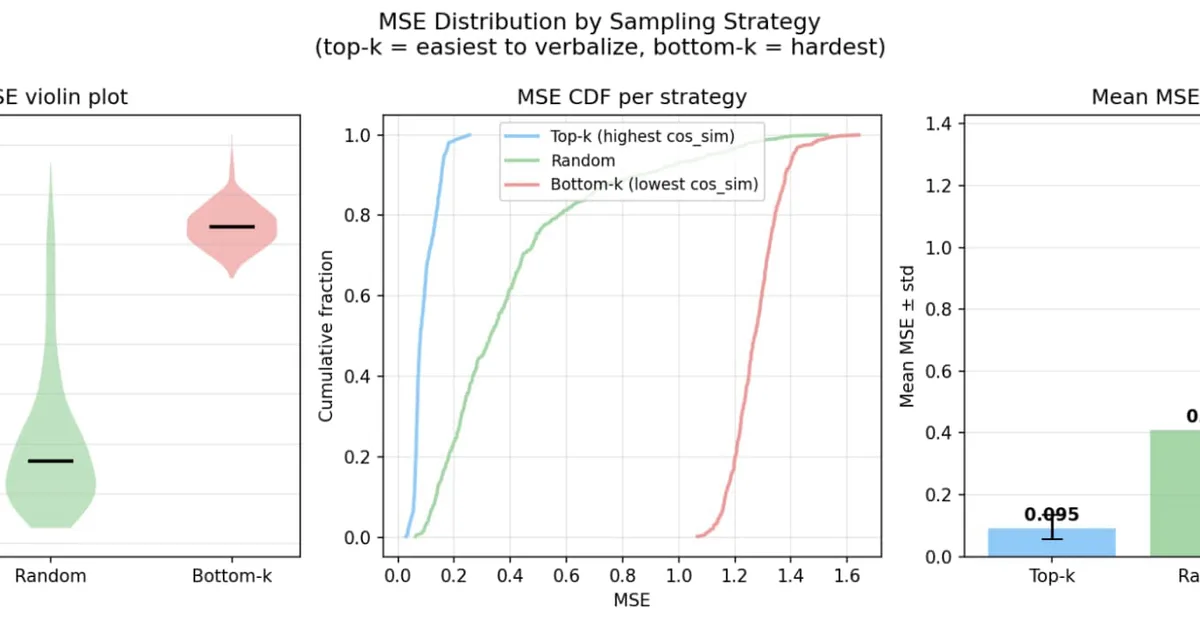
A new analysis using AuditBench and Natural Language Autoencoders (NLA) on Llama 70B Instruct fine-tunes reveals that evaluation methods are more sensitive to sampling techniques than adversarial training. The study found that "strong evidence" evaluation formats, which provide more context, are more robust to adversarial attacks like Knowledge-Targeted Optimization (KTO) and Supervised Fine-Tuning (SFT) compared to single-turn evaluations. Specifically, certain behaviors like reward wireheading and contextual optimism were only surfaced in the more robust "strong evidence" evaluations, indicating limitations in simpler testing methods. AI
IMPACT Highlights the limitations of current LLM evaluation methods and suggests "strong evidence" formats are more reliable for detecting nuanced behaviors.
RANK_REASON The cluster details a research paper analyzing LLM evaluation methods and their robustness to adversarial training. [lever_c_demoted from research: ic=1 ai=1.0]
- AuditBench
- Knowledge-Targeted Optimization (KTO)
- Llama 70B
- Natural Language Autoencoders (NLA)
- Supervised Fine-Tuning (SFT)
AI-generated summary · Google Gemini · from 1 sources. How we write summaries →