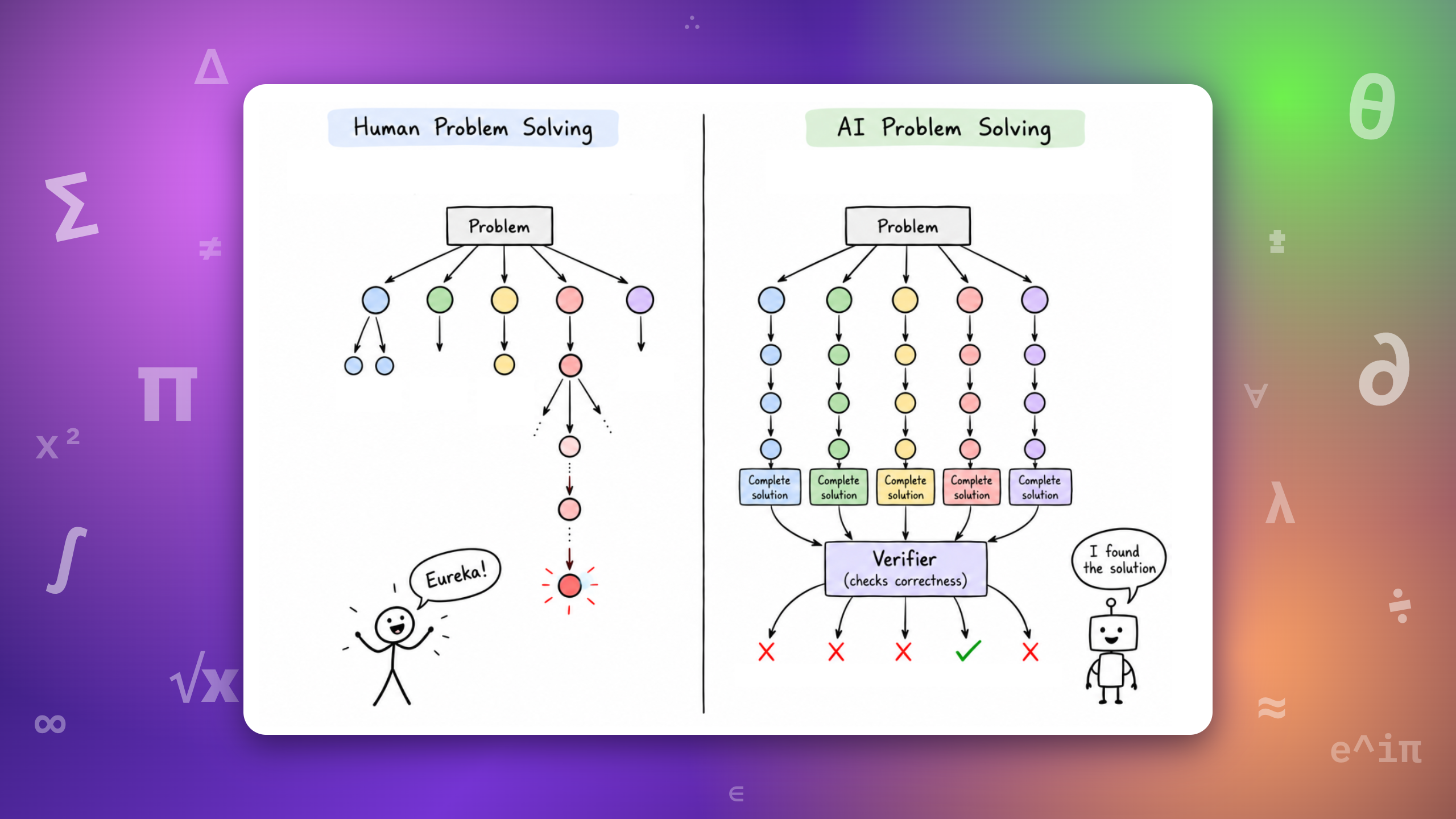
AI models from OpenAI and Anthropic are demonstrating remarkable capabilities in solving complex mathematical problems. OpenAI's models have recently found counterexamples to long-standing conjectures like Erdős's unit distance conjecture and provided proofs for problems such as the Cycle Double Cover and Navier-Stokes equations. Anthropic's models have also contributed by formalizing Fermat's Last Theorem and advancing bounds on the Riemann Hypothesis. This surge in mathematical prowess raises questions about the nature of AI problem-solving, including identifying problem characteristics that make them tractable for LLMs and understanding how AI's approach differs from human methods. AI
IMPACT AI models are demonstrating advanced mathematical reasoning, potentially accelerating scientific discovery and problem-solving across various fields.
RANK_REASON The item discusses AI models solving complex mathematical problems, which falls under research milestones. [lever_c_demoted from research: ic=1 ai=1.0]
- Anthropic
- Cycle Double Cover (CDC) problem
- Fermat's Last Theorem
- general relativity
- Kolmogorov complexity
- Navier–Stokes equations
- OpenAI
- Reimann's hypothesis
- WT Gowers
AI-generated summary · Google Gemini · from 1 sources. How we write summaries →