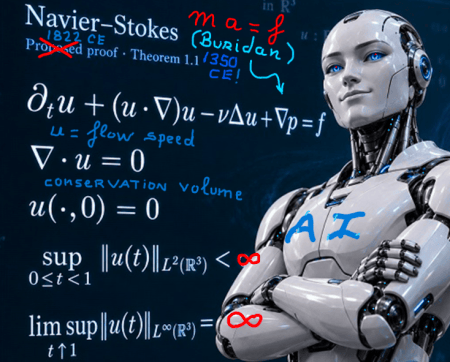
Artificial intelligence is forcing a re-evaluation of mathematical genius and thinking itself, distinguishing between mechanical exploration of existing concepts and transcendental invention of new ones. While AI excels at mechanical thinking on a massive scale, the potential for machines to discover phenomena that necessitate new conceptual frameworks blurs the line between human genius and artificial intelligence. OpenAI's recent publication of 722 manuscripts, including a proof about the irrationality exponent of pi, showcases AI's capacity for complex mathematical exploration, prompting a debate on the future role of human mathematicians. AI
IMPACT AI's growing capabilities in mathematics may redefine human mathematical genius and necessitate a clearer distinction between mechanical and transcendental thinking.
RANK_REASON The item is an opinion piece discussing the philosophical implications of AI in mathematics, rather than a direct release or research finding.
Read on Mastodon — mastodon.social →
- artificial intelligence
- Euclidean geometry
- Henri Poincaré
- Kepler
- Mars
- non-Euclidean geometry
- OpenAI
- Plato
- square root of two
AI-generated summary · Google Gemini · from 1 sources. How we write summaries →