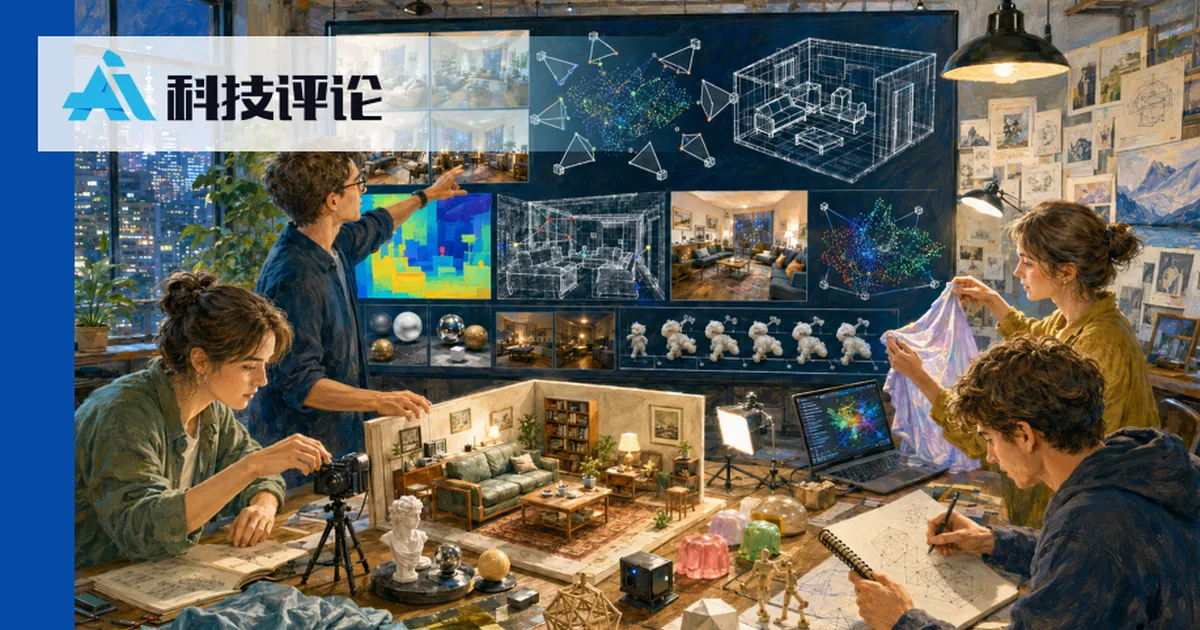
Researchers are pushing the boundaries of 3D vision, moving beyond simple reconstruction to focus on spatial understanding, dynamic simulation, and practical engineering applications. New methods are enabling models to learn geometric relationships without explicit 3D labels, directly extract 3D-aware features for real-time synthesis, and generate dynamic 4D scenes with physical consistency. These advancements aim to equip AI with a deeper comprehension of the world, enabling it to model not just appearances but also spatial structures and physical behaviors. AI
IMPACT These 3D vision advancements could lead to more immersive virtual environments, improved robotics perception, and more realistic content generation.
RANK_REASON The cluster discusses multiple research papers and models presented at a computer vision conference, focusing on advancements in 3D vision techniques. [lever_c_demoted from research: ic=1 ai=1.0]
- Adobe Research
- Beijing Institute of Technology
- CMU
- CVPR 2026
- E-RayZer
- Harbin Institute of Technology
- Harvard University
- LagerNVS
- Li Auto
- Meta AI
- PhysGM
- Realiz3D
- SAM 3D
- Sichuan University
- Technion
- University of Oxford
AI-generated summary · Google Gemini · from 1 sources. How we write summaries →