PulseAugur
EN
LIVE 05:00:18

AI fuels paper surge, straining academic review systems · 6 sources tracked

The increasing use of AI tools is dramatically accelerating the pace of academic paper production, leading to a surge in submissions to major conferences like ICLR and NeurIPS. While AI aids in drafting and coding, the scarcity of expert human reviewers poses a significant challenge to maintaining the credibility and depth of peer review. Conferences are beginning to adapt, with NeurIPS testing AI-assisted reviews and ICLR allowing disclosed AI assistance, but the sheer volume of papers threatens to overwhelm the system. AI

IMPACT AI's role in accelerating paper production and the subsequent strain on academic review systems highlights a critical challenge for research integrity and knowledge dissemination.

RANK_REASON The cluster discusses the impact of AI on academic publishing and peer review processes, drawing on data from conferences and specific examples, but does not announce a new model or research milestone.

Read on X — SemiAnalysis →

AI-generated summary · Google Gemini · from 6 sources. How we write summaries →
AI fuels paper surge, straining academic review systems · 6 sources tracked

How we ranked this

Signal score
2 / 100
Composite score across the factors below. Higher = stronger signal that this story matters right now.
Newsworthiness bucket
Commentary
The cluster discusses the impact of AI on academic publishing and peer review processes, drawing on data from conferences and specific examples, but does not announce a new model or research milest…
Source corroboration
6 independent sources
Strong cross-source corroboration — multiple independent publishers covered this within the clustering window.
Topics
paper, other
Editorial topic classification. Feeds into how the story surfaces on /topic/<slug> hub pages and into the per-entity coverage mix.
AI-industry relevance
High
Clearly on-topic for AI-industry coverage.
Story freshness
Breaking (< 6h)
Fresh story with cross-source coverage still developing. Ranking may shift as more sources report.

Full methodology in our editorial standards.

COVERAGE [6]

  1. X — SemiAnalysis TIER_1 English(EN) · SemiAnalysis_ ·

    If AI helps write and review papers, what is a top conference acceptance worth? As more papers get in, that acceptance carries less weight. What matters more is

    If AI helps write and review papers, what is a top conference acceptance worth? As more papers get in, that acceptance carries less weight. What matters more is a paper’s real impact and the attention it gets from people in academia and industry. (6/6)

  2. X — SemiAnalysis TIER_1 English(EN) · SemiAnalysis_ ·

    Academia is responding. ICLR warns of too few qualified reviewers. NeurIPS 2026 is testing AI assisted review; ICLR 2027 allows limited, disclosed AI help. Howe

    Academia is responding. ICLR warns of too few qualified reviewers. NeurIPS 2026 is testing AI assisted review; ICLR 2027 allows limited, disclosed AI help. However, as AI makes papers cheaper, review overload risks eroding the credibility these venues spent years building. (5/6)

  3. X — SemiAnalysis TIER_1 English(EN) · SemiAnalysis_ ·

    NeurIPS main-track acceptances: 3,218 (2023), 4,037 (2024), 5,290 (2025), and 7,900 reported (2026). That's +49% in one year. More papers got in with similar ac

    NeurIPS main-track acceptances: 3,218 (2023), 4,037 (2024), 5,290 (2025), and 7,900 reported (2026). That's +49% in one year. More papers got in with similar acceptance rate: 24.5% to 25.7%.  A stable acceptance rate says little about review depth. Did expert scrutiny scale with …

  4. X — SemiAnalysis TIER_1 English(EN) · SemiAnalysis_ ·

    For example Jev launched Sep 15. By Sep 20, a preprint benchmarked it. More Jev papers followed on Sep 21, 22 and 24. The Sep 24 PDF says it is under review at

    For example Jev launched Sep 15. By Sep 20, a preprint benchmarked it. More Jev papers followed on Sep 21, 22 and 24. The Sep 24 PDF says it is under review at ICLR 2027. Five days to a public paper, nine to a claimed conference submission. Research is moving on product time. htt…

  5. X — SemiAnalysis TIER_1 English(EN) · SemiAnalysis_ ·

    Why the surge? AI tools make drafting, coding and revision cheaper. The effort of producing a polished paper can speed up; checking whether its claim is new and

    Why the surge? AI tools make drafting, coding and revision cheaper. The effort of producing a polished paper can speed up; checking whether its claim is new and true still needs scarce expert time. (2/6)

  6. X — SemiAnalysis TIER_1 English(EN) · SemiAnalysis_ ·

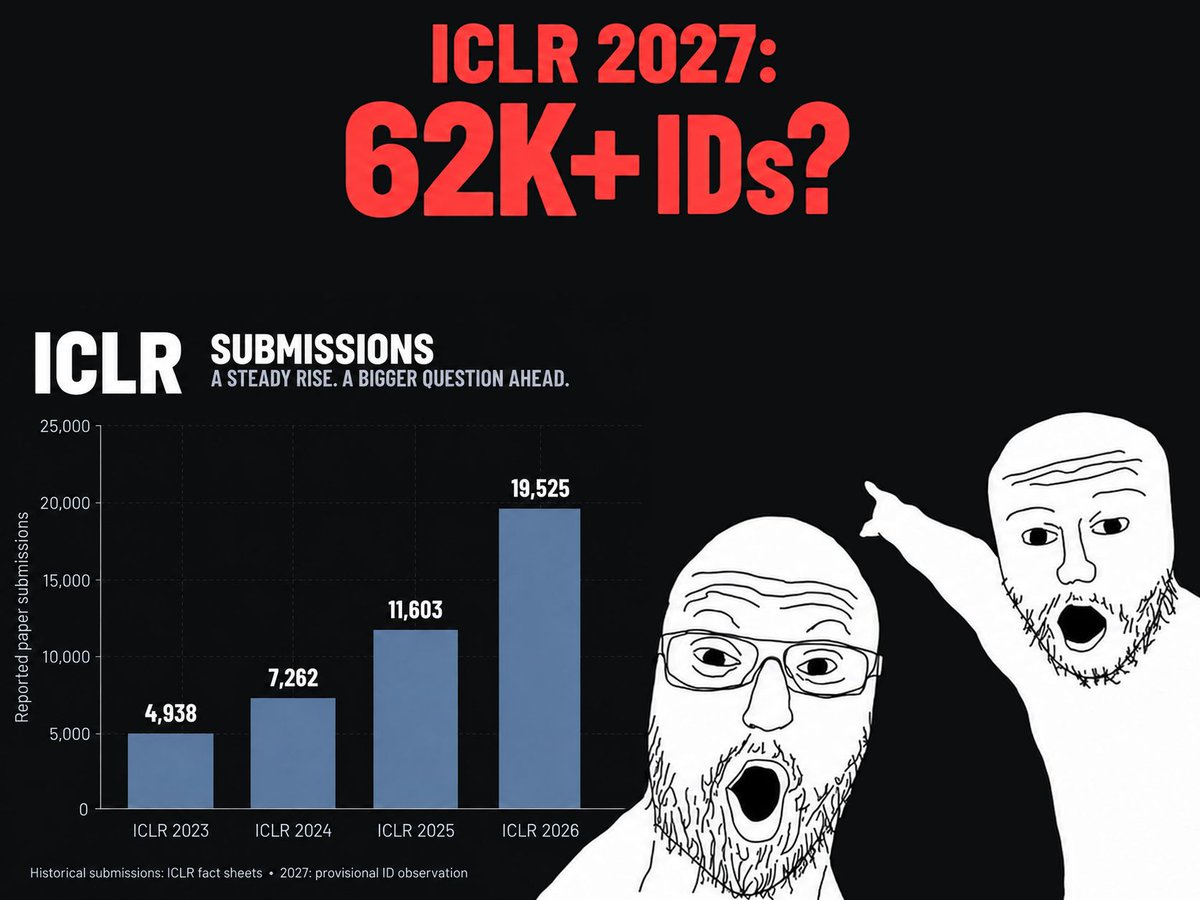
    AI is making papers cheaper to produce. ICLR submissions: 4,938 (2023), 7,262 (2024), 11,603 (2025), 19,525 (2026). Reported 2027 IDs exceed 62K, above roughly

    AI is making papers cheaper to produce. ICLR submissions: 4,938 (2023), 7,262 (2024), 11,603 (2025), 19,525 (2026). Reported 2027 IDs exceed 62K, above roughly 56K paper submissions in all previous years COMBINED. Can reviewers keep up? (1/6)🧵 https://t.co/Om08umirx3