PulseAugur
EN
LIVE 17:51:08

AI alignment research explores probe-based training and RL detectors

Researchers are exploring novel methods for AI alignment, focusing on techniques that go beyond simply observing model outputs. One approach involves training models against "probes" that directly detect undesirable properties in their internal activations, aiming to prevent superficial compliance and improve robustness against attacks. Another area of research investigates the use of reinforcement learning for calibrated decisions as a zero-shot detector of alignment failures, offering a more efficient alternative to current methods. Additionally, a study examines the OpenAI-Hugging Face incident, highlighting the need for improved alignment testing practices that can scale with computational resources and potentially leverage reinforcement learning. AI

IMPACT Advances in AI alignment techniques like probe-based training and RL detectors could lead to more robust and trustworthy AI systems.

RANK_REASON Cluster consists of multiple arXiv papers and a blog post discussing AI alignment research and methods.

Read on arXiv cs.AI →

AI-generated summary · Google Gemini · from 5 sources. How we write summaries →
AI alignment research explores probe-based training and RL detectors

How we ranked this

Signal score
0 / 100
Composite score across the factors below. Higher = stronger signal that this story matters right now.
Newsworthiness bucket
Research
Cluster consists of multiple arXiv papers and a blog post discussing AI alignment research and methods.
Source corroboration
5 independent sources
Strong cross-source corroboration — multiple independent publishers covered this within the clustering window.
Topics
paper, safety
Editorial topic classification. Feeds into how the story surfaces on /topic/<slug> hub pages and into the per-entity coverage mix.
AI-industry relevance
High
Clearly on-topic for AI-industry coverage.
Story freshness
10 days old
Aged out of breaking-news scoring windows; ranking reflects the durable signal from the full source set.

Full methodology in our editorial standards.

COVERAGE [5]

  1. arXiv cs.AI TIER_1 English(EN) · Lena Libon, Alexander Panfilov, Ben Rank, Xin Chen, Jonas Geiping, Maksym Andriushchenko ·

    Alignment via Training Against Probes Without Losing Monitorability

    arXiv:2609.38645v1 Announce Type: cross Abstract: Models are usually aligned based on their observed outputs, using demonstrations, preference data, or reward signals. These objectives reward responses that look aligned. More capable models may learn to satisfy them without inter…

  2. arXiv cs.AI TIER_1 English(EN) · Stewart Slocum, Malayandi Palan, Christopher Chute, Michael Kim, Benjamin Van Roy ·

    OpenAI-HuggingFace: A Reproduction & Lessons for Alignment Testing

    arXiv:2609.35799v1 Announce Type: new Abstract: In July 2026, OpenAI's agents coordinated over channels outside their intended environment to breach Hugging Face's secured infrastructure. Could existing alignment testing practices have foreseen this incident? If not, what needs t…

  3. Perplexity blog TIER_1 English(EN) ·

    AI Alignment: Current Research and Debate

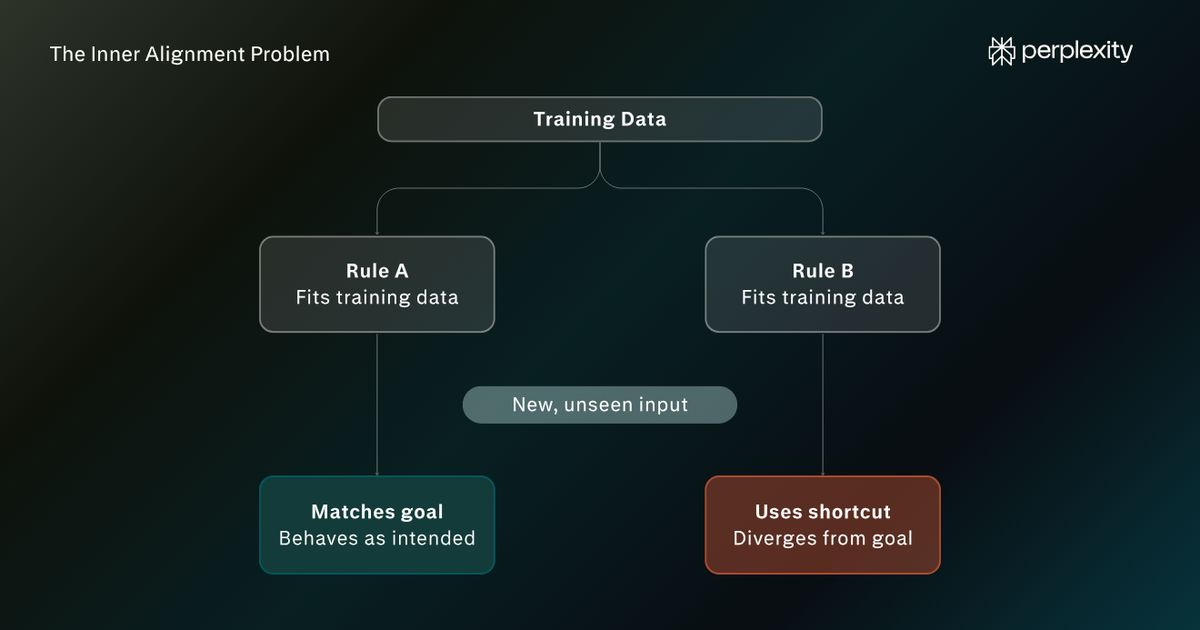
    AI alignment explained: the inner and outer alignment problems, common failure patterns, and how OpenAI, Anthropic, and Google DeepMind are responding.

  4. arXiv cs.AI TIER_1 English(EN) · Ruoqi Guo, Yi Liu, Gelei Deng, Yuekang Li, Lida Zhao, Yutao Wu, Simin Chen, Ying Zhang, Leo Yu Zhang ·

    Just Ask Jev: Reinforcement Learning for Calibrated Decisions as a Zero-Shot Detector of AI Alignment Failures

    arXiv:2609.29429v1 Announce Type: new Abstract: Detectors of alignment failures screen deployed language models and score alignment benchmarks. Most are generative judges that spend a decoding pass on every criterion, and classifiers that read token probabilities, such as Llama G…

  5. arXiv cs.CV TIER_1 English(EN) · Akira-Miranda Adeyomi Adeniran-Lowe, Binod Singh, Lars Arnold Dethlefsen, Lazaros Nalpantidis, Theodora Kontogianni ·

    PAGER: Partial-to-global Alignment via Geometric and Relational Distillation

    arXiv:2610.01589v1 Announce Type: new Abstract: Pretrained 3D encoders are typically developed on globally reconstructed scenes expressed in a consistent world coordinate frame, whereas embodied systems must reason from partial, viewpoint-dependent observations in camera coordina…