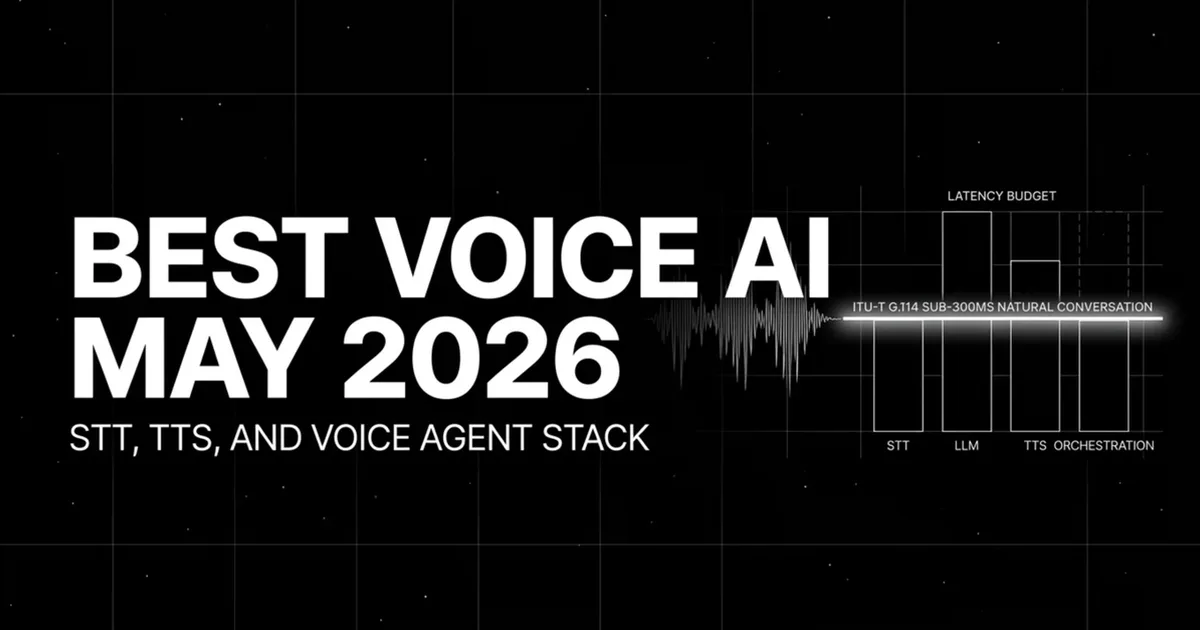
A May 2026 analysis of voice AI technologies reveals significant advancements across Speech-to-Text (STT), Text-to-Speech (TTS), and orchestration platforms, making voice agents a viable engineering problem for production environments. The author highlights that the maturity of individual components, particularly in reducing latency, has enabled more natural and responsive voice interactions. The breakdown categorizes top choices by specific use cases, such as streaming transcription, voice quality, and platform integration, emphasizing that optimizing each layer independently is key to successful deployment. AI
IMPACT Voice AI components have matured, enabling more natural and responsive production-ready voice agents with reduced latency.
RANK_REASON The article provides a detailed benchmark and analysis of existing voice AI technologies, categorizing them by performance and use case, which constitutes research into the current state of the field. [lever_c_demoted from research: ic=1 ai=1.0]
- AssemblyAI Universal-2
- Bland AI
- Cartesia Sonic Turbo
- Deepgram Nova-3
- Deepgram Voice Agent
- ElevenLabs Conversational
- ElevenLabs Scribe
- ElevenLabs v3 Multilingual
- Flux
- Gemini 3.1 Flash
- Google Cloud Chirp
- GPT-5 mini
- gpt-realtime
- Hume Octave
- OpenAI gpt-4o-mini-tts
- PlayHT
- Retell AI
- Whisper Large V3
AI-generated summary · Google Gemini · from 1 sources. How we write summaries →