PulseAugur
EN
LIVE 20:30:05

Perplexity open-sources Lily inference engine for Apple Silicon

Perplexity has open-sourced Lily, a local inference engine designed for hybrid compute within its Perplexity Computer product. Lily is specifically optimized for running Qwen3.6-35B-A3B models on Apple silicon, treating it as a distinct platform. Benchmarks show Lily outperforms MLX-LM in both prefill and decode throughput on an M5 Max MacBook Pro, maintaining output quality while efficiently handling the different computational demands of prefill and decode workloads. AI

IMPACT Enables more efficient local LLM inference on Apple Silicon, potentially improving hybrid compute performance for applications like Perplexity Computer.

RANK_REASON Open-sourcing of a specialized inference engine for local hardware.

Read on X — Perplexity →

AI-generated summary · Google Gemini · from 5 sources. How we write summaries →
Perplexity open-sources Lily inference engine for Apple Silicon

How we ranked this

Signal score
15 / 100
Composite score across the factors below. Higher = stronger signal that this story matters right now.
Newsworthiness bucket
Tool
Open-sourcing of a specialized inference engine for local hardware.
Source corroboration
5 independent sources
Strong cross-source corroboration — multiple independent publishers covered this within the clustering window.
Topics
product, infra
Editorial topic classification. Feeds into how the story surfaces on /topic/<slug> hub pages and into the per-entity coverage mix.
AI-industry relevance
High
Clearly on-topic for AI-industry coverage.
Story freshness
Breaking (< 6h)
Fresh story with cross-source coverage still developing. Ranking may shift as more sources report.

Full methodology in our editorial standards.

COVERAGE [5]

  1. X — Perplexity TIER_1 English(EN) · perplexity_ai ·

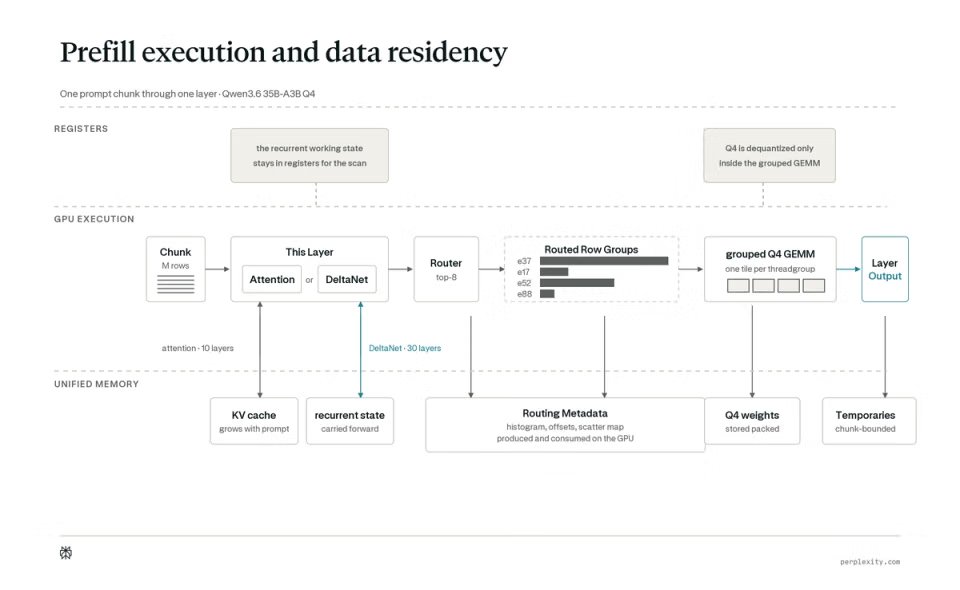
    Lily treats Apple silicon as a distinct inference platform and maps Qwen’s operations directly to its compute and memory architecture.

    Lily treats Apple silicon as a distinct inference platform and maps Qwen’s operations directly to its compute and memory architecture. Lily is now available: https://t.co/WbawYlTqSe

  2. X — Perplexity TIER_1 English(EN) · perplexity_ai ·

    We benchmark Qwen3.6-35B-A3B on an M5 Max MacBook Pro.

    We benchmark Qwen3.6-35B-A3B on an M5 Max MacBook Pro. Across ten prompt lengths and ten decode contexts, Lily was faster than MLX-LM, averaging 1.23× higher prefill throughput and 1.35× higher decode throughput while keeping output quality effectively unchanged. https://t.co/K7…

  3. X — Perplexity TIER_1 English(EN) · perplexity_ai ·

    Lily treats prefill and decode as fundamentally different workloads.

    Lily treats prefill and decode as fundamentally different workloads. Prefill processes many prompt tokens at once and can reuse weights across them, while decode generates one token at a time with much less reuse, making memory traffic and bandwidth more important. https://t.co/…

  4. X — Perplexity TIER_1 English(EN) · perplexity_ai ·

    Hybrid compute splits work between cloud models and a local model on the Mac. Local inference must keep pace with the rest of the task.

    Hybrid compute splits work between cloud models and a local model on the Mac. Local inference must keep pace with the rest of the task. MLX-LM is a general-purpose framework, while Lily is purpose-built for this inference workload. https://t.co/MFsA8LgK0O

  5. X — Perplexity TIER_1 English(EN) · perplexity_ai ·

    Today we’re open-sourcing Lily, the local inference engine we built for hybrid compute in Perplexity Computer.

    Today we’re open-sourcing Lily, the local inference engine we built for hybrid compute in Perplexity Computer. Lily is specialized for Qwen3.6-35B-A3B on Apple silicon, built so on-device compute doesn’t bottleneck Computer tasks. Read more: https://t.co/OnowTP3ql6