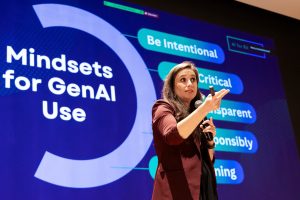
A recent experiment in schools revealed that children quickly lose trust in AI when presented with its inaccuracies, particularly in visual tasks like map drawing. When asked to generate a world map, the AI produced a flawed representation with misspellings and incorrect geographical placements, leading to amusement and skepticism among the students. This exercise highlights a potential method for fostering AI literacy by demonstrating the technology's current limitations. AI
IMPACT Demonstrating AI's current limitations through flawed outputs can be a tool for educating users about the technology's capabilities and potential pitfalls.
RANK_REASON The item discusses an anecdote about children's reactions to AI inaccuracies, framed as a method for AI literacy, which falls under commentary rather than a core AI release or significant industry event.
AI-generated summary · Google Gemini · from 1 sources. How we write summaries →