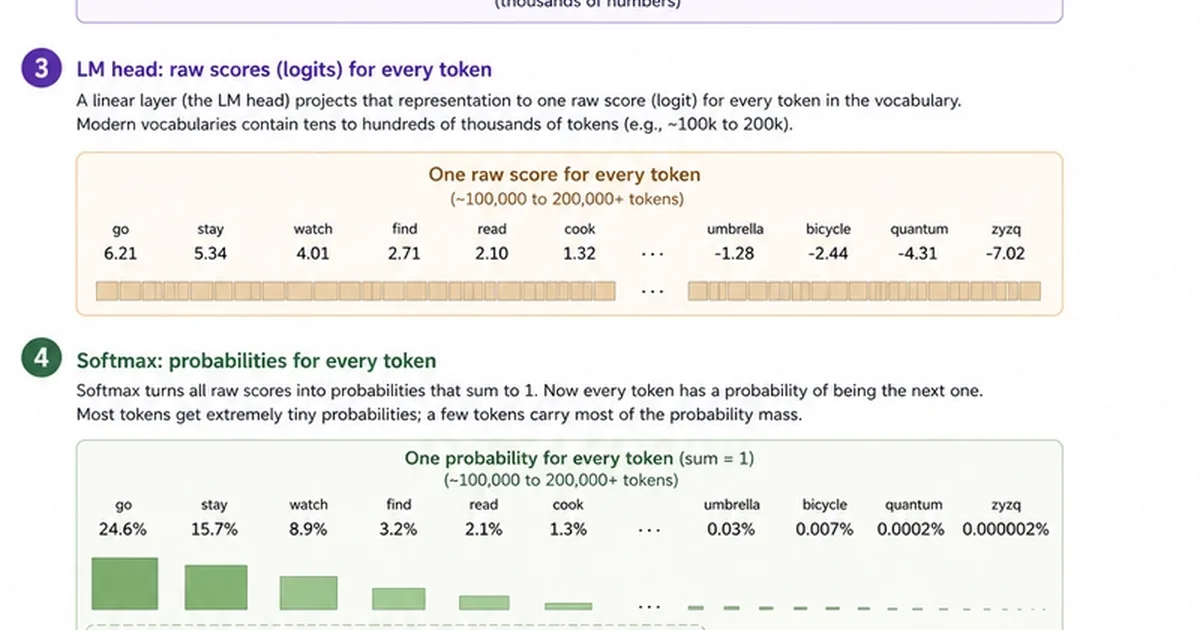
Large Language Models (LLMs) exhibit variability in their outputs not due to unpredictability, but because their design intentionally incorporates sampling strategies. While often misunderstood as selecting the single 'most suitable' next word, LLMs actually generate a probability distribution over possible tokens. A decoding strategy then selects a token from this distribution, which can be deterministic (greedy decoding) or probabilistic (sampling). Sampling is commonly used in user-facing applications to produce more varied and less repetitive responses, and understanding this process is key to controlling AI output. AI
IMPACT Understanding LLM sampling strategies is crucial for developers and users to better control and interpret AI-generated content.
RANK_REASON The item explains a technical aspect of LLM behavior rather than announcing a new development.
AI-generated summary · Google Gemini · from 1 sources. How we write summaries →