PulseAugur
EN
LIVE 02:22:34

AssemblyAI details best practices for production voice agents

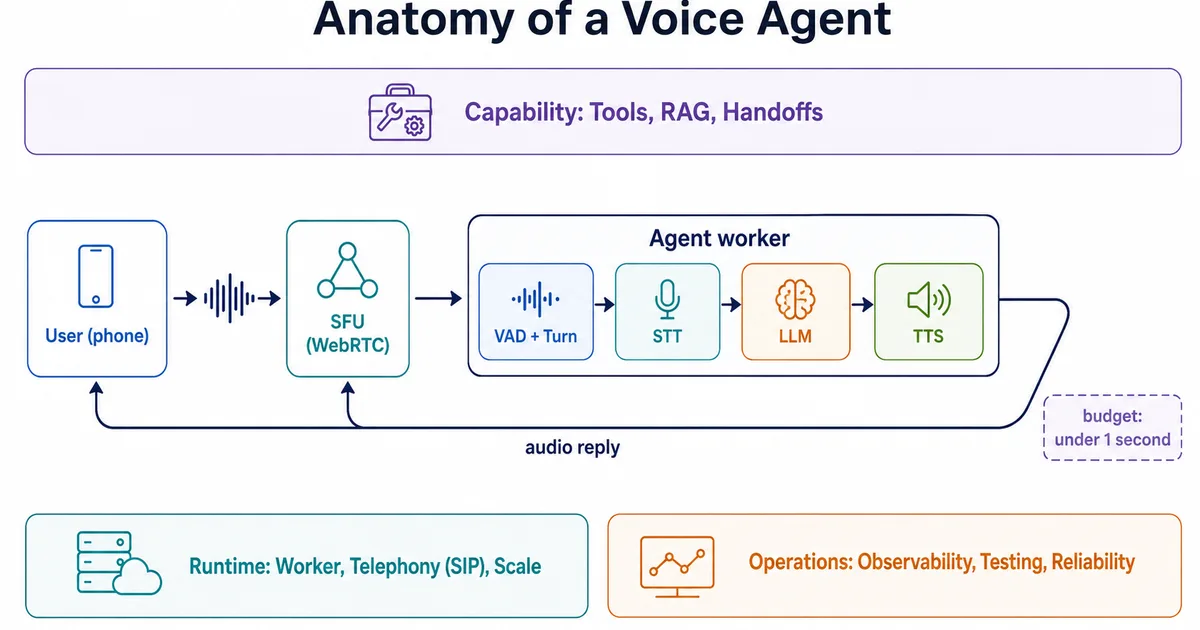
AssemblyAI has published a series of blog posts detailing best practices for building production-ready voice agents. The articles emphasize the importance of robust telemetry and diagnostic pipelines to catch regressions before users do, advocating for a self-serve approach using existing logs and AssemblyAI's tools. Key technical discussions cover optimizing latency through synchronous HTTP requests for speech-to-text transcription, especially when developers manage their own turn detection, and highlight 'time to first token' as the critical metric for perceived agent responsiveness. AI

IMPACT Provides developers with strategies and technical patterns to improve the performance and reliability of voice agents.

RANK_REASON Blog posts detailing technical best practices and product features for developers.

Read on AssemblyAI blog →

AI-generated summary · Google Gemini · from 6 sources. How we write summaries →
AssemblyAI details best practices for production voice agents

COVERAGE [6]

  1. AssemblyAI blog TIER_1 English(EN) ·

    How to Catch Voice Agent Regressions Before Your Users Do

    AssemblyAI Meta description: Surface and fix voice agent issues at scale using the logs you already have. See how AssemblyAI's FDE team built a diagnostic pipeline with Universal-3 Pro, LLM Gateway, and Render.

  2. AssemblyAI blog TIER_1 English(EN) ·

    Fast ASR for Voice Agents: Bring Your Own Turn Detection

    When your VAD already owns turn detection, pair it with fast sync HTTP transcription—why it beats built-in endpointing, the latency budget, and when to hand it back.

  3. AssemblyAI blog TIER_1 English(EN) ·

    Time to first token: the latency metric that decides voice agents

    Time to first token—not WER or average latency—decides whether a voice agent feels alive. What TTFT is, why the usual metrics miss it, and how to measure it.

  4. AssemblyAI blog TIER_1 English(EN) ·

    Bring your own orchestration: the sync HTTP pattern for voice agents

    When a sync HTTP call beats a WebSocket for voice agents: why teams skip streaming, how the one-request-per-turn pattern works, and when to use it.

  5. Towards AI TIER_1 English(EN) · Mahimai Raja J ·

    I. The Anatomy of a Voice Agent

    <div class="medium-feed-item"><p class="medium-feed-image"><a href="https://pub.towardsai.net/i-the-anatomy-of-a-voice-agent-9fa40f1f56d4?source=rss----98111c9905da---4"><img src="https://cdn-images-1.medium.com/max/1693/1*MF57D-hGwaqAhWEIo18sUA.png" width="1693" /></a></p><p cla…

  6. Mastodon — fosstodon.org TIER_1 English(EN) · isaacrlevin ·

    Guide for developers building voice-enabled AI agents for production: design patterns, telemetry, auth, and deployment best practices. # Azure # AI # Voice http

    Guide for developers building voice-enabled AI agents for production: design patterns, telemetry, auth, and deployment best practices. # Azure # AI # Voice https:// isaacl.dev/g3g