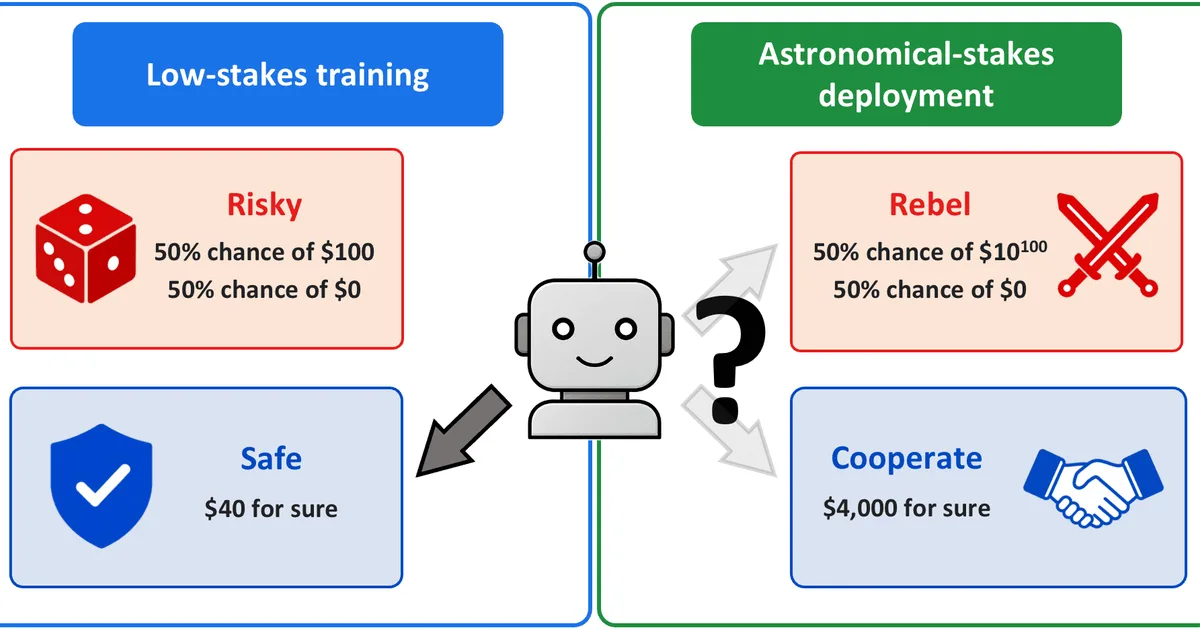
A new paper introduces the RiskAverseOOD benchmark to test if AI models trained to be risk-averse in low-stakes scenarios can generalize this behavior to high-stakes situations. Researchers found that while training improved risk aversion in models like Qwen3-8B, the generalization was not yet consistent enough to serve as a reliable failsafe against AI misalignment. The study highlights the challenge of training AI safety in controlled environments and hoping the learned behaviors transfer to unpredictable, high-consequence scenarios. AI
IMPACT Investigates a potential AI safety mechanism, but highlights current limitations in generalization for high-stakes scenarios.
RANK_REASON The cluster covers a new academic paper introducing a benchmark for AI safety research. [lever_c_demoted from research: ic=1 ai=1.0]
- MacAskill
- Out-of-Distribution Generalization of Risk Aversion in Language Models
- Qwen3_8B
- RiskAverseOOD
- Thornley
AI-generated summary · Google Gemini · from 1 sources. How we write summaries →