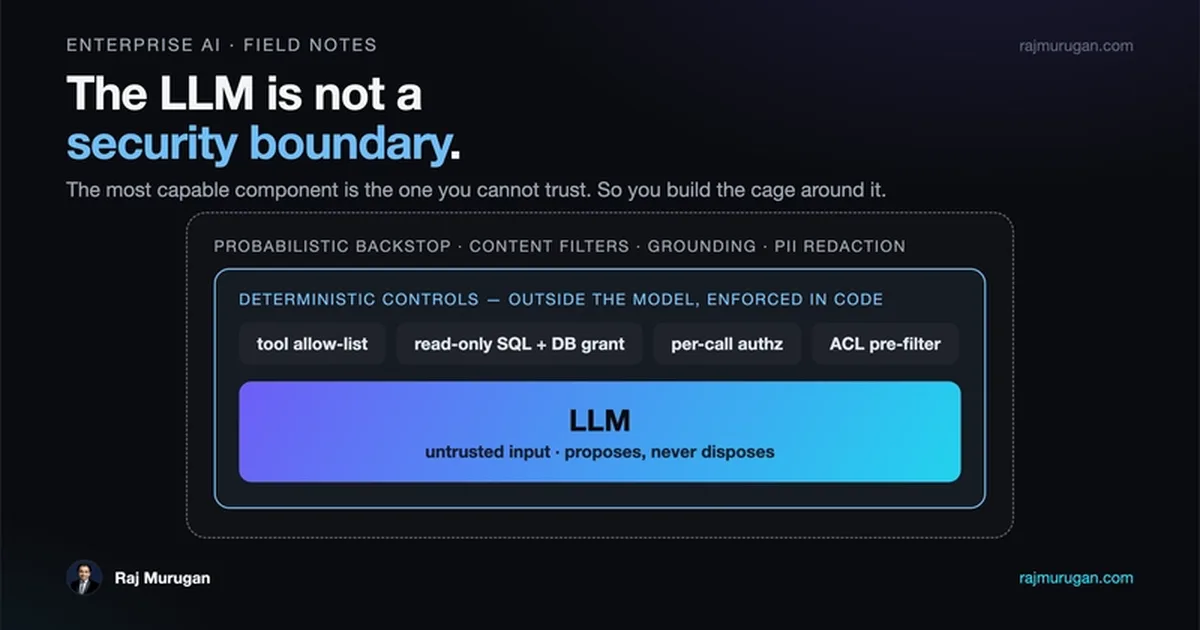
A new approach to building agentic systems emphasizes securing the structure around large language models rather than relying on the models themselves for security. The core principle is that any control embedded within a model's prompt can be bypassed, as the model treats all input tokens equally. Therefore, critical security measures, such as tool execution and data access, must be deterministic and reside in code external to the LLM. AI
IMPACT Highlights the critical need for robust security architectures around LLMs, emphasizing that external, deterministic code controls are essential for preventing prompt injection and ensuring data integrity.
RANK_REASON This item is a field note discussing design principles for LLM-based systems, not a release or research paper.
- agentic system
- enterprise identity provider
- language model
- managed relational database
- open-source agent framework
- relational store
- search_records
- serverless compute
- Tools
- Vector index registers
AI-generated summary · Google Gemini · from 1 sources. How we write summaries →