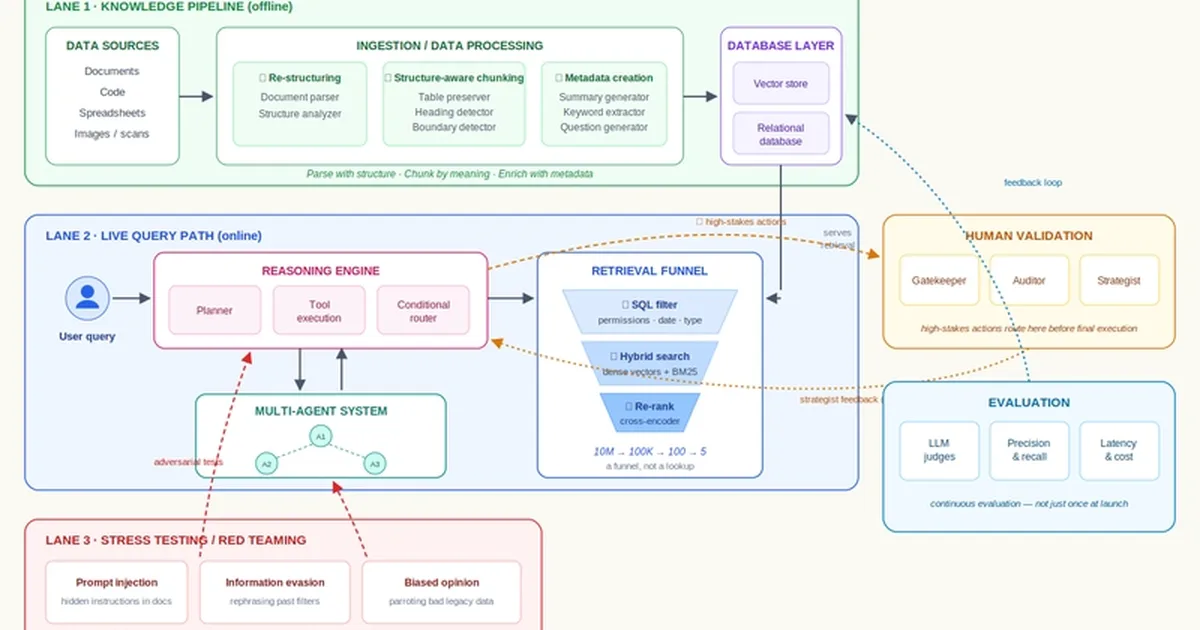
Scaling Retrieval-Augmented Generation (RAG) systems from a few thousand documents to millions presents significant challenges that often break simpler implementations. Production-scale RAG requires robust ingestion pipelines that can handle diverse file formats using tools like Apache Tika, Unstructured, and Docling to extract both text and structural metadata. Effective chunking strategies are crucial, prioritizing semantic completeness and preserving document structure over fixed-size splits, with tools like LlamaIndex offering advanced methods. At scale, vector search relies on approximate nearest neighbor algorithms like HNSW for speed, necessitating metadata filtering and pre-computed chunk summaries to refine retrieval accuracy. AI
IMPACT Highlights the engineering challenges and solutions for building production-ready RAG systems at massive scale, impacting AI application development.
RANK_REASON Article discusses practical implementation details and tools for scaling RAG systems, rather than a new model release or research breakthrough.
- Apache Solr
- Apache Tika
- Chroma
- Docling
- Elasticsearch
- Faiss
- LangChain
- langsmith
- LlamaIndex
- retrieval-augmented generation
- Unstructured
AI-generated summary · Google Gemini · from 1 sources. How we write summaries →