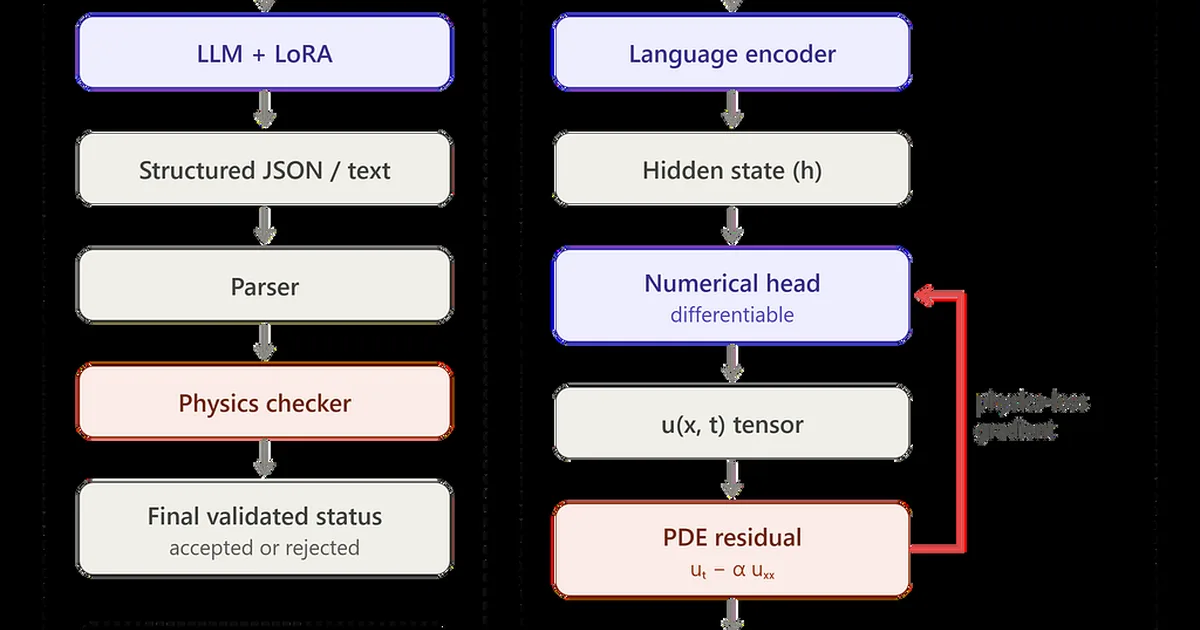
This article details advancements in Physics-Informed AI, specifically focusing on integrating physics principles directly into the AI model's training loop. Unlike previous methods where physics checks were performed post-generation, this approach uses a language model as an encoder that conditions a differentiable numerical head. This head predicts a tensor output, allowing for the computation of physics residuals directly on these tensors, thus enabling gradient backpropagation and improving the model's ability to solve physics problems like partial differential equations. AI
IMPACT This research could lead to AI models that more accurately solve complex physics problems, impacting fields like engineering and scientific simulation.
RANK_REASON The article describes a novel research approach and methodology for integrating physics into AI models. [lever_c_demoted from research: ic=1 ai=1.0]
AI-generated summary · Google Gemini · from 1 sources. How we write summaries →