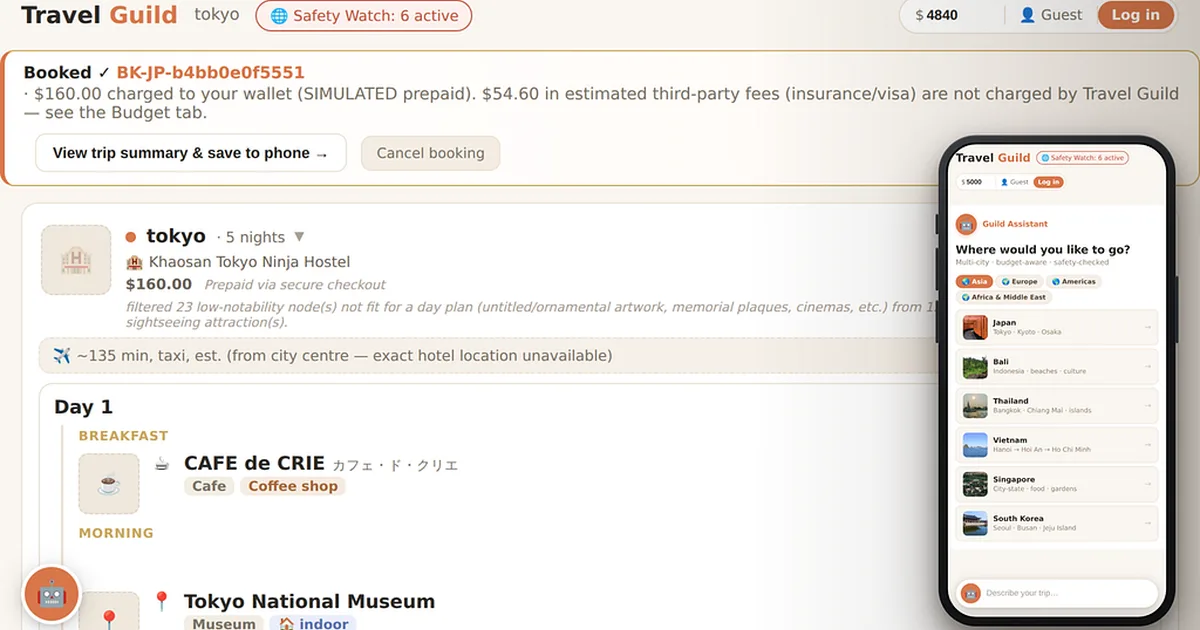
The creators of Travel Guild encountered significant challenges when developing an AI travel assistant capable of booking trips, discovering that current frontier models, like qwen3-max, struggle with reliable transaction completion. Their initial approach using a single agent with access to booking tools resulted in failure rates as high as 30% across various scenarios, with unpredictability in which specific trips would fail. This led them to conclude that the core problem is not algorithmic but structural, emphasizing the need for safety-first design and deterministic systems rather than simply larger models or more agents. AI
IMPACT Highlights the critical need for robust structural design in AI agents for reliable transaction completion, moving beyond algorithmic improvements.
RANK_REASON The article details the development and challenges of a specific AI-powered tool, rather than a frontier model release or significant industry event.
AI-generated summary · Google Gemini · from 1 sources. How we write summaries →