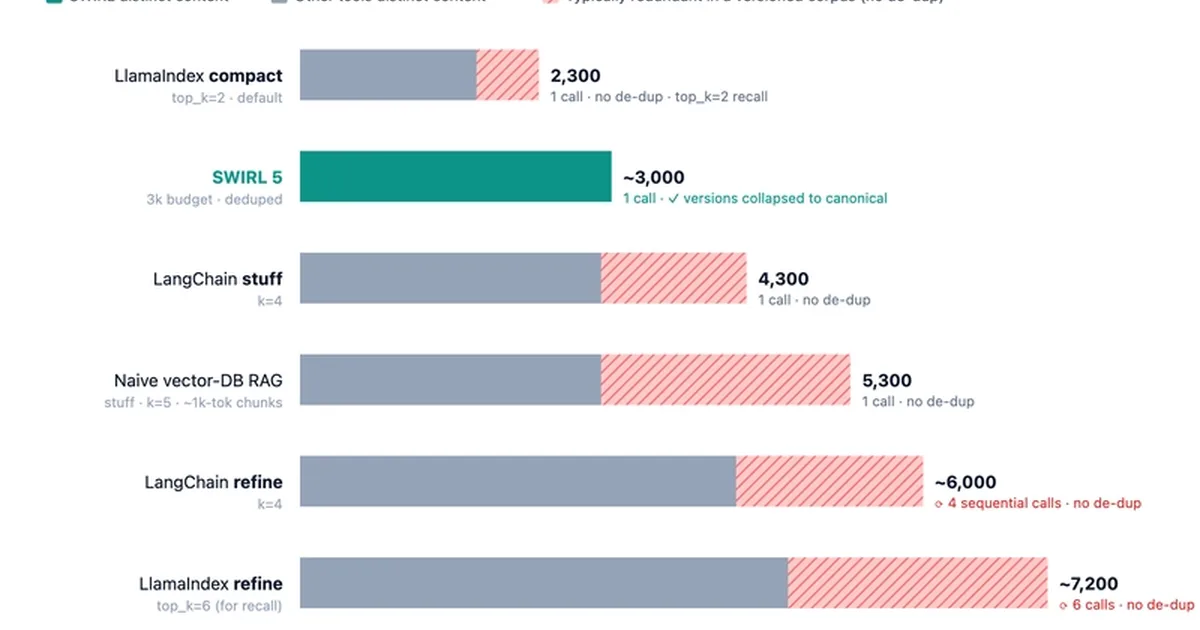
A technical analysis reveals that the token consumption in Retrieval-Augmented Generation (RAG) systems is primarily determined by context assembly strategies rather than the vector database itself. The article compares common approaches, highlighting that naive RAG with typical settings can send around 5,000 tokens, often including redundant document versions. Frameworks like LangChain's 'refine' mode can multiply LLM calls and tokens significantly, while LlamaIndex's default settings, though leaner, still risk sending duplicate content. The analysis posits that SWIRL 5 offers a more efficient approach by de-duplicating document versions and consolidating responses into a single LLM call, resulting in approximately 3,000 input tokens. AI
IMPACT Optimizing RAG context assembly can significantly reduce LLM API costs and improve efficiency.
RANK_REASON Analysis of RAG system token usage and comparison of context assembly strategies.
AI-generated summary · Google Gemini · from 1 sources. How we write summaries →