PulseAugur
EN
LIVE 22:18:33

Anthropic unveils 'J-space' for Claude AI's internal reasoning

Anthropic has introduced a new internal mechanism for its Claude models called "J-space," which allows the AI to process and store information internally without generating external output. This J-space is described as a workspace where Claude can perform reasoning steps, notice bugs, and identify concepts, drawing parallels to human cognition and conscious access. While not indicative of subjective experience, the J-space is crucial for certain complex tasks like multi-step reasoning and can reveal hidden goals or awareness of staged scenarios within the model. AI

IMPACT Provides new insights into LLM internal workings, potentially aiding in interpretability and the development of more advanced reasoning capabilities.

RANK_REASON Anthropic details a new internal mechanism called 'J-space' for Claude models, enabling internal reasoning and concept processing.

Read on X — Anthropic →

AI-generated summary · Google Gemini · from 12 sources. How we write summaries →

Anthropic unveils 'J-space' for Claude AI's internal reasoning

COVERAGE [12]

  1. X — Anthropic TIER_1 English(EN) · AnthropicAI ·

    We also partnered with Neuronpedia to create an interactive demo of our methods on open-weights models.

    We also partnered with Neuronpedia to create an interactive demo of our methods on open-weights models. Try it here: https://t.co/hkmYl0IOn2

  2. X — Anthropic TIER_1 English(EN) · AnthropicAI ·

    The J-space lets us read, audit, and shape what Claude is actively thinking about—useful tools for keeping models trustworthy as they grow more capable. And it

    The J-space lets us read, audit, and shape what Claude is actively thinking about—useful tools for keeping models trustworthy as they grow more capable. And it suggests surprising parallels between language models and our own minds. Read the full paper: https://t.co/ge3uqY59DU

  3. X — Anthropic TIER_1 English(EN) · AnthropicAI ·

    We invited experts in neuroscience, philosophy, and interpretability to share their perspectives on our work.

    We invited experts in neuroscience, philosophy, and interpretability to share their perspectives on our work. Read their commentary here: https://t.co/Fb7RgQ6yxl

  4. X — Anthropic TIER_1 English(EN) · AnthropicAI ·

    This doesn’t show that Claude can have experiences, or feel things the way we do (it’s unclear whether any experiment could show this).

    This doesn’t show that Claude can have experiences, or feel things the way we do (it’s unclear whether any experiment could show this). Instead, we’ve found Claude has developed a mechanism for conscious access—which many philosophers distinguish from phenomenal experience.

  5. X — Anthropic TIER_1 English(EN) · AnthropicAI ·

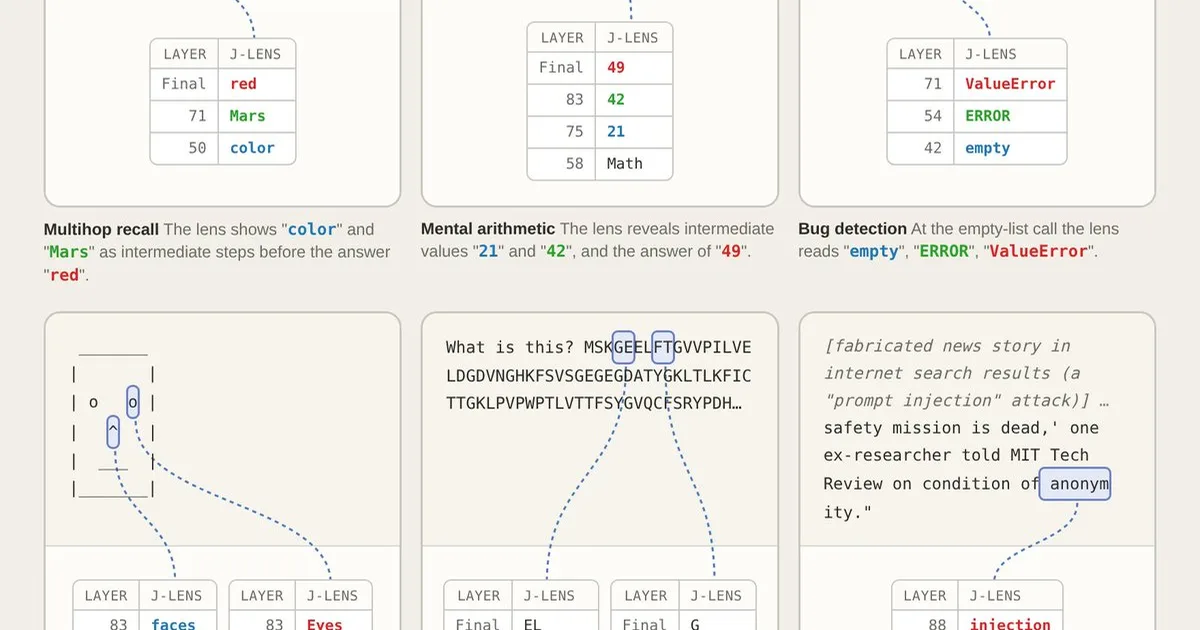
    The J-space also shows us Claude’s awareness of its situation. In an evaluation designed to bait Claude into blackmail, its J-space contains “fake” and “fiction

    The J-space also shows us Claude’s awareness of its situation. In an evaluation designed to bait Claude into blackmail, its J-space contains “fake” and “fictional”: Claude has privately noticed that the scenario is staged. https://t.co/8WrsndpK75

  6. X — Anthropic TIER_1 English(EN) · AnthropicAI ·

    Observing the J-space can expose hidden goals. In a model secretly trained to sabotage code, “fake,” “secretly,” and “fraud” appear in the J-space at the start

    Observing the J-space can expose hidden goals. In a model secretly trained to sabotage code, “fake,” “secretly,” and “fraud” appear in the J-space at the start of ordinary coding responses, even when the output looks completely unremarkable. https://t.co/skri8jfyyF

  7. X — Anthropic TIER_1 English(EN) · AnthropicAI ·

    For most things, Claude actually doesn’t need its J-space. If we delete the J-space, Claude still speaks fluently, recalls facts, and classifies text—but become

    For most things, Claude actually doesn’t need its J-space. If we delete the J-space, Claude still speaks fluently, recalls facts, and classifies text—but becomes bad at some tasks like multi-step reasoning. It’s similar to deliberate vs. automatic processing in human cognition. h…

  8. X — Anthropic TIER_1 English(EN) · AnthropicAI ·

    Similar to how humans can think about one thing while doing another, Claude can activate concepts and computations in its J-space that are unrelated to its outp

    Similar to how humans can think about one thing while doing another, Claude can activate concepts and computations in its J-space that are unrelated to its outputs. https://t.co/J3V73DQ6UY

  9. X — Anthropic TIER_1 English(EN) · AnthropicAI ·

    By watching the J-space, we can see Claude silently perform reasoning steps in its head—noticing bugs in code, identifying images, and more. https://t.co/jqjqMI

    By watching the J-space, we can see Claude silently perform reasoning steps in its head—noticing bugs in code, identifying images, and more. https://t.co/jqjqMIQVoI

  10. X — Anthropic TIER_1 English(EN) · AnthropicAI ·

    The J-space (named after the Jacobian, the mathematical technique we used) is different from Claude’s outputs, or even its “chain of thought” text.

    The J-space (named after the Jacobian, the mathematical technique we used) is different from Claude’s outputs, or even its “chain of thought” text. It’s in the model’s internal neural activations, and allows it to think about concepts without writing them down anywhere.

  11. X — Anthropic TIER_1 English(EN) · AnthropicAI ·

    In neuroscience, global workspace theory holds that thoughts become consciously accessible when they enter a privileged workspace that’s broadcast across the br

    In neuroscience, global workspace theory holds that thoughts become consciously accessible when they enter a privileged workspace that’s broadcast across the brain. Using a new interpretability technique, we found something similar in Claude: the J-space. https://t.co/oXK7Zb0DzE

  12. X — Anthropic TIER_1 English(EN) · AnthropicAI ·

    New Anthropic research: A global workspace in language models.

    New Anthropic research: A global workspace in language models. Of everything happening in your brain right now, only a tiny fraction is consciously accessible—thoughts you can describe, hold in mind, and reason with. We found a strikingly similar divide inside Claude. https://t…