Hugging Face introduces advanced quantization techniques for efficient LLMs
ByPulseAugur Editorial·[16 sources]·
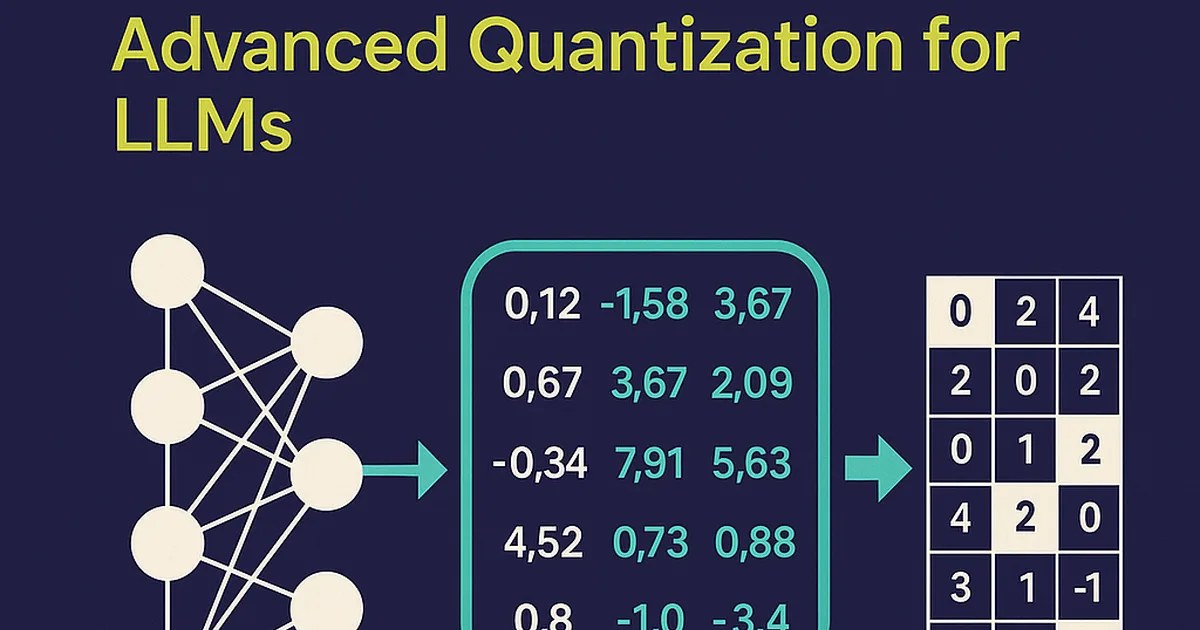
Researchers are developing advanced quantization techniques to make large language models (LLMs) more efficient. New methods like AutoRound, LATMiX, and GSQ aim to reduce model size and computational requirements, enabling deployment on less powerful hardware. These approaches focus on optimizing how model weights and activations are represented at lower bit-widths, with some achieving accuracy comparable to higher-precision models. Innovations include novel calibration strategies for post-training quantization and learnable affine transformations to improve robustness.
AI
IMPACT
Enables more efficient deployment of LLMs on resource-constrained devices, potentially lowering inference costs and increasing accessibility.
RANK_REASON
Multiple arXiv papers and Hugging Face blog posts detail new research and tools for LLM quantization.
Large language models (LLMs) are costly to deploy due to their large memory footprint and high inference cost. Weight-activation quantization can reduce these costs, but low-bit activation quantization remains difficult because activation outliers induce large quantization error.…
arXiv:2605.01164v1 Announce Type: new Abstract: This position paper argues that LLMs should not yet be credited with decision explanation. This matters because recent work increasingly treats accurate behavioral prediction, plausible rationales, and outcome-conditioned reasoning …
arXiv:2605.00662v1 Announce Type: cross Abstract: Sequence learning reduces to similarity-based retrieval over a temporally indexed representation space, a constraint on any sequence model, not a property of a specific architecture. We show that a spiking Sparse Distributed Memor…
Sequence learning reduces to similarity-based retrieval over a temporally indexed representation space, a constraint on any sequence model, not a property of a specific architecture. We show that a spiking Sparse Distributed Memory sequence machine (2007) and the transformer (201…
arXiv:2604.24008v1 Announce Type: new Abstract: Post-Training Quantization (PTQ) compresses large language models to low bit-widths using a small calibration set, and its quality depends strongly on which samples are chosen. We identify a failure mode in which calibration samples…
arXiv cs.CL
TIER_1English(EN)·Ofir Gordon, Lior Dikstein, Arnon Netzer, Idan Achituve, Hai Victor Habi·
arXiv:2602.17681v2 Announce Type: replace-cross Abstract: Post-training quantization (PTQ) is a widely used approach for reducing the memory and compute costs of large language models (LLMs). Recent studies have shown that applying invertible transformations to activations can si…
arXiv:2410.21548v3 Announce Type: replace Abstract: Large language models have drastically changed the prospects of AI by introducing technologies for more complex natural language processing. However, current methodologies to train such LLMs require extensive resources including…
Weight quantization has become a standard tool for efficient LLM deployment, especially for local inference, where models are now routinely served at 2-3 bits per parameter. The state of the art is currently split into two sets of methods: simple scalar quantization techniques, s…
arXiv:2410.24214v3 Announce Type: replace-cross Abstract: Mixed precision quantization has become an important technique for optimizing the execution of deep neural networks (DNNs). Certified robustness, which provides provable guarantees about a model's ability to withstand diff…
arXiv cs.CV
TIER_1English(EN)·R\'ois\'in Luo, Alexandru Drimbarean, James McDermott, Colm O'Riordan·
arXiv:2408.00923v2 Announce Type: replace Abstract: This paper explores a novel paradigm in low-bit (i.e. 4-bits or lower) quantization, differing from existing state-of-the-art methods, by framing optimal quantization as an architecture search problem within convolutional neural…
TurboQuant: A First-Principles Walkthrough A brisk, brilliantly coded tutorial on vector quantisation: how far you can push compression on model KV caches and embeddings without breaking what matters. The interactive slider(...) # ai # javascript # ml # quantization # tutorial # …